
Key Takeaways
- Containment and recovery are different performance targets. A properly engineered cartridge dust collector can capture powder coating overspray, but only clean, segregated, process-approved material should return to the spray guns.
- Color-change frequency determines much of the recovery layout. Compare dedicated cartridge modules with cyclone-plus-final-filter systems before following a generic industrial cartridge dust collector selection guide.
- Filter blinding can damage booth airflow and finish consistency. Fine powder, humidity, oil contamination, and ineffective pulse cleaning require diagnosis beyond the standard cartridge dust collector maintenance checklist.
- Recovery quality must be checked independently. Measure powder cleanliness, particle-size behavior, blend ratio, and finished-coating appearance—not just the collector’s nominal filtration efficiency.
- Troubleshoot system airflow before changing filters. Inlet distribution, final-filter resistance, and fan performance can also contribute to the weak suction and low airflow symptoms seen at spray booths.
Why Powder Coating Booth Dust Collection Is Different
A powder coating booth does more than remove airborne dust. It must contain a finely dispersed coating material while maintaining stable air movement around grounded workpieces. Where the powder formulation permits reuse, the same system may also need to recover overspray without mixing colors, moisture, metal particles, or shop debris into the next batch.
This creates two separate engineering questions. Can the system capture powder safely and consistently? And can the material it collects still produce an acceptable coating? A collector may answer the first question successfully but fail the second. High filter efficiency does not prove that recovered powder is suitable for reuse.
The operating result depends on spray-gun transfer efficiency, booth airflow, cartridge design, recovery architecture, cleaning controls, and changeover practices. This guide examines the collection and recovery system rather than repeating general advice about powder-coating guns or curing ovens.
Follow the Overspray from Booth to Collector
Containment, Separation, and Final Filtration
During electrostatic spraying, charged particles deposit on the grounded part, while undeposited powder remains airborne. Booth exhaust draws this overspray toward a collection or recovery stage. Some systems capture it directly on cartridge filters; others use a cyclone to remove most recoverable powder before air passes through final filters. Depending on the approved design, filtered air is then exhausted or handled through a compliant recirculation arrangement.
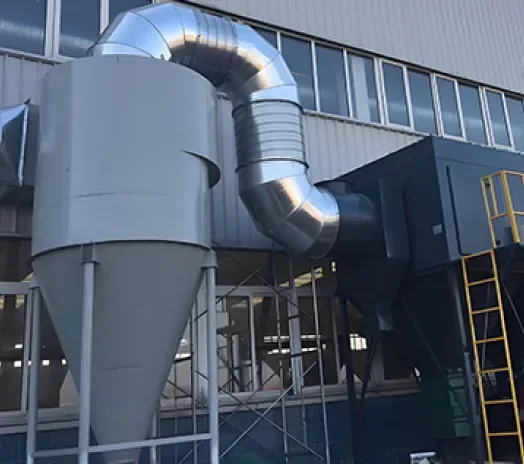
A cartridge recovery unit typically uses pulse-cleaned pleated filters. Released powder falls into a collection area that may feed a sieve and reclaim hopper. In a non-reclaim configuration, collected powder goes to waste instead. The existence of a dust collector therefore does not automatically mean the plant has a usable powder recovery system.
The booth needs sufficient, well-distributed airflow to keep overspray from escaping. However, excessive or uneven suction can disturb the powder cloud, increase material carried away from the part, and complicate efficient application. Capture airflow must be engineered for booth geometry, openings, gun positions, conveyor arrangement, cross-drafts, and relevant safety requirements—not selected from a universal CFM-per-gun rule.
Three Numbers That Should Never Be Confused
First-pass transfer efficiency describes the fraction of sprayed powder deposited on the workpiece on its first pass. Collection efficiency describes how effectively airborne powder is removed from the air stream. Usable reclaim is the quantity of collected powder that passes the plant’s quality checks and is permitted to re-enter the process.
Consider an illustrative shift in which 100 kg of powder is sprayed and 65 kg initially reaches the parts. The other 35 kg becomes overspray or process loss. Even if a collection system captures nearly all airborne material, only a portion may be clean and suitable for recycling. The exact reclaim quantity must be measured; it cannot be calculated from filter efficiency alone. This example is a mass-balance illustration, not a tested Omela recovery rate.
Cartridge Recovery vs. Cyclone Recovery: Choose by Production Pattern
A cartridge booth can be economical for repeated production in one color, dedicated color families, or installations with interchangeable collection modules. Powder released from the filters may be recovered if its quality is controlled. When different colors share the same filters, however, residual powder trapped in pleats and housings can complicate complete cleaning.
A cyclone is often useful in frequent-color-change systems. The main separation stage removes much of the overspray before the fine particles reach the downstream cartridge or final filter. The cyclone, feed center, and ductwork still need cleaning, and the fines that reach the final filter are not automatically reclaimable. Actual recovery depends on powder particle size, cyclone efficiency, and the full handling process.
| Design question | Cartridge recovery module | Cyclone plus final filtration |
|---|---|---|
| Best operational fit | Repeated colors, dedicated modules, controlled reclaim | Frequent color changes and centralized recovery where appropriate |
| Main recovery mechanism | Powder releases from cartridge media | Bulk powder separates in cyclone; fine remainder reaches filters |
| Color-change challenge | Powder retained in pleats, hopper, and module | Residue in cyclone, ducts, sieve, and transfer system |
| Filtration concern | Media blinding and pulse-cleaning recovery | Final-filter loading, cyclone carryover, and duct losses |
| What to verify | Reclaim quality, cartridge access, changeover time | Separation performance, powder quality, cleanability, safety design |
This comparison is not a claim that cyclones are always faster or cartridge booths always cheaper. Single-color lines, dedicated modules, unusual powders, and the costs of cleaning or discarding material can change the outcome.
Why Powder Coating Cartridge Filters Become Blinded
Fine Particles, Moisture, and Oil
Healthy pulse cleaning removes a releasable powder cake and allows differential pressure to recover. Filter blinding begins when particles or sticky deposits become difficult to release, leaving progressively higher residual resistance. Particularly fine powder can penetrate media openings or lodge deep in pleat valleys. Heavy local loading and tightly packed pleats can reduce the area receiving effective airflow.
Moisture and oil create another failure path. Condensation in the booth or wet, contaminated compressed air may turn free-flowing powder into an adherent deposit. Oil can impair both powder quality and media cleanability. Do not assume that raising pulse pressure will fix a physically blinded cartridge; it may instead damage media or seals if it exceeds the collector’s approved settings.
Watch the post-cleaning differential-pressure baseline, not merely the instantaneous peak. If the baseline keeps rising under comparable airflow while pulse valves and air supply function correctly, inspect cartridges and operating conditions. Check final filters too: restricted downstream filtration can weaken booth draw even when primary cartridges appear acceptable.
| Symptom | Plausible causes | Most useful check |
|---|---|---|
| DP remains high after pulses | Embedded fines, sticky deposits, weak pulse delivery | Compare post-cleaning baseline and inspect air supply |
| Powder escapes booth opening | Poor airflow balance, cross-draft, restricted primary/final filters | Measure capture airflow at normal production settings |
| Reclaim contains another color | Incomplete booth, cartridge, duct, or hopper cleaning | Inspect entire powder-contact path after changeover |
| Finish shows specks or contamination | Dirty reclaim, damaged sieve, overhead debris | Check sieve integrity and coated test panels |
| Powder clumps or feeds erratically | Moisture, oil, changed particle distribution | Check powder condition and compressed-air quality |
Match Media and Cleaning to the Powder
Surface-loading pleated media may help release suitable dry powder, but cartridge selection requires more than a stated filtration efficiency. Review actual powder chemistry, particle distribution, dust concentration, airflow per usable media area, acceptable pressure drop, pulse-system geometry, and the collector’s safety design. Filter seals, gasket seating, and dust discharge are equally important to reliable operation.
If the same cartridges blind shortly after replacement, investigate upstream powder contamination and airflow before purchasing another set. A media change cannot reliably overcome water contamination, an overfilled hopper, poorly distributed inlet flow, or a defective pulse valve.
Color Changes and Reclaimed Powder Quality
Where Cross-Contamination Starts
A color change is not complete when the spray guns look clean. Previous powder may remain in gun hoses, pumps, injector blocks, hopper corners, reclaim ducts, cyclone surfaces, sieve frames, and cartridge pleats. Later airflow can release this residue into a new coating batch.
For frequent changes between contrasting colors, removable hoppers, dedicated hoses or recovery modules, and easily cleaned booth surfaces can save more time than simply increasing dust collector size. The correct cleaning sequence and compatibility of any cleaning method must follow the equipment instructions and combustible-dust safety plan.
Why Recovered Powder Needs Its Own Quality Check
Recovered powder may differ from virgin material in particle-size distribution and flowability. A peer-reviewed powder-coating study found that smaller particle size was the strongest of the examined contributors to poorer flow behavior after electrostatic recovery. That result explains why screening is helpful but cannot, by itself, guarantee restored application performance.
Metallic and special-effect coatings need particular caution. Some dry-blended metallic powders should not be reclaimed because pigment separation can change appearance. Certain bonded products may be reused only with a validated mixing procedure and appearance checks. There is no universal safe virgin-to-reclaim ratio for all powder chemistries; use the coating manufacturer’s grade-specific instructions, trial panels, and quality acceptance limits.
For each reclaim batch, compare color, gloss, film build, surface defects, powder flow, and any project-specific specification against a qualified reference. Where customers require high appearance consistency, especially across multiple production lots, spraying to waste may be the more defensible choice.
What Published Industrial Cases Teach Us
These are third-party published applications and research, not Omela projects. Reported savings reflect complete spray-system upgrades, which may include guns, booths, recovery equipment, and operating practices. They must not be credited solely to cartridge filters.
Sheet-Metal Fabrication: Shorter Changeovers and Less Powder Purchased
In a manufacturer-published case, a North American sheet-metal fabricator operated a powder line with roughly five to seven color changes a day. After replacing its older booth with a newer integrated color-change and recovery arrangement, reported changeover time fell from about 20 minutes to five minutes.
On one recurring job, the company reported using 480 lb of powder instead of approximately 1,000 lb with the previous system and saving about $2,500 in material. The comparison was site-specific; the report does not isolate the contribution of the dust collector from improved application transfer and recovery equipment. The operational lesson is to measure both color-change time and powder consumption per acceptable finished part.
Metal Products Finishing: Reclaim Became Practical
A trade-publication report on a metal-products manufacturer described color changes that previously took as long as three hours with two employees. After a new booth and recovery arrangement, the company reported completing changeovers in 20 minutes or less with one operator and achieving 95% powder usage or better.
That 95% figure is a reported system material-utilization result, not cartridge capture efficiency and not a guarantee for other colors or part geometries. It demonstrates how recovery architecture and cleaning access can change a production line’s economics when they are evaluated as a complete process.
Powder Recycling Research: Recovered Material Can Behave Differently
A peer-reviewed laboratory investigation compared virgin and electrostatically recovered powder, studying particle size, humidity exposure, and flow-additive concentration. Reduced particle size had the most significant measured effect on poorer reclaimed-powder flow behavior; humidity had a smaller effect within that experimental setup.
This is not a production-line savings claim. It provides independent technical evidence that reclaim quantity and reclaim quality are separate. A plant should validate coating results after recycling instead of assuming collected powder is equivalent to unopened virgin powder.
Maintenance, Safety, and a Practical Booth Checklist
Powder coating dust can present fire and explosion hazards. In U.S. operations, OSHA’s powder-coating provisions under 29 CFR 1910.107(l) address ventilation, powder accumulation, ignition sources, and safe cleaning. Applicable fire codes and current combustible-dust standards, including NFPA 660 where relevant, require project-specific evaluation. A high-efficiency cartridge or antistatic treatment is not, by itself, an explosion-protection system.
A practical inspection routine should combine process performance, recovery quality, and equipment integrity:
- At each shift or defined inspection interval: Record booth airflow or capture observations, primary and final filter differential pressure, pulse-controller status, and visible powder escape.
- Inspect the powder path: Check hopper level, sieves, recovery bins, ducts, cartridge sealing surfaces, and locations where powder can accumulate.
- Check compressed air: Verify the specified dryness, cleanliness, pressure recovery, valves, and drains; investigate oil or water contamination promptly.
- Before a color change: Follow the approved shutdown and cleanout procedure for guns, hoses, booth surfaces, recovery equipment, and dedicated modules where used.
- Before reclaim is reused: Confirm powder identity, screening, contamination controls, allowable blend ratio, and a satisfactory coated sample.
- After maintenance: Re-establish the airflow and differential-pressure baseline; document the change and verify ventilation and safety interlocks.
Do not use cleaning methods that create uncontrolled combustible powder clouds. Inspection, collection, and maintenance procedures must follow the facility’s hazard assessment, local requirements, and the equipment manufacturer’s instructions.
Final Engineering Recommendation
A well-designed powder coating cartridge dust collector is not simply a filter box attached to a spray booth. It is part of a coordinated system that must contain overspray, preserve stable application airflow, manage filter loading, and—where appropriate—recover powder with acceptable color and finish quality.
Start selection with the powder formulation, production rate, booth geometry, daily color-change frequency, reclaim policy, and safety assessment. Then evaluate cartridge or cyclone recovery, filter cleanability, pressure-drop trends, cleaning access, and the quality controls needed before reuse. The best operating result is measured in acceptable coated parts, controlled exposure, reliable downtime, and usable material—not nominal collection efficiency alone.
FAQ
Can a Cartridge Dust Collector Recover Powder Coating Overspray for Reuse?
Yes, if the collector is designed as part of a compatible recovery process. Captured powder must remain segregated, clean, and suitable for the coating formulation. Collection efficiency alone does not establish the quantity that can safely be reused.
Is a Cyclone Better Than Cartridge Recovery for Frequent Color Changes?
A cyclone with downstream filtration can simplify some high-frequency changeover arrangements, but it still needs cleaning and may send fine powder to final filters. Compare actual changeover time, recovered-powder quality, layout, maintenance, and capital cost for the specific line.
Why Do Powder Coating Cartridge Filters Blind Even with Pulse Cleaning?
Fine particles, excessive loading, moisture, oil contamination, unsuitable media, or ineffective pulses can leave deposits that no longer release readily. Check post-cleaning pressure-drop trends, compressed-air condition, cartridge seals, airflow, and final-filter resistance before replacing elements.
Can Different Powder Coating Colors Share the Same Recovery Filters?
They sometimes can, but residue retained in cartridges, ducts, hoppers, and transfer equipment can contaminate subsequent colors. Dedicated modules or controlled cleanout procedures may be needed, especially for strongly contrasting colors or appearance-critical finishes.
What Reclaimed Powder Percentage Should Be Mixed with Virgin Powder?
There is no universal ratio. The acceptable proportion depends on powder chemistry, whether metallic pigments are bonded or dry-blended, particle distribution, appearance requirements, and the coating supplier’s instructions. Validate each proposed blend with production-representative coated samples.
Author

Jessica Ma – Senior Filtration Engineer, Omela Filtration
Jessica Ma is a senior filtration engineer at Omela Filtration, specializing in dust and liquid filtration. With over 15 years of experience, she focuses on optimizing baghouse performance, enhancing filtration efficiency, and developing high-performance solutions for industrial dust collectors and precision liquid filtration applications.