
Process Assessment
Review airflow, dust loading, particle behavior, temperature, moisture, emission targets, and site constraints.
An industrial cartridge dust collector uses pleated filter media to capture fine, dry airborne particulate in a compact housing. The pleats provide more filter area within a shorter element than a conventional smooth filter bag, which can reduce equipment footprint when the dust is suitable for cartridge filtration.
During filtration, particulate is physically intercepted by the media and retained mainly on the cartridge surface. Automatic compressed-air pulses release the accumulated dust cake into a hopper or collection bin. Cartridge collectors are commonly considered for welding fume, laser and plasma cutting, grinding, blasting, and powder handling, but final selection must account for dust loading, moisture, temperature, particle behavior, available space, and combustible-dust risks.
| Best suited to | Fine, dry, free-flowing particulate and industrial fumes |
|---|---|
| Filter elements | Pleated cartridge filters |
| Cleaning method | Timer- or differential-pressure-controlled reverse pulse |
| Typical installation | Compact integrated or modular centralized system |
| Important limits | Moisture, sticky dust, temperature, dust loading, and explosion risk |
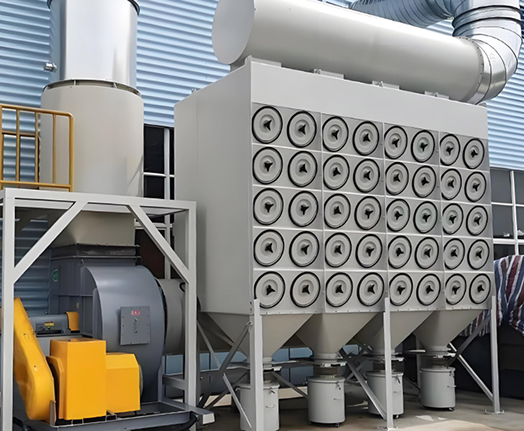
Correct filtration velocity, efficient pulse cleaning, and application-matched filter media help maintain stable differential pressure while controlling energy and maintenance costs.
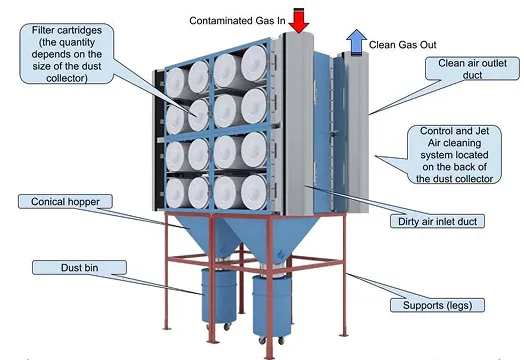
A hopper is a temporary transfer zone, not long-term storage. Allowing dust to build up into the filter section can cause re-entrainment, high differential pressure, poor cleaning, and additional fire or explosion risk.
The collector continues filtering while rows of cartridges are pulsed in sequence. This is a compact and economical arrangement for many low- to moderate-loading applications, but airflow remains across the element during cleaning and can redeposit part of the released dust.
One compartment is isolated from process airflow before pulsing, giving released dust time to fall without immediate re-entrainment. It is worth evaluating for high inlet loading, difficult dust release, continuous-duty systems, or installations that require cleaning without stopping the complete process.
High inlet concentration changes the collector design. Simply adding more cartridges may not solve rapid loading if the inlet carries dust directly onto the pleats, released dust is re-entrained, or the hopper cannot discharge material as quickly as it arrives.
A pulse jet baghouse, cyclone pre-cleaner, wet collector, or a combined system may be more appropriate when the process involves:
The final recommendation should be based on measured or defensible design data rather than a generic airflow-to-cartridge ratio.
A representative selection example showing how inlet loading, installation space, cartridge orientation, cleaning mode, and dust discharge should be evaluated together.
Very high inlet loading could rapidly cover conventional inclined or horizontal cartridges, while the available installation area made a large baghouse difficult to accommodate. The system also had to operate continuously and maintain stable filtration during cleaning.
Vertical cartridges were selected to avoid a dust-retaining upper surface and to help released dust move toward the hopper under gravity.
Surface-loading cartridge media was evaluated with additional effective filter area and a conservative filtration velocity to support fine-dust capture and pulse release.
The collector was divided into independent modules. One module can be isolated and pulsed while the remaining modules continue filtering.
Hopper capacity and continuous discharge were treated as part of the filtration design so collected dust would not build back into the cartridge section.
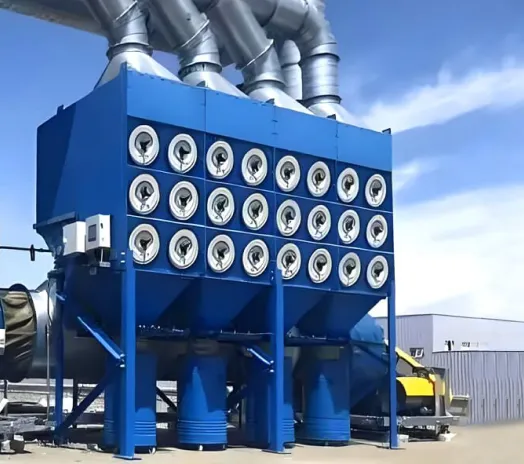
At this loading, dust can remain on the upper cartridge surface, reducing usable media area and increasing pulse demand, re-entrainment, and the risk of rapid differential-pressure rise.
Vertical installation supports downward dust release, while compartment isolation removes process airflow during each cleaning cycle and limits immediate redeposition on the cleaned cartridges.
Pleated cartridges provide a large nominal media area without requiring the height of conventional filter bags.
Nanofiber or membrane media can retain fine particulate near the surface and support dust release when correctly matched to the process.
Clean-on-demand controls can initiate pulse cleaning according to system resistance instead of relying only on fixed intervals.
Baffles, pre-separation zones, and downflow arrangements can reduce direct high-velocity impact on the cartridges.
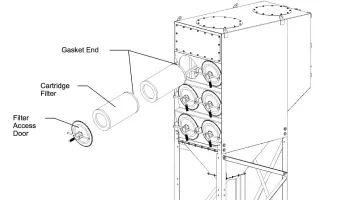
Side- or front-access configurations can simplify cartridge inspection and replacement.
Cartridge quantity, fan, controls, discharge equipment, and optional safety interfaces can be adapted to the installation.
Cartridge collectors are best classified in two ways: by the orientation of the filter cartridges and by the architecture of the complete system. Orientation affects dust release and service access; system architecture affects airflow capacity, transport, expansion, and dust-discharge arrangements.
The cartridges are installed upright. Gravity assists the downward movement of released dust and there is no upper horizontal cartridge surface on which dust can readily settle.
The cartridges are installed at an angle, commonly in a downflow housing where dirty air enters above and moves downward toward the hopper.
The cartridges slide horizontally into the housing. The arrangement is straightforward and compact, particularly where equipment height is restricted.
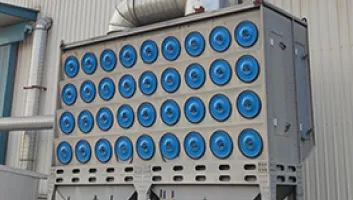
A self-contained system combining cartridges, fan, pulse controller, and dust bin for a local source or a small group of extraction points.
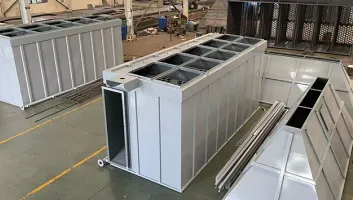
Standardized modules are combined for larger airflow or multiple extraction points. Repeatable module dimensions can simplify manufacture, transport, site assembly, and future expansion.
A configured system for unusual dust, hygiene demands, corrosive service, sparks, secondary filtration, or combustible-dust protection requirements.
| Style | How It Is Retained | Selection Considerations |
|---|---|---|
| Closed-end / single-open cartridge | One end is closed and the element is commonly secured by a central rod, bolt, frame, or clamping mechanism. | Provides positive mechanical retention in many designs, but removal may involve more steps and hardware. |
| Open-ended / double-open cartridge | Both ends are open and the cartridge is compressed between a mounting plate and external cap or handwheel. | Can speed replacement, but correct plate spacing, gasket condition, and compression are essential for sealing. |
| Chuck, bayonet, or lug-mounted cartridge | The end cap engages a matching receiver and is locked or clamped in position. | Can provide fast access; the cartridge interface must match the collector and maintain repeatable gasket compression. |
From welding and thermal cutting to grinding and powder handling, each process presents different dust characteristics, airflow demands, and safety requirements. Omela configures cartridge dust collection systems around the actual operating conditions.

Collection of fine metal oxide particulate from downdraft and cutting-table extraction systems.

Source capture for manual welding, robotic cells, extraction arms, and centralized welding systems.

Dust control for grinding, sanding, blasting, mixing, screening, packaging, and transfer points.
Preliminary sizing starts with airflow and a filtration velocity selected for the dust, filter media, cleaning system, and operating duty.
Basic relationship: required nominal filter area = airflow ÷ selected filtration velocity.
Published pleated media area should not be treated as the only sizing criterion. Pleat utilization, inlet velocity, cartridge spacing, pulse-cleaning penetration, and maintenance margin also affect performance.
The better collector depends on the dust and operating conditions. A compact footprint alone should not determine the selection.
| Selection Factor | Cartridge Collector | Pulse Jet Baghouse |
|---|---|---|
| Filter element | Pleated cartridge | Fabric bag supported by a cage |
| Footprint | Generally more compact | Usually requires more height |
| Fine dry dust and fume | Often well suited | Also possible with suitable media |
| Very high dust loading | May require conservative sizing or pre-separation | Often better suited |
| Sticky or fibrous dust | Can bridge or blind cartridge pleats | Still requires special design and media |
| Temperature range | Limited by available cartridge construction | Broader high-temperature fabric options |
| Maintenance | Compact elements and side/front access options | May involve a larger quantity of bags and cages |
Selection summary: consider a cartridge collector when compact installation, fine dry dust, and cleanable pleated media suit the process. Consider a baghouse when dust loading is very high, gas volume is large, or specialized high-temperature fabric media is required.
| Media | Typical Use | Important Considerations |
|---|---|---|
| Cellulose blend | General dry dust | Moisture and abrasion sensitivity |
| Spunbond polyester | General industrial and abrasive dust | Temperature and chemical compatibility |
| Nanofiber surface media | Fine dry dust and welding fume | Dust-release behavior and substrate selection |
| PTFE membrane | Fine particulate and surface filtration | Pulse settings, mechanical durability, and cost |
| Antistatic media | Dust with static-charge concerns | Does not replace a complete explosion-protection strategy |
| Flame-retardant media | Selected spark or ignition-risk applications | Does not make the complete system fireproof |
Media selection should consider temperature, moisture, particle size, dust loading, abrasiveness, chemical exposure, electrical resistivity, emission target, and dust-release behavior.
Two collectors with the same nominal airflow can have very different construction, filter area, dust-handling capacity, and safety scope. A useful quotation should identify the major configuration assumptions rather than show only a model number and price.
| Housing and modules | Steel grade and thickness, corrosion protection, number of modules, access doors, clean-air sealing, support frame, and indoor or outdoor construction |
|---|---|
| Cartridges and filter area | Media type, cartridge dimensions, quantity, pleat construction, mounting style, gasket design, and spare-element requirement |
| Cleaning system | Pulse valves, air header, controller, differential-pressure monitoring, online or offline cleaning, and compressed-air preparation |
| Hopper and dust discharge | Hopper volume, dust bin, slide gate, rotary airlock, screw conveyor, level monitoring, and required emptying frequency |
| Fan, controls, and accessories | Fan duty, motor, variable-frequency drive, control panel, instrumentation, inlet pre-separation, and secondary filtration |
| Safety and project scope | Hazard testing, explosion protection and isolation interfaces, spark or fire controls, transport, installation, commissioning, and documentation |
From process-data review and equipment selection to commissioning guidance and replacement-cartridge support.
Review airflow, dust loading, particle behavior, temperature, moisture, emission targets, and site constraints.
Select collector arrangement, cartridges, media, fan duty, controls, discharge, and service access.
Verify housing construction, sealing, cartridge fit, pulse components, controls, and documented specifications.
Support airflow checks, rotation checks, pulse settings, differential-pressure baseline, and leak inspection.
Use differential-pressure trends and operating observations to refine cleaning and airflow settings.
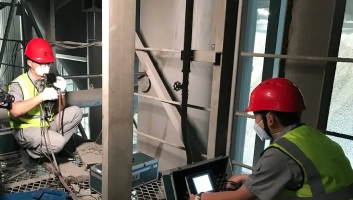
Diagnose blinding, sealing leaks, abnormal emissions, pulse-system problems, and uneven cartridge loading.
Collector performance depends on more than the filter element. Omela reviews the dust source, airflow, media, cleaning system, fan, discharge equipment, maintenance access, and applicable safety requirements as one connected system.
Cartridge media and surface treatment are selected against the dust, temperature, moisture, chemistry, emission target, electrical properties, and dust-release behavior—not by filter area alone.
Pulse pressure, valves, nozzles, cartridge arrangement, inlet distribution, and selected filtration velocity are treated as connected design inputs.
Access doors, cartridge orientation, dust-bin handling, controller visibility, and service clearance are considered during system configuration.
Support can cover preliminary selection, equipment configuration, commissioning guidance, replacement elements, and troubleshooting.
From the first technical discussion to installation and long-term maintenance, our team stays involved at every stage. We analyze your operating conditions, adjust product designs when needed, and ensure the final filtration setup works reliably in real plant environments. After delivery, our service team continues to provide guidance and troubleshooting support, helping you keep your system stable and downtime low.






It is a dry filtration system that uses pleated cartridges to separate airborne particulate from an industrial air stream. Cleanable systems commonly use compressed-air pulses to release dust from the cartridge surface.
By cartridge orientation, the common types are vertical, inclined, and horizontal. By system architecture, they can be compact integrated units, modular central collectors, or application-specific systems. The two classifications describe different design decisions.
Vertical cartridges allow released dust to move downward without settling on an upper horizontal surface, so they deserve consideration at higher dust loading. Inclined and horizontal arrangements provide compact side access and are common in fume applications, but possible dust retention on the upper cartridge surface must be considered.
Downflow describes the main dirty-air direction, typically from an upper inlet toward the hopper or lower section. It does not by itself describe cartridge orientation; inclined or horizontal cartridges can both be installed in a downflow housing.
A controller opens a diaphragm valve and releases a short compressed-air pulse into the cartridge. The pressure wave travels through the element and dislodges accumulated dust from the outer media surface so it can fall into the hopper.
Online cleaning pulses cartridges while the collector continues filtering. Offline cleaning isolates a compartment from process airflow before pulsing, which reduces immediate dust re-entrainment and can improve cleaning for high-loading or difficult applications.
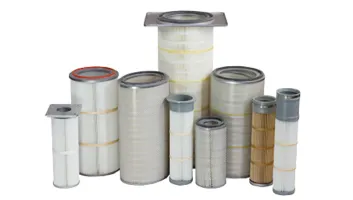
A closed-end, single-open cartridge is commonly retained by a rod, bolt, frame, or clamp. An open-ended, double-open cartridge is usually compressed between a mounting plate and cap. Open-ended designs can simplify replacement, while accurate spacing, gasket condition, and compression remain essential for sealing.
Preliminary sizing uses the required airflow and a filtration velocity selected for the dust, media, cleaning system, and operating duty. Inlet velocity, cartridge spacing, pleat utilization, dust loading, and maintenance margin must also be checked.
There is no universal value. The appropriate velocity depends on dust loading, particle behavior, media, cartridge geometry, cleaning effectiveness, duty cycle, and the required emission performance.
Selection should consider temperature, moisture, chemistry, particle size, abrasiveness, electrical resistivity, dust-release behavior, emission target, and whether a surface layer such as nanofiber or PTFE membrane is appropriate.
It can in selected cases, but the design may require vertical cartridges, lower filtration velocity, pre-separation, isolated compartments with offline cleaning, and continuous hopper discharge. A baghouse or combined system may be the better option when loading is extremely high or the dust is difficult to release.
They are generally intended for dry particulate. Moisture, oil, sticky material, or fibers can bridge or blind the pleats. The process should be reviewed before selection because another media type, pre-treatment step, or collector technology may be more suitable.
A baghouse may be preferable for very high dust loading, large gas volumes, sticky or difficult material, or temperatures requiring specialized fabric media not available in a suitable cartridge construction.
Common causes include excessive airflow, moisture, media blinding, overloaded pleats, insufficient pulse energy, blocked valves or nozzles, poor compressed-air quality, and unsuitable filter media.
Use emissions, differential-pressure trends, physical condition, loss of cleanability, sealing integrity, and application history. There is no reliable universal calendar interval for every process.
Potentially, but only after a dust-hazard and process-safety review. Antistatic or flame-retardant cartridges alone do not make a collector explosion-safe; the complete protection and isolation concept must meet the applicable requirements.
Start with the dust identity and available test data, process and ignition sources, airflow and concentration, equipment location, duct arrangement, discharge method, and whether filtered air may return indoors. A qualified specialist should then define the prevention, protection, and isolation measures.
Major cost drivers include housing construction, module count, effective filter area and media, online or offline cleaning, fan and controls, hopper and discharge equipment, corrosion protection, secondary filtration, safety devices, transport, installation, and commissioning scope.
Equipment, replacement elements, and spares can be scoped separately when compatibility is confirmed. For an existing collector, provide the manufacturer and model, cartridge dimensions, end-cap and gasket arrangement, media specification, operating conditions, and clear photos or drawings.
Send your airflow, dust characteristics, process temperature, emission target, installation layout, and compressed-air data. Omela will review the conditions and recommend a preliminary configuration.