
Key Takeaways
- Weak suction in an industrial cartridge dust collector should be treated as a system symptom rather than immediate proof that the filters or fan have failed. Loaded cartridges, duct leakage, restrictions, poor source capture, pulse-cleaning problems, insufficient fan static pressure, branch imbalance, and production expansion can all produce similar complaints.
- Cartridge dust collectors rely on airflow, filter area, pulse cleaning, fan performance, and dust discharge working together. A problem in any one of these areas can gradually reduce useful airflow at the process source even while the collector continues to run.
- Differential pressure is one of the most useful diagnostic measurements because weak suction with high filter ΔP usually points in a different direction from weak suction with normal filter ΔP.
- Leakage on the negative-pressure side can draw unwanted ambient air into the duct system. The fan may continue moving substantial total airflow, while less of that capacity is available where dust actually needs to be captured.
- Pulse cleaning should maintain a stable operating pressure range rather than simply make the cartridges appear clean. Weak compressed air, failed valves, poor pulse distribution, moisture, unsuitable media, or a packed hopper can all reduce cleaning effectiveness.
- Fan selection should always be based on required airflow at actual installed static pressure, including source capture, ducts, elbows, dampers, loaded filters, pre-separation equipment, and the final exhaust path.
Weak Suction Is a Symptom, Not a Diagnosis
A cartridge dust collector may operate normally for months or years before operators begin noticing that suction no longer feels as strong as it once did. Dust may escape around the machine, smoke may remain visible for longer, the farthest pickup point may become noticeably weaker, or material may begin settling inside horizontal duct runs.
The natural response is often to assume that the cartridges are clogged and should be replaced. Filter loading is an important cause of airflow loss, but it is only one possibility within a much larger airflow system.
A partly closed damper can create almost the same symptom as loaded filters. So can a collapsed flexible hose, a blocked duct, a leaking access door, an added production machine, an underperforming fan, a full hopper, or a source-capture hood that no longer matches the process.
Troubleshooting therefore becomes much more efficient when the question changes from:
“Which component should we replace?”
to:
“Where in the airflow path has the pressure, resistance, or useful airflow changed?”
That shift from replacement to diagnosis is the foundation of reliable dust collector troubleshooting.
Follow the Complete Airflow Path
A cartridge dust collection system can be simplified into one continuous path:
Capture Point → Ductwork → Collector Inlet → Filter Cartridges → Fan → Exhaust
Every part of this path consumes some of the pressure developed by the fan.
At the source, the hood or machine connection must capture the dust before it escapes into the room. Inside the ductwork, enough velocity must be maintained to transport the captured material without creating excessive resistance. Inside the collector, the cartridges add resistance that changes as dust accumulates. The fan then has to overcome the combined resistance of the entire system, including anything installed downstream on the clean-air side.
Because these elements are connected, a change in one part of the system can appear as weak suction somewhere completely different.
A blocked elbow upstream of the collector may look like a fan problem. Poor pulse cleaning may appear to be inadequate duct airflow. A leaking access panel can consume fan capacity while the collector itself appears mechanically normal.
For this reason, troubleshooting should always follow the direction of airflow rather than examining individual components in isolation.
Differential Pressure Helps Divide the Problem
Differential pressure across the filter cartridges measures how much resistance the filtration section is creating. It does not describe the entire system, but it is one of the fastest ways to determine which direction the investigation should take.
A healthy cartridge collector develops some pressure drop because air has to pass through the filter media and its accumulated dust cake. As loading increases, resistance normally rises, while pulse cleaning should prevent that resistance from increasing without control.
The most useful reference is usually the collector’s own historical operating range, rather than one universal pressure-drop number taken from another system.
| Operating Symptom | Likely Direction | First Area to Investigate |
|---|---|---|
| Weak suction with high filter ΔP | Filter loading, blinding or cleaning problem | Cartridges, pulse system, dust behavior |
| Weak suction with normal filter ΔP | Duct, fan, damper, leakage or capture issue | System airflow and static pressure |
| Near branches strong, far branches weak | Branch imbalance or excessive duct resistance | Duct sizing, gates and branch layout |
| Capture falls when more machines operate | Total airflow demand exceeds available capacity | Fan duty and simultaneous branch demand |
| Airflow improves after pulse cleaning | Filter loading is contributing to the loss | Cleaning performance and filter area |
| New cartridges installed but suction remains weak | Main limitation is probably elsewhere | Ductwork, fan, hood and system design |
The table is useful because it prevents a common maintenance mistake: treating every weak-airflow complaint as a filter problem.
High Differential Pressure: Look Beyond “Dirty Filters”
When weak suction occurs together with steadily rising filter differential pressure, the cartridge section deserves careful inspection. However, calling the cartridges “dirty” still does not explain why resistance is increasing.
The collector may simply be receiving more dust than it was originally designed to handle. The available filter area may be too small for the present airflow and duty cycle, which increases filtration velocity and accelerates loading. Fine particles may also penetrate more deeply into the media, especially when the cartridge surface is not well suited to the dust.
Moisture and oil create another type of problem because they can make dry particulate adhere to the media rather than release during pulse cleaning. In those conditions, a filter can appear moderately clean on the outside while significant resistance has already developed deeper inside the structure.
The most informative observation is what happens to differential pressure after cleaning. If ΔP falls meaningfully after a pulse cycle, at least part of the surface cake remains releasable. If the post-cleaning baseline becomes progressively higher week after week, permanent blinding or deeper loading may be developing.
This distinction is more useful than judging cartridges only by appearance.
Normal Filter ΔP Does Not Guarantee Good Suction
The opposite diagnostic error is equally common. When filter differential pressure remains within a familiar range, operators may conclude that the dust collection system is healthy.
In reality, filter ΔP only measures resistance across the cartridge section.
A partially blocked duct can reduce source airflow without producing unusually high cartridge resistance. The same is true for a collapsed flexible hose, an incorrectly positioned blast gate, a reduced VFD setting, a damaged fan drive, or an exhaust-side restriction.
A source-capture problem can also occur when total airflow remains adequate. If a hood has been moved farther from the process, or if the process now throws dust in a different direction, the collector may still move the designed volume of air while capturing less contamination.
Weak suction combined with normal cartridge ΔP is therefore a strong reason to move the investigation away from the filters and toward the rest of the airflow system.
Duct Leakage Can Reduce Useful Capture Airflow
Dust collection systems often operate with the dirty-air ductwork under negative pressure. This changes the way leakage appears.
A leak in a positive-pressure duct tends to push air outward. A leak in a negative-pressure section tends to pull ambient air inward.
This incoming air is sometimes described as false air or parasitic air because it consumes part of the fan’s capacity without contributing to useful source capture.
For example, if the fan is moving air through leaking duct joints, loose collector doors, poorly sealed hopper connections, or damaged flexible sections, part of the total airflow reaching the fan is coming from those leaks rather than from the process hood.
The result can be deceptive because the fan may still be moving substantial air overall. The real problem is that less of that airflow is being pulled from the location where the dust is generated.
Leakage can also create turbulence and additional friction losses, particularly around damaged or poorly aligned joints.
This is why duct seams, access doors, hopper interfaces, inspection covers, flexible connections, and collector panels deserve attention whenever source airflow weakens without a corresponding increase in filter ΔP.
Restrictions Can Develop Gradually
Not every duct restriction appears suddenly.
Fine powder may slowly accumulate at an elbow. Heavier particles may settle inside a horizontal run after airflow has fallen below the required transport velocity. Flexible hose can deform or collapse over time, especially where it is bent tightly or subjected to mechanical damage.
Once material begins settling, the effective duct area becomes smaller and resistance increases. That creates a feedback cycle in which low airflow encourages buildup, while buildup causes even lower airflow.
Eventually the farthest pickup point may become noticeably weaker even though the collector and fan have not changed.
Persistent material accumulation inside ductwork should therefore be treated as an airflow warning rather than ordinary housekeeping. Where the dust is combustible, accumulated material can also introduce additional fire or explosion concerns.
Pulse Cleaning Should Maintain Permeability
Pulse cleaning is designed to control the dust cake that naturally forms on cartridge media. Short bursts of compressed air release part of that cake so the cartridges can remain within a stable differential-pressure range.
The objective is not to return the filter to a visually new condition after every pulse. A functioning pulse system should preserve usable permeability and stable airflow over time.
Cleaning performance depends on several interacting factors, including available compressed-air pressure and volume, valve condition, blow-tube alignment, pulse timing, media construction, and the physical behavior of the collected dust.
If the compressed air contains excessive moisture or oil, certain powders may become more adhesive and difficult to remove. If a diaphragm valve is damaged or a blow tube is misaligned, part of the cartridge bank may receive much weaker cleaning than the rest.
Increasing pulse frequency is therefore not always the correct response to high differential pressure. A collector can consume more compressed air while still failing to remove the material responsible for the resistance.
Pulse cleaning is intended to recover a cleanable dust cake; it cannot reliably rescue media that has already become permanently blinded.
The Hopper and Dust Bin Are Part of the Cleaning System
When a pulse releases dust from the cartridge surface, that dust still has to leave the filtration area.
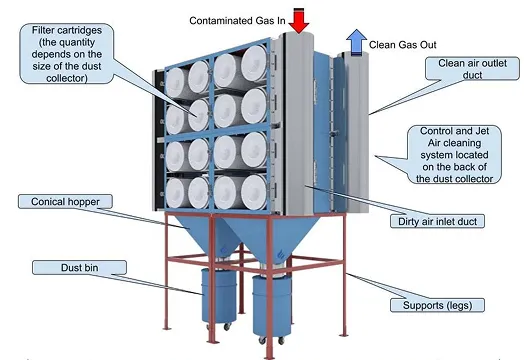
It falls toward the hopper and then into a drawer, drum, bin, rotary valve, or another discharge arrangement. If the discharge path is blocked or the container is allowed to overfill, released dust may accumulate beneath the cartridges.
This can interfere with cleaning, increase dust re-entrainment, and eventually contribute to unstable pressure drop.
A packed hopper can therefore create symptoms that resemble poor pulse cleaning even when the compressed-air system is functioning correctly.
Filter cleaning is only complete when released dust is successfully moved away from the cartridges and out of the collector.
For high-loading processes, dust-discharge capacity and emptying frequency should be treated as part of the collector’s operating design rather than a secondary maintenance issue.
Fan Airflow Cannot Be Evaluated Without Static Pressure
One of the most common dust collection misunderstandings is reading a fan specification such as:
10,000 m³/h
and assuming the installed system will automatically receive that airflow.
Fans operate along a performance curve, and the delivered airflow depends on the resistance against which the fan is operating.
The complete system resistance can include the source hood, branch ductwork, straight duct, elbows, transitions, dampers, pre-separators, spark-control equipment, collector inlet, loaded filter cartridges, afterfilters, silencers, exhaust ductwork, and stack.
As resistance rises, the actual operating point changes.
This is why fan selection should always be expressed as:
Required airflow at required static pressure
rather than airflow alone.
Filter loading makes this even more important because cartridge resistance changes during operation. A fan that provides excellent suction with new filters may no longer maintain adequate process airflow once the cartridges reach their normal loaded condition.
The system should therefore be evaluated for real operating resistance, not only the clean-filter condition observed during commissioning.
New Filters Do Not Always Restore Airflow
Replacing cartridges is a relatively easy maintenance action, which explains why it is often tried first.
When airflow improves significantly after a cartridge change, filter resistance was clearly contributing to the problem.
However, when new filters produce little or no improvement, that result should not be viewed as wasted maintenance. It provides useful diagnostic information because it shows that the main airflow limitation probably exists elsewhere.
The next investigation should include actual system airflow, static pressure, duct condition, branch balance, fan speed, fan rotation, VFD settings, outlet resistance, and source-capture geometry.
A system can have perfectly clean filters while still producing weak capture if the fan is operating outside the required duty point or if the ductwork is restricting the flow.
New cartridges remove one variable from the diagnosis; they do not guarantee that the rest of the system is correctly designed or operating.
Production Growth Can Quietly Exceed the Original Design
Some dust collection systems lose suction even though nothing has technically failed.
The facility has simply changed.
A machine was added to an existing branch, a second production line began running at the same time, operating hours increased, the main duct was extended, or the process began producing more dust than before.
Each change may appear minor when considered individually, but together they can consume the airflow and filter-area margin that existed in the original design.
The collector may continue working acceptably with one machine while struggling when two or three branches operate simultaneously. The farthest machine may become the first location where operators notice the loss of suction.
This is why troubleshooting should include a comparison between the current production layout and the operating conditions used when the system was originally sized.
If the plant has changed significantly, weak suction may reflect an undersized system rather than defective components.
Source Capture Can Fail Even When System Airflow Is Adequate
Airflow and capture are related, but they are not identical.
A collector can move the correct total air volume while still allowing dust to escape if the pickup geometry is poor.
The hood may be positioned too far from the source. The opening may no longer match the size or direction of the dust plume. A machine guard or enclosure may have been modified. Cross drafts from doors, fans, makeup air, or nearby processes may interfere with the intended airflow pattern.
In these cases, increasing fan speed may increase energy use without substantially improving capture.
The cheapest airflow problem to correct is often the one located at the source. Repositioning or redesigning the pickup point can sometimes restore effective dust control without changing the collector or fan.
Published Dust Collection Application Lessons
Case 1: Production Expansion Exceeded the Existing Airflow System
A published manufacturing case involved a workshop that expanded its equipment while continuing to use a refurbished cartridge collector rated at approximately 6,000 CFM together with the original 4- and 6-inch ductwork.
After the expansion, the shop required more than 10,000 CFM under the expected simultaneous operating conditions. The farthest machine received particularly poor airflow, while filters loaded rapidly and the workshop remained dusty.
Inspection also found that differential-pressure gauges had not been installed, so cartridge replacement decisions were largely based on appearance. At the same time, the hopper had become packed with accumulated dust, which further interfered with cleaning and discharge.
The correction addressed the entire system, including collector capacity, duct sizing, airflow control, differential-pressure monitoring, and hopper maintenance.
Lesson: When a facility has outgrown its original design, replacing cartridges or adjusting the fan cannot compensate for insufficient system capacity and restrictive ductwork.
Case 2: Adequate Capture, but Poor Filter Cleaning
A published plasma-cutting application used a 12-cartridge collector that was capable of capturing the process fume, yet the filters were reportedly lasting only about one week because the cleaning performance was inadequate.
The replacement system also used a 12-cartridge configuration, which is important because the improvement did not come simply from installing more cartridges or drastically increasing collector size.
After the filtration and cleaning arrangement was corrected for the actual cutting-fume duty, the system reportedly operated for about one year with differential pressure around 1.9 in. w.c., while the cartridges remained in service.
Lesson: When a collector can capture the contaminant but filter resistance rises too quickly, the root cause may be cleaning effectiveness and cartridge operating conditions rather than insufficient fan airflow.
Case 3: Stable Differential Pressure Supported Long Operating Hours
Another published cartridge-collector application served several blasting pickup points and operated approximately 20 hours per day, four days per week after the system airflow was balanced.
Reported differential pressure remained in a relatively stable range of approximately 1.9–2.4 in. w.c.
Those values should not be copied as a universal target because different dusts, filters, airflow rates, and media constructions operate at different pressure ranges.
The useful observation is the stability of the trend rather than the absolute number.
Lesson: A healthy collector does not necessarily have the lowest possible differential pressure. Stable source airflow and a repeatable ΔP range are more useful indicators of system health.
Troubleshoot in a Logical Sequence
- Confirm where the airflow problem exists. Determine whether suction is weak at one pickup point, several branches, or the complete system, because a local branch problem requires a different investigation from a plant-wide loss of airflow.
- Compare current filter ΔP with the normal trend. High ΔP points toward filtration and cleaning, while normal ΔP should shift attention toward duct restrictions, leakage, fan performance, dampers, and source capture.
- Verify pulse cleaning and dust discharge. Check compressed-air supply, valves, blow tubes, cleaning response, hopper condition, and dust-bin level before concluding that the cartridges themselves have failed.
- Inspect the complete duct network. Look for buildup, damaged or collapsed hose, changed gate positions, added branches, leaking joints, excessive elbows, and any modifications made since commissioning.
- Measure airflow and static pressure. Compare actual operating measurements with the fan curve and original design condition rather than relying on fan nameplate airflow.
- Compare today’s production with the original system basis. Added machines, longer operating hours, different dust loading, new branches, or simultaneous processes may have pushed the collector beyond its original design capacity.
The objective is to isolate the limiting part of the system before changing major equipment.
High Pressure Drop and Low Airflow Are Related but Not Identical
High filter differential pressure can certainly reduce process airflow because the fan must overcome greater resistance across the cartridges.
However, low airflow can occur even when filter ΔP is completely normal.
A blocked duct upstream of the collector can limit airflow without raising cartridge resistance. A negative-pressure leak can reduce useful hood airflow by bringing ambient air into the system. An undersized fan may fail to provide the required flow even with new cartridges, while poor hood geometry can allow dust to escape despite adequate total system airflow.
High ΔP is one possible cause of low airflow, but low airflow should never be diagnosed from filter pressure alone.
Understanding this distinction prevents unnecessary cartridge replacement and keeps troubleshooting focused on the full system.
Should You Install a Larger Fan?
A larger fan can solve a genuine fan-capacity problem, but it should not be the first response to unexplained weak suction.
If cartridges are blinded, a larger fan may increase energy consumption while accelerating filter loading. If ductwork is restricted, added fan pressure does not remove the obstruction. If capture geometry is poor, additional airflow may still miss the dust source.
Higher fan speed can also increase duct velocity, noise, abrasion, filter loading, and electrical demand.
A fan upgrade is therefore justified when measurements show that the existing fan cannot deliver the required airflow at the actual system static pressure.
That conclusion should come from airflow testing, static-pressure measurements, and the fan curve rather than from subjective impressions of weak suction.
Use Differential Pressure as a Trend, Not Just an Alarm
A differential-pressure gauge becomes much more valuable when readings are recorded over time.
After new cartridges are installed, the system establishes an initial baseline. As the media seasons and dust cake develops, resistance normally increases. Pulse cleaning should then maintain the collector within a reasonably repeatable operating range.
If the post-cleaning baseline rises gradually from week to week, the cartridges may be becoming permanently loaded. If the pressure changes suddenly after a process change, incoming dust characteristics or loading may have changed. If source airflow falls while filter ΔP remains stable, attention should shift away from the cartridges.
A pressure history turns ΔP from a filter-change indicator into a process diagnostic tool.
This is particularly valuable in facilities where airflow problems develop gradually and operators may not notice the change until visible dust begins escaping.
Final Engineering View
Weak suction in a cartridge dust collector is best understood as a problem somewhere along the complete airflow path:
Capture Point → Ductwork → Collector Inlet → Filter Cartridges → Fan → Exhaust
Filter loading can increase resistance, while ineffective pulse cleaning can accelerate that increase. Duct restrictions can prevent air from reaching the collector, whereas negative-pressure leaks can consume fan capacity at locations where airflow is not needed. Production expansion can increase demand beyond the original design, and a full hopper can interfere with dust release even when the cleaning valves operate correctly.
At the same time, a collector can move adequate total airflow and still perform poorly if the pickup hood does not capture the contaminant where it is generated.
The wrong troubleshooting question is therefore:
“Should we replace the filters or install a bigger fan?”
The more useful question is:
“Where along the airflow path has useful airflow been lost, and which measurement confirms that limitation?”
Start with the pressure-drop trend, then verify pulse cleaning and dust discharge. Inspect the ductwork and source capture before measuring airflow and static pressure against the fan curve. Finally, compare current production conditions with the original design basis.
When troubleshooting follows this sequence, weak suction becomes a measurable system problem rather than a guessing exercise.
Frequently Asked Questions
Why is my cartridge dust collector losing suction?
Weak suction can result from loaded or blinded cartridges, ineffective pulse cleaning, duct restrictions, negative-pressure leakage, incorrect damper positions, insufficient fan static pressure, added process equipment, outlet restrictions, or poor source-capture geometry. The most efficient diagnosis normally combines filter differential pressure with actual airflow and static-pressure measurements.
Does high differential pressure always mean the cartridges need replacement?
No. High differential pressure can also result from poor pulse cleaning, excessive dust loading, moisture or oil contamination, insufficient filter area, difficult-to-release dust, or an overloaded hopper. The pressure response after cleaning and the long-term ΔP trend should be reviewed before replacement is treated as the only solution.
Can duct leakage cause weak suction?
Yes. Leakage on the negative-pressure side draws ambient air into the duct system, which consumes part of the fan’s available airflow. As a result, less useful airflow may be available at the machine or hood even though the fan continues moving a substantial total air volume.
Why is suction still weak after installing new filter cartridges?
If new cartridges produce little improvement, the main limitation may be duct restriction, leakage, fan speed, branch imbalance, source-capture geometry, downstream resistance, or a system that has outgrown its original design. New filters eliminate one source of resistance but do not correct problems elsewhere in the system.
Can low compressed-air pressure cause weak dust collector suction?
Yes, indirectly. Insufficient pulse energy prevents accumulated dust from releasing effectively, causing filter differential pressure to increase over time. As total system resistance rises, the fan may deliver less process airflow at the pickup points.
Should I increase fan speed when suction becomes weak?
Fan speed should normally be increased only after measurements confirm that the fan genuinely lacks capacity at the actual system static pressure. Increasing speed without finding the root cause can increase energy use, filter loading, noise, duct wear, and maintenance without correcting a restriction or source-capture problem.
Author

Jessica Ma – Senior Filtration Engineer, Omela Filtration
Jessica Ma is a senior filtration engineer at Omela Filtration, specializing in dust and liquid filtration. With over 15 years of experience, she focuses on optimizing baghouse performance, enhancing filtration efficiency, and developing high-performance solutions for industrial dust collectors and precision liquid filtration applications.