
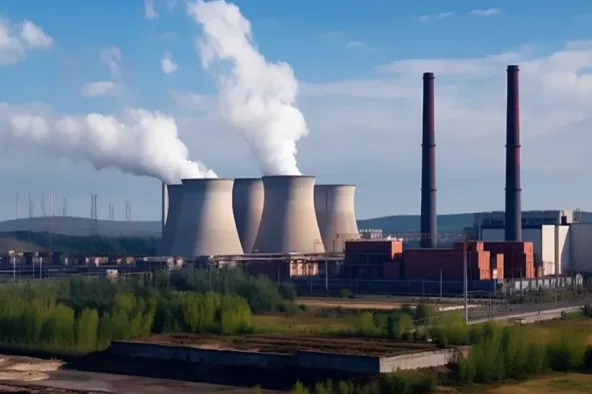
When a thermal power plant in Zhejiang, China reached out to us, their baghouse was in rough shape. The dust collector filter bags had reached the end of their service life, the collector’s interior walls were heavily corroded, the tube sheet had warped in sections, and the original filter cages were so rusted they had fused to the bag seats. Replacing the bags alone wasn’t going to solve anything — the whole system needed attention.
This case study walks through what we found, what we recommended, and how the system performed after a full baghouse refurbishment with new PPS filter bags and structural repairs.
The Challenge: When Filter Bag Failure Is Only Part of the Problem
Thermal power and coal-fired boiler operations put extreme stress on dust collection equipment. Flue gas from these processes typically carries high concentrations of SO₂, NOₓ, and moisture — a combination that accelerates corrosion of steel housings, warps tube sheets over time, and breaks down filter media that isn’t engineered for the job.
This particular facility had been operating for over two decades. Their baghouse showed all the common failure patterns we see in aging coal-fired power plant dust filtration applications:
Severely corroded sidewall panels. The internal steel was pitted and flaking. Left unaddressed, corroded walls create leak points that completely undermine filtration efficiency — no matter how good the new filter bags are.
Warped and damaged tube sheet (flower plate). A deformed tube sheet means filter bags can’t seat properly. Bypass leakage around the bag collars is one of the most common reasons post-replacement emission readings disappoint.
Fused filter cages. The original steel cages had rusted to the point where they couldn’t be removed cleanly. Trying to install new bags onto compromised cages causes premature bag wear, abrasion damage, and uneven airflow distribution.
Aging access panels and top covers. Old, deformed covers increase the risk of air ingress and complicate maintenance access.
The plant’s environmental compliance team was also under pressure. Under China’s dual-carbon policy framework, industrial facilities in the thermal power sector face increasingly strict particulate emission limits. The client required emissions below 5 mg/Nm³ at the baghouse outlet. Their current system wasn’t reliably hitting that target.
What Omela Recommended: A Full Refurbishment, Not Just a Bag Swap
After our engineering team conducted an on-site condition analysis, we advised against a straightforward bag replacement. Putting new filter bags into a structurally compromised collector is one of the most common and costly mistakes in baghouse maintenance — the new bags degrade faster, emissions stay unpredictable, and you end up doing the same job again in 12–18 months.
If you want to understand the root causes before deciding on a solution, read our guide on top 5 factors influencing the service life of dust filter bags.
Our recommendation was a complete baghouse refurbishment covering three areas:
1. Structural repair and surface treatment. Replace corroded wall panels, repair or replace the warped tube sheet sections, treat all interior steel surfaces with corrosion-resistant coating, and install new access panels and top covers. This restores the mechanical integrity of the collector housing before any new filtration media goes in.
2. Full cage replacement. Every filter bag cage was replaced with new galvanized steel filter bag cages. Properly dimensioned cages ensure the PPS filter bags maintain their cylindrical shape during operation and cleaning cycles, which directly affects both filtration efficiency and bag service life.
3. PPS filter bags. Based on the flue gas conditions — operating temperature around 104°C, SO₂ at 661 mg/m³, moisture content at 9.8%, with NOₓ present — we specified Omela PPS filter bags.
PPS is the right material for this application. It handles continuous temperatures up to 160°C (peak 190°C), resists hydrolysis in moisture-laden flue gas, and maintains structural integrity in acidic environments with SOₓ and NOₓ. For coal-fired boiler and thermal power applications, it’s the industry-standard choice for a reason. Polyester would degrade too quickly in this chemical environment; fiberglass would be over-specified given the temperature range. For a full breakdown of how PPS compares to other high-temperature materials, see our article on next-generation PPS filter bags for power plants.
The Refurbishment Process
The project was completed in late December. Our field service team handled the full scope — bag removal, structural repairs, surface treatment, cage installation, and bag installation. Having the same team manage the entire process matters: there’s no ambiguity about where responsibility sits if something doesn’t perform as expected, and the installation is done with full knowledge of the equipment condition and the filter media being used.
The before-and-after contrast in the photos tells the story clearly. The corroded, debris-filled interior of the pre-refurbishment collector was replaced with clean, properly coated tube sheets, new pulse pipes, and uniformly installed filter bags. The difference in system condition is visible immediately.
For maintenance teams planning a similar project, our article on how to clean dust collector filter bags covers the pulse-jet cleaning principles that keep a refurbished system performing long after installation.
Verified Results: 1.3 mg/Nm³ at the Baghouse Outlet
One month after completion, our engineering team returned to the site for a formal performance verification using calibrated stack testing equipment. The test was conducted per GB/T 16157 and HJ/T 836-2017 standards.
Measured particulate concentration at the baghouse outlet: 1.3 mg/Nm³.
The client’s compliance requirement was 5 mg/Nm³. The system was operating at less than 30% of the required limit.
The full flue gas parameters at the time of testing:
| Parameter | Value |
|---|---|
| Flue gas temperature | 104.0 °C |
| Actual flow rate | 160,200 m³/h |
| Standard flow rate | 117,314 m³/h |
| Moisture content | 9.8% |
| O₂ | 3.6% |
| SO₂ | 661 mg/m³ |
| NOₓ | 20 mg/m³ |
| CO | 252 mg/m³ |
| Particulate matter (outlet) | 1.3 mg/Nm³ |
The system has continued running normally since commissioning. The client has expressed full satisfaction with both the project execution and the verified emissions performance.
To see how a similar approach applies to waste incineration — another flue gas environment with aggressive chemistry — read our case study on PTFE filter bags for waste-to-energy plants.
Why Baghouse Refurbishment Often Makes More Sense Than Full Replacement
This project is a good example of a decision that plant managers and procurement teams face regularly. When a baghouse starts having problems, the instinct is sometimes to replace the entire collector. But that involves significant capital expenditure, extended downtime, civil work, and in many cases, a longer permitting process.
A properly scoped refurbishment — where structural problems are corrected, cages are replaced, and the right filter media is selected for the actual operating conditions — can restore a baghouse to as-new performance at a fraction of the cost. The key is doing the engineering assessment first and not cutting corners on the structural repairs in order to save on the bag budget.
If you’re evaluating filter media options for a power plant or industrial boiler application, our power plant dust collector filter bag type guide walks through the decision process in detail. And if you want to understand what separates PPS from PTFE for the most chemically aggressive environments, the article on PPS and PTFE laminated filter bags applications covers the tradeoffs directly.
In this case, the combination of PPS filter bags rated for the chemical and thermal environment, proper cage geometry to support bag performance, and restored collector housing integrity produced a result that significantly exceeded the client’s compliance requirements.
Omela’s Dust Filtration Services & Products
Omela Filtration provides full-scope baghouse refurbishment and dust filtration engineering services for industrial dust collectors across thermal power, waste incineration, cement, steel, chemical, and other heavy industries. Our services include:
On-site condition analysis and filter media selection. Before any recommendation is made, our engineers assess the actual operating conditions: flue gas temperature, chemical composition, moisture, dust load, and equipment condition. Filter media selection follows from the real data, not from assumptions. Learn more about how to choose a filter bag for effective industrial filtration systems.
Filter bag removal and installation. Professional removal and installation of industrial filter bags, handled by our own trained field service teams.
Filter cage replacement. Supply and installation of new galvanized steel filter bag cages or stainless steel filter bag cages matched to your specific baghouse geometry and bag dimensions.
Structural repair and surface treatment. Corroded wall panels, warped tube sheets, damaged access covers — all addressed as part of a complete refurbishment scope.
Post-installation performance verification. Stack testing and performance verification after commissioning, so you have documented proof of emissions compliance.
Single-source accountability. When Omela handles the filter bags, cages, structural repairs, and installation as an integrated scope, there’s no ambiguity about responsibility. Every component of the system is specified and installed by the same team.
Our key products for thermal power and coal-fired boiler applications:
- PPS Filter Bags — for coal-fired boilers, thermal power, cement kilns
- PTFE Filter Bags — for waste incineration, chemical processing, ultra-low emission requirements
- Fiberglass Dust Filter Bags — for extreme high-temperature applications up to 260°C
- P84 High Temperature Dust Filter Bags — for fine particulate control and low pressure drop
- Galvanized Steel Filter Bag Cages — standard replacement cages for pulse-jet baghouses
- PPS Needle Punched Felt — raw filter media for custom bag fabrication
Talk to an Engineer
If your baghouse is showing signs of performance degradation — rising pressure drop, inconsistent emissions readings, filter bags failing earlier than expected, or visible corrosion during maintenance — it’s worth having an engineer look at the whole system, not just the filter bags.
Contact Omela Filtration to schedule an on-site condition assessment or discuss your application requirements.
Author

Jessica Ma – Senior Filtration Engineer, Omela Filtration
Jessica Ma is a senior filtration engineer at Omela Filtration, specializing in dust and liquid filtration. With over 15 years of experience, she focuses on optimizing baghouse performance, enhancing filtration efficiency, and developing high-performance solutions for industrial dust collectors and precision liquid filtration applications.