
There’s a question I ask every plant manager and maintenance engineer who contacts us about emission compliance problems with their baghouse system: have you done a fluorescent powder leak test?
The answer is usually no. Sometimes they’ve never heard of it. Sometimes they know what it is but assume it’s only for new installations. Sometimes they’ve been relying on visual inspection — walking the clean-air plenum with a flashlight and checking bags by eye — and assume they’ve found every problem.
They almost certainly haven’t. Visual inspection is slow, inconsistent, and structurally unable to identify certain categories of leak paths that fluorescent powder testing catches reliably. Tube sheet bypass, micro-seam failures, snap band leaks, cage-to-bag interface gaps, and hairline fabric defects are effectively invisible to visual inspection but show up immediately under UV light after fluorescent powder has been introduced into the system.
In fifteen years of field service across cement plants, power stations, steel mills, waste incinerators, and chemical processing facilities, fluorescent powder leak testing has consistently been the single highest-value diagnostic step available. It takes a few hours. It requires no specialized structural access beyond what’s needed for routine bag inspection. And it regularly identifies leak paths that have been degrading emission performance for months or years without anyone knowing they existed.
Here’s what the process involves, how it compares to conventional inspection methods, and what it looks like in practice — including two recent field cases from cement and coal power installations in the Philippines.
What Fluorescent Powder Leak Testing Actually Is
The principle is straightforward. A fine fluorescent tracer powder — typically 3 μm particle size, non-toxic, non-radioactive, free of organic phosphates and heavy metals — is introduced into the dirty-air side of the baghouse while the system is running or under simulated airflow conditions. The powder behaves exactly like process dust: it follows the gas stream through the system, gravitates toward areas of lower resistance, and accumulates wherever there’s a leak path.
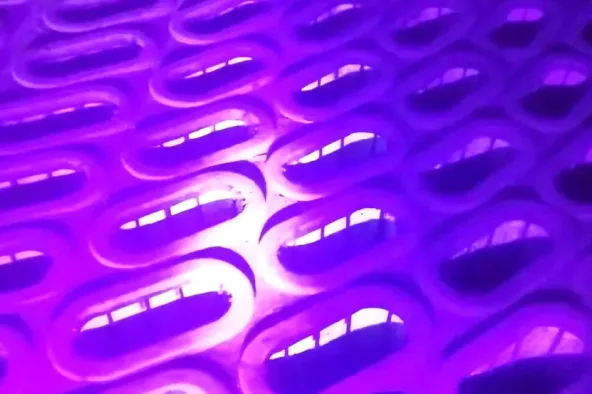
After allowing the powder to distribute through the system (typically 15–30 minutes of operation), the system is shut down and the clean-air side is inspected using a UV monochromatic lamp. Any fluorescent powder that has passed through — indicating a leak path — glows brightly under UV light. The leak location is immediately visible: you can see exactly which bag, which seam, which tube sheet connection, or which structural joint is leaking, and how severely.
The fluorescent tracer powder is available in multiple colors — pink, orange, green, blue, yellow — to facilitate repeat testing. If you run a green test after installation and then need to re-test after repairs, using a different color (pink, for example) confirms that any fluorescent material detected in the second test represents a new or unresolved leak, not residual powder from the first test.
Why Visual Inspection Is Not Enough
Most plant maintenance teams rely on some combination of visual bag inspection (looking for holes, tears, abrasion marks), differential pressure monitoring, and opacity measurement to assess baghouse condition. These methods have value — but they all share a fundamental limitation: they detect consequences, not causes, and they detect them late.
Differential pressure tells you the system is experiencing higher resistance, but it doesn’t tell you which bag is leaking or where the bypass path is. Opacity measurement tells you particulate is escaping, but it averages across the entire filter area and may not register a single leaking bag until the leak has grown large enough to measurably affect the total outlet concentration. Visual inspection catches obvious physical damage — torn bags, broken snap bands, collapsed cages — but misses micro-leaks at seams, tube sheet bypass around bag collars, and fabric defects that are invisible to the eye but significant enough to affect emission compliance.
Fluorescent powder testing identifies all of these simultaneously, in a single test cycle, with spatial precision that points the maintenance team directly at the problem.
The comparison is quantifiable:
| Parameter | Fluorescent Powder Testing | Conventional Visual Inspection |
|---|---|---|
| Inspection time (1,000-bag system) | 2–4 hours | 1–3 days |
| Personnel required | 2–3 people | 4–6 people |
| Detects micro-seam leaks | Yes | No |
| Detects tube sheet bypass | Yes | Rarely |
| Detects snap band seal failures | Yes | Sometimes |
| Detects fabric micro-perforations | Yes | No |
| Quantifies leak severity | Yes (by powder accumulation pattern) | Subjective |
| Repeatable / documentable | Yes (photo under UV) | Subjective |
| Cost per inspection | Lower (fewer hours, fewer people) | Higher (more labor, longer downtime) |
The time savings alone are significant in plant environments where baghouse downtime is limited to scheduled maintenance windows. But the real value is detection accuracy — finding the leaks that visual inspection simply cannot identify.
When to Conduct Fluorescent Powder Leak Testing
There are three situations where fluorescent powder testing should be standard practice:
After new filter bag installation. Every new bag installation carries a risk of installation error — bags not fully seated, snap bands not properly engaged, cage damage during installation that creates an abrasion point, tube sheet gaskets disturbed during the work. A fluorescent powder test immediately after installation verifies that the entire system is sealed before it’s returned to service. This is the most cost-effective time to find and correct problems, because the bags are new and accessible, and fixing a seal issue at this stage costs virtually nothing compared to discovering it months later through emission exceedances.
When emission measurements exceed expectations. If your outlet opacity or particulate concentration has increased without an obvious process change, a fluorescent powder test is the fastest diagnostic path to identifying the source. It eliminates guesswork and allows the maintenance team to target repairs rather than conducting a full bag-by-bag visual inspection.
As part of scheduled preventive maintenance. For plants operating under strict emission permits — cement plants in environmental control zones, waste incinerators with dioxin compliance requirements, power plants under continuous emission monitoring — incorporating fluorescent powder testing into the annual or semi-annual maintenance schedule provides a verified baseline of system integrity. It’s the equivalent of a pressure test on a boiler: it confirms that the containment boundary is intact before the system is returned to service.
For a broader discussion of how leak testing fits into a complete baghouse maintenance program, our article on the benefits of leak testing for dust collection systems covers the compliance and cost-of-ownership arguments in more detail.
Our Laboratory and Field Capabilities
Effective leak testing — and the failure analysis that often follows — requires more than fluorescent powder and a UV lamp. It requires analytical capability to determine why a leak occurred, not just where it is.
Our laboratory is equipped with testing and analysis instruments imported from leading manufacturers in Germany, Switzerland, the Netherlands, Japan, and the United States:
German FilTEq FEMA 1 Dust Filtration Efficiency Test System — measures the actual particulate filtration efficiency of filter media samples under controlled conditions, verifying that the media meets its rated specification before installation.
Swiss Textest FX3300-IV Air Permeability Tester — measures the air permeability of filter media under standardized pressure differential, confirming that the fabric weight and construction are appropriate for the cleaning mechanism and face velocity of the specific baghouse system.
Dutch Phenom Pure Scanning Electron Microscope (SEM) — provides high-magnification imaging of filter fiber microstructure, used in failure analysis to identify whether a bag failure was caused by chemical attack (acid hydrolysis, oxidation), thermal degradation, mechanical fatigue, or abrasion. SEM analysis of failed bags is one of the most definitive diagnostic tools available for determining the root cause of premature failure.
CU-2 (YG(B)002) Fiber Fineness Analyzer — measures fiber diameter distribution in filter media samples, used to verify that precision fine-fiber construction meets its specification and to identify fiber degradation in failed bags.
Japanese Espec GPH-H20 High-Temperature Drying Oven — used for controlled thermal aging tests, simulating the long-term temperature exposure that filter media experiences in service.
American PMI CFP-1100AX Pore Size Analyzer — measures the pore size distribution of filter media, which directly determines filtration efficiency on fine particles. This instrument is particularly important for verifying PTFE membrane integrity and for diagnosing blinding in needle-felt filter media.
This laboratory capability means that when a fluorescent powder test identifies a leaking bag, we can go beyond finding the leak — we can determine why it occurred, which informs whether the corrective action is a simple bag replacement, a specification change, a cleaning system adjustment, or a system design modification.
Case Study 1: Cement Plant — Toril, Davao City, Philippines
Application: Cement production facility in Toril, Davao City, operating a multi-compartment pulse-jet baghouse on the kiln/raw mill exhaust line. The plant had completed a full filter bag replacement using polyester filter bags and was preparing to return the baghouse to service.
The Situation
The plant’s operations team had completed bag installation using their own maintenance crew — a standard practice for facilities with experienced in-house teams. Before returning the system to normal operation, the plant requested Omela’s on-site fluorescent powder leak testing service to verify installation integrity.
What We Did
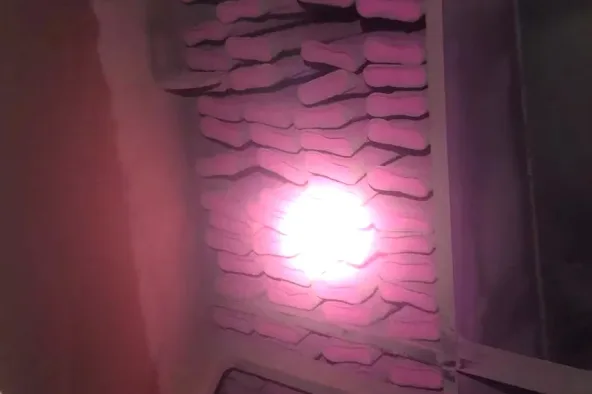
Our field service team traveled to the Toril site and conducted a full fluorescent powder leak test across all compartments. Green tracer powder was introduced into the dirty-air side with the system running under test airflow conditions. After the distribution period, the system was shut down and the clean-air plenum was inspected compartment by compartment using UV lamps.
Findings
The test identified three categories of issues:
First, four bags in two compartments had snap bands that were not fully seated in the tube sheet openings. Under UV light, fluorescent powder was clearly visible around the collar area on the clean-air side — indicating bypass flow around the bag-to-tube-sheet seal. These bags were correctly installed in terms of orientation and positioning, but the snap band engagement was incomplete. This is one of the most common installation defects and is almost never caught by visual inspection, because the bag appears correctly installed when viewed from above.
Second, one tube sheet gasket on a compartment access door showed fluorescent powder traces at the gasket perimeter, indicating a seal leak at the housing interface rather than at any individual bag. This type of structural leak is invisible during bag-level inspection but contributes directly to outlet emissions.
Third, two bags showed micro-perforations at the seam — likely caused by handling damage during installation. Under UV light, thin lines of fluorescent powder were visible along the seam path. These perforations were small enough that they would not have been visible to the eye under normal lighting conditions but were large enough to produce measurable particulate bypass under operating conditions.
Outcome
All identified issues were corrected on-site within a few hours: snap bands were re-seated, the gasket was replaced, and the two damaged bags were swapped out. A second leak test using pink tracer powder confirmed no remaining leak paths. The baghouse was returned to service with verified installation integrity — and the plant avoided what would likely have been a gradual emission compliance problem that might not have been traced back to installation defects for months.
Case Study 2: Coal-Fired Power Plant — Brgy. Alas-Asin, Mariveles, Bataan, Philippines
Application: Coal-fired power generation facility in Mariveles, Bataan, operating a large-scale pulse-jet baghouse system on the boiler exhaust. The facility had been experiencing gradually increasing opacity readings over a period of several months, despite the filter bags being within their rated service life. The maintenance team had conducted multiple visual inspections and replaced several bags that showed visible wear, but the opacity trend continued upward.
The Situation
The plant contacted Omela for diagnostic support after internal troubleshooting failed to resolve the emission trend. Their monitoring data showed a gradual opacity increase that didn’t correlate with any process change — fuel composition, boiler load, and cleaning cycle parameters had all remained consistent. The bags were PPS filter bags specified for the coal-fired operating environment, and the visible bag replacements that had been done addressed obviously damaged bags but hadn’t resolved the overall trend.
What We Did
We deployed a field service team for a combined fluorescent powder leak test and failed bag failure analysis. The leak test was conducted across all compartments using green tracer powder. In parallel, three bags that had been removed during the plant’s earlier troubleshooting were sent to our laboratory for SEM analysis and fiber condition assessment.
Findings
The fluorescent powder test identified eleven bags across four compartments with leak paths — significantly more than the three bags the plant’s visual inspection had identified. The leak categories broke down as follows:
Five bags had seam failures at the bottom closure. Under SEM analysis, the seam thread showed acid hydrolysis damage — the SO₂ content in the flue gas had attacked the sewing thread (which was polyester, not PPS) at operating temperature. The PPS filter media was intact, but the thread joining the media at the bottom seam had degraded to the point where micro-gaps had opened along the seam line. This is a known failure mode when sewing thread material is not matched to the filter media’s chemical resistance — and it’s invisible to visual inspection until the gap is large enough to see with the naked eye.
Four bags had cage wire abrasion wear at consistent locations — the cage wires at the third and fourth ring from the top showed corrosion pitting that created sharp edges, which abraded the bag fabric from the inside. The abrasion pattern was consistent across all four bags, indicating a systemic cage condition issue rather than individual bag defects.
Two bags had snap band bypass similar to the Davao case — incomplete seating that was not visible from above but was immediately apparent under UV light.
Outcome
The corrective actions were multi-layered. The eleven leaking bags were replaced. All remaining bottom seams were inspected and re-sewn where thread degradation was identified — using PPS thread matched to the filter media’s chemical resistance. The cage inspection that followed identified corrosion pitting on cage wires in multiple compartments, and affected cages were scheduled for replacement. The snap band seating protocol was reviewed with the plant’s maintenance team.
The failure analysis report — including SEM imagery of the thread degradation and cage abrasion patterns — was provided to the plant’s engineering team, and the filter bag specification was updated to require PPS sewing thread for all future PPS bag orders. Opacity readings returned to baseline within the first week of operation after the corrections were completed.
This case illustrates the core value of fluorescent powder testing combined with laboratory failure analysis: the plant’s own visual inspection found 3 of the 11 actual leak sources. Without fluorescent powder testing, the remaining 8 would have continued contributing to the emission trend, and without the SEM failure analysis, the root cause — mismatched thread chemistry — would not have been identified and would have recurred with the next bag set.
How to Arrange a Fluorescent Powder Leak Test
Fluorescent powder leak testing can be conducted as a standalone service call or as part of a larger bag replacement, system maintenance, or failure analysis project. The typical process:
Pre-test coordination — our team reviews your baghouse configuration (number of compartments, bag count, access points, cleaning system type) and confirms the powder color selection based on your dust type and any previous tests.
On-site testing — typically completed within a single shift for systems up to 2,000 bags. Larger systems may require two shifts. The system needs to be available for testing airflow during powder introduction, then shut down for UV inspection.
Reporting — all identified leak points are documented with location, severity classification, and photographic evidence under UV light. For projects that include failure analysis, laboratory results (SEM, air permeability, fiber condition) are included in the report with root cause determination and corrective action recommendations.
For a broader look at how filter bag failure analysis works — including the common failure modes that fluorescent powder testing helps diagnose — our article on the top 3 reasons why filter bags fail covers the engineering context. For understanding how leak detection fits into a complete baghouse maintenance program, see the benefits of leak testing for dust collection systems.
To arrange a fluorescent powder leak test or discuss your specific system, visit our filtration services page or contact our engineering team directly.
Frequently Asked Questions
What is fluorescent powder leak testing and how does it work?
Fluorescent tracer powder — a fine, non-toxic, 3 μm particle-size powder — is introduced into the dirty-air side of the baghouse during operation or simulated airflow. The powder behaves like process dust and follows any leak path through the filter system. After distribution (typically 15–30 minutes), the system is shut down and the clean-air side is inspected under UV light. Any fluorescent powder that has passed through becomes brightly visible, identifying the exact location and severity of every leak path — whether it’s a bag tear, a seam failure, a snap band bypass, a tube sheet gasket leak, or a structural joint defect.
Is fluorescent powder safe for my filter bags and equipment?
Yes. The powder is formulated with stable, non-toxic organic pigments. It is non-radioactive, free of organic phosphates and heavy metals, and does not damage filter bags, fan systems, ductwork, or pulse-jet components. It is removed during routine cleaning cycles and does not affect filter media performance. Most formulations provide heat resistance up to 280°C, making them suitable for high-temperature applications including cement kilns, steel plants, power boilers, and waste-to-energy systems.
When should I conduct a fluorescent powder leak test?
Three situations: after every new filter bag installation or major bag replacement to verify installation integrity; when emission measurements (opacity or particulate concentration) increase without an obvious process cause; and as part of scheduled preventive maintenance for plants operating under strict emission permits. The post-installation test is the most cost-effective, because finding and fixing seal issues with new bags costs virtually nothing compared to discovering the problem months later through emission exceedances.
How long does a fluorescent powder leak test take?
For a typical industrial baghouse system (500–2,000 bags), the complete test — powder introduction, distribution period, UV inspection of all compartments, and documentation — is typically completed within a single shift (4–8 hours). Larger systems may require two shifts. This compares to 1–3 days for conventional bag-by-bag visual inspection, with higher accuracy and significantly lower labor requirements.
Can fluorescent powder testing identify the root cause of a leak?
The test identifies the location and severity of every leak path, which narrows the diagnostic field significantly. However, determining why a leak occurred — chemical attack on sewing thread, cage abrasion, thermal degradation, installation error — requires laboratory failure analysis of the affected bags. This is why we offer fluorescent powder testing combined with laboratory analysis (SEM, air permeability, fiber condition assessment) as an integrated service: the field test finds the leaks, and the laboratory analysis determines the root cause and informs the corrective action.
What colors of fluorescent powder are available, and which should I use?
Multiple colors are available — pink, orange, green, blue, and yellow — to facilitate repeat testing and to ensure contrast against your specific dust type. Green works well in cement, aluminum, and power applications. Pink is suitable across most conditions. Yellow should be avoided in cement, lime, asphalt, and sulfur-containing environments. Blue works across most industries but not with light-colored dust. For plants that test multiple times per year, using a different color each time confirms that any detected powder represents a current leak, not residual from a previous test.
Author

Jessica Ma – Senior Filtration Engineer, Omela Filtration
Jessica Ma is a senior filtration engineer at Omela Filtration, specializing in dust and liquid filtration. With over 15 years of experience, she focuses on optimizing baghouse performance, enhancing filtration efficiency, and developing high-performance solutions for industrial dust collectors and precision liquid filtration applications.