
Key Takeaways
- Liquid filter bags can be used in industrial wastewater treatment for suspended solids, sludge flocs, rust, scale, sand, fibers, precipitated solids, and other particulate contaminants.
- Micron rating should be selected according to the actual particle distribution and treatment objective—not simply by choosing the smallest available micron number. Finer filtration can improve particle capture but may also increase pressure drop and shorten bag life under high solids loading.
- Polypropylene liquid filter bags are a practical starting point for many wastewater applications because PP needle felt combines depth filtration, dirt-holding capacity, and broad compatibility with many aqueous streams.
- Polyester liquid filter bags can be considered where higher temperature capability or mechanical strength is required, while mesh filter bags are useful for coarse solids, defined openings, and applications where cleaning and reuse are practical.
- Heavy solids loading often favors staged filtration: remove coarse solids first and use finer bags downstream instead of forcing the entire solids load into one fine filter.
- Filter bag performance depends on the complete system: flow rate, TSS concentration, particle characteristics, micron rating, filtration area, housing configuration, allowable differential pressure, pump capacity, and change-out frequency.
- A good wastewater filtration design should answer three questions together: What solids must be removed? How much solids loading reaches the filter? What downstream process or discharge requirement must be protected?
Where Filter Bags Fit in Wastewater Treatment
Wastewater filtration is rarely about removing one uniform type of particle.
Industrial wastewater may contain suspended process solids, biological flocs, coagulated or precipitated solids, rust, scale, sand, fibers, pigments, metal hydroxides, and other particulate contaminants.
The treatment objective also varies.
One plant may need to protect an RO system. Another may need to reduce visible suspended solids before water reuse. A metal-finishing facility may need to capture precipitated solids after chemical treatment, while another process may use bag filtration as a polishing step before discharge.
This is why filter bags should be considered as one part of the complete treatment train rather than a universal replacement for clarification, biological treatment, membrane filtration, or other wastewater technologies.
A typical industrial arrangement might look like:
Equalization / Chemical Treatment → Settling or Clarification → Bag Filtration → Cartridge or Membrane Filtration → Reuse or Discharge
In simpler applications, bag filtration may primarily protect pumps, heat exchangers, spray nozzles, activated carbon systems, RO membranes, or other downstream equipment.
The first design decision is therefore not the micron rating. It is defining exactly what the bag filter is expected to do.
Suspended Solids and TSS Are Not the Same as Micron Rating
One of the most common specification mistakes is trying to convert a TSS value directly into a filter micron rating.
For example:
Influent TSS = 200 mg/L, therefore use a 10 µm bag.
That conclusion cannot be made from TSS alone.
TSS describes the mass concentration of suspended material. Micron rating describes particle-size retention behavior.
Two wastewater streams can both contain 200 mg/L TSS while behaving completely differently inside a filter bag.
One stream may contain relatively large, rigid mineral particles.
Another may contain soft biological flocs, fine precipitates, or compressible organic solids.
The same nominal 10 µm filter bag could therefore produce very different pressure-drop development, filtrate quality, and service life.
For reliable selection, TSS should be considered together with:
- Particle-size distribution
- Particle shape and hardness
- Whether the solids are rigid or compressible
- Whether particles form a dense filter cake
- Required downstream water quality
- Flow rate and solids loading
This distinction becomes particularly important in wastewater because hydraulic flow and solids concentration may change substantially during production.
Why Sludge Flocs Behave Differently from Sand or Rust
A 50 µm sand particle and a 50 µm sludge floc do not necessarily behave the same way inside a filter bag.
Sand, rust, scale, and similar mineral particles are generally relatively rigid.
Sludge flocs may be soft, irregular, porous, and compressible.
When differential pressure increases, soft solids can deform against the filter surface and create a dense cake.
This can produce a common wastewater filtration problem:
The filter has enough nominal filtration area, but pressure drop rises much faster than expected.
Selecting an even finer filter bag may make the problem worse.
For example, replacing a 50 µm bag with a 5 µm bag in a heavy sludge stream may improve initial filtrate clarity, but the finer media may blind rapidly and require frequent replacement.
In this situation, upstream clarification or staged filtration may be more effective than simply reducing the micron rating.
How to Select the Micron Rating
A useful engineering principle is:
Use the coarsest micron rating that consistently achieves the required downstream result.
Not:
Use the finest filter bag available.
A practical starting framework is:
| Wastewater Condition | Possible Starting Range | Main Objective |
|---|---|---|
| Large grit / coarse debris | 200–800 µm | Equipment protection |
| Fibers / coarse suspended solids | 100–200 µm | Bulk solids removal |
| General industrial suspended solids | 25–100 µm | Prefiltration |
| Fine precipitates / polishing | 5–25 µm | TSS reduction |
| Fine final polishing | 1–10 µm | Downstream protection |
These values should be treated as starting ranges rather than guaranteed design values.
Actual selection depends on particle-size distribution, filter efficiency, TSS loading, flow rate, required filtrate quality, and acceptable change-out frequency.
For an unknown wastewater stream, testing several micron ratings under actual operating conditions is often more useful than selecting a filter solely from theoretical particle size.
Nominal vs. Absolute Micron Rating
Another common mistake is assuming every filter marked “10 micron” provides identical retention.
It does not.
Needle-felt filter bags are commonly specified using a nominal micron rating.
Particles can be captured on the surface and throughout the depth of the felt structure. Retention characteristics may also change as a solids cake develops.
Monofilament mesh works differently.
Its woven structure provides defined openings and primarily uses surface filtration.
Therefore, when comparing filter bags, engineers should ask:
Is the stated micron rating nominal, absolute, or based on a defined particle-retention efficiency?
The micron number alone does not provide the complete answer.
This distinction becomes particularly important when the objective is repeatable outlet quality rather than simply removing visible particles.
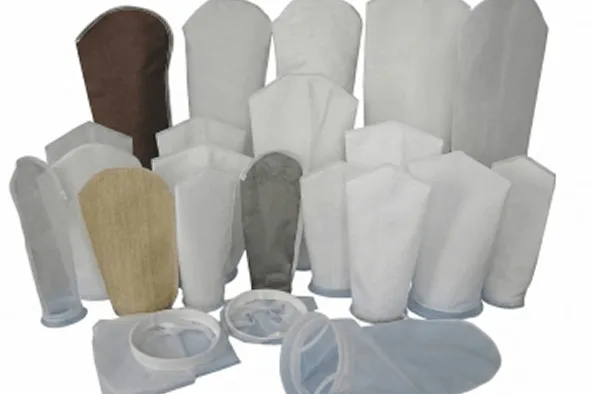
PP Felt, Polyester Felt, or Mesh?
There is no universal “wastewater filter bag material.”
Media selection depends on wastewater chemistry, temperature, particle characteristics, filtration objective, and required service life.
| Media | Main Characteristic | Typical Wastewater Duty | Main Consideration |
|---|---|---|---|
| Polypropylene Felt | Chemical resistance + depth filtration | General wastewater, chemical treatment, process water | Temperature and oxidizers |
| Polyester Felt | Strength + higher temperature capability | Industrial wastewater, utility water | Strong alkaline conditions |
| PP / Nylon / Polyester Mesh | Defined openings + high permeability | Coarse solids, fibers, grit | Mainly surface filtration |
| High-Efficiency Multilayer Media | Improved fine-particle retention | Final polishing | Higher cost and ΔP |
For many general industrial wastewater duties, polypropylene needle felt is a logical starting material.
Its three-dimensional fiber structure provides depth filtration and good dirt-holding capacity, while polypropylene provides compatibility with many acids, alkalis, salts, and aqueous streams.
Polyester may be preferred where higher temperature capability or mechanical strength is important.
Mesh filter bags are particularly useful when the particles are relatively coarse and the application benefits from high permeability, defined openings, or reusable filtration.
Chemical compatibility should always be checked against the actual wastewater composition, not simply against the word “water.”
Coagulation and Flocculation Change Filter Performance
Wastewater chemistry upstream of the bag filter can significantly affect filtration behavior.
Coagulation destabilizes fine suspended or colloidal particles, while flocculation promotes their combination into larger flocs that can be separated more easily.
A typical process may therefore look like:
Fine Colloids → Coagulation / Flocculation → Larger Flocs → Clarification → Bag Filtration
This can improve downstream filtration.
But it creates another potential problem.
If large quantities of freshly formed chemical sludge are sent directly into a fine filter bag, the bag may load extremely quickly.
The important question is:
Is the bag filter polishing normal clarifier carryover, or is it being expected to hold the entire precipitated sludge load?
Those are very different operating conditions.
For heavy sludge production, clarification, sedimentation, flotation, or another bulk-solids separation stage should generally handle most of the load before fine filtration.
Pressure Drop Is One of the Best Operating Indicators
A clean filter bag normally begins with relatively low differential pressure.
As solids accumulate:
Clean Bag → Solids Capture → Filter Cake Formation → Rising ΔP → Bag Change-Out
Pressure drop therefore provides useful information about both the filter and the upstream process.
Rapidly increasing differential pressure may indicate:
- Excessive solids loading
- Micron rating that is too fine
- Increased process flow
- Soft or compressible sludge
- Poor upstream clarification
- Insufficient filtration area
- Changes in wastewater chemistry
Suppose a filter bag previously operated for two days before reaching its change-out pressure.
If it suddenly reaches the same pressure in two hours, replacing the bag solves the immediate maintenance problem.
It does not explain the process change.
The better question is:
What changed upstream?
Why Smaller Micron Does Not Always Mean Better TSS Control
Consider a wastewater system currently using a 50 µm bag.
The operator wants clearer water and changes directly to 5 µm.
Initially, outlet clarity may improve.
But the finer media may also load much faster.
As pressure drop rises, flow decreases and replacement frequency increases. The plant may eventually spend substantially more on filter bags without achieving stable filtration.
A more practical system might use:
100 µm Prefiltration → 25 µm Bag → 5 µm Final Polishing
instead of:
5 µm Bag Only
The exact sequence depends on the real particle-size distribution and treatment objective.
The principle is more important than the numbers:
Remove high solids loading before asking fine filtration media to perform polishing duty.
Filter Bag Housing Selection Matters as Much as the Bag
A correctly selected filter bag can still perform poorly inside an undersized or incorrectly configured housing.
Housing selection should consider:
- Required flow rate
- TSS concentration
- Filter area
- Expected pressure drop
- Operating pressure
- Wastewater temperature
- Chemical compatibility
- Connection size
- Change-out frequency
- Allowable process interruption
For low or moderate flow, a single-bag housing may be sufficient.
For higher flow or heavier solids loading, a multi-bag housing distributes the flow across a larger filtration area.
This reduces hydraulic loading on each bag and can extend operating cycles.
For continuous processes where filtration cannot stop during bag replacement, parallel or duplex arrangements can allow one side to remain online while the other is serviced.
Size #1 vs. Size #2 Filter Bags
Standard industrial bag sizes simplify replacement and housing design.
| Bag Size | Approximate Dimensions | Relative Area | Typical Use |
|---|---|---|---|
| Size #1 | Ø180 × 430 mm | Lower | Lower flow / compact systems |
| Size #2 | Ø180 × 810–820 mm | About 2× Size #1 | Higher flow / heavier solids |
The larger Size #2 bag provides approximately twice the filtration area of Size #1.
This can be especially valuable in wastewater applications because solids loading, rather than clean-water flow alone, often determines practical bag life.
However, filter area should not be interpreted as a guaranteed flow rating.
A Size #2 bag handling clean water at 100 µm behaves very differently from the same bag filtering high-TSS sludge at 5 µm.
An Industrial Wastewater Case: When Housing Fit Became the Real Problem
A documented wastewater treatment operation provides a useful example of why filter bag installation and housing compatibility matter.
The system contained multiple bag-filter positions treating sediment-heavy water.
During operation, the liquid downstream of many filter positions remained visibly cloudy.
Inspection found that only part of the installed filter positions were functioning correctly.
The problem was not simply micron rating.
Several filter bags were not properly suited to their chambers, allowing sediment-heavy water to partially bypass the filtration media.
Samples from correctly functioning bag-filter positions reportedly showed approximately:
Influent TSS: 900 mg/L
Effluent TSS: 1 mg/L
Yet the combined treatment-system discharge remained much higher because malfunctioning positions allowed suspended solids to pass.
The lesson is particularly relevant when replacing an existing wastewater filter bag:
A filter bag cannot provide its intended retention if wastewater can bypass the media.
Correct bag diameter, length, ring or flange design, support basket, sealing surface, and housing compatibility are therefore just as important as the micron rating.
Heavy TSS Often Requires Staged Filtration
Wastewater filtration becomes inefficient when one fine filter is expected to perform both bulk solids removal and final polishing.
Consider wastewater containing:
- Sand
- Rust
- Fibers
- 50–200 µm process solids
- Fine chemical precipitates
- Soft sludge flocs
Sending the entire stream directly into a 5 µm filter bag may provide excellent initial retention but extremely short bag life.
A staged process might instead use:
Coarse Screening → Settling / Clarification → Coarse Bag → Fine Bag → Final Treatment
Each stage removes the contaminant fraction it handles most efficiently.
This can reduce the solids load reaching the fine filtration stage and stabilize differential pressure.
The economic question is therefore not simply:
Which filter bag is cheapest?
It is:
Which filtration arrangement provides the lowest practical cost per volume of treated wastewater while consistently meeting the required outlet quality?
When Filter Bags Are Not the Right Final Treatment
Filter bags have clear limitations.
They are primarily liquid-solid separation devices.
They can be effective for suspended solids, precipitated particles, sludge carryover, rust, scale, sand, fibers, and other particulate contaminants.
But they do not directly remove every contaminant found in wastewater.
If the treatment objective includes dissolved salts, dissolved organics, very fine colloids, microorganisms, or stringent reuse-water requirements, additional treatment may be necessary.
A complete treatment train could therefore involve:
Chemical Treatment → Clarification → Bag Filtration → Cartridge Filtration → UF / RO → Disinfection
The exact arrangement depends on the wastewater and required outlet quality.
This is why bag filtration should be positioned according to its actual strength:
controlled removal of suspended particulate matter and protection of downstream processes.
Troubleshooting Short Filter Bag Life
When wastewater filter bags clog much faster than expected, changing the media immediately is not always the best first step.
A systematic investigation should begin with:
- Measure actual flow and influent TSS. Has loading increased?
- Inspect the retained solids. Are they sand, fibers, precipitates, sludge, or oily solids?
- Check upstream treatment. Has coagulation, settling, flotation, or clarification changed?
- Review micron rating. Is the filter tighter than necessary?
- Monitor differential pressure. How quickly does ΔP increase?
- Inspect the bag seal and support basket. Is bypass occurring?
- Review available filter area. Is one bag handling too much flow or solids?
- Consider staged filtration. Could coarse solids be removed before the fine bag?
This treats short bag life as a process symptom rather than simply a consumable problem.
What Information Should Be Provided for Wastewater Filter Bag Selection?
A request that says:
“We need a 10 micron PP filter bag.”
is usually not enough for reliable wastewater filtration selection.
A useful RFQ should include:
- Wastewater source and process
- Normal and maximum flow rate
- Inlet TSS or estimated solids loading
- Target outlet TSS or filtration objective
- Known particle-size distribution
- Description of the suspended solids
- Operating temperature
- pH
- Important chemicals present
- Required micron rating, if specified
- Existing bag dimensions
- Ring or flange type
- Housing size
- Number of bags per housing
- Inlet and outlet connection sizes
- Normal operating pressure
- Allowable differential pressure
- Desired operating time between bag changes
If an existing filtration system is performing poorly, two additional pieces of information are particularly valuable:
Current bag life and differential-pressure trend.
Together, these often reveal more about the actual process than the filter bag part number alone.
Final Engineering View
Wastewater filter bag selection can be understood as a connected chain:
Wastewater Composition → Solids Characteristics → TSS Loading → Micron Rating → Filter Media → Filter Area → Pressure Drop → Bag Life → Effluent Quality
Optimizing only one part rarely produces the best result.
A smaller micron rating may capture finer particles but increase pressure drop.
A larger housing may extend bag life but cannot correct poor upstream clarification.
A high-capacity felt bag can retain more solids but cannot remove dissolved contaminants.
A correctly selected filter bag can still perform poorly if wastewater bypasses its sealing ring.
And a system that operates well under average conditions may behave very differently during a high-TSS process upset.
For many industrial wastewater applications, the practical strategy is:
Remove bulk solids first, use bag filtration for controlled suspended-solids removal, and reserve fine filtration for the stage where it is actually needed.
This generally provides a better balance between TSS reduction, flow rate, pressure drop, filter bag life, maintenance frequency, and operating cost.
When selecting a wastewater filter bag, therefore, do not start with:
“What micron bag should I buy?”
Start with:
“What solids are in the wastewater, how much of them reaches the filter, and what does the next treatment stage need?”
Once these questions are answered, micron rating, filter media, bag size, filtration area, and housing configuration become much easier to determine.
Frequently Asked Questions
What micron filter bag should be used for wastewater treatment?
There is no universal micron rating. Coarse solids removal may require hundreds of microns, general suspended-solids filtration may use approximately 25–100 µm, and finer polishing may require 1–25 µm. The actual selection should be based on particle distribution, TSS loading, required outlet quality, and acceptable filter life.
Can filter bags reduce wastewater TSS?
Yes. Filter bags can remove suspended particulate matter and therefore reduce TSS when the solids are physically retainable by the selected filtration media. They do not remove dissolved solids, and actual performance depends on particle characteristics, media efficiency, sealing, flow, and solids loading.
Is polypropylene or polyester better for wastewater filter bags?
Polypropylene is commonly used for general wastewater because of its chemical resistance and depth-filtration characteristics. Polyester offers higher temperature capability and good mechanical strength. Selection should be based on the actual wastewater chemistry and operating temperature.
Why do wastewater filter bags clog so quickly?
Common causes include excessive TSS loading, micron ratings that are too fine, soft or compressible sludge flocs, poor upstream clarification, insufficient filtration area, excessive flow per bag, or changing process conditions.
Should I use a Size #1 or Size #2 filter bag?
Size #2 provides roughly twice the filtration area of a standard Size #1 bag and is often more practical for higher flow or heavier solids loading. The final selection should still consider flow rate, TSS concentration, micron rating, desired bag life, and housing configuration.
Can a filter bag remove dissolved solids from wastewater?
No. Filter bags are designed primarily for suspended particulate matter. Dissolved salts, ions, and many dissolved organic contaminants require other treatment processes such as adsorption, ion exchange, membrane filtration, chemical treatment, or combinations of these technologies.
Author

Jessica Ma – Senior Filtration Engineer, Omela Filtration
Jessica Ma is a senior filtration engineer at Omela Filtration, specializing in dust and liquid filtration. With over 15 years of experience, she focuses on optimizing baghouse performance, enhancing filtration efficiency, and developing high-performance solutions for industrial dust collectors and precision liquid filtration applications.