
Key Takeaways
- Design the housing for the actual pressure envelope. A pulse jet baghouse dust collector must withstand normal operating suction and credible upset conditions; filter differential pressure is not automatically the pressure acting across every casing panel.
- Steel plate thickness is not a universal specification. Panel width, stiffener spacing, material properties, corrosion allowance, temperature, and structural supports influence the required construction.
- Stiffeners and welds form one structural system. Reinforcement only works when load paths through plates, ribs, connections, and supports are checked together.
- Air leakage is not always a filter problem. Gaps in access doors, flanges, and tube-sheet welds can affect emissions and the operating conditions of dust filter bags.
- Inspection must verify the installed equipment. Combine structural checks, leak testing, and operating measurements with relevant baghouse design calculations and the approved fabrication requirements; confirm maintenance access around filter bag cages.
Why the Dust Collector Housing Deserves Its Own Design Review
Industrial dust collection is often discussed as a choice of airflow, filtration area, and filter media. Those are essential, but they do not fully describe the steel enclosure surrounding the filters. The housing carries pressure loads, supports tube sheets and maintenance equipment, maintains separation between dirty and clean air, and connects the collector to ducts, hoppers, and supporting steel.
An enclosure may look substantial and still have local weaknesses: an oversized unstiffened panel, an unsupported access-door opening, a warped flange, or a discontinuous tube-sheet weld. These defects do not necessarily appear during an initial visual inspection. Some develop as operating pressure, temperature, corrosion, and repeated cleaning cycles act on the structure.
Good engineering therefore starts with the entire dust collection system—capture points, duct resistance, fan selection, filtration resistance, and dust characteristics—before translating those requirements into a housing design. This article focuses on the mechanical enclosure and explains what engineers should specify, verify, and monitor. It is not a substitute for project-specific structural calculations or approval by a qualified engineer.
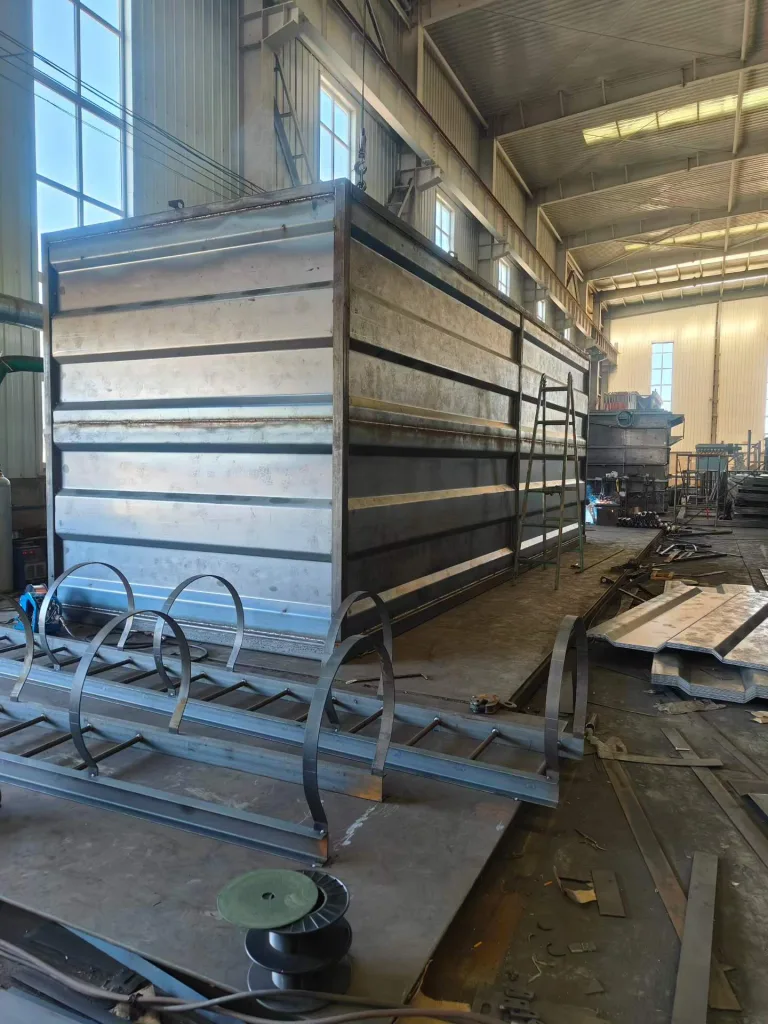
Negative Pressure: The Load Behind Panel Deflection and Buckling
Separate Housing Pressure from Filter Differential Pressure
Many baghouses operate under suction because the extraction fan sits downstream of the filters. Atmospheric pressure then pushes inward against enclosure panels. A positive-pressure design behaves differently: leakage can move outward, and loading direction changes. A collector with multiple compartments may experience different pressures at the dirty-air inlet and clean-air plenum.
Three pressure terms should not be confused: system static pressure is associated with the resistance the fan must overcome; filter differential pressure is the pressure difference across the filter elements; housing design pressure is the pressure difference the particular enclosure or compartment must safely resist. The maximum pressure on a panel may occur during a blocked inlet, abnormal fan operation, damper malfunction, or another defined upset condition—not necessarily during normal filtration.
| Design input | Why it matters to the casing | Verification question |
|---|---|---|
| Normal negative or positive pressure | Determines sustained inward or outward panel loading | Where is pressure measured relative to atmosphere? |
| Maximum credible operating/upset pressure | Governs structural design beyond average operation | Which damper, fan, or blockage scenarios were evaluated? |
| Filter differential pressure | Indicates media resistance and changes in operating duty | Is it being confused with the casing pressure rating? |
| Wind, seismic, thermal and maintenance loads | Adds separate or combined structural demands | Which site loads and combinations are included? |
| Combustible-dust hazard | May require engineered venting, isolation or suppression | Has a dust hazard analysis defined the protection strategy? |
A simple illustration explains why a seemingly modest pressure can matter. At 2,000 Pa of uniform inward pressure, a flat 2 m × 3 m wall has a resultant load of 12,000 N over its surface. That is about 12 kN of total distributed force, not a point load and not a design recommendation. Whether the wall performs adequately depends on plate bending, buckling, boundary restraint, stiffener geometry, welds, and safety factors.
For combustible dusts, normal vacuum strength must never be confused with deflagration resistance. Explosion venting, suppression, isolation, and any applicable reduced explosion pressure require their own engineered assessment under the relevant standards and site conditions.
Steel Plate Thickness, Stiffeners, and the Real Load Path
Why a Thicker Plate Is Not Always the Best Answer
Steel plate thickness is important, but specifying a thicker sheet without examining its unsupported span is an incomplete design method. Under pressure, broad flat panels can bow inward; slender panels and stiffeners may buckle before the steel reaches its nominal yield strength. Changes in the orientation and spacing of stiffeners can alter bending response substantially.
Commercial baghouse drawings provide examples of casing material ranging from relatively thin sheet steel to much heavier plate for different models and pressure duties. Those values demonstrate design variation—not a minimum thickness applicable to all collectors. A 3 mm wall suitable for one geometry must not be assumed adequate for a large flat panel operating at a different suction level.
A structural review should consider plate span, panel aspect ratio, allowable deflection, edge restraint, stiffener section properties, local buckling, and the method of joining ribs to the shell. The steel grade, fabrication tolerances, and corrosion allowance also matter. Numerical analysis may help on large irregular housings, but a credible model still needs realistic support and load assumptions.
Reinforcement Must Transfer Loads to Supports
A stiffener is useful only if pressure loads can pass from the plate into the stiffener and onward through crossmembers, frames, and foundations. Welding a narrow rib to the middle of a large wall does not automatically establish a complete load path. Door cutouts, inlet penetrations, cleanout openings, and rectangular-to-round transitions interrupt the surrounding plate and often need local reinforcement.
Hoppers deserve separate attention. They carry accumulated dust, discharge equipment, potential bridging loads, and sometimes attached platforms or ducts. Their geometry and supports differ from vertical housing walls. Likewise, field-welded modules should be checked for alignment and distortion during lifting and assembly, not only for their final operating pressure.
Welding, Tube Sheets, Access Doors, and Air Leakage
The Difference Between Inward Leakage and Dust Bypass
In a negative-pressure housing, an exterior crack or failed access-door gasket typically draws ambient air into the collector. This infiltration can increase system airflow demand, disturb temperature control, and promote condensation where cold air enters a humid process stream. In a positive-pressure section, an enclosure leak may discharge dusty gas outward.
A different problem arises at the tube sheet or internal partition separating dirty and clean compartments. If a weld is incomplete or a filter seating area is damaged, unfiltered gas can bypass the filter media. That bypass may raise outlet dust even while filter cartridges or bags remain undamaged. For this reason, the location of the leak matters as much as its size.
| Symptom | Possible housing-related cause | Useful next inspection |
|---|---|---|
| Local inward air whistle or cold spot | Exterior seam, door seal, or flange leakage | Inspect the joint and verify compartment pressure |
| Unexpected condensation or corrosion | Cold-air infiltration and inadequate thermal control | Check leak paths, dew point, insulation, and drain points |
| Dust on the clean-air side | Tube-sheet weld discontinuity, partition defect, or filter seating gap | Perform an approved leak-location investigation |
| Cracked paint or recurring weld cracks | Panel movement, stress concentration, or fatigue | Obtain a structural assessment before repair |
| Distorted door frame or flange | Panel deflection, lifting damage, or improper alignment | Measure geometry and evaluate the load path |
What Welding Quality Really Means
Continuous, properly executed welds are particularly important at boundaries that must remain gas-tight. Nevertheless, “more weld” is not the whole answer. Weld size, joint preparation, fit-up, sequence, and inspection need to match the required mechanical strength and sealing function. Excessive heat input or poorly planned welding sequences can distort flat panels and tube sheets, making bag installation and gasket compression less reliable.
A factory inspection may combine visual weld examination, dimensional checks, and a specified leak-test method. More advanced nondestructive examination is appropriate where the governing design or critical joints require it. The relevant acceptance criteria must be stated in the project documents rather than assumed from a photograph of a completed weld.
Corrosion, Abrasion, and Temperature Are Housing Design Loads Too
Even a structurally adequate new housing can lose capacity over time. Wet acidic or alkaline dust, high humidity, and temperature cycling can degrade coatings and initiate corrosion near welds or drain points. Corrosion may reduce the effective plate section, weaken stiffener connections, and undermine flange sealing. Material and coating selection must consider process chemistry and whether the casing can remain above the relevant dew point.
Abrasive dust creates a different failure mechanism. A high-velocity inlet jet striking a thin wall or hopper can produce local wear long before the rest of the enclosure deteriorates. Inlet orientation, deflectors, replaceable liners, and abrasion-resistant steel at the impact zone may be more practical than increasing the thickness of every housing panel.
These are separate design decisions: structural thickness resists loads, corrosion allowance addresses expected material loss, and sacrificial wear protection addresses concentrated particle impact. The same specification cannot be justified by all three without examining the actual operating environment.
What Published Industrial Cases Teach Us
Public engineering and supplier reports provide useful evidence, but the following are third-party cases, not Omela installations. Reported outcomes are site-specific and should not be used as guaranteed design values.
Spray-Dryer Collector: A High-Pressure-Drop Warning
A published sodium-silicate spray-dryer account reported filter differential pressure exceeding 7.5 inches of water gauge and stated that the baghouse casing had collapsed. The supplier subsequently reported improved filtration performance after changing the filter media: airflow increased by about 30%, and differential pressure remained below 5.5 inches of water gauge in the described operation.
This example underscores the consequences of allowing excessive resistance to persist. However, the public summary does not disclose the casing drawings, panel pressure measurements, or complete failure investigation. It would be incorrect to assume that the quoted filter differential pressure alone establishes the shell’s actual structural rating or exact collapse mechanism. Both filtration operating limits and independently verified housing pressure limits must be respected.
Biomass Processing: Wind Loads Govern More Than Filtration
A documented palm-frond drying installation used a modified baghouse handling roughly 60,765 ACFM at 188°F. The design incorporated a high rear inlet for lightweight material, a walk-in service plenum, and cross-bracing associated with a reported 140 mph wind rating. The project also included specified combustible-dust protection features.
The key structural lesson is that outdoor baghouse housings and their support frames face environmental loads even when process suction is modest. A pressure-resistant panel does not automatically provide sufficient lateral stability for the entire elevated collector, and filter performance cannot replace structural calculations for site wind conditions.
Abrasive Mineral Processing: Protect the Impact Zone
A reported Gilsonite-handling application experienced severe wear at an existing collector’s inlet and repeated filter damage associated with airflow distribution. The replacement design used an alternative inlet arrangement, an internal protective ring, and ¼-inch abrasion-resistant steel in specified inlet and hopper components. The project report also described completing installation within three days rather than the four planned.
The lesson is not that every dust collector requires ¼-inch walls. It is that local abrasion protection should be placed where the material actually strikes the enclosure. The quoted thickness describes selected wear-exposed parts of one design, not a general casing-thickness recommendation.
Factory Inspection and Structural Maintenance Checklist
A useful inspection plan checks both the factory-built geometry and its performance after installation. The following list is a starting framework to adapt to the approved drawings and plant safety program:
- Before fabrication: Verify design pressure, upset scenarios, steel grade, plate thickness, stiffener layout, applicable structural loads, and corrosion or wear allowance.
- During welding: Check alignment, fit-up, critical continuous seams, tube-sheet joints, door frames, and any inspection hold points specified in the quality plan.
- Before shipment: Record panel flatness, flange geometry, coating condition, transport bracing, and the location of approved lifting attachments.
- After installation: Confirm supports, anchors, field joints, gaskets, access-door closure, and the integrity of clean-air versus dirty-air separation.
- During operation: Trend pressure, airflow, leakage observations, corrosion, deformation, and recurring weld or gasket failures; investigate abnormal changes rather than repeatedly patching symptoms.
For suspected structural damage, isolate the equipment and obtain a qualified engineering review before altering stiffeners, cutting openings, or welding reinforcement onto a pressurized or otherwise hazardous collector. Leak tests and internal inspections must follow applicable lockout and confined-space procedures.
Final Engineering Recommendation
A reliable industrial dust collector housing is designed around the complete mechanical duty, not a single wall thickness or a catalog pressure-drop number. Determine where suction and positive pressure act, establish credible abnormal loads, calculate the plate-and-stiffener load paths, and protect the locations exposed to abrasion, condensation, and corrosion.
Then verify welding, seals, tube-sheet separation, and structural dimensions before shipment, followed by suitable installation and operating checks. For a technical review, collect the approved general arrangement, pressure envelope, dust and gas properties, site loading criteria, proposed materials, and expected maintenance access. These inputs make the housing specification testable and reduce the risk of avoidable leakage, deformation, and premature repair.
FAQ
What Negative Pressure Should an Industrial Dust Collector Housing Withstand?
There is no universal value. The design must cover the specific compartment’s normal and credible upset pressures, together with applicable structural and environmental loads. Do not substitute filter differential pressure for a verified casing pressure rating.
Is Thicker Steel Always Better for a Baghouse Housing?
No. Plate thickness must be evaluated with panel span, stiffener spacing, support conditions, material properties, corrosion allowance, and allowable deflection. A locally reinforced design may perform better than a heavier but poorly supported panel.
Why Do Dust Collector Housing Panels Deform Under Suction?
External atmospheric pressure pushes inward when the housing operates below ambient pressure. Excessive unsupported spans, inadequate stiffeners, weak connections, or operating pressures above the approved design envelope can produce deflection or buckling.
Can Air Leakage Occur Even If All Filter Bags Are Intact?
Yes. Failed exterior gaskets and seams can admit unwanted air, while defects in tube-sheet welds, internal partitions, or filter seating can allow unfiltered gas to bypass the media. The leak location determines the likely symptom and repair.
What Should Be Inspected Before Accepting a New Dust Collector Housing?
Check approved structural drawings, material and welding records, dimensions, stiffener connections, flange and door alignment, tube-sheet sealing, protective coatings, and required leak or acceptance tests. Verify that shipment and installation have not damaged critical joints.
Author

Jessica Ma – Senior Filtration Engineer, Omela Filtration
Jessica Ma is a senior filtration engineer at Omela Filtration, specializing in dust and liquid filtration. With over 15 years of experience, she focuses on optimizing baghouse performance, enhancing filtration efficiency, and developing high-performance solutions for industrial dust collectors and precision liquid filtration applications.