
Key Takeaways
- High flow filter cartridges are commonly used as a final particulate protection stage in seawater reverse osmosis (SWRO) pretreatment. Their large-diameter pleated construction can provide substantial filtration area with fewer elements, helping accommodate large seawater flow rates while controlling pressure drop.
- Cartridge filtration is not the primary treatment stage responsible for achieving a low Silt Density Index (SDI). Coagulation, dissolved air flotation, multimedia filtration, or ultrafiltration generally perform most of the suspended-solids and colloidal removal required before the final cartridge stage.
- Industrial filter cartridges should be selected according to seawater quality, required retention efficiency, flow rate, allowable differential pressure, cartridge loading, and compatibility with the existing housing. Micron rating alone cannot determine SWRO membrane protection.
- Melt-blown depth filter cartridges may be considered for certain particulate protection duties, while larger pleated cartridges can be advantageous in high-throughput installations. The correct media structure depends on the contamination profile and the role of the filtration stage.
- SWRO pretreatment performance should be evaluated through SDI₁₅, turbidity, differential pressure, cartridge service life, and downstream membrane operating trends. Rapid cartridge plugging often indicates a change in feed-water quality or insufficient upstream pretreatment rather than defective cartridges.
Why Seawater Desalination Needs Reliable Cartridge Filtration
Seawater reverse osmosis is widely used to produce freshwater from seawater, particularly in coastal regions where conventional freshwater resources are limited.
Although modern SWRO membranes can separate dissolved salts effectively, their performance depends heavily on the quality of water delivered by the pretreatment system.
Seawater contains more than dissolved salts. Depending on the intake location and environmental conditions, it may also contain suspended sediment, fine mineral particles, organic matter, microorganisms, algae, and colloidal material.
These contaminants can accumulate on membrane surfaces, increase hydraulic resistance, reduce permeate production, and contribute to more frequent membrane cleaning.
The purpose of pretreatment is to reduce these fouling risks before water reaches the membrane elements.
Cartridge filtration is normally positioned near the end of this pretreatment process, where it provides an additional particulate barrier between upstream treatment equipment and the SWRO system.
The cartridge is intended to protect the membrane from residual particles and unexpected particulate carryover, not to replace the plant’s primary solids-removal process.
This distinction is especially important in seawater desalination because intake-water quality may change substantially with weather, tides, seasonal biological activity, or disturbances near the intake.
A correctly selected cartridge can support stable operation, but it cannot compensate indefinitely for poor upstream filtration.
Where Cartridge Filters Fit in the SWRO Pretreatment Train
The pretreatment arrangement depends on whether seawater is collected through an open intake, beach well, or another source.
Open seawater intakes can experience substantial changes in suspended-solids concentration, biological activity, and turbidity. Subsurface intakes may provide more stable particulate quality, although dissolved chemistry and other contaminants still require evaluation.
A typical open-intake SWRO treatment sequence may be represented as:
Seawater Intake → Screening → Coagulation / Clarification → Multimedia Filtration or UF → Cartridge Filtration → High-Pressure Pump → SWRO Membranes
Chemical conditioning and dechlorination, when required, must also be integrated at the appropriate points in the process.
Each stage performs a different function.
| Treatment Stage | Main Function | Relationship to Cartridge Filtration |
|---|---|---|
| Intake screening | Removes large debris and coarse material | Prevents large solids from entering the treatment system |
| Coagulation / clarification | Aggregates or removes fine suspended and colloidal material | Reduces loading on downstream filters |
| Multimedia filtration / UF | Removes most remaining suspended solids and reduces particulate fouling potential | Determines much of the incoming cartridge load |
| High-flow cartridge filtration | Captures residual particles and particulate breakthrough | Provides the final particulate safety barrier |
| SWRO membranes | Separate dissolved salts to produce freshwater | Benefit from stable, well-pretreated feed water |
The final cartridge stage becomes particularly important when upstream filtration experiences breakthrough, media carryover, or an unexpected change in operating conditions.
However, cartridge filtration does not reliably remove all dissolved organic compounds, dissolved salts, or biological fouling potential.
Reliable SWRO membrane protection depends on the entire pretreatment train, not simply the micron rating of the last filter.
Understanding SDI and Its Role in SWRO Membrane Protection
The Silt Density Index, commonly expressed as SDI₁₅, is one of the most widely used indicators of particulate fouling potential in reverse osmosis feed water.
The standard test measures how rapidly a 0.45 µm test membrane becomes obstructed under specified pressure conditions during a defined filtration period.
SDI₁₅ is useful because seawater can appear relatively clear while still containing fine particles and colloids capable of contributing to membrane fouling.
A low turbidity reading does not necessarily indicate low particulate fouling potential.
This is why desalination plants commonly monitor both turbidity and SDI rather than relying on visible clarity alone.
For many conventional RO membrane applications, an SDI₁₅ below 5 is used as a maximum feed-water guideline, while values below 3 are commonly preferred to reduce particulate fouling risk. The actual acceptable level must follow the membrane manufacturer’s requirements and the plant’s design basis.
SDI is a measure of fouling potential under a standardized test, not a direct measurement of the quantity of solids retained by the plant’s cartridge filters.
It also does not fully characterize organic or biological fouling.
A system may achieve an acceptable SDI while still experiencing fouling associated with dissolved organic matter, microbial activity, or chemical precipitation.
SDI should therefore be treated as one important indicator within a broader membrane-protection program.
Can High Flow Filter Cartridges Reduce SDI?
Cartridge filtration can contribute to SDI reduction by retaining residual particulate capable of blocking the SDI test membrane.
However, the improvement depends on the material entering the cartridge and the effectiveness of upstream treatment.
A cartridge cannot be expected to correct every source of high SDI.
For example, seawater containing significant colloidal material may require coagulation and media filtration or ultrafiltration before the final cartridge stage. Selecting an extremely fine cartridge as the only response to high SDI can produce rapid plugging without providing economical long-term treatment.
An industrial SWRO study provides a useful illustration. In a full-scale plant with two stages of dual-media filtration, average SDI₁₅ was approximately 3.4 after the second media-filter stage and approximately 3.0 after cartridge filtration.
Most particulate removal had already occurred upstream, while the cartridge provided an additional improvement.
This shows why the cartridge stage should be considered a final polishing and protection step within an integrated pretreatment system.
For reliable diagnosis, engineers should compare feed-water quality before and after the major pretreatment stages rather than assuming that any increase in SDI can be solved through a different cartridge alone.
Why High Flow Cartridges Are Used in Large Seawater Desalination Plants
Seawater desalination plants often process large volumes of feed water continuously.
Under these conditions, cartridge selection affects not only filtration performance but also housing dimensions, cartridge inventory, maintenance labor, and pressure loss.
High-flow cartridges use a large-diameter pleated construction that provides substantial filtration area within each element.
Compared with systems using many smaller conventional cartridges, a properly designed high-flow system may require fewer individual elements for the same total throughput.
Fewer elements can simplify replacement and reduce maintenance time, particularly where large cartridge housings require extensive manual servicing.
Greater effective filtration area can also reduce filtration velocity and initial pressure drop when cartridges are properly sized.
However, the maximum flow rating of a cartridge should not be treated as the recommended operating flow for every seawater application.
Manufacturer flow ratings may be established under clean-water conditions. Actual operation depends on seawater temperature, particle loading, micron rating, media properties, and allowable pressure drop.
A cartridge operating near its maximum clean-water flow may have insufficient margin when seasonal solids loading increases.
For SWRO applications, the more useful design objective is to maintain stable filtration performance under realistic operating conditions rather than maximize the flow through each individual element.
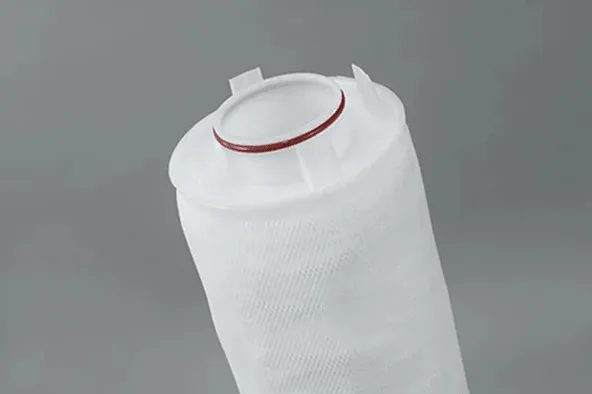
Micron Rating: How Fine Should SWRO Cartridge Filtration Be?
Micron rating is a central consideration when selecting cartridge filters for reverse osmosis pretreatment.
A filter that is too coarse may allow undesirable particles to pass into the downstream system, while an unnecessarily fine element may accumulate contamination rapidly and require frequent replacement.
For many RO applications, an absolute-rated cartridge around 5 µm is a common technical reference for the final particulate barrier. Some applications require a finer rating, while others may use a different specification based on upstream treatment quality and membrane manufacturer requirements.
The distinction between nominal and absolute ratings is important because two cartridges with the same stated micron size may provide different retention efficiencies.
Media construction also influences loading behavior.
A depth cartridge may store particles throughout its internal structure, while a pleated cartridge provides increased effective filtration area. A high-flow pleated element can offer substantial throughput, but its performance still depends on the media’s retention characteristics and the incoming contamination.
The correct micron rating is the one that meets the downstream protection requirement while maintaining acceptable pressure drop and service life under actual seawater conditions.
Installing a finer cartridge should not be the default response to high SDI or premature membrane fouling.
The first step should be to identify what contamination remains after upstream treatment and whether that material can be removed more efficiently before the final cartridge stage.
Pressure Drop and Cartridge Loading in Seawater Service
Differential pressure is one of the most useful operating measurements in a cartridge filtration system.
When the cartridges are clean, they create an initial pressure drop determined by the media structure, effective filtration area, and water flow.
As particles accumulate, resistance increases.
The rate of this increase depends on solids loading, particle characteristics, filtration velocity, and the condition of the upstream pretreatment process.
A gradual pressure increase may represent normal cartridge loading.
A rapid increase after a storm, algal event, or pretreatment upset may indicate that more contamination is reaching the cartridge stage than expected.
The important distinction is between an unusually high initial resistance and resistance that develops rapidly during operation.
| Operating Observation | Possible Cause | Recommended Investigation |
|---|---|---|
| High initial ΔP with clean cartridges | Excessive flow per element, insufficient area, or restrictive media | Review cartridge sizing and actual flow |
| Rapid ΔP increase during operation | High solids loading or pretreatment breakthrough | Check upstream turbidity, SDI, and filtration |
| Short cartridge life during seasonal changes | Variable seawater contamination | Review intake conditions and pretreatment response |
| Normal cartridge ΔP but deteriorating RO performance | Biological, organic, scaling, or non-cartridge-related fouling | Review membrane and pretreatment trends |
| Unexpectedly low ΔP with poor filtrate quality | Possible bypass, damaged seals, or installation defects | Inspect cartridge seating and housing integrity |
The maximum allowable cartridge differential pressure should follow the manufacturer’s specification and the operating limits of the housing and pumps.
One universal change-out pressure should not be applied to every installation.
For SWRO pretreatment, a reliable differential-pressure trend is often more valuable than a single pressure reading taken during an abnormal operating condition.
Why Seawater Conditions Can Shorten Cartridge Service Life
Seawater quality is not constant.
Coastal water can be affected by storms, sediment resuspension, algal blooms, biological growth, and seasonal changes in organic matter.
These changes may produce significant variation in the solids reaching the cartridge filters.
For example, a pretreatment system may perform consistently under normal seawater conditions but experience breakthrough when turbidity rises rapidly after a storm.
The final cartridge then receives material that should have been removed earlier.
If this continues, the cartridges may reach terminal differential pressure much sooner than expected.
The resulting frequent change-outs are sometimes mistaken for a cartridge-quality problem.
However, replacing the cartridges with an identical set simply restores filtration capacity temporarily. It does not correct the increased incoming solids load.
Increasing effective cartridge area may improve operating margin, but severe particulate or biological contamination still requires appropriate upstream treatment.
When cartridge service life suddenly becomes shorter, the first investigation should focus on changes in seawater quality and pretreatment performance.
This approach is generally more useful than immediately choosing a finer micron rating.
Seawater Compatibility: Media, Housing, and Sealing
Seawater presents material-selection challenges that are less prominent in some freshwater systems.
Its dissolved salts, especially chlorides, can contribute to corrosion of susceptible metallic components.
Cartridge media, internal supports, end caps, O-rings, and housings should therefore be evaluated for compatibility with seawater and the relevant treatment chemicals.
Polypropylene is commonly considered for particulate filtration because of its chemical resistance and availability in both depth and pleated constructions.
Other materials may be suitable where their chemical and mechanical properties meet the application requirements.
The housing material requires separate attention. Depending on pressure, temperature, chemical treatment, and chloride exposure, suitable designs may use compatible polymers, FRP, or appropriately engineered corrosion-resistant metals.
Stainless steel should not automatically be assumed immune to seawater corrosion, particularly under high-chloride conditions where pitting or crevice corrosion may occur.
Seal materials must also be compatible with the process water and any cleaning or chemical-dosing conditions.
A cartridge with the correct micron rating but poor sealing can allow particulate bypass, while incompatible materials may experience premature deterioration.
SWRO cartridge selection should therefore consider the complete wetted assembly rather than the filter medium alone.
Published Seawater Desalination Application Lessons
Case 1: Full-Scale SWRO Pretreatment Reduced SDI Through Multiple Filtration Stages
A published full-scale seawater desalination study investigated particulate, organic, and biological fouling potential across the pretreatment system.
The treatment arrangement included inline coagulation, two stages of dual-media filtration, and final cartridge filtration before the SWRO membranes.
Researchers measured multiple water-quality parameters to assess the performance of the pretreatment stages.
The two-stage media filtration removed more than 80% of SDI₁₅, approximately 94% of the measured modified fouling index, and more than 95% of microbial ATP under the investigated conditions.
The average SDI₁₅ after the second media-filter stage was approximately 3.4, decreasing to approximately 3.0 after cartridge filtration.
The study also showed that improvements in particulate indicators did not necessarily correspond to equally strong removal of organic or biological fouling potential.
Lesson: Final cartridge filtration can provide useful additional particulate protection, but most SDI reduction should occur in the upstream pretreatment system. Acceptable SDI does not eliminate the need to consider organic and biological fouling.
Case 2: Seawater Pretreatment Trial Reached Cartridge Change-Out Pressure in Nine Days
A published seawater reverse osmosis pretreatment demonstration investigated whether different filtration arrangements could produce feed water suitable for membrane operation.
One trial used 5 µm melt-blown polypropylene cartridges after multimedia filtration.
The cartridge loading rate was approximately 3.0 gallons per minute per 10-inch equivalent filter length.
Despite this relatively controlled loading rate, the cartridges reached the trial’s maximum recommended differential pressure of approximately 20 psi after 210 hours, equivalent to about nine days.
The filtrate SDI remained approximately 4 to above 6.67 during the experiment, failing to meet the target of 3.
The report concluded that the tested upstream multimedia filtration arrangement did not provide sufficiently effective pretreatment for the seawater conditions.
The SWRO membrane system was not operated during this particular cartridge-filter trial.
Lesson: Cartridge filtration cannot economically compensate for poor upstream pretreatment. Even a correctly specified final cartridge may plug rapidly when excessive fouling material reaches it.
Case 3: SWRO Membrane Autopsy Identified Contamination Linked to Cartridge Performance
A published investigation examined membranes and cartridge filters from a full-scale seawater desalination plant on the Red Sea.
Researchers analyzed the accumulated foulants and evaluated the effectiveness of the pretreatment system.
The membrane deposits contained organic material and inorganic particles, including compounds associated with aluminum, iron, and magnesium silicates.
The investigation found that sediment originating from the seawater intake had accumulated in both the cartridge filters and the downstream membrane system.
Measurements also showed increases in suspended solids and microbial ATP after cartridge filtration, indicating that the filter stage was not consistently providing the expected protection.
The study identified inappropriate cartridge replacement timing as a factor that increased the downstream fouling potential.
Lesson: Cartridge condition and replacement strategy can affect membrane protection even when upstream filtration is installed. Differential pressure should be considered together with water quality, cartridge integrity, and downstream membrane performance.
Cartridge Replacement Should Follow Water Quality and Operating Trends
In large SWRO plants, cartridge replacement can involve significant maintenance work.
A high-flow design may reduce the number of individual elements, but replacement frequency remains strongly influenced by feed-water conditions.
Replacing cartridges purely according to a fixed calendar interval may be inefficient if the loading pattern varies substantially.
On the other hand, allowing cartridges to remain in operation beyond their approved differential-pressure or integrity limits can create additional problems.
Maintenance decisions should consider filter differential pressure, operating time, treated volume, filtrate quality, and any unusual changes in upstream treatment.
Cartridges should also be inspected for deformation, damaged end caps, deteriorated seals, or other conditions that may compromise particulate retention.
For critical membrane protection, a cartridge that is still allowing adequate flow is not necessarily providing adequate filtration if its integrity has been compromised.
A reliable change-out strategy therefore balances available dirt-holding capacity with the requirement to protect the membranes and associated equipment.
What Engineers Should Check Before Selecting High Flow Cartridges for SWRO
The most useful information for selecting seawater cartridge filtration equipment is the actual operating duty rather than a nominal cartridge capacity.
A practical assessment should include:
- Seawater source and pretreatment: Determine whether the intake is open or subsurface, and review screening, coagulation, flotation, media filtration, or UF already installed.
- Feed-water quality: Record normal and peak turbidity, SDI₁₅, suspended-solids loading, temperature, and any significant seasonal variation.
- Filtration requirements: Confirm the required micron rating, nominal or absolute retention specification, expected filtrate quality, and applicable SWRO membrane requirements.
- Hydraulic and mechanical conditions: Establish normal and peak flow, allowable clean and terminal ΔP, filter area, housing configuration, materials, seals, and available installation space.
- Operating history: Review cartridge change-out intervals, used-element condition, upstream filter performance, membrane fouling, CIP frequency, and any recurring water-quality upsets.
These factors help determine whether the system needs greater cartridge filtration area, a different media structure, a revised micron rating, improved sealing, or changes to upstream pretreatment.
High Flow Cartridges and Total SWRO Operating Cost
The purchase price of the cartridge is only one part of the filtration cost.
Large desalination systems must also consider cartridge quantity, labor, inventory, disposal, pressure-related energy consumption, and the risk of downstream membrane fouling.
A high-flow cartridge may have a higher individual purchase price than a conventional small-diameter cartridge, but fewer elements can reduce maintenance complexity and change-out time.
Greater filtration area can also support lower operating resistance when the elements are appropriately sized.
However, these benefits depend on the quality of the water reaching the cartridge stage.
If poor upstream pretreatment causes frequent plugging, changing to a high-flow design may reduce the immediate maintenance burden without correcting the underlying water-quality problem.
The better economic question is not simply which cartridge costs less.
It is which cartridge and pretreatment arrangement can maintain acceptable membrane-feed quality at the lowest practical total operating cost.
That evaluation should include cartridge service life, pressure-drop trends, maintenance requirements, membrane cleaning frequency, and the cost of process interruptions.
Final Engineering View
High-flow cartridge filtration is an important protective stage in seawater desalination, but its role must be understood within the complete SWRO pretreatment process.
The main contaminant load should be reduced through appropriate upstream treatment.
Cartridge filtration then provides additional protection against residual particles and unexpected particulate breakthrough before the high-pressure pump and SWRO membranes.
The overall treatment sequence can be summarized as:
Seawater Intake → Primary Pretreatment → Multimedia Filtration / UF → High Flow Cartridge Filtration → SWRO Membranes
The success of this arrangement depends on stable water quality, appropriate micron rating, adequate filtration area, correct housing sealing, and reliable operating controls.
SDI₁₅ helps indicate particulate fouling potential, but it does not fully represent biological, organic, or scaling risks.
Differential pressure reveals changes in cartridge resistance, but it does not independently establish downstream water quality.
These measurements should therefore be interpreted together.
The wrong starting question is:
“Which high-flow cartridge provides the maximum seawater filtration capacity?”
The better question is:
“What particulate protection does the SWRO system require, and how can the final cartridge stage provide that protection without excessive pressure drop, premature plugging, or unnecessary replacement cost?”
Effective seawater cartridge filtration is not about forcing the final filter to remove as much contamination as possible. It is about ensuring that upstream pretreatment and final membrane protection work together under real seawater conditions.
Frequently Asked Questions
What is the purpose of cartridge filtration in seawater desalination?
Cartridge filtration provides a final particulate barrier before the high-pressure pump and SWRO membranes. It helps capture residual suspended particles and occasional particulate breakthrough from upstream pretreatment, reducing the risk of particulate-related membrane fouling.
What SDI is recommended for SWRO feed water?
Many RO membrane guidelines use SDI₁₅ below 5 as an upper reference and recommend values below 3 to reduce particulate fouling risk. The required value depends on the membrane manufacturer, system design, and operating conditions.
Can high-flow cartridges reduce SDI in seawater?
They can contribute to SDI reduction by retaining residual particles, but most particulate and colloidal removal should occur through upstream pretreatment. A cartridge alone cannot reliably correct severely elevated SDI caused by inadequate coagulation, media filtration, or UF performance.
What micron rating is suitable for SWRO cartridge filtration?
A 5 µm absolute-rated cartridge is a common reference for RO pretreatment, although the actual requirement depends on membrane specifications, upstream water quality, particle characteristics, and fouling history. Finer filtration may be appropriate in selected applications.
Why do seawater desalination cartridges plug quickly?
Common causes include high suspended-solids loading, seasonal turbidity changes, biological material, algae, upstream filter breakthrough, excessive flow per cartridge, or an unsuitable media specification. Rapid pressure-drop increase should trigger an assessment of upstream water quality and pretreatment performance.
Are high-flow cartridges better than standard cartridges for SWRO?
High-flow cartridges can reduce element count and provide greater filtration area per element, making them attractive for large treatment systems. However, they are not automatically superior in every application. Selection should account for system flow, water quality, pressure drop, maintenance, and total operating cost.
Does acceptable SDI guarantee that SWRO membranes will not foul?
No. SDI primarily indicates particulate fouling potential under a standardized test. Organic fouling, biological activity, scaling, and chemical incompatibility can still affect membrane performance even when SDI is within the specified range.
Author

Jessica Ma – Senior Filtration Engineer, Omela Filtration
Jessica Ma is a senior filtration engineer at Omela Filtration, specializing in dust and liquid filtration. With over 15 years of experience, she focuses on optimizing baghouse performance, enhancing filtration efficiency, and developing high-performance solutions for industrial dust collectors and precision liquid filtration applications.