
Key Takeaways
- Laser cutting dust collectors must handle fine metal fume together with sparks, hot particles, and cutting debris. Flame-retardant filter media can provide additional resistance to ignition or flame propagation, but it does not make the cartridges spark-proof or the collector fireproof.
- Industrial cartridge dust collectors may use flame-retardant media in selected metalworking applications where ignition exposure has been identified. Media selection should also consider filtration efficiency, dust loading, operating temperature, pulse-cleaning performance, and pressure drop.
- Hot particles reaching a cartridge can cause localized burn marks, media perforation, damaged pleats, and loss of filtration integrity. Repeated cartridge heat damage should trigger an investigation of the upstream spark path rather than only a change in filter material.
- Flame-retardant, anti-static, high-temperature-resistant, and membrane-laminated media provide different properties. A cartridge advertised with one of these features should not automatically be assumed to provide the others.
- Metalworking and welding fume filtration systems require coordinated source capture, ductwork, filtration, and hazard controls. Depending on the process, upstream spark traps, inlet baffles, drop-out chambers, or additional fire-protection measures may be appropriate.
- The most reliable approach combines verified filter-media properties, effective hot-particle control, sufficient airflow, stable differential pressure, safe dust discharge, and application-specific hazard assessment.
Why Flame-Retardant Filter Media Matters in Laser Cutting
Laser cutting produces more than fine airborne particulate. Depending on the metal, plate thickness, laser settings, and assist gas, the process can also generate sparks, hot fragments, and small particles of molten material.
These materials are initially produced near the cutting head, but some can be carried into the extraction system if they are not separated or cooled before reaching the filtration section.
Cartridge dust collectors are commonly used for laser cutting because pleated filter cartridges provide substantial filtration area within a relatively compact housing. During operation, fine metal oxide particles accumulate on the cartridge surface and are periodically released through compressed-air pulse cleaning.
This creates an important operating consideration: the filter section can contain both combustible filter materials and accumulated process dust when an ignition-capable particle enters the collector.
The resulting hazard depends on the ignition source, actual dust characteristics, cartridge construction, and the overall equipment design.
Flame-retardant filter media may be selected to improve resistance to ignition or flame propagation under specified conditions. However, that property does not mean the media can withstand continuous spark impact or direct contact with molten metal.
Understanding this limitation is essential when selecting replacement cartridges or upgrading an existing laser cutting dust collector.
What Is Flame-Retardant Filter Media?
Flame-retardant filter media is designed or treated to reduce its tendency to ignite, sustain combustion, or propagate flame under particular test conditions.
Depending on the manufacturer and material construction, flame-retardant performance may be achieved through the choice of base fibers, additives, coatings, chemical treatments, or combinations of these technologies.
For example, some industrial cartridges use synthetic media incorporating flame-retardant treatments, while other media constructions are selected partly for their inherent response to heat or flame exposure.
These approaches do not necessarily provide equivalent performance.
A flame-retardant treatment may reduce the spread of combustion under a defined laboratory test, but the filter cartridge still contains additional components such as end caps, adhesives, gaskets, support structures, and accumulated dust.
The complete assembly may therefore behave differently from an isolated sample of filter media.
Flame-retardant performance is a defined material property, not a guarantee that a cartridge will survive every ignition source encountered during production.
This distinction is especially important when comparing technical datasheets. A statement such as “flame-retardant polyester” should be supported by an identified test method, reported result, and clear description of the material tested.
Flame-Retardant Does Not Mean Fireproof or Spark-Proof
Several terms commonly used in industrial filtration sound similar but describe different properties.
A cartridge may provide excellent fine-particle filtration while having limited resistance to direct spark contact. Another may offer improved flame-retardant properties but require a different media area or cleaning arrangement to achieve the required operating performance.
| Filter Media Property | Primary Function | Important Limitation |
|---|---|---|
| Standard filter media | Captures particulate under normal operating conditions | May lack a specified flame-retardant classification |
| Flame-retardant media | Improves resistance to ignition or flame propagation under defined tests | Does not guarantee resistance to molten particles or eliminate fire hazards |
| Anti-static media | Helps control electrostatic charge when correctly integrated and grounded | Does not provide automatic flame or explosion protection |
| High-temperature media | Withstands a specified continuous operating temperature | Does not necessarily withstand concentrated spark impact |
| PTFE membrane or nanofiber media | Improves fine-particle capture or surface-loading behavior | Does not automatically establish flame-retardant performance |
These differences matter because an industrial dust collector may require several properties simultaneously.
A laser cutting operation may need efficient capture of fine metal fume, stable pulse-cleaning performance, suitable resistance to heat exposure, and control of electrical charge where the dust hazard assessment requires it.
Selecting a cartridge with only one advertised feature may leave other requirements unresolved.
Flame retardancy, temperature resistance, electrostatic behavior, and filtration efficiency should be specified and verified separately.
How Sparks and Hot Particles Damage Filter Cartridges
During laser cutting, sparks and molten fragments can be generated as material is removed from the cutting kerf.
Larger fragments may fall into the cutting table, while smaller and lighter particles can become entrained in the extraction airflow.
As they travel through the ductwork, some particles lose heat. Others may remain sufficiently hot to damage a filter if they reach the cartridge section.
The risk depends on particle size, temperature, composition, residence time, airflow, and the presence of combustible material.
When hot particles contact cartridge media, the resulting damage may be highly localized. A small area can be discolored, melted, weakened, or perforated even when the rest of the cartridge appears normal.
A single damaged pleat may create a bypass path that allows collected particulate to reach the clean-air side.
Repeated hot-particle exposure can also cause progressive mechanical deterioration, particularly where the cartridge repeatedly receives concentrated dust and sparks from the inlet.
The important engineering lesson is that a cartridge can remain mechanically intact over most of its surface while losing filtration integrity through a relatively small burn hole.
This is why visible heat damage should not be evaluated only by the size of the affected area.
Why Burn Marks Often Point to an Upstream Problem
When operators discover localized burn marks on filter cartridges, the first reaction may be to replace them with flame-retardant media.
That may be part of an appropriate upgrade, but it does not identify why the hot material reached the cartridge.
The underlying problem may originate at the cutting table, extraction duct, spark-control device, inlet arrangement, or the process itself.
For example, a cutting table may allow excessive hot debris to enter its extraction chamber. A direct duct path may carry entrained particles toward the collector, while an unsuitable inlet configuration may direct the contaminated airflow toward the first row of cartridges.
The operating pattern can provide useful information.
If burn damage is concentrated on cartridges closest to the inlet, the system may have a localized hot-particle exposure problem. If damage repeatedly appears during a particular cutting process, the material, assist gas, plate thickness, and operating parameters should be reviewed.
Changing cartridge media without investigating the source and transport path of hot particles can leave the original ignition exposure unchanged.
A replacement cartridge may reduce susceptibility to certain ignition conditions, but it should not be expected to compensate for inadequate upstream protection.
Standard vs Flame-Retardant Filter Cartridges
Standard industrial cartridge media are selected primarily according to particle size, dust loading, filtration efficiency, chemical compatibility, pressure drop, and cleaning requirements.
For general dry particulate without significant ignition exposure, a correctly selected standard medium may provide effective and economical filtration.
Laser cutting introduces additional thermal and mechanical considerations.
Where the hazard assessment identifies credible hot-particle or ignition exposure, flame-retardant media may become a useful specification alongside the required filtration performance.
However, replacing standard media with a flame-retardant alternative should not be treated as a simple material substitution without reviewing the technical consequences.
The new cartridge may differ in permeability, stiffness, pleat geometry, surface treatment, cleaning behavior, or allowable operating temperature.
These properties influence both clean-filter resistance and long-term operation.
For example, a cartridge that is more resistant to flame propagation may still develop excessive differential pressure if its media area is insufficient for the fine metal fume being collected.
The most suitable cartridge must satisfy the filtration duty and the specified flame-retardant requirements at the same time.
How to Verify Flame-Retardant Filter Media Claims
A flame-retardant claim becomes useful only when the test method and scope are clear.
Some industrial filter products refer to flame-response tests such as DIN 53438, while certain polymer materials may be described using UL 94 classifications.
These methods evaluate defined material specimens and conditions, and their results should not be treated as interchangeable.
A classification obtained from a material specimen does not establish that an entire installed cartridge collector is fireproof or suitable for combustible-dust service.
When reviewing a filter-media datasheet, several questions are particularly important:
| Specification | What Should Be Confirmed | Why It Matters |
|---|---|---|
| Flame-retardant claim | Test standard, classification, and actual test result | Establishes what was evaluated |
| Tested construction | Media sample, treated fabric, or finished cartridge assembly | Avoids applying material-only results to the complete cartridge |
| Base media and treatment | Fiber composition, coating, and flame-retardant treatment | Identifies the material actually being supplied |
| Operating temperature | Permitted continuous temperature and applicable limits | Prevents confusing thermal service limits with spark resistance |
| Filtration performance | Efficiency test basis, media area, and expected pressure drop | Confirms the cartridge still meets the filtration duty |
| Cleaning compatibility | Pulse-cleaning requirements and media durability | Supports stable operation and cartridge life |
The exact documentation required depends on the customer’s specification, applicable standards, and the intended application.
A cartridge with a recognized material flame-response classification should not automatically be represented as compliant with every fire-protection requirement.
For existing collectors, the replacement element must also match the housing dimensions, attachment method, gasket design, and cleaning system.
A technically defensible flame-retardant specification identifies what was tested, under which conditions, and how the result relates to the actual installed cartridge.
Upstream Spark Control Should Come Before the Filter Section
Flame-retardant media provides a material-level characteristic. Upstream spark control addresses a different part of the hazard: the transport of ignition-capable particles toward the cartridges.
These two measures can complement one another, but they are not interchangeable.
A laser cutting extraction system typically begins at the machine table or enclosure. From there, contaminated air travels through extraction zones, dampers, and ductwork before reaching the dust collector.
Depending on the cutting process, the system may include a drop-out section, inlet baffle, spark trap, pre-separation chamber, or another engineered device intended to reduce the number or energy of hot particles reaching the filter section.
A simplified arrangement is:
Cutting Table → Active Damper → Ductwork → Spark-Control Stage → Cartridge Collector → Fan → Exhaust
A drop-out chamber can help separate heavier particles by changing airflow direction and velocity. An inlet baffle can reduce direct particle impact on cartridges, while a suitable spark-control device may reduce the transport of hot material.
However, these measures must be selected for the actual process and should not be assumed to capture every ignition source.
Any installed component also introduces some airflow resistance, which must be included in the fan and ductwork design.
The objective is to reduce hot-particle exposure before the contaminated air reaches the accumulated dust on the cartridges.
The cartridge should not serve as the primary spark arrestor.
Why Spark Control Must Be Included in Fan Static Pressure
Adding spark-control equipment can improve the arrangement of the extraction system, but it can also change its hydraulic performance.
Every baffle, separator, transition, and additional duct component introduces resistance.
If that pressure loss is ignored when selecting the fan, the system may deliver less airflow at the cutting table than required.
This can create a different operating problem: the cartridges may be better protected from some hot particles, but smoke capture may become weaker because the fan can no longer maintain the correct operating point.
A properly designed system therefore needs to consider the combined resistance of the cutting table, active extraction zone, ductwork, spark-control device, loaded cartridges, and outlet arrangement.
Effective spark protection and effective source capture must be designed together rather than optimized independently.
This is particularly important when upgrading an existing collector because the original fan may have been selected without accounting for the additional resistance of a new spark-control stage.
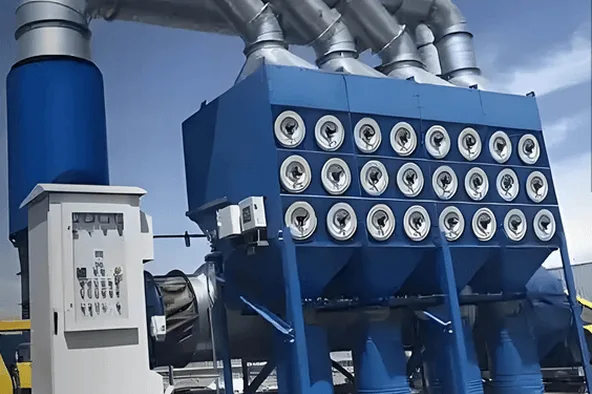
Fine Metal Fume Still Requires Suitable Filtration Efficiency
Flame-retardant properties address ignition behavior, but the primary purpose of a cartridge dust collector remains particulate removal.
Laser cutting can generate extremely fine metal oxide particles that follow the extraction airflow and accumulate on the filter surface.
A suitable cartridge must retain the required particulate while allowing accumulated dust to release during pulse cleaning.
Surface-loading or membrane-style media may help control fine-particle penetration and improve cleanability in appropriate applications.
However, the media construction must also be compatible with the specified flame-retardant requirements.
A flame-retardant treatment should not be assumed to improve particulate efficiency or dust-release behavior unless the complete media has been evaluated.
Similarly, an efficient nanofiber or membrane cartridge should not automatically be assumed to have a particular flame-retardant classification.
The correct selection combines particle retention, flame-response properties, cleaning performance, and pressure-drop stability.
Differential Pressure and Pulse Cleaning Remain Important
Cartridge differential pressure increases as particulate accumulates on the filter media.
Pulse cleaning releases part of the dust cake and helps maintain an acceptable operating range.
For fine laser cutting fume, stable differential pressure depends on media structure, filtration area, dust characteristics, compressed-air quality, cleaning settings, and inlet distribution.
Flame-retardant media does not remove these requirements.
A cartridge with additional flame-resistant properties can still plug prematurely if the effective filtration area is too small or the dust is difficult to release.
Repeated pulse cleaning also cannot repair a cartridge that has already suffered burn damage.
If a damaged area allows air to bypass the filtration media, an apparently acceptable pressure-drop reading may not indicate satisfactory filtration performance.
Differential pressure is a useful maintenance indicator, but it cannot replace physical inspection for heat damage or sealing defects.
Where burn marks or perforations are suspected, the equipment should be assessed using the manufacturer’s safe shutdown and maintenance procedures before further operation.
Flame-Retardant Media and Combustible Metal Dust Are Different Safety Questions
Laser cutting shops may process carbon steel, stainless steel, galvanized sheet, aluminum, and other materials.
These processes can generate different particulate characteristics and hazards.
For example, fine aluminum-containing dust may present combustible-dust risks under appropriate conditions.
The hazard depends on the actual dust composition, particle characteristics, concentration, potential ignition sources, and collector arrangement.
Selecting flame-retardant cartridges does not eliminate these risks.
The dust itself may remain combustible even when the filter media offers improved resistance to flame propagation.
Likewise, anti-static media cannot replace grounding, bonding, isolation, explosion protection, or other measures that may be required after a hazard assessment.
Material changeover also matters because residual dust from previous production can remain in the cutting table, ductwork, collector, and hopper.
The fire or explosion characteristics of the collected dust must be evaluated independently from the flame-retardant properties of the filter media.
Where combustible dust is present, collector design, location, protective devices, cleaning procedures, and maintenance should follow applicable requirements and a qualified assessment of the actual process.
Published Metalworking and Laser Cutting Application Lessons
Case 1: Plasma Cutting Filter Fires Addressed with Spark Control and Flame-Retardant Cartridges
A published metal fabrication application involved a manufacturer experiencing repeated dust collector fires associated with hot particles generated during plasma cutting.
The original system allowed sparks and embers to reach the filtration area, creating cartridge damage and maintenance interruptions.
The replacement arrangement combined a vertical cartridge collector with an upstream spark-control device and flame-retardant filter media.
The vertical cartridge orientation was intended to reduce the opportunity for burning particles to remain on exposed cartridge surfaces, while the upstream spark-control stage reduced the number of hot particles reaching the collector.
According to the published application report, the manufacturer experienced no further collector fires during the reported operating period after the upgrade.
This outcome reflects the combined equipment changes rather than proving that flame-retardant media alone prevented ignition.
Lesson: Hot-particle protection should be designed as a coordinated system. Filter orientation, upstream spark control, and suitable media can work together, but the effectiveness of each measure depends on the actual process.
Case 2: Stainless Steel Grinding Facility Added Multiple Layers of Fire Protection
A published metalworking application involved a stainless steel fabrication facility operating three downdraft grinding stations connected to a dust collection system.
The facility had experienced two collector fires despite existing operating procedures.
The subsequent upgrade addressed the extraction system more broadly rather than simply changing the filter material.
The revised arrangement included improved ductwork, four upstream spark-cooling devices, a compact filtration unit with flame-retardant filter media, and a dedicated fire-detection and suppression system.
The collector was selected for approximately 1,400 CFM.
After six months of reported operation over two shifts, six days per week, the system maintained differential pressure below approximately 1.8 inches of water column, and no further fires were reported during that period.
This was a particular installation reported by the system supplier, not a universal performance guarantee.
Lesson: Flame-retardant media may form one layer of protection, but reliable system design can also require source capture, spark cooling, detection, suppression, and effective airflow management.
Case 3: Mixed-Metal Laser Cutting Caused a Dust Collector and Duct Fire
A documented industrial laser cutting incident involved a machine processing both cold-rolled steel and aluminum through an attached dust collection system.
The collection equipment had not been adequately cleaned when production changed between the two metals.
A fire developed inside the dust collector and the metal duct connecting the laser to the filtration equipment, resulting in a larger building fire.
The official investigation identified incompatible material handling and insufficient cleaning between operations as important hazards.
The corrective measures described in the record included improved cleaning procedures between ferrous and non-ferrous production and changes to collector placement.
The record does not establish that a flame-retardant cartridge would have prevented the event.
Lesson: Filter-media properties cannot compensate for incompatible dust accumulation, uncontrolled ignition exposure, or an unsuitable collector arrangement. Material changes and housekeeping belong in the overall safety strategy.
How to Select Flame-Retardant Filter Media for Laser Cutting
A practical selection process should begin with the operating conditions rather than choosing a cartridge based only on the phrase “flame retardant.”
- Review the cutting process. Identify the metals, plate thicknesses, laser power, assist gases, cutting duty, and the extent of sparks or hot particles that may enter the extraction system.
- Assess actual dust characteristics. Determine whether the dust is primarily fine metal oxide particulate, heavier cutting debris, coated material residue, or a mixture that may present combustible-dust concerns.
- Evaluate upstream spark protection. Check the cutting-table extraction path, ductwork, baffles, separators, and existing protection devices before deciding whether additional media properties are needed.
- Verify the filter-media specification. Request the flame-retardant test method and result, tested construction, filtration-efficiency information, operating temperature, cartridge dimensions, and cleaning requirements.
- Confirm system compatibility. Evaluate effective filtration area, fan static pressure, pulse cleaning, cartridge mounting, gasket sealing, maintenance access, and collected-dust handling.
- Establish operating and inspection procedures. Define how differential pressure, outlet emissions, spark exposure, visible cartridge damage, and material changes will be monitored.
The final selection should be based on the verified process requirements and the complete dust collection system rather than a single material characteristic.
When Should Heat-Damaged Cartridges Be Replaced?
Filter cartridges should be inspected whenever unusual emissions, localized heat damage, or other operating abnormalities suggest a loss of filtration integrity.
Burn marks may indicate that a hot particle reached the media, but appearance alone cannot establish whether the cartridge remains suitable for service.
A small perforation may allow particulate bypass even when the rest of the cartridge appears intact.
Damaged seals, deformed pleats, melted components, or weakened media can also affect filtration performance.
Where heat damage is confirmed or suspected, the collector should be safely isolated and assessed according to the manufacturer’s maintenance instructions and the site’s fire-safety procedures.
A cartridge with confirmed burn-through or compromised filtration integrity should not be treated as serviceable merely because differential pressure remains within the normal range.
Any replacement should also be accompanied by an investigation of the hot-particle source. Otherwise, the next cartridge may experience the same damage.
Can Flame-Retardant Cartridges Replace Spark Traps?
Flame-retardant media and spark-control devices perform different functions.
A flame-retardant cartridge is intended to improve the response of the filter material to certain ignition conditions.
An upstream spark-control device is intended to reduce the amount or energy of hot material reaching the filtration section.
The former affects the filter media, while the latter affects the contaminant stream before filtration.
Neither measure should automatically be considered sufficient on its own.
A spark-control device may allow some hot particles to pass under certain conditions, and flame-retardant media may still suffer localized damage from concentrated heat.
Where the process requires additional protection, fire detection, suppression, isolation, or other controls may also need to be considered.
The most defensible design approach is to reduce ignition exposure before filtration and select filter media that is suitable for the remaining operating conditions.
Final Engineering View
Flame-retardant filter media can be a useful part of laser cutting dust collection when the process presents credible hot-particle or ignition exposure.
However, flame retardancy is only one material property.
It does not establish complete filtration efficiency, long-term pressure-drop stability, spark resistance, continuous-temperature capability, or system-level fire and explosion protection.
A laser cutting dust collection system should be evaluated as a continuous process:
Cutting Table → Source Capture → Ductwork → Spark Control → Cartridge Filtration → Pulse Cleaning → Dust Discharge
Each stage performs a different function.
The cutting table must capture the fume and direct contaminated air into the extraction system.
Upstream protection should reduce the transport of hot particles where required.
The cartridge media must provide suitable particulate retention, cleaning performance, and verified material properties.
The fan must maintain adequate airflow at the installed system resistance, while the dust discharge system must remove accumulated material safely.
The wrong starting question is:
“Are flame-retardant filter cartridges enough to prevent a dust collector fire?”
The more useful question is:
“What ignition sources can reach the collector, what properties does the selected cartridge actually provide, and what additional controls are required for this process?”
Flame-retardant media should be selected as one verified component of a properly designed extraction and protection system—not as a substitute for controlling sparks, hot particles, or combustible-dust hazards.
Frequently Asked Questions
What is flame-retardant filter media?
Flame-retardant filter media is designed or treated to improve resistance to ignition or flame propagation under specified test conditions. Its performance depends on material construction, treatment, and the test method used. It does not make the cartridge or dust collector fireproof.
Do laser cutting dust collectors need flame-retardant cartridges?
Not every application requires the same media. Flame-retardant cartridges may be appropriate where an assessment identifies relevant ignition or hot-particle exposure, but selection must also consider dust characteristics, filtration requirements, spark control, and the complete system design.
Can sparks burn holes in filter cartridges?
Yes. Hot particles or molten fragments can cause localized media damage, including burn marks, melting, weakened pleats, or perforations. Small defects may compromise filtration integrity even when the rest of the cartridge appears normal.
Are flame-retardant and anti-static filter cartridges the same?
No. Flame-retardant properties address certain ignition or flame-propagation characteristics, while anti-static properties help control electrostatic charge when correctly integrated and grounded. One property does not automatically provide the other.
Can flame-retardant filter media replace a spark trap?
No. Flame-retardant media and upstream spark-control devices address different parts of the hazard. A suitable protection strategy may require both, together with additional controls based on the actual dust and process.
How can flame-retardant filter media claims be verified?
Review the documented test method, classification, test result, material construction, and scope of testing. Confirm whether the evidence applies to the media sample or the complete cartridge, and verify compatibility with the required filtration and operating conditions.
Should a cartridge with burn marks be replaced?
Burn marks require investigation because they may indicate heat damage or loss of filtration integrity. If the media is perforated, weakened, or otherwise unable to meet its filtration requirements, replacement is necessary. The upstream cause should also be corrected.
Author

Jessica Ma – Senior Filtration Engineer, Omela Filtration
Jessica Ma is a senior filtration engineer at Omela Filtration, specializing in dust and liquid filtration. With over 15 years of experience, she focuses on optimizing baghouse performance, enhancing filtration efficiency, and developing high-performance solutions for industrial dust collectors and precision liquid filtration applications.