
Key Takeaways
- Laser cutting dust collectors used for galvanized steel must capture fine metal fume, oxide particles, and cutting debris generated when the laser heats both the steel substrate and its protective zinc coating. The coating changes the composition of the emitted particles and should be considered during extraction-system selection.
- Zinc can vaporize at temperatures well below the melting point of steel. The vapor may subsequently oxidize and condense into fine particulate, including zinc oxide, although the actual aerosol composition depends on the cutting conditions and should not be assumed to consist entirely of ZnO.
- Oxygen, nitrogen, and compressed-air assist gases influence the cutting reaction, molten-metal removal, edge condition, and potentially the contaminant stream. Assist-gas selection affects the cutting process, but no single gas guarantees lower fume emissions in every application.
- Cartridge dust collectors can capture fine laser-generated particulate using high-surface-area media, but cartridge efficiency, filter area, pulse cleaning, inlet design, and sealing must be matched to the actual operating conditions.
- Filter cartridge performance and pressure drop should be evaluated together. Fine metal fume can contribute to rapid loading, increasing resistance and reducing airflow if the filtration system lacks sufficient capacity or effective cleaning.
- Cartridge filtration primarily removes particulate. Gas-phase contaminants, sparks, hot particles, and material-specific fire hazards require separate evaluation rather than relying on filter efficiency alone.
Why Galvanized Steel Creates a Different Fume Collection Problem
Galvanized steel is widely used in HVAC ductwork, electrical enclosures, automotive components, agricultural equipment, and general sheet-metal fabrication because its zinc coating provides corrosion protection.
The steel can be processed using industrial fiber laser or CO₂ laser cutting equipment, but the zinc coating introduces additional considerations for both cutting quality and fume extraction.
During laser cutting, concentrated thermal energy heats the steel and its coating. Molten material and vaporized substances are expelled from the cutting zone by the assist-gas stream, while a portion of the material becomes airborne particulate.
When ordinary carbon steel is cut, the emitted material commonly contains iron-rich particles and oxides. With galvanized sheet, the zinc coating can contribute additional vapor and oxidation products, creating a potentially different aerosol composition.
This does not mean that every visible particle is zinc oxide or that galvanized steel always produces more fume than every other material.
The emission rate and particle composition depend on coating thickness, plate thickness, laser power, cutting speed, assist gas, machine enclosure, and other operating variables.
For dust collection, the important difference is that galvanized steel introduces a coating-related contaminant source that should be considered alongside the steel substrate.
Understanding how those contaminants form helps explain why source capture, cartridge selection, and operating-condition monitoring are important.
What Happens to Zinc During Laser Cutting?
Galvanized steel normally consists of a steel substrate protected by a zinc-based coating.
Zinc has a boiling point of approximately 907°C, substantially lower than the melting point of steel.
As the laser heats the cutting zone, the zinc coating can melt and vaporize before the underlying steel is completely melted or removed.
The resulting zinc-containing vapor enters a rapidly changing thermal environment. As the material cools and reacts with the surrounding atmosphere, part of the vapor can form solid particles through nucleation, oxidation, condensation, and particle growth.
Zinc oxide is one possible product of this process.
However, the resulting fume may also contain iron-rich oxides and other components associated with the sheet material, surface treatment, and cutting conditions.
This distinction is important because zinc vapor and zinc oxide fume are not the same physical form of contamination.
Zinc vapor is part of the high-temperature gas-phase process, while condensed zinc oxide fume consists of airborne solid particles.
Industrial cartridge filters are designed primarily to capture particulate. They should not be assumed to remove all gas-phase contaminants simply because they efficiently retain fine metal dust.
The actual chemical composition of emitted particles can be established through appropriate sampling and analytical methods rather than relying on the appearance of the smoke.
Why Fine Particle Size Matters in Dust Collection
Laser cutting can generate particles much smaller than those produced by conventional mechanical grinding.
When metal vapor cools rapidly, very small primary particles may form and subsequently combine into larger agglomerates.
Published research examining laser cutting emissions from several metal sheets has identified primary particles in the nanometer range, with many collected primary particles measuring approximately 5–50 nm.
Larger aggregates and agglomerates can also form, so the aerosol entering the extraction system may contain a broad range of particle sizes.
The resulting distribution depends on the material and cutting process.
For dust collector selection, this means that the visible appearance of smoke does not reveal the particle-size distribution or the filtration efficiency required.
Fine metal fume can remain airborne and move with the extraction airflow, making effective capture particularly important.
It can also create demanding filtration conditions.
Fine particles may accumulate on cartridge surfaces, penetrate certain media structures, or form deposits that are difficult to release during pulse cleaning.
The extent of this behavior depends on particle morphology, media construction, filtration velocity, dust loading, and operating conditions.
A cartridge collector should therefore be evaluated for both its particle-retention capability and its ability to maintain acceptable resistance during continuous operation.
Does Galvanized Steel Produce More Fume Than Carbon Steel?
Galvanized steel can produce a different aerosol composition and emission profile from uncoated carbon steel, but the difference should not be reduced to a universal percentage.
The zinc coating introduces material that can vaporize and oxidize during cutting, while the steel substrate continues to contribute iron-rich particulate.
Depending on the cutting parameters, this combination may increase or change the particulate load entering the extraction system.
However, the amount generated also depends on sheet thickness, laser power, cutting speed, assist gas, pierce frequency, and heat input.
A thin galvanized sheet processed using one laser system cannot be directly compared with a thicker uncoated steel plate processed under different conditions.
Published metal-sheet laser cutting studies have reported differences in aerosol concentration associated with sheet thickness and material type, but these observations are specific to the experimental conditions.
It is therefore more accurate to describe galvanized steel as a material with different fume characteristics than to claim that it always produces a fixed multiple of ordinary steel dust.
For practical dust collector operation, differential-pressure trends, visible capture performance, actual filtration conditions, and changes in the production material are more useful indicators than a universal fume-generation assumption.
How Oxygen, Nitrogen, and Compressed Air Affect the Cutting Process
Assist gas performs an important function in laser cutting.
It helps remove molten or vaporized material from the kerf, influences heat transfer and chemical reactions, and affects the final cut-edge condition.
Oxygen is reactive and can contribute heat through oxidation reactions. Nitrogen is commonly used where oxidation of the cut edge needs to be reduced, while compressed air introduces a mixture of gases whose performance depends on pressure, purity, moisture, and machine settings.
The distinction is especially relevant when cutting coated steel.
| Assist Gas | Main Process Behavior | Potential Fume Collection Consideration |
|---|---|---|
| Oxygen | Supports oxidation reactions and can contribute heat during cutting | May influence oxide formation and the composition of emitted particulate |
| Nitrogen | Provides material ejection with less oxygen supplied by the assist-gas stream | Can change cutting conditions and particle formation, but does not eliminate zinc-containing emissions |
| Compressed Air | Provides material ejection using an oxygen/nitrogen mixture | Cutting behavior depends on gas quality, pressure, and process settings |
| Nitrogen/Oxygen Mixtures | Combine inert-gas assistance with controlled oxygen content | May change cutting performance and process chemistry under validated conditions |
These differences do not establish that one assist gas always produces the lowest amount of airborne contamination.
An oxygen-assisted process may operate with different cutting speeds, power settings, and thermal conditions from a nitrogen-assisted process.
Those additional variables can influence particle generation.
Nitrogen also does not guarantee that no zinc oxide will form because oxygen may still be present in the surrounding environment.
Assist-gas selection should be based on cutting performance, material behavior, edge-quality requirements, and verified process conditions rather than assumptions about fume reduction alone.
When a workshop changes assist gas, the dust collection system should be evaluated if the modification significantly changes production conditions or the contaminant stream.
Fine Fume Capture Begins at the Cutting Table
The first requirement of an effective galvanized steel dust collection system is to capture the fume before it spreads through the workshop.
Most industrial flatbed laser cutting systems achieve this through a cutting-table extraction arrangement or machine enclosure.
In a zoned extraction table, dampers concentrate airflow near the active cutting position rather than applying the same suction across the entire table.
This helps direct contaminated air toward the extraction duct while reducing unnecessary airflow through inactive zones.
A typical arrangement follows:
Cutting Zone → Active Extraction Zone → Ductwork → Hot-Particle Control → Filter Cartridges → Fan → Exhaust
The effectiveness of this system depends on how the capture zone interacts with the actual cutting plume.
If extraction airflow is insufficient, fine particulate can escape into the machine enclosure or surrounding workplace.
If the enclosure has excessive uncontrolled leakage, some of the fan’s capacity may be consumed by air entering from locations where capture is not needed.
If the active damper is incorrectly controlled, the extraction zone may not follow the cutting head.
Correct source capture should be established before attempting to compensate with finer cartridges or a larger filtration unit.
Filter efficiency only determines what happens to the particulate that actually reaches the collector.
Airflow and Fan Static Pressure Must Be Considered Together
A dust collector may have a high nominal airflow rating but still provide insufficient suction at the cutting table.
This occurs because actual airflow depends on the total resistance of the installed extraction system.
The fan must overcome losses from the cutting table, dampers, ductwork, elbows, transitions, inlet protection, filter cartridges, outlet ducting, and any additional treatment stages.
As cartridges accumulate fine dust, their resistance normally increases.
The fan operating point can therefore change during production.
A system that captures fume effectively with clean cartridges may develop weaker suction if it cannot maintain the required airflow as filter differential pressure rises.
This is why collector selection should use required airflow at the actual system static pressure, including an appropriate loaded-filter condition.
Laser power alone is not enough to establish the airflow requirement.
The cutting-table dimensions, active zone, enclosure leakage, number of machines, material thickness, cutting duty, and duct arrangement all need to be considered.
For galvanized steel, the process should also account for the coating-related contaminant stream and the expected fine-particle load.
Choosing Filter Cartridges for Zinc-Containing Metal Fume
Cartridge dust collectors are widely used for laser cutting applications because pleated cartridges provide substantial filtration area within a relatively compact housing.
However, the cartridge specification must be matched to the contaminant.
Fine metal fume may require high-efficiency filter media with suitable surface-loading and dust-release characteristics.
Membrane-laminated or other application-matched media can help keep fine particulate near the filtration surface, depending on the cartridge construction.
The objective is to retain the required particulate while allowing pulse cleaning to recover enough permeability for continued operation.
High initial filtration efficiency does not automatically mean stable long-term pressure drop.
An element may retain fine particles effectively but develop excessive resistance if the available media area is insufficient, the particulate load is high, or the collected dust cannot be released efficiently.
Cartridge sealing and installation are also important because improperly seated cartridges or damaged gaskets can allow particulate to bypass the media.
For critical outlet-quality requirements, filter efficiency should be supported by appropriate test data and verified against the operating application.
Media selection should not rely solely on broad labels such as flame-retardant, anti-static, or high-efficiency without understanding their specific test basis and suitability.
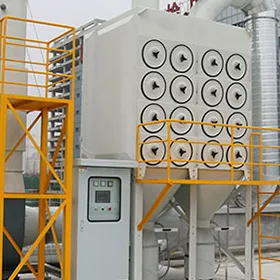
Why Pressure Drop Can Rise During Galvanized Steel Cutting
Differential pressure, commonly written as ΔP, measures the resistance across the filter section.
When cartridges are clean, they create an initial pressure drop determined by media characteristics and airflow.
As particulate accumulates, resistance increases.
Pulse cleaning releases part of the dust cake and helps maintain the collector within a normal operating range.
When processing galvanized steel, changes in fine particulate loading may affect how quickly resistance develops.
However, high differential pressure cannot automatically be attributed to zinc oxide.
Other possible causes include insufficient filtration area, excessive flow per cartridge, moisture or oil contamination, poor pulse cleaning, uneven inlet distribution, or media that is poorly matched to the collected dust.
The most useful signal is the operating trend.
If pressure drop increases gradually but remains within the expected range, the collector may be operating normally.
If the post-cleaning baseline continues increasing, the cartridges may be retaining more material than the cleaning system can release.
If a production change from uncoated steel to galvanized sheet coincides with a significant change in ΔP, the material change deserves investigation.
A pressure-drop trend indicates changing filtration resistance; it does not independently identify the chemical composition of the collected dust.
Pulse Cleaning and Dust Discharge Affect Long-Term Performance
Fine metal-fume filtration depends on the ability to remove accumulated dust from the cartridge surface.
In pulse-cleaned collectors, short bursts of compressed air create a reverse pressure wave that releases part of the dust cake.
The released material then falls into the hopper and is transferred to a collection container or discharge device.
If the pulse-cleaning system does not provide sufficient energy, cartridge resistance may continue rising despite frequent cleaning cycles.
Low compressed-air pressure, poor air quality, failed diaphragm valves, blocked blow tubes, or unsuitable pulse settings can all affect performance.
The hopper must also remain functional.
If accumulated dust is allowed to reach the cartridge section, released particles may become re-entrained and contribute to additional filter loading.
This is particularly important in continuous laser cutting, where fine particulate can accumulate over long operating periods.
Stable differential pressure requires suitable filter media, effective pulse cleaning, and reliable dust discharge working together.
Simply increasing cleaning frequency does not guarantee better performance and may increase compressed-air consumption or filter stress without correcting the underlying problem.
Spark Control and Material-Specific Dust Hazards
Laser cutting can generate sparks, hot particles, molten fragments, and fine airborne particulate.
These materials can enter the extraction path unless the cutting table and upstream protection are designed to limit their transport.
A cartridge should not be treated as the first barrier against hot particles.
Depending on the process, upstream protection may involve drop-out sections, inlet baffles, spark-control devices, duct arrangements, temperature monitoring, and other controls selected through a hazard assessment.
The chemical composition of the collected dust also matters.
Zinc oxide itself is generally classified as noncombustible, but that does not establish the fire or explosion characteristics of every dust stream collected during galvanized steel processing.
Metallic particles, coating residues, mixed materials, combustible contaminants, and hot debris may introduce different risks.
A workshop using one collector for galvanized steel, aluminum, carbon steel, and other materials should therefore assess the complete mixed-dust composition.
Flame-retardant cartridge media and anti-static properties can support an overall protection strategy, but neither automatically makes the collector fireproof or explosion-proof.
Safe collector placement, protection measures, dust handling, and maintenance should follow the results of the applicable hazard assessment.
Zinc Oxide Fume and Occupational Exposure
Zinc oxide fume deserves attention because inhalation of sufficient airborne concentrations can cause metal fume fever.
Symptoms may include fever, chills, muscle aches, cough, nausea, and general weakness.
In the United States, the OSHA permissible exposure limit for zinc oxide fume is 5 mg/m³ as an eight-hour time-weighted average. Other jurisdictions may use different occupational exposure limits or measurement requirements.
However, visible haze and odor are not reliable substitutes for exposure monitoring.
Zinc oxide is an odorless material, and a workshop can have hazardous airborne contamination without an obvious smell.
Similarly, the absence of visible smoke does not establish that the operator’s breathing-zone exposure is acceptable.
The appropriate approach is to use source capture, suitable ventilation, and exposure assessment where required.
Dust collection performance and worker exposure should be verified through appropriate measurements rather than assumptions based on the appearance of the air.
Cartridge filtration primarily addresses particulate contamination. Any relevant gaseous emissions require separate evaluation and may require additional control measures.
Published Laser Cutting Application Lessons
Case 1: Fine Particle Emissions Measured During Galvanized Steel Cutting
A published occupational exposure study examined particulate generated during laser cutting at three industrial facilities.
The researchers sampled emissions from several metallic materials, including 1.5 mm galvanized steel processed using a CO₂ laser.
The galvanized steel specimen was identified as DX51D+Z275, and the study examined particle concentration, size distribution, chemical composition, and workplace exposure.
The experiment found substantial fine particulate generated during laser cutting. Across the investigated materials, most measured condensation particles were in the ultrafine range, while microscopy identified primary particles commonly around 5–50 nm.
For the galvanized steel cutting sample, the reported near-source particulate concentration was approximately 1.5 mg/m³, with a measured range of 1.2–1.9 mg/m³ under the specific experimental conditions.
Importantly, the chemical analysis did not support treating the entire collected aerosol as zinc oxide. Iron-containing phases were identified, while zinc was below the analytical detection limit in that particular particulate sample.
The measurement was made in the experimental sampling arrangement, not as an eight-hour operator exposure result.
Lesson: Galvanized steel laser cutting can generate substantial fine particulate, but particle composition must be established from actual sampling. The presence of a zinc coating does not justify assuming that every collected particle is zinc oxide.
Case 2: Laser Cutting Aerosol Size Changed with Material and Sheet Thickness
An earlier published investigation examined aerosols generated while laser cutting metallic sheets, including coated and uncoated steels.
The tested sheets were approximately 0.5–3 mm thick.
The researchers reported aerosol median geometric diameters of approximately 2–2.5 µm under their measurement conditions and observed changes in particle concentration associated with sheet thickness.
The measured aerosol composition also varied according to the material being processed.
These results should not be interpreted as contradicting studies identifying much smaller primary particles. Different measurement methods can characterize primary particles, agglomerates, or airborne particle distributions differently.
The important engineering finding is that particle size and concentration depend on the cutting process and the material, rather than following one universal value.
Lesson: Cartridge filtration should be selected from the expected particle-size distribution and actual process duty. One published particle-size value should not be used as the sole design basis for every galvanized steel laser cutting installation.
Case 3: Enclosed Laser Cutting and Exhaust Filtration Were Evaluated Together
A published laser-processing investigation examined emissions from cutting and welding several materials, including galvanized steel.
The cutting experiments used a 1 kW CO₂ laser, while the welding experiments used a separate 5 kW CO₂ laser.
The equipment operated within an enclosed working area connected to an exhaust system.
Researchers collected aerosol samples from the exhaust duct using controlled sampling methods and investigated the performance of filtration arrangements for laser-processing emissions.
This is important because it treated the laser process, enclosure, exhaust airflow, and filtration system as connected parts of the emission-control problem.
The publicly available study summary does not provide a universal cartridge efficiency or airflow specification for galvanized steel, so those values should not be inferred from the experiment.
Lesson: Reliable laser fume control requires the emission source, enclosure, ductwork, sampling conditions, and filtration stage to be evaluated together rather than selecting a cartridge solely from a general particle-size assumption.
What Should Be Checked Before Selecting a Dust Collector?
A dust collector intended for galvanized steel laser cutting should be evaluated using actual production information.
The following checklist provides a practical starting point:
- Material and coating: Confirm the galvanized sheet specification, zinc coating, thickness, surface treatment, and whether other metals or coated materials will be processed.
- Cutting process: Record laser type, power, cutting speed, assist gas, pierce frequency, operating hours, and expected production volume.
- Source capture: Review the cutting-table area, enclosure, extraction zones, damper operation, and potential leakage paths.
- Airflow and resistance: Establish required capture airflow and total system pressure loss, including ducts, elbows, dampers, spark protection, loaded cartridges, and outlet equipment.
- Cartridge and cleaning system: Review filter efficiency, media construction, filtration area, pulse-cleaning capability, compressed-air quality, differential-pressure limits, and maintenance access.
- Safety and monitoring: Evaluate hot-particle risks, actual dust composition, collected-material handling, worker exposure, exhaust discharge, and applicable fire or combustible-dust requirements.
The purpose of these checks is to establish the complete operating duty rather than select a collector based only on laser power or a general airflow rating.
How to Monitor Collector Performance During Production
After a collector is installed, its performance should be assessed under normal and demanding operating conditions.
This includes checking airflow at the active extraction zones, recording filter differential pressure, observing pulse-cleaning recovery, inspecting collected dust, and reviewing any changes in production materials.
A normal operating baseline should be established for the collector when processing the materials expected in regular production.
If galvanized steel is introduced into a workshop that previously processed only uncoated carbon steel, the maintenance team should observe whether the material change affects filter loading or dust-discharge behavior.
A stable pressure-drop trend suggests that the filtration section is operating within a repeatable range, while progressively increasing post-cleaning resistance may indicate developing cartridge loading or reduced cleanability.
Visible fume escape, unusual emissions, or changes in capture should trigger investigation even when cartridge ΔP appears normal.
Monitoring should connect material changes, process conditions, airflow, filter resistance, and emissions rather than relying on cartridge age alone.
Can the Same Collector Handle Galvanized and Uncoated Steel?
A centralized cartridge collector may be able to serve both galvanized and uncoated carbon steel when the complete system is designed for the combined production duty.
However, the two materials should not automatically be considered identical from a filtration and operating perspective.
Galvanized steel introduces zinc-containing coating material that can influence the emitted fume, while differences in sheet thickness, laser settings, assist gas, and production volume can change particulate loading.
A shared system should therefore be reviewed for its ability to capture the expected fume, maintain sufficient airflow, handle the collected dust, and preserve filter performance across the actual material mix.
The critical question is not whether both processes use the same type of cutting machine.
It is whether the extraction and filtration system can manage the contaminant characteristics and operating conditions of every material connected to it.
Final Engineering View
Galvanized steel laser cutting introduces additional fume-collection considerations because the laser heats both the steel substrate and a zinc-based protective coating.
The zinc may vaporize, oxidize, and contribute to fine particulate formation, but the resulting aerosol cannot be treated as pure zinc oxide without appropriate chemical analysis.
Assist-gas selection affects the cutting reaction and removal of material from the kerf, while laser power, sheet thickness, cutting speed, and production duty influence how much contamination enters the extraction system.
The complete fume-control process should therefore be evaluated as:
Zinc-Coated Steel → Laser Heating → Vaporization and Particle Formation → Source Capture → Ductwork → Cartridge Filtration → Pulse Cleaning → Dust Discharge
Cartridge filters must provide suitable particle retention while maintaining manageable pressure drop over time.
The fan must deliver sufficient airflow at the actual installed resistance, including loaded cartridges.
The cutting table must capture the plume before it spreads, and hot-particle control must occur upstream of the filter section where required.
Worker exposure and gas-phase contaminants must also be considered separately from particulate filtration performance.
The wrong starting question is:
“What filter cartridge is best for zinc oxide fume?”
A more useful question is:
“What contaminants does this galvanized steel cutting process actually generate, and what extraction, filtration, airflow, and safety measures are required to control them?”
Effective galvanized steel fume collection begins with understanding the material and cutting process, then selecting a complete extraction system around the resulting particulate and operating conditions.
Frequently Asked Questions
Does laser cutting galvanized steel produce zinc oxide fume?
Laser cutting can vaporize zinc from the protective coating, and subsequent oxidation and condensation may produce zinc oxide-containing particulate. However, the actual emitted aerosol may also contain iron-rich oxides and other materials. Its composition depends on the cutting conditions and should not be assumed to consist entirely of zinc oxide.
Are galvanized steel laser cutting fumes hazardous?
Inhalation of zinc oxide fume can cause metal fume fever, while other particulate or gaseous emissions may introduce additional exposure concerns. Effective source capture, ventilation, suitable filtration, and appropriate exposure assessment are important for safe operation.
Is oxygen or nitrogen better for galvanized steel laser cutting?
The appropriate assist gas depends on the material thickness, cutting equipment, desired edge quality, and operating conditions. Oxygen supports oxidation reactions, while nitrogen is often selected where reduced edge oxidation is desirable. Neither guarantees lower fume emissions under every cutting condition.
Can a cartridge dust collector capture zinc oxide particles?
A properly designed cartridge dust collector can retain fine zinc oxide-containing particulate when the filter media, efficiency, sealing, airflow, and cleaning system are suitable. Cartridge filtration should not be assumed to remove all gas-phase emissions.
Why does filter differential pressure increase during galvanized steel cutting?
Pressure drop can increase as fine particles accumulate on the cartridges. Other contributing factors may include insufficient media area, high airflow per cartridge, poor pulse cleaning, moisture or oil contamination, and difficult-to-release dust deposits. Differential-pressure trends should be used together with operating observations.
Can one dust collector filter galvanized steel and carbon steel cutting fumes?
It may be possible when the collector is sized and configured for both processes. Material composition, particulate loading, airflow, spark exposure, filter media, cleaning, and dust-handling requirements should be evaluated together.
Does galvanized steel require a special dust collector?
Not necessarily a completely different collector type, but the system must be suitable for the actual fume characteristics and operating conditions. A pulse-cleaned cartridge collector may be appropriate when source capture, filtration efficiency, airflow, dust loading, and applicable safety requirements are properly addressed.
Author

Jessica Ma – Senior Filtration Engineer, Omela Filtration
Jessica Ma is a senior filtration engineer at Omela Filtration, specializing in dust and liquid filtration. With over 15 years of experience, she focuses on optimizing baghouse performance, enhancing filtration efficiency, and developing high-performance solutions for industrial dust collectors and precision liquid filtration applications.