
Key Takeaways
- Industrial filter cartridges in power plants are mainly used for particulate removal, membrane protection, condensate polishing prefiltration, and protection of downstream high-purity water equipment. They do not replace RO, ion exchange, EDI, softening, or other processes for dissolved contaminants.
- High flow filter cartridges can reduce cartridge count and housing footprint in high-throughput boiler makeup and RO pretreatment systems, but flow per element must still be matched to solids loading and allowable differential pressure.
- Melt-blown filter cartridges are useful where depth loading and economical suspended-solids removal are more important than tightly defined final retention.
- String wound filter cartridges provide another depth-filtration option, but yarn, core material, temperature, hydraulic stress, and contaminant characteristics must all be considered.
- Power plant cartridge selection should begin with water source → treatment stage → contaminant → downstream equipment → required retention → flow → pressure drop, not simply a micron number.
- For RO systems, the final cartridge is normally a safety barrier, not the primary solids-removal stage. Rapid cartridge plugging should trigger an upstream pretreatment review.
Power Plant Water Treatment Is Not One Filtration Application
A power plant may contain several water systems operating at completely different purity levels.
Raw makeup water may contain sediment and suspended solids. RO feedwater requires protection from fine particulate and colloidal material. Condensate may appear extremely clean but still carry very fine corrosion products. Cooling water, meanwhile, can continuously collect airborne dirt, corrosion debris, organic material, and biological solids.
This is why asking:
“What micron filter cartridge is used in a power plant?”
does not have one answer.
The more useful question is:
“Where is the cartridge installed, what is reaching it, and what equipment does it need to protect?”
| Water System | Typical Filtration Objective | Main Cartridge Consideration |
|---|---|---|
| Boiler Makeup Water | Remove residual suspended solids before high-purity treatment | Dirt holding, flow, downstream protection |
| RO Pretreatment | Final particulate safety barrier before HP pump and membranes | Defined retention, low ΔP, stable performance |
| Condensate Polishing | Remove corrosion products and fine particulate | Fine retention, temperature, strength, high flow |
| Cooling Water | Control suspended solids and protect downstream equipment | Solids loading, side-stream flow, service cost |
The same cartridge construction should not automatically be specified for all four duties.
Boiler Makeup Water: Filtration Is One Stage in a Larger Treatment Train
Boiler makeup water can originate from groundwater, surface water, municipal supply, reclaimed water, or desalinated water.
The treatment sequence therefore varies widely.
A plant using relatively clean municipal water may require a much simpler pretreatment arrangement than a plant taking water from a river or reclaimed-water system.
A typical high-purity boiler makeup process may include clarification or multimedia filtration, ultrafiltration, cartridge filtration, reverse osmosis, and then ion exchange or EDI polishing.
The cartridge stage usually has a very specific purpose:
remove residual particulate before sensitive downstream equipment.
It is important to separate particulate filtration from dissolved-contaminant removal.
A filter cartridge can retain rust, sediment, precipitated material, or suspended particles.
It cannot normally remove dissolved calcium, magnesium, sodium, chloride, sulfate, or silica simply by using a smaller micron rating.
Those dissolved contaminants require other treatment technologies.
This distinction prevents one of the most common mistakes in boiler-water filtration: expecting a fine cartridge to solve a water-chemistry problem.
RO Pretreatment: The Cartridge Is the Final Safety Barrier
In most RO systems, the final cartridge filter sits directly before the high-pressure pump and membrane array.
Its role is not to replace upstream clarification, multimedia filtration, or UF.
Its role is to catch residual particulate that escapes those processes.
Industry membrane guidance commonly recommends a final cartridge below 10 µm absolute, with 5 µm absolute frequently used as the standard starting point.
Where very fine colloidal silica or metal-silicate fouling is a concern, even tighter filtration may be considered.
But smaller does not automatically mean better.
If a 5 µm cartridge is loading rapidly because the upstream treatment is passing excessive solids, changing directly to 1 µm may simply increase pressure drop and replacement frequency.
The cartridge then becomes an expensive indicator of an upstream process problem.
This is why RO troubleshooting should look at cartridge loading together with feed turbidity, SDI, iron, biological conditions, upstream filtration performance, and actual flow per element.
Nominal and Absolute Micron Ratings Should Not Be Treated as Equivalent
A specification that says only:
“5 micron cartridge”
is incomplete.
A nominal-rated depth cartridge and a 5 µm absolute-rated final safety filter can have very different retention efficiencies.
For general sediment removal, nominal depth filtration may be perfectly appropriate.
For the final protection of an RO membrane system, the retention requirement normally needs to be more clearly defined.
The important questions are therefore not only:
What micron?
but also:
At what efficiency and under what rating method?
This distinction becomes increasingly important as the cartridge moves closer to high-value downstream equipment.
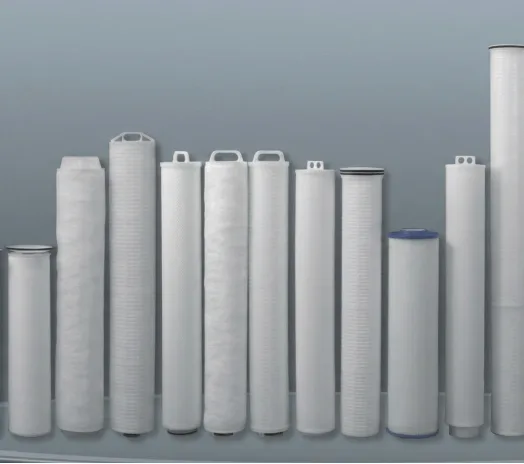
High Flow Cartridges for Large Boiler Makeup Systems
Power plants can operate at water flow rates where traditional small-diameter cartridges require very large element counts.
Large-diameter high-flow cartridges provide an alternative.
Their main benefit is not simply “more flow.”
They can reduce the number of elements required to handle a given system flow, which can reduce housing footprint, replacement time, sealing points, and maintenance labor.
For example, a system designed around hundreds of conventional cartridges may sometimes be simplified substantially by using fewer large-format high-flow elements.
But high-flow construction does not eliminate normal filtration rules.
The design still has to consider solids loading, micron rating, viscosity, clean pressure drop, terminal pressure drop, cartridge surface area, and expected service interval.
A high-flow element operated aggressively near its maximum hydraulic capacity may provide fewer cartridges but also less operating margin as the media loads.
In continuous power-generation service, stable operation is normally more valuable than minimizing cartridge quantity alone.
Flow Rate Must Be Considered Per Cartridge
A system flow such as:
300 m³/h
does not by itself define the number of filter cartridges required.
That flow has to be distributed across the installed elements.
Two systems handling the same total flow may require different cartridge quantities because one carries relatively clean RO feedwater while the other contains significantly more suspended solids.
The practical design target is therefore not just allowable clean-water flow.
It is a balance between:
flow per element, initial ΔP, contaminant loading, service interval, and available housing area.
Operating with more filtration area generally reduces the hydraulic burden on each element and provides more loading capacity before terminal differential pressure is reached.
Condensate Polishing Has a Different Objective
Condensate is fundamentally different from raw makeup water.
It has already passed through the steam-water cycle and is typically much cleaner in terms of ordinary suspended solids.
However, corrosion inside the cycle can generate extremely fine iron oxides and other corrosion products.
Condenser leakage or operating disturbances can introduce additional contaminants.
The purpose of condensate treatment is therefore not simply to make water visually clear.
It is to protect high-value boiler, steam generator, turbine, and feedwater-system components from very low concentrations of contamination.
Cartridge filtration may remove particulate corrosion products, while ion-exchange polishing addresses dissolved ionic contaminants.
These are complementary functions.
A very fine cartridge does not replace the ion-exchange stage where dissolved impurity removal is required.
Iron Oxide Can Be a Major Condensate Filtration Challenge
Fine iron oxide is often one of the most important particulate contaminants in steam-cycle condensate.
Its concentration may appear extremely low compared with ordinary industrial wastewater, yet power plants can still be concerned with values measured in parts per billion.
This changes the filtration objective.
The question is no longer:
Can the filter make the water look clean?
It becomes:
Can the filter consistently remove very fine corrosion products at high flow without unacceptable pressure drop?
This places greater emphasis on retention efficiency, cartridge construction, structural support, hydraulic stability, and predictable differential-pressure behavior.
Startup Can Be Harder on the Filter Than Normal Operation
A condensate system that performs well during steady operation may behave very differently during startup.
Corrosion products can accumulate while equipment is idle.
When the plant restarts, those contaminants can move through the system in a relatively short period.
The cartridge therefore sees a solids load much higher than the normal steady-state condition.
If the element was selected only according to normal operating water quality, startup can result in rapid plugging, high differential pressure, bypass, or mechanical damage.
This is an important distinction in power-generation filtration:
average contamination does not always define the worst filtration condition.
The system should be evaluated for both steady operation and abnormal high-loading periods such as startup.
Structural Strength Matters in Condensate Service
Micron rating alone is particularly inadequate for condensate applications.
A cartridge may also have to withstand elevated temperature, repeated backwashing, pressure transients, high differential pressure, and water hammer.
These loads affect the core, media, end caps, seals, connections, and bonding method.
For this reason, a standard ambient-temperature polypropylene sediment cartridge should not automatically be substituted into a condensate polishing vessel merely because it has the required micron rating.
The complete element construction has to match the real hydraulic and thermal environment.
Cooling Water Is a Different Solids Problem Again
Open cooling systems continuously interact with the surrounding environment.
Dust, sand, organic material, corrosion products, and biological debris can enter the circulating water.
At the same time, evaporation concentrates dissolved minerals.
Filtration can reduce suspended solids and help control fouling, but it does not remove the dissolved minerals responsible for many scaling problems.
This distinction matters because cooling-water filtration and cooling-water chemistry solve different problems.
A cartridge filter may protect a sensitive heat exchanger or polishing stage from particles.
It cannot replace the chemical treatment and blowdown strategy required to control dissolved solids, corrosion, or biological growth.
Side-Stream Filtration May Be More Practical Than Full-Flow Cartridge Filtration
A large cooling-water loop may circulate an enormous volume of water.
Passing the complete circulation flow through disposable fine cartridges may therefore be technically possible but economically unattractive.
Side-stream filtration provides another approach.
A portion of the circulating water is continuously withdrawn, filtered, and returned to the loop.
This gradually reduces suspended-solids inventory without requiring a filter sized for the entire cooling-water flow.
Depending on particle size and loading, side-stream systems may use centrifugal separation, screens, discs, media filtration, cartridges, or combinations of technologies.
Cartridge filtration is most attractive when finer removal or protection of a specific downstream component justifies disposable media.
Cartridge Construction Should Match the Treatment Stage
| Cartridge Type | Main Strength | Typical Power Plant Direction |
|---|---|---|
| Melt-Blown Depth | Economical depth loading and dirt holding | General pretreatment and sediment removal |
| String Wound | Depth loading with selectable yarn/core | Variable solids and selected utility-water duties |
| Pleated | High surface area and more controlled retention | Fine polishing and RO protection |
| High Flow Pleated | High throughput with fewer elements | Large boiler makeup and RO pretreatment systems |
| Specialized Condensate Element | Fine corrosion-product control and stronger construction | Condensate polishing |
This table should be treated as a selection direction rather than a universal specification.
Water chemistry, temperature, housing design, differential pressure, cartridge rating method, and actual contamination still determine the final choice.
Pressure Drop Is One of the Best Diagnostic Signals
A cartridge gradually becomes more resistant as particles accumulate.
The normal progression is simple:
clean cartridge → solids loading → increasing differential pressure → terminal ΔP → replacement
The important information is not only the final differential pressure.
It is how quickly the filter gets there.
If a cartridge that previously operated for six weeks suddenly reaches its change-out condition in five days, replacing it restores operation temporarily but does not explain the change.
Possible causes include deterioration in upstream treatment, changing raw-water quality, iron precipitation, biological fouling, increased flow, a membrane pretreatment problem, or a change in contaminant characteristics.
Pressure-drop history therefore acts as a process diagnostic tool.
Published Power Plant Filtration Lessons
| Published Application | Observed Problem or Result | Engineering Lesson |
|---|---|---|
| Power plant RO pretreatment | 5 µm cartridges reached a 10 psi change-out ΔP within 1–7 days; larger filtration area and upstream chemistry changes extended runs beyond 30 days | Short life may indicate inadequate area or upstream conditions, not simply the wrong micron rating |
| Condensate polishing evaluation | Pleated filtration achieved very high iron removal under monitored power-station conditions | Condensate filtration should be judged by measurable retention, flow, and ΔP rather than appearance |
| 775 MW combined-cycle plant | Startup contamination caused premature plugging, high ΔP, bypass, and cartridge integrity problems | Startup loading and hydraulic stress must be considered separately from steady-state operation |
These cases have one important point in common:
A filter cartridge is not only removing contamination. Its condition can also tell you what is happening elsewhere in the treatment system.
Micron Rating Should Follow the Downstream Requirement
The cartridge should protect something specific.
Before RO, it protects the high-pressure pump and membrane feed channels.
In condensate polishing, it may reduce corrosion products reaching the steam-water cycle.
In cooling water, it may protect a heat exchanger or downstream polishing unit.
Once the protection objective is known, the required retention becomes easier to justify.
Selecting a tighter rating than necessary may increase differential pressure, cartridge quantity, change-out labor, and operating cost without delivering meaningful additional protection.
The engineering target is therefore not the smallest micron number.
It is the retention level required by the next process stage at an acceptable hydraulic and operating cost.
A Practical Selection Sequence
- Identify the water system. Determine whether the cartridge serves boiler makeup, RO pretreatment, condensate polishing, cooling water, or another utility-water duty.
- Identify the contaminant. Distinguish suspended sediment, corrosion products, colloidal material, biological solids, and dissolved contaminants.
- Define what must be protected. The downstream target may be an RO membrane, ion-exchange bed, boiler cycle, heat exchanger, or polishing stage.
- Define retention and flow. Establish micron rating, rating efficiency, normal and peak flow, and required cartridge area.
- Define hydraulic limits. Check clean ΔP, terminal ΔP, housing pressure loss, temperature, pressure, and viscosity.
- Evaluate operating life. Compare expected contaminant loading, change-out interval, maintenance access, cartridge quantity, and total operating cost.
Only after these questions are answered should the exact cartridge construction be finalized.
Common Selection Problems Are Usually System Problems
Many cartridge problems appear initially to be product problems.
A filter plugs too fast, so the plant requests a higher-capacity cartridge.
Differential pressure rises, so the micron rating is increased.
RO membranes foul, so a finer cartridge is installed.
Sometimes those changes are correct.
But they should not be made without understanding why the existing filter is behaving that way.
Rapid loading may point to upstream breakthrough.
Very low cartridge loading combined with membrane fouling may suggest contaminants that are too small or dissolved for the cartridge to remove.
Mechanical failure may indicate pressure, temperature, backwash, or water-hammer conditions beyond the cartridge’s structural capability.
The most useful troubleshooting question is therefore:
What changed in the water or operating condition before the filter performance changed?
What Information Is Needed for Cartridge Selection?
A useful power-plant filtration inquiry should describe the treatment stage, source water, downstream equipment, normal and maximum flow, water temperature, operating pressure, current cartridge construction, micron rating and rating type, initial and terminal differential pressure, current cartridge life, and known water-quality indicators such as turbidity, SDI, TSS, or condensate iron.
Housing dimensions, cartridge length, end configuration, seal material, and photos of used elements can also help when replacing an existing system.
For an operating problem, differential-pressure history is often more valuable than the existing cartridge part number alone.
Final Engineering View
Power plant water treatment contains several fundamentally different filtration duties.
For boiler makeup water, cartridge filtration removes residual particulate before high-purity treatment.
For RO pretreatment, it normally acts as the final particulate safety barrier before the high-pressure pump and membranes.
For condensate polishing, the challenge may be extremely fine corrosion products combined with high flow, temperature, startup loading, and demanding hydraulic conditions.
For cooling water, filtration controls suspended solids and fouling, often through side-stream rather than full-flow treatment.
These applications should not automatically use the same cartridge.
A useful way to think about selection is:
Water Source → Treatment Stage → Contaminant → Downstream Equipment → Retention Requirement → Filter Area → Flow per Element → Differential Pressure → Service Life
The wrong starting question is:
“What micron cartridge is normally used in a power plant?”
The better question is:
“What is this filter protecting, what contamination reaches it, and how much flow and solids loading must it handle before the next treatment stage?”
Once those questions are answered, selecting between depth, pleated, string-wound, high-flow, or specialized condensate elements becomes much more straightforward.
Frequently Asked Questions
What micron filter cartridge is normally used before RO in a power plant?
A final cartridge safety filter below 10 µm absolute is commonly recommended for RO pretreatment, with 5 µm absolute frequently used. The final rating should follow membrane supplier requirements, upstream treatment performance, feed-water quality, SDI, and fouling conditions.
Can filter cartridges remove boiler-water hardness?
Ordinary particulate filter cartridges do not remove dissolved calcium and magnesium hardness. Hardness and dissolved salts normally require softening, reverse osmosis, ion exchange, EDI, or other water-chemistry treatment.
Why does condensate require filtration if it already looks clean?
Power plant condensate can carry very fine iron oxides and other corrosion products generated within the steam-water cycle. These particles may need to be controlled even at concentrations too low to affect visible clarity.
Why do RO pretreatment cartridges clog quickly?
Rapid plugging can indicate high suspended-solids loading, deterioration of upstream clarification or UF, iron precipitation, biological fouling, insufficient cartridge area, excessive flow per element, or changing source-water conditions.
Are high-flow cartridges useful in power plants?
Yes. Large-format high-flow cartridges can be useful in high-throughput boiler makeup and RO pretreatment systems because they can reduce cartridge count and housing footprint. They still have to be sized for actual flow, solids loading, micron rating, and differential pressure.
Should cooling-tower water always use cartridge filtration?
No. Large cooling systems often use side-stream filtration, and the filtration technology may include centrifugal separators, screens, disc filters, sand/media filtration, cartridges, or combinations of these technologies. Selection depends on particle size, suspended-solids loading, flow, and required water quality.
Author

Jessica Ma – Senior Filtration Engineer, Omela Filtration
Jessica Ma is a senior filtration engineer at Omela Filtration, specializing in dust and liquid filtration. With over 15 years of experience, she focuses on optimizing baghouse performance, enhancing filtration efficiency, and developing high-performance solutions for industrial dust collectors and precision liquid filtration applications.