
Key Takeaways
- Liquid filter bags are used in paint and coating production to remove suspended solids, gels, pigment agglomerates, fibers, paint coagulates, oversized particles, and process contaminants before mixing, transfer, filling, or spraying.
- Paint and coating filtration is not only about micron rating. It also depends on viscosity, pigment load, resin system, solvent or water base, flow rate, pressure drop, housing size, sealing performance, and final finish quality.
- Polypropylene liquid filter bags are suitable for many paints, inks, coatings, adhesives, and resin systems where chemical compatibility and cost efficiency matter.
- Polyester liquid filter bags are useful for coatings, inks, resins, adhesives, and emulsions that need stronger mechanical stability, higher dirt-holding capacity, and better resistance to process stress.
- Mesh filter bags and nylon liquid filter bags are often selected for removing coarse gels, fibers, skins, pigment clusters, and oversized particles with lower pressure drop.
- For high-temperature, reusable, abrasive, or demanding coating systems, stainless steel liquid filter bags may be considered.
- To select the right paint and coating filter bags faster, send viscosity, coating type, pigment load, target contaminant, micron rating, flow rate, pressure drop limit, housing size, ring type, and photos to contact Omela Filtration.
Why Paint and Coating Filtration Matters
In paint, coatings, varnishes, inks, and related formulated liquids, small contaminants can create large quality problems. A pigment agglomerate may cause specks. A gel particle may create surface defects. A fiber may remain visible after application. A paint coagulate may block a nozzle, damage spray consistency, or create customer complaints after filling.
The reference page you provided explains this problem clearly: in paints, coatings, and inks, filtration may be the last step between the batch and a customer rejection. It specifically mentions gels, seeds, skins, and oversized pigment agglomerates as contaminants that can become craters or fisheyes in the final finish.
For Omela, the practical point is simple: paint filtration protects finish quality. The filter bag should remove harmful contaminants without stripping useful formulation components, creating excessive pressure drop, slowing production, or causing bypass.
What Contaminants Appear in Paint and Coating Lines?
Paint and coating systems are complex mixtures. They may contain resin, pigments, fillers, solvents, water, dispersants, defoamers, additives, waxes, emulsions, and functional particles. Some solids are part of the formula; others are unwanted contamination.
The main filtration target is not “remove everything.” The real target is to remove particles that are larger, harder, unstable, or harmful to downstream quality.
Common contaminants include pigment agglomerates from poor dispersion, gels from resin or polymer reaction, fibers from packaging or wiping materials, paint coagulates from aging or incompatibility, skins from tank surfaces, dried flakes from vessel walls, storage contaminants, undissolved additives, and oversized particles introduced during transfer or mixing.
Eaton’s industrial filtration information also lists paint and lacquer applications such as removal of agglomerates, paint coagulates, solvent filtration, removal of storage contaminants, filling lines, and paint mixing lines.
Where Filter Bags Are Used in the Process
Paint and coating filter bags may be used at several points in the production line. The best location depends on whether the goal is raw material protection, batch clarification, filling-line protection, or spray/nozzle protection.
A typical paint or coating filtration process may include:
- Raw material pre-straining
Coarse mesh bags can remove packaging fibers, hard debris, skins, and oversized solids before materials enter the main batch. - Mixing or letdown filtration
After pigments, resins, solvents, water, and additives are mixed, filter bags can remove gels, undispersed particles, and agglomerates. - Transfer line filtration
Filter bags protect pumps, valves, hoses, filling machines, and storage tanks from oversized solids. - Final filtration before filling
This step helps reduce visible defects and customer complaints by removing particles before packaging. - Spraying or coating-line protection
Finer filtration may be needed when nozzles, coating heads, or high-quality surfaces are sensitive to small contaminants.
The reference site recommends filtering as late in the process as possible, after letdown and before filling, because that is where contamination control most directly protects the finished batch.
What Paint and Coating Filter Bags Include
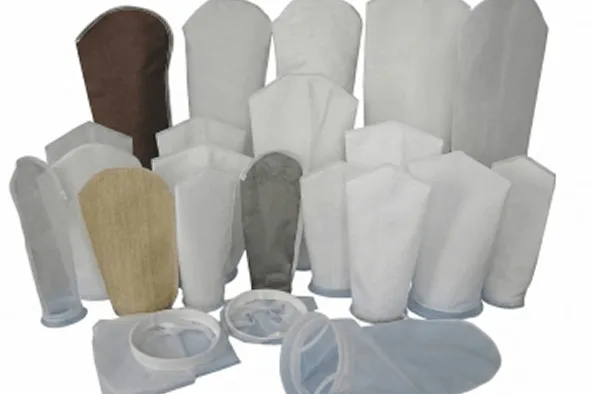
Paint and coating filter bags are not limited to one material. Depending on the formulation and process conditions, they may include PP felt bags, polyester felt bags, nylon mesh bags, PP/PE mesh bags, high-efficiency multilayer bags, PTFE bags, or stainless steel mesh bags.
Omela defines a liquid filter bag as a filtration element installed inside a bag filter housing to remove suspended solids, gels, particles, oil droplets, or contaminants from industrial process liquids. Performance depends on media selection, micron rating, permeability, chemical compatibility, temperature limits, and how well the bag fits and seals inside the housing.
For paint and coating production, the bag construction should support stable flow, low fiber shedding, reliable sealing, and predictable contaminant retention.
Mesh vs Felt Bags for Paint and Coatings
The first selection decision is often mesh versus felt.
Mesh filter bags are surface filters. They are commonly used for larger contaminants such as gels, skins, fibers, paint lumps, pigment clusters, and oversized particles. Omela’s mesh filter bag page explains that mesh bags use woven monofilament or multifilament media, provide consistent pore size, and support surface filtration for hard particles, gels, debris, or contaminants.
Felt filter bags are depth filters. They are better when the liquid contains a wider distribution of finer suspended solids and when higher dirt-holding capacity is needed. PP felt and polyester felt are common choices for general paint and coating filtration.
A practical rule is:
- Use mesh bags when the main problem is coarse gels, fibers, skins, lumps, or pigment agglomerates.
- Use felt bags when the main problem is finer suspended solids, general clarification, or polishing.
- Use staged filtration when one bag cannot balance contaminant removal, pressure drop, and production speed.
Material Selection for Paint and Coating Filter Bags
| Filter Bag Material | Suitable Use in Paints & Coatings | Main Advantage | Watch Point |
|---|---|---|---|
| PP Felt | Water-based coatings, inks, adhesives, resin systems, general industrial fluids | Cost-efficient, good chemical compatibility, wide micron range | Lower temperature resistance than polyester or metal mesh |
| Polyester Felt | Coatings, inks, resins, emulsions, mechanically demanding lines | Stronger mechanical stability and good dirt-holding capacity | Check alkali and specific solvent compatibility |
| Nylon Mesh | Pigment agglomerates, gels, fibers, skins, reusable surface filtration | Precise openings, strong mesh, low fiber shedding | Check acid and solvent compatibility |
| PP / PE Mesh | Coarse pre-straining, paint lumps, oversized particles | Low pressure drop and high flow | Not ideal for fine final polishing |
| PTFE | Aggressive solvents or specialty coatings | Strong chemical resistance | Higher cost |
| Stainless Steel Mesh | Hot, abrasive, reusable, or high-pressure filtration | Durable, washable, heat-resistant | Higher initial cost and usually coarser filtration |
Omela’s PP filter bag page states that polypropylene liquid filter bags are suitable for paints, inks, coatings, adhesives, and resin systems, and that their multi-layer felt structure captures gels, agglomerates, pigments, and suspended solids while helping stabilize viscosity-critical formulations.
Omela’s polyester filter bag page lists coatings, inks, adhesives, resins, and emulsions as suitable applications, and notes that polyester bags can remove gels, agglomerates, and oversized pigments while helping prevent nozzle plugging, streaks, and surface defects.
Choosing the Right Micron Rating
Micron rating should be selected according to the smallest harmful contaminant, not simply the finest filter bag available.
For coarse pre-straining, a larger micron mesh bag may be enough to remove fibers, skins, lumps, and visible pigment agglomerates. For final filling or coating quality control, a finer felt or multilayer bag may be needed. For high-gloss coatings, automotive-type finishes, or spray applications, the filter rating may need to be tighter because even small particles can create visible defects.
The reference site gives practical starting points: architectural and industrial coatings may begin around 25–50 µm; high-gloss or automotive-quality finishes may require 10–25 µm; inks and tint bases may require 1–10 µm; and raw material pre-straining may use washable mesh around 100–400 µm.
These numbers should be treated as starting points, not universal rules. The final choice depends on viscosity, pigment size, resin system, solvent compatibility, pressure drop limit, and final product quality requirements.
Viscosity, Flow Rate, and Pressure Drop
Paint and coating liquids are often more difficult to filter than water. Some products are thick. Some are shear-sensitive. Some contain pigments or fillers. Some change viscosity with temperature. A filter bag that works well in a low-viscosity liquid may plug quickly in a high-solids coating.
The reference page makes an important point: viscous products often need more surface area, not simply a coarser bag. It suggests stepping up to a larger bag size before increasing micron size.
This is important for Omela selection work. When pressure drop rises too quickly, the answer is not always to make the filter coarser. The better solution may be a larger bag size, Size #2 housing, multi-bag housing, staged filtration, lower flow per bag, or a mesh prefilter before final filtration.
Sealing, Welded Construction, and Contamination Control
In paint and coating filtration, bypass can ruin the value of the filter bag. If liquid flows around the bag collar or through seam holes instead of through the media, agglomerates and gels may still reach the filling line.
The reference page emphasizes welded bag construction because sewn bags have needle holes, while ultrasonically welded bags avoid thread, needle holes, and potential bypass paths. It also notes that silicone-free media can matter because silicone contamination may create coating defects such as craters.
For Omela customers, this means seam type, ring material, housing fit, and media cleanliness should be reviewed when the product is sensitive to appearance defects. Standard sewn bags may be enough for many general coatings, but welded seams or cleaner constructions may be worth considering for high-value paints, inks, varnishes, and final-filling filtration.
EEAT-Based Case Lessons from Industry Sources
| Industry Reference | What It Shows | Practical Lesson |
|---|---|---|
| Paints, coatings, and inks filtration reference | Gels, seeds, skins, and oversized pigment agglomerates can create craters and fisheyes; welded bags and correct micron selection help keep them out. | Paint filtration should protect final finish quality, not only remove visible dirt. |
| Automotive paint shop case | Even coatings supplied to strict specifications may still face agglomerated particles, dust, and fibers during decanting, mixing, and processing. The case also notes a 50,000-car-body-per-year line with a zero-defect requirement. | High-end paint lines need consistent filtration because contamination can enter during normal handling. |
| General Finishes bag housing case | A wood finish manufacturer used nylon mesh or bag filters near the point of filling and adopted a single bag filter housing to increase capacity and maintain finished product quality. | Filter housing design affects production speed, operator intervention, and final product consistency. |
| Coating chemicals case | A coating-related chemical process produced inhomogeneous agglomerates that negatively affected product quality; filtration helped support particle-size uniformity. | Agglomerate control is not limited to finished paint; it also matters in coating raw materials and intermediates. |
| Omela liquid filter bag product data | Omela’s liquid filter bag guidance links performance to media, micron rating, permeability, chemical compatibility, temperature, and housing sealing. | A filter bag must be matched to the process, not selected by micron rating alone. |
These examples support one clear conclusion: paint and coating filtration is a quality-control step, not just a maintenance item.
Common Paint Filtration Problems and Corrections
| Field Problem | Likely Cause | Practical Correction |
|---|---|---|
| Nozzle clogging | Pigment agglomerates, gels, fibers, or paint coagulates | Use mesh prefilter or finer final filtration before spraying |
| Surface specks or defects | Oversized particles, fibers, skins, or storage contamination | Improve final filtration before filling or application |
| Fast bag plugging | Micron rating too fine, viscosity too high, pigment load too heavy | Use larger bag, staged filtration, or lower flow per bag |
| Unstable flow | Temperature or viscosity changes | Control temperature and review pump/filter sizing |
| Coagulates passing downstream | Rating too coarse or bypass around bag seal | Check micron rating, ring fit, housing basket, and seam design |
| Product contamination | Fiber shedding, thread fragments, dirty handling | Consider monofilament mesh, welded construction, or cleaner bag handling |
| Frequent changeout | Small filter area or high solids load | Use Size #2 bags, multi-bag housing, or staged coarse-to-fine filtration |
The best correction is not always “choose a finer filter.” A very fine bag may catch more particles, but it may also increase pressure drop, slow filling, and shorten service life. The correct approach is to balance filtration quality, production speed, and operating cost.
How Omela Helps with Paint and Coating Filtration
Omela supports paint and coating filtration by helping customers compare media, micron rating, bag size, sealing ring, construction style, and filter housing requirements.
For general coatings and inks, PP felt may be a practical first choice when cost efficiency and chemical compatibility are important. For mechanically demanding or higher-temperature coating systems, polyester felt may be better. For coarse gels, fibers, skins, and pigment clusters, nylon mesh or other mesh filter bags may provide lower pressure drop and more direct surface filtration. For aggressive solvents, PTFE should be reviewed. For hot or reusable filtration, stainless steel mesh may be considered.
The right Omela recommendation depends on the real process: paint type, viscosity, pigment load, contaminant size, filling speed, spray nozzle sensitivity, solvent compatibility, operating temperature, pressure drop limit, and whether the filter is used for pre-straining, transfer, mixing, filling, or final polishing.
Common Mistakes to Avoid
The first mistake is choosing micron rating by guesswork. A coating line should define the smallest particle that causes defects, nozzle clogging, or filling-line problems.
The second mistake is using one fine filter bag for every step. Coarse-to-fine staged filtration is often more stable, especially when the product contains high pigment load or gel particles.
The third mistake is ignoring viscosity. Thick coatings may need more filter area, lower flow per bag, or larger housings.
The fourth mistake is ignoring bypass. If the bag ring does not seal correctly, even the correct micron rating cannot protect the product.
The fifth mistake is focusing only on filter bag price. In paint and coating production, the cost of rejected product, nozzle cleaning, downtime, and rework can be much higher than the filter bag cost.
To Request a Quote
For paint and coating filter bags, please send:
- Paint, coating, varnish, ink, resin, or emulsion type
- Water-based, solvent-based, high-solids, pigmented, filled, or specialty formulation
- Viscosity at operating temperature
- Operating temperature and allowable temperature range
- Target contaminants: pigment agglomerates, gels, fibers, skins, paint coagulates, oversized particles, or storage contaminants
- Required micron rating or current filter rating
- Flow rate and operating pressure
- Initial and maximum allowable pressure drop
- Housing size, bag size, support basket, ring type, and gasket material
- Current filter bag material and service life
- Current problem: clogging, surface defects, nozzle plugging, bypass, short life, or frequent changeout
- Quantity and delivery destination
- Photos of current filter bags, housing, contaminants, and failed bags
With this information, Omela can help compare PP felt, polyester felt, nylon mesh, PP/PE mesh, PTFE, stainless steel mesh, multilayer bags, and matching bag filter housing options.
Omela Engineering View
Paint and coating filter bag selection should start from the final quality problem, not only from the filter bag specification.
If the issue is visible specks, craters, fisheyes, nozzle clogging, or inconsistent finish, the filtration target must be clearly identified. Is the problem caused by pigment agglomerates, soft gels, fibers, skins, paint coagulates, or oversized particles? Each contaminant behaves differently inside a filter bag.
The best filter bag is not always the finest one. It is the filter bag that removes harmful contaminants while maintaining stable flow, acceptable pressure drop, reliable sealing, reasonable changeout frequency, and consistent coating quality.
Omela Filtration helps customers select paint and coating filter bags based on product type, viscosity, chemistry, pigment load, contaminant size, filling or spraying conditions, and filtration target.
FAQ
What are paint and coating filter bags used for?
Paint and coating filter bags are used to remove pigment agglomerates, gels, fibers, paint coagulates, skins, oversized particles, and storage contaminants before mixing, transfer, filling, spraying, or final packaging.
Should I use mesh or felt filter bags for paint filtration?
Mesh filter bags are usually better for coarse gels, fibers, skins, pigment clusters, and oversized particles. Felt filter bags are better for finer suspended solids, polishing, and higher dirt-holding capacity.
What micron rating is suitable for paint and coating filter bags?
The suitable micron rating depends on the coating type, contaminant size, viscosity, final finish requirement, and application method. Coarse pre-straining may use larger micron mesh, while final filtration before filling or spraying may require finer felt or multilayer bags.
Why do paint filter bags clog quickly?
Fast clogging is often caused by high viscosity, heavy pigment load, excessive gels, too fine a micron rating, insufficient filter area, low temperature, or lack of coarse prefiltration.
Can filter bags help reduce coating surface defects?
Yes. Correctly selected filter bags can help remove oversized particles, gels, fibers, skins, and pigment agglomerates that may cause specks, streaks, craters, fisheyes, or nozzle problems.
Are welded filter bags useful for paint and coating filtration?
Welded filter bags may be useful when bypass, thread contamination, fiber shedding, or appearance-sensitive filtration is a concern. The final choice depends on product sensitivity, housing fit, and filtration target.
What information is needed to quote paint and coating filter bags?
Provide coating type, viscosity, solvent or water base, pigment load, target contaminants, micron rating, flow rate, pressure drop limit, housing size, ring type, current problems, quantity, and photos.
Author

Jessica Ma – Senior Filtration Engineer, Omela Filtration
Jessica Ma is a senior filtration engineer at Omela Filtration, specializing in dust and liquid filtration. With over 15 years of experience, she focuses on optimizing baghouse performance, enhancing filtration efficiency, and developing high-performance solutions for industrial dust collectors and precision liquid filtration applications.