
Key Takeaways
- Neither carbon format is automatically the better chlorine filter. Compare a specific activated carbon filter cartridge at its actual flow rate, incoming chlorine level, and required outlet residual.
- Free chlorine reduction is largely a surface chemical reaction. Carbon properties, water pH, temperature, and contact conditions matter; a smaller micron rating alone does not establish better dechlorination.
- Carbon block and GAC differ in hydraulics. Bonded blocks can provide controlled flow paths and particle retention, while properly designed GAC cartridges can accommodate low pressure loss and substantial flow. The broader filter cartridge selection still needs the right housing and pretreatment.
- Breakthrough is a performance measurement, not a calendar date. Measure inlet and outlet disinfectant residuals and follow the qualified cartridge’s tested capacity instead of assuming every filter lasts six months.
- Industrial and RO systems need a complete treatment plan. Read the underlying carbon filtration fundamentals and evaluate the upstream and downstream requirements of water treatment applications.
Why the Carbon Block vs. GAC Choice Is More Than a Micron Comparison
A buyer may find two cartridges described as activated carbon, both intended to improve chlorine taste and odor, yet see very different rated capacities and flow requirements. One is a dense, bonded carbon block; the other contains loose granular activated carbon (GAC). The important distinction is not which one looks darker or carries the finer micron rating. It is whether the actual cartridge removes enough chlorine at the flow, chemistry, and cumulative water volume required by the application.
A useful comparison starts with four questions: How much free chlorine enters the filter? How low must the outlet concentration be? What flow must the system deliver without excessive pressure loss? How much treated water can pass before the required removal performance is lost?
A sufficiently sized GAC stage, a correctly selected block, or another treatment configuration may meet the target. Evidence for the exact cartridge matters more than the media label.
How Carbon Block and Granular Activated Carbon Actually Differ
Carbon Block: Fine Carbon in a Bonded Structure
A carbon block generally combines finely divided activated carbon with a binder to form a porous cylindrical element. Water passes through the bonded wall. Its pore structure can provide particulate retention as well as contact with reactive carbon surfaces. Well-manufactured blocks reduce the potential for preferential channels, although poor seals, cracks, or inappropriate operation can still create bypass.
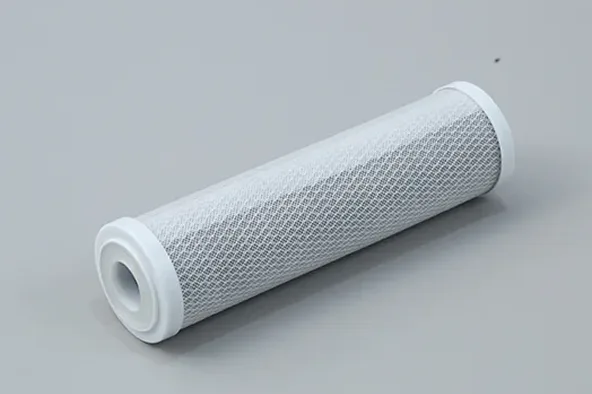
Tighter particle ratings can increase hydraulic resistance, particularly when sediment is present. A 0.5-micron rating primarily describes particulate performance under the stated test basis; it does not mean the cartridge removes 99.5% of chlorine, and it cannot be used alone to predict chlorine capacity.
GAC: A Granular Bed with Engineered Flow Distribution
A GAC cartridge holds activated carbon particles inside a housing. Water may move axially along a packed bed or radially through a larger surface area, depending on construction. End screens, expansion pads, post-filters, and flow distributors can limit channeling and reduce carbon-fines release.
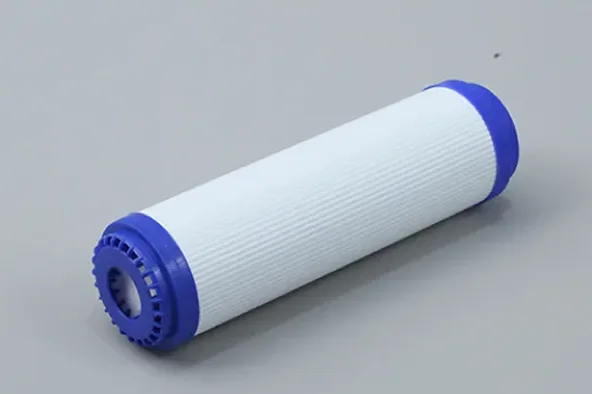
GAC does not necessarily mean high flow, and a carbon block does not necessarily mean low flow. Grain size, bed length, effective carbon mass, cartridge diameter, and flow configuration determine the result. Some GAC cartridges have no meaningful sediment micron rating; others contain a separate particulate stage.
| Selection Factor | Carbon Block Cartridge | GAC Cartridge |
|---|---|---|
| Media construction | Bonded fine carbon particles | Loose granular carbon held in a bed |
| Flow path | Through porous block wall | Axial or radial, depending on design |
| Particle retention | Often specified by a micron rating | May be unrated unless a separate stage is included |
| Chlorine reduction | Depends on carbon chemistry, flow and capacity | Depends on carbon chemistry, bed design and flow |
| Hydraulic concern | Block resistance and sediment clogging | Channeling, fines and bed distribution |
| Best selection evidence | Tested chlorine capacity, flow and pressure drop | Tested chlorine capacity, flow and pressure drop |
What Removes Free Chlorine: Surface Reaction and Contact Time
Activated carbon is widely described as an adsorbent, which is correct for many dissolved organic substances. However, free chlorine removal is primarily a reaction at the carbon surface: hypochlorous acid (HOCl) or hypochlorite (OCl⁻) is reduced, while the carbon surface is oxidized. Free chlorine should therefore not be discussed as though it simply occupies the same adsorption sites as every organic contaminant.
Reaction rate depends partly on which chlorine species dominates. At higher pH, more free chlorine exists as OCl⁻, which generally reacts more slowly with conventional activated carbon than HOCl. Lower water temperatures can also slow dechlorination. Organic contamination, carbon quality, accessible surface, and particle size may further alter performance.
Contact Time: Useful, but Not a Universal Shortcut
For a conventional GAC bed, engineers often use empty bed contact time (EBCT): the empty bed’s geometric volume divided by volumetric flow. This is a nominal design measure, not the actual microscopic contact time of every water molecule with a carbon surface. Cartridge internals, porosity, and short-circuiting influence real performance.
As an illustrative calculation, suppose a carbon bed occupies 0.6 L and receives 3 L/min. Its nominal EBCT is 0.6 ÷ 3 = 0.2 minute, or 12 seconds. Doubling flow to 6 L/min reduces nominal EBCT to 6 seconds. These values are arithmetic examples, not recommended chlorine-removal design times or guarantees of performance.
Flow Rate, Pressure Drop, and the Real Meaning of Capacity
Flow and treatment performance must be evaluated together. Higher flow usually means less residence time in a given carbon volume; it can increase the risk of early chlorine leakage when the cartridge is operated beyond its tested duty. Higher flow also raises hydraulic pressure loss, with the amount determined by cartridge construction and water viscosity.
Pressure drop alone cannot diagnose chlorine breakthrough. Conversely, a sediment-loaded block may cause low delivery flow while its remaining carbon still reduces chlorine. Use a pressure gauge for hydraulic condition and chlorine testing for chemical performance.
A manufacturer may state, for example, a rated chlorine-reduction volume at 1 gallon per minute, while another model is specified at 2 gallons per minute. Those figures should not be compared as if both cartridges had undergone identical test protocols. Check inlet challenge concentration, removal endpoint, water temperature, pH, duty cycle and the exact model, as well as whether the figure is a certification claim or the manufacturer’s internal test.
Chlorine Breakthrough: When Removal Starts to Fail
Breakthrough occurs when chlorine begins appearing at the outlet above a defined performance threshold. It is not necessarily a sudden failure: outlet chlorine may remain very low for a period and then climb as available reactive capacity declines or operating conditions change.
An engineer should define the endpoint before commissioning. For example, an application might set a site-specific outlet limit of 0.1 mg/L free chlorine based on its process requirement. That number is only an illustration, not a universal potable-water standard or a substitute for the membrane manufacturer’s maximum permissible oxidant concentration.
Testing should distinguish free chlorine from total chlorine. Total chlorine may include chloramines, which often require different carbon media or longer contact times. A cartridge advertised for free-chlorine taste reduction must not automatically be treated as a validated chloramine-removal system.
| Operating Observation | Possible Interpretation | Practical Next Step |
|---|---|---|
| Outlet free chlorine rises while pressure drop stays normal | Carbon treatment capacity or contact performance is declining | Verify inlet concentration, flow and replacement point |
| High pressure drop but low outlet chlorine | Sediment clogging rather than exhausted carbon | Inspect upstream pretreatment and cartridge condition |
| Chlorine appears only at peak demand | Contact time or flow distribution is inadequate | Test at maximum operating flow and review sizing |
| Sudden chlorine spike after installation | Seal bypass, incorrect orientation or inadequate flush | Inspect housing, gaskets and installation procedure |
| Free chlorine is low but total chlorine remains | Chloramine may be present | Confirm disinfectant type and select verified treatment |
What Published Tests and Product Data Actually Show
The following are third-party public examples, not Omela laboratory tests or customer installations. They demonstrate how carbon grade, cartridge construction and real operating flow affect claims. Because the products and test methods differ, they are not a controlled carbon-block-versus-GAC head-to-head trial.
Laboratory Comparison: GAC Grade Changes Chlorine Capacity
A published laboratory report describes cartridges containing about 45 cubic inches of GAC, tested at 1 gpm with 2 mg/L free chlorine. Under that reported setup, standard carbon reached approximately 4,000 gallons at 90% reduction, while premium carbon reached about 12,000 gallons at the same reduction level. The report also provides higher capacities at a less stringent 75% reduction endpoint.
The key insight is that even within GAC, carbon quality and the chosen removal threshold can change reported service capacity substantially. The report came from a media supplier’s research materials and is not independent evidence that all premium GAC will perform three times better in another water supply.
Product Specifications: Two GAC Designs, Different Rated Volumes
In published manufacturer specifications, a 4.5 × 10-inch GAC-BB cartridge is listed at 12,000 gallons and 2 gpm for chlorine taste-and-odor reduction. A similarly sized RFC-BB radial-flow GAC cartridge is listed at 50,000 gallons and 2 gpm. Both use granular activated carbon, yet the stated capacities differ markedly.
This is an engineering warning against treating “GAC cartridge” as one standard performance category.
Carbon Block Specifications: Flow Restriction Can Be Intentional
A published carbon-block cartridge series describes more than 20,000 gallons of chlorine taste-and-odor reduction capacity and includes a model with an integrated 0.6 gpm flow restrictor designed to increase contact time. It shows why lower flow may be a deliberate performance choice, not simply a defect or inconvenient restriction.
The published number applies to a particular product family and the manufacturer’s stated conditions, not to every carbon block. A fair purchasing comparison asks for the actual performance data sheet and the capacity at the planned flow, rather than quoting one model’s best figure as a material-wide guarantee.
Selecting Carbon Block, GAC, or a Two-Stage System
For a modest point-of-use flow with fine sediment-control needs, a qualified carbon block may be an efficient solution. For higher throughput or lower pressure-loss requirements, an appropriately sized GAC or radial-flow cartridge can be attractive. Where both bulk dechlorination and fine particulate polishing matter, a sediment stage followed by GAC and then a carbon block may be useful—but each stage adds pressure drop and replacement cost.
RO pretreatment requires special attention. Residual free chlorine can damage many thin-film composite RO membranes, while removal of disinfectant upstream can create a microbiological control concern if the system is poorly maintained. Use upstream sediment filtration where needed, suitable carbon capacity, controlled stagnation, and a monitoring plan appropriate to the water supply. For municipal water, check whether the utility uses free chlorine or chloramine before final selection.
For food, beverage or potable-water applications, verify the actual product’s wetted materials, relevant certifications, system sanitation requirements, and declared contaminant-reduction claims. NSF/ANSI 42 concerns aesthetic effects including chlorine taste and odor; certification to a standard must be checked for the specific product and claim. A label saying that materials comply with NSF/ANSI 42 is not the same as certification of the finished filter’s chlorine-reduction performance.
A Practical Replacement and Monitoring Checklist
- Establish a baseline: Record incoming free and total chlorine, pH, water temperature, normal and peak flow, and clean-cartridge differential pressure.
- Set the performance endpoint: Define the maximum permitted outlet disinfectant residual for the intended process and check whether the exact cartridge’s claims support it.
- Track throughput: Record cumulative treated volume rather than relying only on installation date; include intermittent high-flow periods.
- Sample under realistic load: Measure inlet and outlet residuals at the normal flow and peak operating flow, using a suitable validated test method.
- Replace for the right reason: Breakthrough, expired verified capacity, unsafe sanitation conditions, or excessive pressure loss may require different corrective actions.
When estimating service intervals, start with validated rated capacity and expected daily volume, then apply the manufacturer’s service-life limits and an appropriate operating margin. For example, 8,000 L of verified usable capacity divided by 400 L/day yields 20 days arithmetically.
Final Engineering Recommendation
Choosing between carbon block and GAC cartridges is a process-design decision, not a contest between labels. Specify the chlorine species, incoming concentration, target outlet value, design flow, available pressure, water chemistry, and desired treated volume. Then compare product-specific evidence under relevant conditions.
Carbon block can combine fine-particle retention with controlled carbon contact. GAC can offer useful flow and chlorine-treatment capacity when its bed and flow path are properly engineered. Neither format replaces measurement of breakthrough, verification of the correct disinfectant type, or an appropriate maintenance program. With those fundamentals established, buyers can select by total treatment performance and operating cost rather than a single micron rating or advertised lifespan.
FAQ
Does Carbon Block Remove More Chlorine Than GAC?
Not automatically. Carbon block may offer favorable surface contact and fine-particle retention, but chlorine reduction depends on carbon grade, flow, water chemistry, cartridge design and tested capacity. Compare specific models at the same operating conditions.
How Does Flow Rate Affect Chlorine Removal and Contact Time?
Increasing flow through a fixed carbon volume reduces nominal contact time and can lead to earlier chlorine leakage. It can also increase pressure drop. Use the cartridge’s verified operating flow and chlorine-reduction data rather than a nominal micron rating.
What Does Chlorine Breakthrough Mean in a Carbon Filter?
Breakthrough means that outlet chlorine exceeds the chosen treatment-performance threshold. Check inlet and outlet residuals at representative flow; pressure drop alone cannot confirm whether the carbon still meets the required chlorine-reduction target.
Is Free Chlorine Removal the Same as Chloramine Removal?
No. Chloramine removal often requires different carbon surface chemistry or longer contact time. Test for free and total chlorine and select a cartridge with a verified claim for the disinfectant actually present.
When Should Carbon Block or GAC Cartridges Be Replaced?
Replace according to the specific product’s rated capacity and service limits, measured breakthrough, hygienic requirements, or excessive hydraulic resistance. The actual interval depends on chlorine concentration, water quality, flow and total treated volume.
Author

Jessica Ma – Senior Filtration Engineer, Omela Filtration
Jessica Ma is a senior filtration engineer at Omela Filtration, specializing in dust and liquid filtration. With over 15 years of experience, she focuses on optimizing baghouse performance, enhancing filtration efficiency, and developing high-performance solutions for industrial dust collectors and precision liquid filtration applications.