
Key Takeaways
- Dust collector filter bags for metal melting furnaces must handle fine smoke, metal oxide dust, hot particles, sparks, temperature fluctuation, abrasion, and sometimes corrosive gas.
- Metal melting furnace dust collection should not be selected by industry name alone. Omela’s metal-industry filtration article notes that electric arc furnaces, aluminum melting furnaces, zinc oxide lines, copper smelters, lead processing plants, and foundry dust collectors may all need different filter media.
- For metal melting furnace baghouses, common media options include aramid/Nomex, PPS, P84, PTFE, fiberglass, FMS, and PTFE membrane filter bags, depending on temperature, gas chemistry, dust fineness, spark risk, moisture, and emission target.
- A pulse jet baghouse dust collector must be reviewed together with hood capture, inlet design, spark control, cooling, air-to-cloth ratio, pulse cleaning, and hopper discharge.
- Filter bag cages are critical in foundry and smelter baghouses because rough, corroded, or wrong-size cages can cause internal abrasion and early bag failure.
- For corrosive, humid, or high-temperature metal oxide dust, matched filter bags, surface treatment, sealing design, and corrosion-resistant cages should be considered together.
- To confirm the right filter bag faster, send furnace type, metal type, dust composition, continuous and peak temperature, spark risk, gas chemistry, bag size, cage photos, current failure photos, and emission target to contact Omela Filtration.
Why Metal Melting Furnace Filter Bags Matter
Metal melting furnaces generate some of the most difficult dust and fume conditions in industrial filtration. The dust stream may contain fine metal oxide particles, smoke, hot particles, flux residues, silica-containing dust from foundry operations, combustion by-products, and sometimes heavy metal compounds. OSHA notes that foundry melting processes can generate metal fumes and dust, and electric arc furnaces may give rise to large amounts of iron oxide and other fumes depending on steel composition.
In iron and steel foundries, EPA identifies hazardous air pollutant emissions including metal and organic compounds; for low-alloy metal castings, metal HAPs may include lead and manganese, with smaller amounts of cadmium, chromium, and nickel. NIOSH also describes foundry airborne hazards as including metal fumes and dusts such as lead, nickel, and chromium, along with silica, combustion products, and other exposure concerns.
This is why metal melting furnace filter bags should not be treated as ordinary dust collector bags. They must support stable emissions, protect workers and downstream equipment, resist heat and abrasion, release fine dust cake, and survive real furnace operating cycles.
What Dust Comes from Metal Melting Furnaces?
Metal melting furnace dust is not only “dust.” It can include smoke-like metal fume, oxide particles, splashed or condensed metal particles, flux dust, refractory dust, sand dust, carbonaceous particles, and hot fragments from charging, melting, tapping, pouring, and cleaning operations.
In electric arc furnace dust formation, research summarized in an EAF dust study shows that bubble bursting at the liquid steel surface can generate droplets and dust particles, with film drops identified as a major source of dust emission. For secondary lead smelters, OSHA explains that flue gases from furnaces and ventilation systems may be sent to cyclones, scrubbers, and baghouses for particulate removal, and that dust collection systems can become a source of lead exposure if not properly operated and maintained.
For a filtration engineer, the practical question is not just “what metal is being melted?” The better question is: what is the dust size, temperature, chemistry, moisture level, spark risk, and emission target?
Common Applications
Metal melting furnace filter bags are used in many ferrous and non-ferrous process sections. In steel and iron foundries, they may serve induction furnaces, electric arc furnaces, cupolas, ladles, pouring lines, shakeout points, grinding areas, and secondary fume extraction. In aluminum plants, they may be used for melting furnaces, holding furnaces, dross handling, and oxide dust control. In copper, zinc, lead, and other non-ferrous systems, the main concern may shift toward heavy metal dust, corrosive gas, and fine particulate recovery.
The same plant may need different filter bag materials in different sections. Omela’s ferrous and non-ferrous metal filtration article explains that a steel sinter strand, electric arc furnace, aluminum melting furnace, zinc oxide line, copper smelter, lead processing plant, and foundry dust collector may all require different filter media. It also notes that selection depends on temperature, dust load, particle size, gas chemistry, moisture, abrasion, spark risk, cleaning method, and emission target.
Main Challenges in Furnace Smoke and Oxide Dust Collection
| Challenge | Why It Matters | Practical Filtration Focus |
|---|---|---|
| Fine metal oxide smoke | Fine particles can penetrate deep into media and raise emissions | PTFE membrane, P84, fine-fiber media, good sealing |
| Hot particles and sparks | Can burn pinholes or damage filter media | Spark arresting, inlet design, aramid/P84/fiberglass/PTFE review |
| Temperature fluctuation | Startup, charging, tapping, and upset conditions change gas temperature | Continuous and peak temperature review |
| Abrasive dust | Oxides, sand, slag, and refractory dust can wear bags | Heavier felt, good cage finish, controlled inlet velocity |
| Corrosive gas or moisture | Can weaken media, corrode cages, or blind bags | PPS/PTFE, PTFE, coated cages, dew point control |
| High dust load | Causes fast pressure drop and frequent cleaning | Correct air-to-cloth ratio and cleaning settings |
| Heavy metal dust | Requires tighter control of leakage, handling, and maintenance | Better sealing, leak detection, safe dust handling |
EPA explains that fabric filters remove particles by depositing them on fabric media, and fine-particle collection depends strongly on the accumulated dust cake. EPA also notes that fabric filters are generally capable of collection efficiencies greater than 99%, but pressure drop rises as dust accumulates, so the bags must be cleaned periodically by shaking, reverse air, or pulse jet cleaning.
Filter Bag Material Selection for Metal Melting Furnaces
There is no universal filter bag material for all metal melting furnaces. The correct media depends on the actual furnace process, gas temperature, dust load, particle size, gas chemistry, moisture, oxygen level, abrasion, spark risk, and emission requirement.
| Filter Bag Media | Typical Use Direction | Main Advantage | Watch Point |
| Polyester with PTFE membrane | Moderate-temperature, dry, stable secondary dust | Cost control and better surface filtration | Not for high heat or corrosive gas |
| Aramid / Nomex | Hot, dry furnace fume and asphalt-like hot gas | Medium-high temperature resistance | Sensitive to acid and hydrolysis |
| PPS | Moist, acidic, sulfur-containing flue gas | Good hydrolysis and acid resistance | Oxidation risk under high oxygen and heat |
| P84 | Fine metal oxide smoke and low emission targets | High fine-particle capture | Higher cost; chemistry review needed |
| PTFE | Corrosive gas, heavy metal dust, severe chemistry | Excellent chemical resistance | Higher cost; structure must match system |
| Fiberglass | High-temperature dry flue gas | High temperature stability | Sensitive to flexing and abrasion |
| FMS / composite media | Hot, abrasive, mixed dust conditions | Composite high-temperature performance | Must match chemistry and cleaning method |
| PTFE membrane laminated media | Fine smoke, sticky dust, strict emissions | Surface filtration and dust release | Requires careful handling and installation |
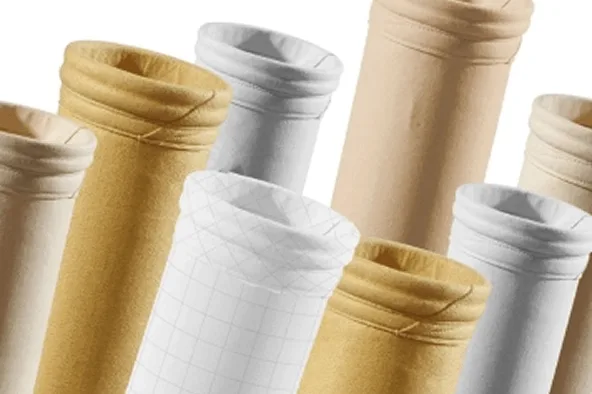
For moderate-temperature aluminum oxide or dry secondary dust, polyester with PTFE membrane may be enough if temperature and chemistry are stable. For hotter furnace fume, aramid, P84, fiberglass, or PTFE membrane media may be more suitable. For acidic, humid, sulfur-containing, or corrosive non-ferrous smelting gas, PPS/PTFE, PTFE, P84 composite, or fiberglass with PTFE membrane may need review. Omela’s existing metal filtration article also gives similar selection logic for aluminum melting furnace, electric arc furnace, zinc oxide, copper/lead smelting, and foundry dust applications.
Why PTFE Membrane Is Often Considered
Metal melting furnace dust is often fine, smoke-like, and difficult to clean after it penetrates into the depth of the felt. PTFE membrane helps keep fine dust on the surface of the media, improving surface filtration and dust cake release.
This is especially useful for fine metal oxide fumes, zinc oxide dust, strict emission limits, and systems where pressure drop rises quickly because fine dust enters the media. PTFE membrane does not solve every problem, but it can reduce deep dust penetration when the baghouse design, air-to-cloth ratio, and cleaning system are suitable.
For metal melting applications, PTFE membrane should be evaluated together with temperature, spark control, bag handling, cage smoothness, and compressed air quality. A damaged membrane can lose its advantage quickly if the cage is rough, the inlet velocity is too high, or hot particles are not controlled.
Hot Particles, Sparks, and Inlet Protection
Hot particles and sparks are a major risk in furnace dust collection. A filter bag may have the correct temperature rating but still fail if sparks or glowing particles hit the bag surface.
Spark damage often appears as small pinholes, burned spots, or localised bag failure. These failures may look like material defects at first, but the real problem may be hot particle carryover, poor duct design, insufficient cooling, or inadequate spark arresting before the baghouse.
For metal melting furnace systems, spark risk should be controlled at the system level. That may involve hoods, spark arrestors, drop-out boxes, inlet baffles, dilution air, temperature monitoring, explosion protection, and correct duct velocity. The filter bag is the final filtration surface; it should not be treated as the only defence against sparks.
Temperature Control and Dew Point Risk
Temperature control is one of the most important factors in furnace baghouse reliability. If the gas is too hot, the filter media can shrink, harden, melt, weaken, or burn. If the gas temperature drops too low, moisture and acid components may condense and cause bag blinding, corrosion, and sticky dust cake.
EPA notes that fabric filters are susceptible to high-temperature damage, while low temperatures may allow acid gases to condense, corrode metal parts, and cause bag blinding that blocks airflow.
For metal melting furnaces, temperature should be measured as both continuous operating temperature and peak temperature. Charging, melting, alloying, fluxing, tapping, and shutdown cycles can produce different temperature profiles. A filter bag selected only by average temperature may fail during peak conditions.
Baghouse Design Matters as Much as Filter Media
A good filter bag cannot fix a poorly designed dust collection system. Furnace smoke capture depends on hood position, capture velocity, duct design, fan capacity, inlet temperature, spark control, and airflow balance.
If the hood does not capture smoke effectively, fugitive emissions remain in the shop. If inlet velocity is too high, abrasive dust can attack the bags. If the air-to-cloth ratio is too high, pressure drop rises quickly and cleaning becomes aggressive. If the pulse-cleaning system is unstable, dust cake may not release evenly.
EPA lists pressure differential, outlet particulate concentration, inlet temperature, temperature differential, exhaust flow, cleaning mechanism operation, and fan current as useful performance indicators for fabric filters. For metal melting furnaces, these indicators should be tracked because furnace conditions can change quickly.
Case Lessons from Industry and Regulatory Sources
Case Lesson 1: Iron and Steel Foundries Need HAP Control
EPA identifies iron and steel foundries as major sources of hazardous air pollutants and notes that these foundries melt scrap, ingot, and other iron or steel forms before pouring molten metal into moulds. The HAPs include metal and organic compounds, with metal HAPs such as lead, manganese, cadmium, chromium, and nickel depending on casting type.
The lesson for filter bag selection is that furnace dust collection is not only a housekeeping issue. In many foundry systems, emission control and leak prevention are tied to worker exposure and environmental compliance.
Case Lesson 2: Foundry Airborne Hazards Are Mixed, Not Single-Source
NIOSH foundry control guidance states that airborne hazards in foundries can include metal fumes and dusts such as lead, nickel, and chromium, combustion and decomposition products from mould and core materials, and silica exposure from casting cleaning operations.
The lesson is that a furnace baghouse may handle metal fume, but the overall foundry dust-control plan must consider the specific process section. Melting, pouring, shakeout, grinding, sand handling, and finishing may require different capture and filtration strategies.
Case Lesson 3: Secondary Lead Smelters Need Careful Dust Collection Maintenance
OSHA’s secondary lead smelter guidance states that furnace flue gases and ventilation air may be routed to cyclones, scrubbers, and baghouses for particulate removal. It also warns that dust collection systems can become a significant lead exposure source if not properly operated, cleaned, and maintained.
The lesson is that filter bag selection must be paired with safe dust handling, hopper discharge, maintenance procedures, and leakage control.
Case Lesson 4: Fabric Filter Performance Depends on Dust Cake and Cleaning
EPA explains that fabric filter performance for small micrometer and sub-micrometer particles depends on dust cake, and that pressure drop increases as dust builds up. Cleaning method and frequency affect filter operation.
The lesson is that low emissions are not achieved by media alone. Dust cake control, pulse cleaning, and pressure drop stability are part of the same system.
Application-Based Selection Logic
For electric arc furnace and induction furnace fume, the main issues are fine metal oxide smoke, hot particles, temperature fluctuation, and spark risk. P84, PTFE membrane, aramid, PPS/PTFE, or fiberglass-based media may be evaluated depending on temperature and chemistry.
For aluminum melting furnace dust collection, the gas may be moderate in temperature, while the dust is often fine aluminum oxide and can be abrasive. Polyester with PTFE membrane may work in stable moderate conditions, while aramid or higher-temperature media should be reviewed when temperature peaks are higher.
For copper, lead, zinc, and other non-ferrous smelting applications, heavy metal dust, corrosion, moisture, and strict emissions become more important. PTFE, PPS/PTFE, P84 composite, fiberglass with PTFE membrane, and corrosion-resistant cages may be more suitable than ordinary polyester.
For foundry melting and pouring, filter bag choice depends on whether the dust stream is mainly hot metal fume, sand-related dust, grinding dust, or mixed shop ventilation. A single plant may need different bags for furnace fume extraction, shakeout, and finishing.
Common Problems and Practical Corrections
| Problem | Likely Cause | Practical Correction |
| Visible smoke at outlet | Bag leaks, poor sealing, fine dust penetration | Check snap band, tubesheet, membrane media, and leak detection |
| High pressure drop | Fine oxide dust, blinding, high air-to-cloth ratio | Use surface filtration, review cleaning, reduce filtration velocity |
| Burn holes or pinholes | Sparks or hot particle carryover | Improve spark arresting, inlet protection, and temperature monitoring |
| Short bag life | Wrong media, abrasion, temperature peaks, damaged cages | Review media, cage finish, inlet velocity, and peak temperature |
| Bag blinding | Moisture, acid dew point, sticky oxide dust | Control temperature, dew point, and use suitable surface treatment |
| Cage-line wear | Rusted, rough, or wrong-size cages | Replace cages or use coated/stainless cages |
| Dust re-entrainment | Hopper discharge or pulse-cleaning issue | Check hopper evacuation, pulse pressure, and airflow design |
The safest correction is not always to choose the most expensive filter bag. The right correction depends on the failure pattern.
To Request a Quote
For metal melting furnace filter bags, please send:
- Furnace type: induction furnace, electric arc furnace, cupola, aluminum melting furnace, copper/lead/zinc smelter, or other furnace
- Metal type and process section: melting, charging, tapping, pouring, dross handling, secondary fume extraction, or foundry ventilation
- Dust composition: iron oxide, aluminum oxide, zinc oxide, lead dust, copper dust, silica, flux, carbon, refractory dust, or mixed dust
- Continuous operating temperature and peak temperature
- Moisture, SOx, NOx, oxygen, acid gas, alkali, chloride, fluoride, or corrosive components
- Spark or hot particle risk
- Air volume, air-to-cloth ratio, and pressure drop trend, if available
- Bag diameter, length, top style, and bottom design
- Current filter bag material and service life
- Cage material, cage coating, and cage photos
- Main problem: smoke leakage, high DP, short life, spark holes, blinding, abrasion, or emissions
- Required outlet emission target
- Quantity and delivery destination
- Photos of used bags, dust cake, cages, tubesheet, and failure points
With this information, Omela can help compare polyester with PTFE membrane, aramid/Nomex, PPS, P84, PTFE, fiberglass, FMS, composite media, surface treatments, and matched cage options.
Omela Engineering View
Metal melting furnace filter bag selection should start from the real dust source, not only the furnace name.
Smoke from an electric arc furnace, oxide dust from an aluminum melting furnace, corrosive fume from a non-ferrous smelter, and mixed dust from a foundry line may all require different filter media. The right solution depends on temperature, dust fineness, gas chemistry, spark risk, moisture, abrasion, emission target, and baghouse cleaning method.
For fine smoke and low emissions, PTFE membrane and P84-type media are often worth reviewing. For hot dry gas, aramid or fiberglass-based media may be suitable. For acidic, moist, or chemically aggressive gas, PPS/PTFE or PTFE may be safer. For abrasive furnace dust, cage quality, inlet design, and filter media weight must be checked together.
The goal is not only to install a filter bag that survives heat. The real goal is to control smoke, capture fine metal oxide dust, reduce pressure drop instability, prevent spark-related holes, protect cages and bags from corrosion, and keep the baghouse reliable over a predictable service interval.
FAQ
What filter bag material is best for metal melting furnaces?
There is no single best material for all metal melting furnaces. Polyester with PTFE membrane may work for moderate dry dust, while aramid, PPS, P84, PTFE, fiberglass, or FMS may be needed for higher temperature, fine metal oxide smoke, acidic gas, moisture, sparks, or stricter emission limits.
What dust comes from metal melting furnaces?
Metal melting furnaces may generate smoke, fine metal oxide dust, hot particles, flux residues, refractory dust, silica-containing dust, carbonaceous particles, and heavy metal dust depending on the metal, furnace type, charge material, and process section.
Why do metal furnace filter bags fail early?
Common causes include high temperature peaks, sparks or hot particles, abrasive oxide dust, wrong filter media, high air-to-cloth ratio, poor pulse cleaning, moisture condensation, acid dew point, damaged cages, and poor installation.
Is PTFE membrane useful for metal oxide dust?
Yes. PTFE membrane can help keep fine metal oxide dust on the surface of the filter media, reduce deep dust penetration, improve pulse cleaning, lower emissions, and reduce blinding risk when the baghouse design is suitable.
How can hot particles be controlled before the baghouse?
Hot particles should be controlled with system-level protection such as spark arrestors, drop-out boxes, inlet baffles, proper duct velocity, cooling, temperature monitoring, and good hood design. Filter bags should not be the only protection against sparks.
What information is needed to quote metal melting furnace filter bags?
Provide furnace type, metal type, dust composition, continuous and peak temperature, gas chemistry, spark risk, bag size, cage condition, cleaning method, pressure drop trend, emission target, quantity, and failure photos.
Can one filter bag specification be used for the whole foundry?
Usually not. A foundry may have melting, pouring, shakeout, sand handling, grinding, and finishing dust collectors. Each section can have different temperature, dust size, abrasion, gas chemistry, and filtration requirements.
Author

Jessica Ma – Senior Filtration Engineer, Omela Filtration
Jessica Ma is a senior filtration engineer at Omela Filtration, specializing in dust and liquid filtration. With over 15 years of experience, she focuses on optimizing baghouse performance, enhancing filtration efficiency, and developing high-performance solutions for industrial dust collectors and precision liquid filtration applications.