
Key Takeaways
- A laser cutting dust collector normally begins with a cutting table or machine enclosure and must manage fine metal fume together with oxide dust, sparks, hot particles, and sometimes heavier cutting debris.
- Cartridge dust collectors can be used for both laser cutting and welding fume, but similar filter technology does not mean the two systems should use the same source capture, airflow, ductwork, or spark-control strategy.
- Metalworking and welding fume filtration should be designed around the process source. Manual welding depends heavily on hood position and capture distance, while laser cutting depends more on table zoning, duct resistance, filter loading, and hot-particle control.
- Welding fume can contain extremely fine particulate, so capturing the plume close to the weld is usually more important than simply increasing total collector airflow.
- Laser cutting commonly places greater demands on spark and hot-particle management because the extraction stream may contain fine fume, cutting dust, slag, sparks, and molten fragments at the same time.
- One centralized collector can sometimes serve laser cutting and welding, but only when simultaneous airflow, branch balance, contaminant compatibility, filter area, spark risk, pressure drop, and maintenance have been reviewed together.
Similar Filter Technology Does Not Mean the Same System
A laser cutting dust collector and a welding fume collector can look very similar.
Both may use pleated filter cartridges.
Both may use pulse-jet cleaning.
Both require a fan, differential-pressure monitoring, dust discharge, and a clean-air outlet.
But the most important differences usually occur before the contaminated air reaches the cartridges.
Laser cutting normally takes place over a defined table or within a machine enclosure. Manual welding may move across a large structure. Robotic welding takes place at repeatable locations. Laser welding may operate inside an enclosed robotic cell.
The source geometry changes, so the capture strategy changes.
| Design Factor | Laser Cutting | Welding |
|---|---|---|
| Typical source capture | Zoned cutting table or machine enclosure | Fume arm, fume gun, hood, backdraft or enclosed cell |
| Main particulate | Fine oxide fume plus cutting dust | Very fine condensed welding fume |
| Larger material | Slag and cutting debris may enter the system | Usually lower bulk solids loading |
| Spark exposure | Often important | Strongly process-dependent |
| Main airflow challenge | Table zoning and installed static pressure | Hood position and capture distance |
| Filter challenge | Fine dust loading plus hot-particle exposure | Fine fume and media cleanability |
| Typical system | Fixed or centralized cartridge collector | Portable, local or centralized extraction |
Neither system is universally more demanding.
They are simply solving different source-capture problems.
Laser Cutting Starts with the Cutting Table
For a flatbed fiber laser, the extraction system begins at the cutting table.
Smoke and fine particulate are generated around the active cutting point and are normally drawn downward or sideways into an extraction chamber.
Large tables often use multiple zones.
Instead of pulling maximum airflow through the entire bed simultaneously, the system opens the section closest to the cutting head.
This concentrates suction where the process is actually generating smoke.
A typical airflow path is:
Cutting Table → Active Damper → Ductwork → Spark Control → Cartridge Collector → Fan → Exhaust
This makes laser cutting dust collection closely connected to machine design.
If table zoning is poor, increasing filter efficiency will not improve source capture.
If duct resistance is underestimated, the fan may not deliver enough airflow at the table.
If hot particles travel too directly into the collector, changing cartridges will not remove the upstream ignition path.
The collector therefore has to be considered as part of the complete laser-machine extraction system.
Welding Fume Capture Depends More on the Position of the Hood
Manual welding creates a much more localized source.
The plume rises from the welding arc, often close to the operator’s breathing zone.
An extraction arm or hood therefore needs to influence the air very close to the weld.
This creates an important difference from laser cutting.
A laser table may require several thousand cubic meters per hour across a controlled extraction zone.
A welding arm may use a much smaller total airflow but still fail if the hood is positioned too far away.
This is why total fan capacity is a weak indicator of welding extraction performance.
A large collector connected to a badly positioned arm can still allow the plume to pass directly through the welder’s breathing zone.
The practical objective is:
capture the fume before it reaches the operator, rather than trying to clean it after it has dispersed through the workshop.
More Airflow Is Not Always Better for Welding
Welding source capture requires balance.
Too little airflow cannot pull the plume toward the hood.
But unnecessarily high air velocity around some gas-shielded welding operations can disturb shielding gas and affect weld quality.
The design objective is therefore not maximum suction.
It is enough capture velocity, applied at the correct location, to move the contaminant away from the breathing zone without interfering with the process.
This is one reason why hood shape and working distance can matter as much as fan power.
Flexible extraction arms can be effective when operators consistently reposition them.
They become much less effective if production requires frequent movement and the hood remains several feet away from the active weld.
Laser Welding Is Not the Same as Laser Cutting
The term “laser” can create confusion.
Laser cutting removes material.
Laser welding joins material.
Their extraction strategies can therefore be very different.
Robotic laser welding is commonly performed inside an enclosure. Very fine fumed particulate can accumulate within that enclosure if ventilation is insufficient.
This contamination matters not only for worker exposure when the enclosure is accessed but also for process reliability.
Fume accumulation around the optical system can interfere with the laser path and contaminate lenses or other components.
For this reason, laser-welding extraction resembles an enclosed robotic welding system much more closely than a flatbed laser cutting table.
The correct classification should always follow the process and contaminant path, not simply whether a laser is involved.
Fine Metal Fume Changes Filter Behavior
Both laser cutting and welding can generate extremely fine particulate.
However, the complete dust stream is often different.
Laser cutting may send fine oxide fume, cutting dust, sparks, slag fragments, and hot particles toward the extraction system.
Welding fume is generated mainly by vaporization and condensation of metals and welding consumables.
Its composition depends on the base material, filler, electrode, coating, welding method, and operating parameters.
Stainless steel, galvanized material, mild steel, aluminum, painted components, and coated sheet should not automatically be treated as identical fume streams.
This matters when choosing cartridge media.
Filtration efficiency is important, but so are dust release, surface loading, oil or moisture contamination, pulse-cleaning response, and resistance to the actual process conditions.
A highly efficient filter that cannot release the collected fume effectively can still develop high differential pressure quickly.
Welding Fume Can Include More Than Particulate
A cartridge filter primarily removes particles.
Welding can also generate gases, vapors, aerosols, and contaminants from coatings or residues.
This distinction becomes especially important when welding painted, oily, galvanized, coated, or plastic-containing components.
Capturing visible smoke does not automatically mean every contaminant has been removed.
This can affect decisions about outdoor exhaust, indoor recirculation, additional filtration stages, or process preparation.
The system design should therefore begin with the actual emission profile rather than assuming that all visible welding smoke behaves like dry metal dust.
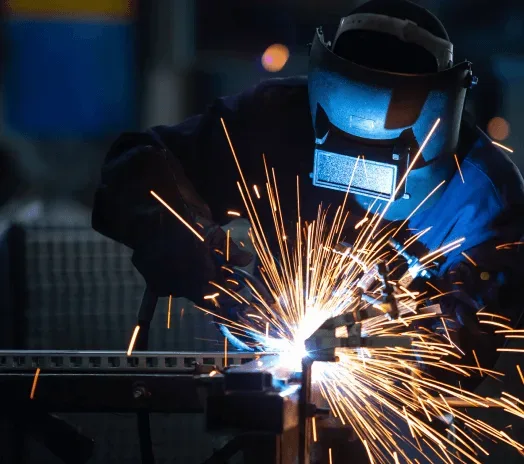
Spark Control Usually Has a More Obvious Role in Laser Cutting
Laser cutting commonly generates sparks and hot fragments that enter directly into the extraction path.
The table itself provides the first level of separation by allowing larger material to fall out.
Additional baffles, direction changes, spark-control devices, or pre-separation can reduce the amount of hot material reaching the filter cartridges.
This should occur upstream.
A filter cartridge should not become the first spark barrier.
Welding systems can also generate sparks and hot particulate, but exposure varies considerably between TIG, MIG, flux-cored welding, robotic welding, laser welding, and other processes.
The correct question is therefore not simply:
Does welding need spark control?
It is:
What ignition-capable particles can enter this particular extraction path?
Anti-Static and Flame-Retardant Media Solve Different Problems
Filter-media terminology should not be confused with complete system protection.
Anti-static media can support electrostatic-charge control when correctly integrated into a conductive system.
Flame-retardant media can provide improved resistance to ignition or flame propagation compared with untreated media.
Neither characteristic means that sparks can safely enter the filter section repeatedly.
Neither automatically makes the collector suitable for combustible metal dust.
Media properties should support the overall system design rather than replace upstream control.
Filter Area Matters in Both Systems
Airflow is only half of cartridge collector sizing.
The other major variable is available filter area.
If too much air passes through too little media, filtration velocity increases.
Fine particles may load the cartridges more aggressively, pressure drop may rise faster, pulse cleaning may become less effective, and source airflow can gradually decrease.
This affects both laser cutting and welding.
A continuously operating laser may generate a significant mass of fine oxide dust.
A welding process may generate less total particulate mass but extremely fine fume that challenges media cleanability.
Two collectors with the same fan airflow can therefore behave very differently if their media area and contaminant loading are different.
The useful comparison is not cartridge count alone.
It is:
airflow + effective filter area + contaminant load + cleaning behavior.
Pressure Drop Is More Useful Than Filter Age
Filter life measured in months can be misleading.
A collector operating two hours per day cannot be compared directly with one operating three shifts.
Production rate, material, process, airflow, media area, pulse pressure, compressed-air quality, and dust properties all affect cartridge life.
Differential pressure provides a better indication of what the system is doing.
A stable collector normally develops a recognizable operating range as dust accumulates and pulse cleaning removes part of the surface cake.
If the post-cleaning pressure baseline keeps increasing, the filters may be becoming permanently loaded.
If pressure suddenly rises after a production change, the contaminant stream may have changed.
If source capture becomes weaker while differential pressure increases, the fan may no longer have enough static-pressure margin for the loaded-filter condition.
The cartridge is therefore not only a consumable.
Its pressure behavior can also act as a diagnostic signal.
Published Metal Fabrication Application Lessons
Case 1: Welding Fume Extractors with Different Capture Performance
A published industrial hygiene evaluation studied portable local exhaust units used in an architectural metal fabrication shop.
Measurements were taken at a working distance of approximately 12 inches from the extraction hood, near the point where welding smoke was generated.
Two units produced capture velocities of approximately 100–135 fpm, while another unit produced only about 70 fpm.
The lower-performing system also required maintenance, including attention to filter condition.
Lesson: Welding fume extraction should be evaluated at the actual welding point. Collector size alone does not prove that adequate source capture exists.
Case 2: Different Processes Used Different Capture Strategies in One Fabrication Plant
A heavy-equipment manufacturing facility had both manual welding and laser cutting operations.
Instead of connecting every process to one identical capture arrangement, the plant used source-capture fume guns for manual welding, a dedicated source-capture collector for laser cutting, and ambient filtration to reduce residual workshop haze.
This created a layered air-quality strategy.
Manual welding fumes were captured close to the source, the laser machine had a collector matched to the cutting process, and room filtration handled particulate that escaped primary capture.
Lesson: One metal fabrication shop does not necessarily need one identical extraction method. Source capture can be selected process by process and then supported by facility-level filtration.
Case 3: Steel and Aluminum Shared a Laser Cutting Collection System
A documented laser cutting incident involved cold-rolled steel and aluminum processed through the same laser and attached dust collection system.
The collection system was not adequately cleaned when production changed between the two metals.
A fire subsequently developed inside the dust collector and the metal duct connecting the laser to the collector.
The important issue was not simply filter efficiency.
Residual dust, material changeover, ignition sources, ductwork, and collector configuration all played a role in the hazard.
Lesson: A laser machine can switch materials quickly, but the extraction system still contains the history of previous production. Mixed-metal operation should include cleaning and compatibility review.
Can One Collector Serve Laser Cutting and Welding?
Sometimes it can.
A centralized cartridge collector can serve different branches when the complete network has been designed for the expected operating conditions.
But sharing a collector should not be assumed merely because both processes generate metal fume.
A laser cutting branch may require relatively high airflow through an active table zone.
A welding arm may use lower volume but depend strongly on local capture velocity.
When multiple branches operate together, the fan has to satisfy the combined airflow and static-pressure requirements.
When some branches are closed, damper control must prevent unnecessary airflow from being wasted through inactive stations.
Material compatibility and spark exposure also matter.
A central system that performs well hydraulically can still be inappropriate if incompatible dusts or ignition conditions are being combined.
Source Capture and Ambient Filtration Are Not the Same Control
Source capture removes contamination before it spreads.
Ambient filtration removes contamination after some of it has already entered the room air.
Both can be useful.
Laser machines often make source capture relatively straightforward because the process occurs within a defined machine table or enclosure.
Large manual welding operations can be more difficult because the operator and welding location move continuously.
In those facilities, properly designed ambient filtration may help reduce background haze.
But ambient filtration should normally support practical source capture rather than replace it.
Preventing fume from reaching the general workspace is usually more efficient than collecting it after dilution into a much larger air volume.
Maintenance Should Follow the Process
Laser cutting systems often require attention to table debris, duct deposits, spark-control components, collector inlets, filter cartridges, hoppers, and dust bins.
Welding systems may require more frequent inspection of flexible hoses, extraction arms, fume-gun nozzles, branch dampers, hood position, and filters loaded with very fine fume.
Both systems need pressure-drop monitoring and appropriate cartridge maintenance.
But a universal rule such as “replace the filters every six months” is weak.
Condition, operating hours, pressure-drop history, process loading, and visible system performance provide much more useful maintenance information.
How to Compare Laser Cutting and Welding Fume Collection
- Identify the source geometry. Determine whether the contaminant comes from a laser table, manual weld, robotic cell, laser-welding enclosure, or several sources operating simultaneously.
- Understand the contaminant stream. Review fine fume, oxide dust, slag, sparks, coatings, oil, gases, and any metal-specific dust concerns.
- Choose the capture method before the collector. Match table extraction, fume arm, fume gun, hood, backdraft, or enclosure extraction to the actual source.
- Calculate installed airflow and resistance. Include ductwork, branches, dampers, spark-control components, loaded filters, and the outlet path.
- Match filter media and filter area. Consider particulate size, surface loading, pulse-cleaning response, oil or moisture exposure, and desired pressure stability.
- Review the real operating pattern. Consider simultaneous machines, material changes, filter loading, maintenance access, collected-dust handling, and future production changes.
Final Engineering View
Laser cutting dust collectors and welding fume collectors often use similar core filtration technology.
That does not make them the same system.
Laser cutting commonly follows:
Cutting Table → Zoned Extraction → Ductwork → Spark Control → Cartridge Collector
Manual welding is more likely to follow:
Weld Point → Fume Arm / Fume Gun / Hood → Ductwork → Collector
Robotic or laser welding may follow:
Enclosed Cell → Controlled Extraction → Central or Dedicated Collector
The real difference lies in the path the contaminant takes before it reaches the cartridge.
For laser cutting, table airflow, hot particles, duct resistance, material changes, and fine dust loading often dominate the design.
For welding, hood position, breathing-zone control, ultrafine fume, process mobility, coatings, and operator behavior may matter more.
Some fabrication plants can successfully combine both processes into a centralized system.
Others benefit from dedicated source-capture systems.
The useful question is therefore not:
“Can we use the same dust collector for laser cutting and welding?”
It is:
“Can one system maintain the correct source capture, airflow, filtration, spark control, contaminant compatibility, and pressure conditions for every connected process?”
If the answer is yes, centralization may be practical.
If the requirements conflict, separate collectors are not unnecessary duplication.
They are different engineering solutions for different contaminant sources.
Frequently Asked Questions
Is a laser cutting dust collector the same as a welding fume collector?
No. Both may use cartridge filtration, but their source capture and contaminant streams differ. Laser cutting commonly uses table or enclosure extraction and can involve fine fume, sparks, slag, and cutting debris. Welding extraction is normally designed to capture fine fume near the weld or within a welding enclosure.
Can the same filter cartridges be used for laser cutting and welding?
Sometimes, but it should not be assumed. Filter selection depends on particulate size, dust loading, surface characteristics, spark exposure, oils or coatings, filtration efficiency, pulse-cleaning behavior, and actual operating conditions.
Why is hood position so important for welding?
Local exhaust influence decreases as the hood moves away from the fume source. Keeping the extraction point close to the welding plume helps capture contamination before it passes through the breathing zone or disperses into the workshop.
Does laser cutting need spark control?
Many laser cutting processes generate sparks and hot particles that can enter the extraction system. Depending on material, cutting conditions, dust characteristics, and system design, upstream hot-particle or spark control may be needed before the filter section.
Can welding and laser cutting share one central collector?
They can in some facilities, provided airflow, branch balance, simultaneous operation, filter area, spark conditions, dust compatibility, pressure drop, controls, and maintenance requirements are evaluated together.
Can ambient filtration replace welding source capture?
Ambient filtration can reduce residual workshop haze but does not automatically replace practical local source capture. Capturing fumes before they spread through the facility usually reduces the contaminant load more effectively.
Author

Jessica Ma – Senior Filtration Engineer, Omela Filtration
Jessica Ma is a senior filtration engineer at Omela Filtration, specializing in dust and liquid filtration. With over 15 years of experience, she focuses on optimizing baghouse performance, enhancing filtration efficiency, and developing high-performance solutions for industrial dust collectors and precision liquid filtration applications.