
Key Takeaways
- Laser cutting dust collection is not one fixed equipment type. It can be designed as a zoned downdraft table system, enclosed extraction system, cartridge dust collector, portable fume extractor, central dust collection system, or hybrid spark-control system.
- The right type depends on cutting table size, enclosure condition, material type, smoke volume, spark risk, dust loading, working hours, workshop layout, and maintenance plan.
- For flatbed fiber laser cutting, a laser cutting dust collector usually combines table extraction, ductwork, spark control, filter cartridges, pulse cleaning, fan system, dust discharge, and differential pressure monitoring.
- Cartridge dust collectors are widely used in laser cutting because pleated filter cartridges provide large filtration area in a compact structure.
- Portable fume extractors are useful for small or temporary jobs, but continuous cutting lines usually need a fixed downdraft, enclosed, or central dust collection system.
- Spark-control design should be reviewed before filter selection because filter cartridges should not be the first defense against sparks and hot particles.
Choosing the Right Extraction Layout for Laser Cutting Smoke
Laser cutting creates smoke, metal fume, fine oxide particles, sparks, and small slag fragments. These contaminants do not behave like ordinary workshop dust. Fine metal fume can stay suspended in the air, while hot particles may damage filter cartridges if they reach the filtration section too directly.
A small enclosed laser machine, a large flatbed fiber laser table, a multi-machine fabrication workshop, and a high-duty aluminum cutting line may all need different dust collection layouts.
The right dust collector type should match the smoke source, cutting table structure, material type, production duty, and spark risk.
This article explains the main laser cutting dust collector types and shows where each type is more suitable.
Main Laser Cutting Dust Collector Types
| Type | Best-Fit Application | Main Strength | Main Watch Point |
|---|---|---|---|
| Zoned downdraft table + collector | Flatbed fiber laser cutting tables | Captures smoke from below the active cutting zone | Table zoning and airflow balance must be correct |
| Enclosed extraction system | Enclosed laser cutting machines | Contains smoke inside a closed working space | Needs controlled negative pressure and clean exhaust path |
| Cartridge dust collector | Fine dry metal fume and compact workshop layouts | Large filter area in a compact body | Fine fume, oil mist, and sparks can shorten cartridge life |
| Portable fume extractor | Small machines, repair work, temporary stations | Flexible and easy to move | Limited airflow and filter capacity |
| Central dust collection system | Multiple cutting machines or production lines | One system can serve multiple cutting points | Requires duct balancing and simultaneous-operation review |
| Hybrid spark-control system | Heavy smoke, sparks, mixed metals, high load | Combines pre-separation, spark control, and cartridge filtration | More design details and maintenance planning required |
No single layout fits every laser cutting workshop. The correct choice comes from the cutting table, production duty, material mix, available space, airflow requirement, and maintenance capability.
Zoned Downdraft Table with Cartridge Dust Collector
A zoned downdraft table is one of the most common layouts for flatbed fiber laser cutting. Smoke is pulled downward through the cutting table instead of rising into the workshop.
In a zoned system, only the active cutting area is extracted strongly. This avoids pulling air through the entire table at the same time. For large cutting tables, this can reduce total air volume demand and improve source capture.
A well-zoned downdraft table can often capture smoke better with less total airflow than a poorly zoned full-table extraction system.
This layout is suitable for carbon steel, stainless steel, aluminum, galvanized sheet, and general sheet-metal fabrication. The final design should still review material type, plate thickness, cutting speed, spark risk, and filter cartridge loading.
The collector should not be considered separately from the table. The table chamber, duct connection, damper movement, active extraction zone, fan static pressure, and filter area all affect the final result.
Enclosed Laser Cutting Extraction System
Some laser cutting machines are enclosed or semi-enclosed. In these systems, the extraction system pulls smoke from the machine enclosure and keeps the cutting chamber under controlled negative pressure.
This layout is useful when the machine structure already helps contain smoke. Instead of relying only on open table capture, the enclosure limits smoke spread and guides airflow toward the extraction point.
An enclosed system works best when the enclosure, airflow path, and exhaust point are designed together.
If the enclosure has too many leakage points, smoke may still escape. If airflow is too weak, fumes may stay inside the machine. If airflow is excessive, it may increase filter loading or disturb the cutting environment.
Enclosed extraction is often suitable for compact laser machines, automatic cutting cells, or workshops where smoke containment and operator separation are important.
Cartridge Dust Collector
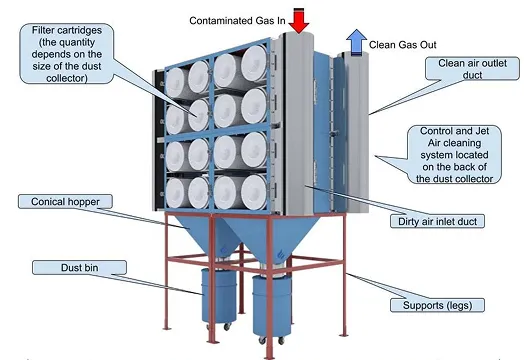
A cartridge dust collector uses pleated filter cartridges to capture fine particles. The pleated structure provides large filtration area inside a compact collector body, which is why cartridge collectors are widely used in laser cutting and metal fume applications.
For laser cutting, filter cartridges must handle fine metal fume, oxide dust, and repeated pulse cleaning. A good cartridge system should also monitor differential pressure so operators can understand when filters are loading, when cleaning is needed, and when replacement is approaching.
Cartridge collectors are strong for fine, dry fume, but they must be protected from sparks, sticky dust, and excessive loading.
If the cutting process produces oil mist, coating residue, moisture, or very high dust load, the cartridges may blind quickly. If sparks reach the media, burn marks or safety risks may appear. In these cases, spark control and pre-separation should be reviewed before simply changing cartridge media.
For related equipment selection, Omela’s cartridge dust collectors page can be used as an internal reference for cartridge orientation, pulse cleaning, differential pressure control, and dust discharge planning.
Portable Fume Extractor
A portable fume extractor is a small, movable extraction unit used for localized smoke and fume capture. It may be suitable for small laser marking, light-duty cutting, repair work, prototype stations, or temporary processing areas.
The main advantage is flexibility. The unit can be moved close to the work area and used where a fixed duct system is not practical.
The limitation is capacity.
Portable fume extractors are convenient, but they are not usually the best choice for large flatbed laser cutting or continuous high-load production.
A portable unit may have limited airflow, smaller filter area, shorter filter life, and less ability to handle sparks or heavy fume loading. If the workshop cuts metal every day for long shifts, a fixed downdraft, enclosed, or central system is usually more reliable.
Central Dust Collection System
A central dust collection system connects multiple cutting machines or extraction points to one larger collector through ductwork. This layout is useful when a workshop has several laser cutting machines, plasma cutting tables, welding stations, or metalworking processes in the same production area.
The advantage is centralized maintenance and system expansion. Instead of installing one collector for every machine, the workshop can manage filtration, dust discharge, and pressure monitoring in one area.
The challenge is airflow balance.
A central system should be sized by simultaneous operation, branch resistance, damper control, and pressure balance—not only total airflow.
If one branch pulls too much air, another machine may lose suction. If future equipment is added without checking fan pressure and duct capacity, smoke capture may become unstable. For central systems, duct design is as important as collector size.
Spark-Control and Hybrid Systems
Laser cutting can produce sparks and hot particles. In some workshops, the better solution is not only a cartridge collector, but a hybrid layout that includes spark reduction, pre-separation, cartridge filtration, and safe dust discharge.
Hybrid systems may include a downdraft table, spark trap, inlet baffle, drop-out chamber, cartridge collector, pulse cleaning, differential pressure monitoring, and final exhaust arrangement. The purpose is to reduce the load on the filter cartridges and control hot-particle risk before filtration.
Spark control should be designed before the filter cartridges, not after cartridge damage appears.
This layout is especially relevant for aluminum cutting, coated sheet cutting, oily material, galvanized sheet, mixed metals, and high-power continuous cutting. The more complex the dust stream, the more important system-level protection becomes.
How to Choose the Right Type
The best dust collector type depends on the real workshop condition. The same collector model may work well in one laser cutting line and perform poorly in another if table design, material type, duty cycle, or maintenance plan is different.
| Selection Question | If the Answer Is Yes | Better Direction |
|---|---|---|
| Is it a large flatbed cutting table? | Smoke comes mainly from the table surface | Zoned downdraft table + cartridge collector |
| Is the machine enclosed? | Smoke can be contained inside the machine body | Enclosed extraction system |
| Is the job small, temporary, or low-duty? | Mobility matters more than high capacity | Portable fume extractor |
| Are there multiple machines? | Several extraction points run in one workshop | Central dust collection system |
| Are sparks or hot particles frequent? | Filter cartridges show burn marks or spark risk is high | Spark-control or hybrid system |
| Is fine fume loading heavy? | Pressure drop rises quickly after replacement | More filter area, better media, or staged protection |
A practical selection should move from the cutting source outward: table capture, airflow path, ductwork, spark control, filter cartridges, fan, pressure drop, dust discharge, and maintenance access.
Omela Filtration Application Lessons
Case 1: Flatbed Cutting Table with Uneven Smoke Capture
A metal fabrication workshop had a large fiber laser cutting table. The collector was running, but smoke escaped from one side of the table.
The review showed that the issue was not only collector capacity. The active extraction zones were not balanced, and some table sections received much weaker suction than others.
Lesson: For flatbed laser cutting, table zoning can be as important as total airflow.
Case 2: Small Workshop Using a Portable Unit
A small workshop used a portable fume extractor for light cutting work. The unit was easy to move and useful for short jobs, but filter loading became too fast when cutting time increased.
The process changed from occasional cutting to regular production. The portable unit no longer had enough airflow or filter capacity for the new duty cycle.
Lesson: Portable extraction is useful for flexibility, but continuous production needs a fixed system review.
Case 3: Fast Cartridge Clogging in Mixed-Metal Cutting
A workshop cutting carbon steel, stainless steel, and coated sheet had frequent cartridge replacement. Differential pressure rose quickly, and pulse cleaning could not fully recover airflow.
The review focused on fine fume loading, dust release, oil or coating residue, airflow per cartridge, and compressed air quality.
Lesson: Cartridge collector performance depends on dust behavior, not only filter efficiency.
Case 4: Central System with Unbalanced Branches
A facility connected several cutting machines to one central collector. The total airflow looked acceptable, but one branch had strong suction while another had visible smoke escape.
The review focused on duct balance, damper logic, simultaneous machine operation, and static pressure.
Lesson: A central system must be balanced by branch demand, not only total collector capacity.
Case 5: Spark Damage on Filter Cartridges
A laser cutting line showed burn marks on cartridge media after processing spark-heavy materials. Replacing cartridges reduced the symptom temporarily but did not remove the cause.
The review pointed to hot particles reaching the filtration stage too directly. The solution direction focused on spark-control path, inlet protection, and safer dust discharge.
Lesson: Spark-control design should protect the cartridges before damage occurs.
Comparison: Which Type Fits Which Workshop?
| Workshop Situation | Recommended Direction | Why |
|---|---|---|
| Single flatbed fiber laser table | Zoned downdraft + cartridge collector | Good source capture and compact filtration |
| Enclosed laser cutting machine | Enclosed extraction | Uses machine enclosure to contain smoke |
| Small temporary cutting station | Portable fume extractor | Flexible and easy to relocate |
| Multiple cutting machines | Central system | Centralized filtration and maintenance |
| Aluminum or spark-heavy cutting | Spark-control / hybrid system | Protects filter cartridges from hot particles |
| Heavy fine fume and high duty cycle | Larger cartridge collector or fixed system | More media area and better pressure stability |
This comparison is a starting point, not a fixed rule. Final selection still depends on airflow, table design, material type, dust loading, static pressure, filter media, spark control, and operating schedule.
Common Mistakes When Choosing a Laser Cutting Dust Collector Type
Many dust collection problems come from selecting the system type too quickly.
One common mistake is using a portable unit for production cutting. It may work during testing but fail when cutting hours increase.
Another mistake is selecting a cartridge collector without checking spark-control requirements. If hot particles reach the cartridges, filter damage can appear even when airflow is correct.
A third mistake is sizing only by laser power. Laser power matters, but table size, material type, thickness, cutting speed, duty cycle, and extraction zone are just as important.
A fourth mistake is treating a central system as one big fan. In reality, each branch needs enough airflow, and the system must be balanced under real operating conditions.
The best collector type is the one that matches the smoke source, production pattern, safety risk, and maintenance strategy.
Information Needed Before Selection
Before choosing a laser cutting dust collector type, prepare:
- Laser machine type, power, cutting table size, and enclosure condition
- Material type, plate thickness, cutting speed, and daily working hours
- Smoke condition, such as visible escape, workshop haze, or weak suction
- Dust type, including carbon steel, stainless steel, aluminum, galvanized sheet, coated sheet, or mixed metals
- Spark history, burn marks, duct layout, available floor space, and future expansion plan
- Current collector type, filter cartridge size, cartridge quantity, pressure-drop trend, and service life
- Photos or videos of the cutting process, table structure, ductwork, collector, and used filters
This information helps decide whether the workshop needs a downdraft table system, enclosed extraction, portable fume extractor, cartridge collector, central system, or hybrid spark-control design.
Final Engineering View
Laser cutting dust collection should not start with the question:
“Which dust collector model should I buy?”
A better question is:
Which dust collection type matches the cutting source and workshop layout?
For flatbed cutting, zoned downdraft extraction may be the best starting point. For enclosed machines, controlled enclosure extraction may work better. For small temporary jobs, portable extraction may be enough. For multiple machines, a central system may reduce equipment duplication but requires duct balancing. For spark-heavy or high-duty cutting, hybrid spark-control and cartridge filtration should be reviewed together.
A well-selected laser cutting dust collector should capture smoke at the source, protect filter cartridges, control pressure drop, reduce spark risk, maintain workshop air quality, and keep maintenance predictable.
FAQ
What are the main types of laser cutting dust collectors?
The main types include zoned downdraft table systems, enclosed extraction systems, cartridge dust collectors, portable fume extractors, central dust collection systems, and hybrid systems with spark-control options.
Which dust collector type is best for flatbed fiber laser cutting?
A zoned downdraft table connected to a cartridge dust collector is often a practical direction for flatbed fiber laser cutting because it captures smoke near the active cutting area and uses cartridge filtration for fine metal fume.
Are portable fume extractors suitable for laser cutting?
Portable fume extractors can be useful for small, temporary, or low-duty laser cutting work. They are usually not ideal for large flatbed cutting tables or continuous production because airflow and filter capacity are limited.
When should a central laser cutting dust collection system be used?
A central system may be suitable when several cutting machines or workstations need dust collection in the same workshop. It requires careful duct balance, fan pressure review, and simultaneous-operation planning.
Why are cartridge collectors common in laser cutting?
Cartridge collectors are common because pleated filter cartridges provide large filtration area in a compact structure, making them suitable for fine dry metal fume when airflow, dust loading, pulse cleaning, and spark control are correctly matched.
Why is spark control important in laser cutting dust collectors?
Sparks and hot particles can damage filter cartridges and may create safety risks. Spark control should be placed before the filter cartridges through table design, pre-separation, baffles, spark traps, or other protection methods.
What information is needed to choose the right laser cutting dust collector type?
Provide laser power, table size, enclosure type, material type, thickness, cutting speed, working hours, smoke condition, spark history, duct layout, filter cartridge details, pressure-drop trend, and photos or videos of the process.
Author

Jessica Ma – Senior Filtration Engineer, Omela Filtration
Jessica Ma is a senior filtration engineer at Omela Filtration, specializing in dust and liquid filtration. With over 15 years of experience, she focuses on optimizing baghouse performance, enhancing filtration efficiency, and developing high-performance solutions for industrial dust collectors and precision liquid filtration applications.