
Key Takeaways
- Industrial filter cartridges serve different functions throughout food and beverage processing, from process-water particulate removal and beverage clarification to membrane protection and final filtration before filling. Each stage should be selected according to the contaminants it receives and the quality required downstream.
- Melt-blown filter cartridges can provide economical depth filtration for process water and certain prefiltration duties, helping reduce suspended-solids loading before finer filtration equipment.
- Pleated membrane filter cartridges are used in critical fine and final filtration where controlled particle retention, microbial reduction, and product quality are important. Final membrane performance depends heavily on effective upstream clarification and prefiltration.
- High flow filter cartridges may be useful for high-throughput process-water treatment, provided their materials, retention ratings, hygienic design, and operating conditions match the application.
- Beverage clarification, membrane protection, and final filtration are not interchangeable. Clarification reduces haze and suspended material, prefiltration protects downstream membranes, and validated final filtration may control specific spoilage microorganisms before packaging.
- Micron rating alone cannot determine filter performance. A reliable filtration train must balance flow rate, product viscosity, pressure drop, contaminant loading, filtration efficiency, hygiene, membrane integrity, and operating cost.
Why Food and Beverage Filtration Should Be Designed as a Process Train
Food and beverage filtration is often discussed in terms of individual products: depth cartridges, pleated filters, membrane cartridges, or high-flow elements. In actual production, however, the position of the cartridge within the process is usually more important than the product category itself.
A beverage plant may need to remove sediment from incoming process water, clarify a liquid ingredient, protect a final membrane from rapid fouling, and control microorganisms before filling. Although these operations all involve filtration, they do not require the same retention efficiency, media construction, or hygienic controls.
A typical beverage filtration train may follow this sequence:
Process Water Treatment → Beverage Clarification → Fine Prefiltration → Membrane Protection → Final Filtration → Filling
Not every production line requires every stage, and some processes use centrifugation, crossflow filtration, clarification agents, thermal treatment, or other technologies alongside cartridge filtration.
The important principle is that each stage should remove the contaminant fraction it handles most effectively while protecting the next stage from unnecessary loading.
If the first stage is too fine, cartridges may clog frequently. If prefiltration is inadequate, the final membrane may experience excessive pressure drop. If final filtration is selected only for visual clarity, the finished beverage may still fail its microbiological requirements.
A successful filtration train therefore connects product quality, hydraulic performance, hygiene, and operating efficiency rather than treating them as separate design decisions.
Where Cartridge Filters Fit in the Production Process
The filtration objective changes as the beverage moves closer to filling.
| Filtration Stage | Main Objective | Typical Filtration Approach | Main Design Concern |
|---|---|---|---|
| Process water | Remove sediment and particulate contaminants | Depth or high-flow cartridges where appropriate | Water quality and flow demand |
| Beverage clarification | Reduce suspended solids, yeast, pulp, or haze-forming particles | Clarification followed by depth or pleated filtration | Product appearance and solids loading |
| Membrane protection | Reduce particles and colloidal load entering the final membrane | Fine depth or pleated prefilter | Final membrane service life |
| Final filtration | Achieve specified particle or microbial retention | Validated membrane cartridge when required | Retention, integrity, and hygiene |
| Filling-line protection | Prevent recontamination before packaging | Sanitary transfer and controlled filling | Downstream hygienic control |
This arrangement explains why the finest cartridge should not automatically be installed at the beginning of the production line.
The quality of the liquid entering each stage determines how effectively that stage can perform its intended function.
Process Water Filtration: Start with the Water’s Intended Use
Process water is one of the largest filtration applications in food and beverage production, but not all process water has the same requirements.
Water may be used directly as a beverage ingredient, for mixing syrups, washing raw materials, rinsing equipment, preparing cleaning solutions, or supplying utility systems. The quality required depends on whether the water becomes part of the final product, contacts food-contact surfaces, or serves a non-product utility function.
Incoming water may contain rust, sand, sediment, pipe scale, or other suspended particles. Depth cartridges can help remove these materials and protect downstream treatment equipment.
For high-flow applications, larger pleated cartridges may reduce the number of elements and simplify replacement.
However, cartridge filtration does not automatically make water microbiologically safe, nor does it remove dissolved hardness, salts, or all organic contaminants.
Where the plant requires demineralized or more tightly controlled ingredient water, additional treatment such as activated carbon adsorption, softening, RO, UV treatment, or another validated process may be necessary.
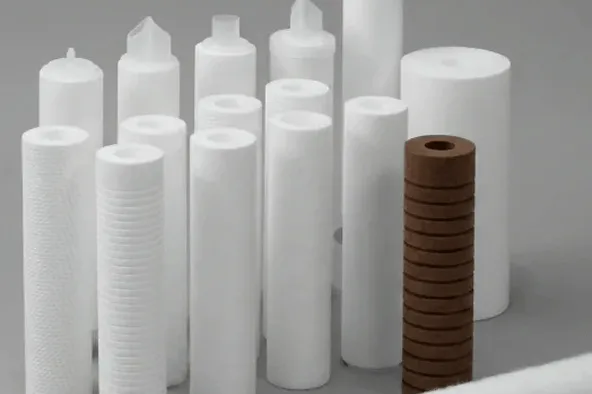
Process-water filtration should be selected according to the water-quality specification and intended use, rather than assuming that every water line requires the same cartridge rating.
Beverage Clarification Is Different from Final Filtration
Clarification focuses primarily on the physical and visual characteristics of the beverage.
Depending on the product, the process may need to reduce suspended pulp, yeast, protein aggregates, sediment, processing residues, or haze-forming material.
For example, clarified juice may require removal of fine pulp and suspended solids, while beer and wine filtration can involve yeast, colloids, and particles remaining after fermentation and maturation.
These materials behave differently inside filter media.
Rigid particles may form a relatively permeable filter cake. Soft particles, proteins, and colloidal material can produce dense deposits that increase differential pressure quickly.
This is why the filtration behavior of a beverage cannot always be predicted from its visible turbidity alone.
A liquid that appears reasonably clear may still contain colloids capable of blocking a fine membrane.
Clarification therefore has two connected objectives: achieving the desired product appearance and reducing the contaminant load reaching downstream filtration.
The second objective becomes especially important when a final membrane is installed before filling.
Why Clarification Should Not Be Expected to Guarantee Microbial Stability
A beverage can become visually clear while still containing microorganisms.
Clarification may reduce yeast and bacterial loading, but it does not automatically provide the validated microbial retention required for a critical final filtration step.
Likewise, a membrane selected for microbial reduction does not necessarily remove every dissolved haze precursor or prevent all future precipitation.
These are different separation mechanisms.
The required strategy depends on product formulation, desired shelf life, packaging, storage conditions, microbiological risk, and whether thermal or nonthermal microbial controls are also used.
For this reason, clarity, microbial stability, and shelf life should be evaluated as related but separate product-quality objectives.
Membrane Protection: Why Prefiltration Matters
Final membrane cartridges are generally selected for relatively precise retention rather than for capturing the entire solids load of an unfinished beverage.
If a fine membrane receives large amounts of pulp, protein aggregates, yeast, gels, or colloidal material, differential pressure may rise rapidly.
The membrane can then become the most expensive solids-removal stage in the process.
Prefiltration prevents this by reducing the particulate burden before the final filter.
A practical sequence might use an initial clarification process, followed by a depth or pleated cartridge, and then a final membrane cartridge where required.
The exact arrangement depends on product characteristics and downstream retention requirements.
The purpose of a prefilter is not simply to add another filter housing. It is to protect the performance, capacity, and service life of the final stage.
A well-matched prefilter can reduce membrane fouling, stabilize pressure drop, and decrease the frequency of final membrane replacement.
However, excessively tight prefiltration can create its own operating problems, so the goal should be balanced loading across the complete process.
Final Membrane Filtration: Retention Must Match the Product Requirement
Final filtration is the last critical filtration stage before the product enters the filling process or another controlled downstream operation.
At this stage, the objective may include fine-particle removal, reduction of spoilage organisms, or a specified microbial retention requirement.
Pleated membrane cartridges are commonly used because their pore structure can provide more clearly defined retention characteristics than general-purpose depth filters.
For many aqueous beverages, hydrophilic membrane materials such as PES are considered because of their flow characteristics and suitability for water-based liquids.
However, membrane chemistry, pore size, adsorption characteristics, food-contact suitability, and cleaning compatibility must still be reviewed.
A 0.45 µm membrane and a 0.2 µm membrane are not automatically interchangeable, and neither micron number alone proves that a beverage will meet a specified microbiological standard.
Critical microbial filtration requires an appropriate validated retention claim, suitable operating conditions, and an integrity-testing strategy where applicable.
Final filtration also depends on hygienic handling after the membrane. If the downstream pipework or filling equipment introduces contamination, the performance of the membrane upstream cannot guarantee final product quality.
Micron Rating Should Follow the Function of Each Stage
It is tempting to arrange a beverage filtration system simply by decreasing micron size from one filter to the next.
Although coarse-to-fine filtration is common, micron rating alone is not enough.
Nominal depth filters and absolute-rated membranes do not necessarily offer equivalent particle-retention efficiency at the same stated micron value.
Depth media retain particles throughout a porous structure, whereas membrane filters generally depend on a more defined pore structure and retention mechanism.
The actual filtration result also depends on particle shape, compressibility, liquid chemistry, flow rate, and the condition of the filter.
| Filtration Duty | Possible Micron Direction | Engineering Consideration |
|---|---|---|
| Coarse ingredient or process-water protection | Approximately 10–100 µm | Remove relatively large suspended particles |
| General fine prefiltration | Approximately 1–10 µm | Reduce load on downstream polishing |
| Fine beverage clarification | Application-specific, often around 0.5–5 µm | Match haze, yeast, colloid, and clarity objectives |
| Final membrane filtration | Often around 0.2–0.65 µm in selected applications | Require product-specific retention validation |
These are illustrative selection ranges, not universal beverage specifications. The correct values depend on the liquid, process stage, target microorganisms or particles, and manufacturer’s validated performance data.
For example, a wine bottling process may use a membrane around 0.45–0.65 µm with demonstrated retention of relevant spoilage organisms, while another beverage may require a different rating and microbial-control strategy.
The objective is not to install the smallest available micron rating, but to use the appropriate retention at each stage.
Flow Rate and Pressure Drop Across the Filtration Train
A beverage filtration line must achieve its product-quality target without restricting production unnecessarily.
Flow rate and differential pressure therefore need to be considered together.
For a clean cartridge, pressure drop depends on media resistance, effective filtration area, liquid viscosity, flow rate, and cartridge geometry.
As solids accumulate, resistance increases.
A higher-viscosity beverage may create significantly more pressure drop than water at the same flow rate. Syrup, concentrated juice, and some protein-containing liquids can therefore behave differently from clean process water even when identical cartridge housings are used.
Temperature also matters because viscosity may change as the liquid warms or cools.
This makes clean-water cartridge flow ratings useful as initial references, but insufficient as guarantees of performance with real beverages.
Cartridge quantity should be determined from the actual product, expected solids loading, available pressure margin, and required production rate.
A large housing may reduce flow per element, but it cannot compensate for a poorly selected micron rating or ineffective upstream clarification.
Why the Final Membrane Often Blocks First
A sudden increase in final membrane pressure drop is not always evidence of membrane failure.
It may indicate that the beverage entering the final stage has changed.
Shortened clarification time, variable raw ingredients, higher yeast loading, unstable protein or colloidal content, and changes in product temperature can all increase membrane fouling.
For example, a brewery may shorten maturation time during peak demand. Although the finished beer may appear similar, the amount and nature of material reaching the filters can change substantially.
Likewise, a juice line may receive fruit with different pulp content or colloidal characteristics during seasonal changes.
If the final membrane begins plugging faster, the first investigation should examine upstream filtrate quality, flow, pressure-drop trends, and changes in the production process.
Installing a finer membrane may increase resistance without correcting the actual loading problem.
Hygienic Design Is Part of Filtration Performance
Food and beverage filtration cannot be evaluated through particle capture alone.
The media and housing must also be suitable for the product and the cleaning procedure.
The complete wetted assembly—including membranes, support layers, cores, end caps, seals, adhesives where present, and housing surfaces—must be compatible with the intended product and operating conditions.
Food-contact documentation should be checked for the applicable market and conditions of use. A generic material name such as polypropylene or PES is not, by itself, sufficient evidence of regulatory compliance.
For reusable or cleanable filters, cleaning and sanitation methods must also be compatible with the cartridge construction.
Repeated exposure to hot water, steam, caustic cleaning agents, or sanitizers can affect materials differently.
A filter that performs well during normal filtration may not necessarily tolerate the plant’s complete CIP or SIP procedure.
Hygienic installation is equally important because damaged O-rings, incorrect cartridge seating, or unsuitable housing seals can allow bypass or contamination.
Filtration performance depends on both the media’s retention capability and the hygienic integrity of the entire system.
Published Food and Beverage Filtration Application Lessons
Case 1: Brewery Clarification Followed by Fine Cartridge Polishing
A published microbrewery application involved a producer making approximately 1,500–2,000 hL of beer annually.
The brewery wanted clearer beer while maintaining a practical filtration arrangement for its relatively small production scale.
Its solution used a two-stage clarification arrangement with coarse and fine depth-filter modules, followed by a 1 µm pleated cartridge polishing stage before the bright beer tank.
The filtration train was designed for approximately 10 hL/h.
The case also demonstrated how upstream beer conditioning affected filter performance. When maturation time fell below four weeks during peak demand, filtration throughput declined compared with beer matured for six weeks.
The reduction was approximately 20% for the coarse depth-filter stage and 10–16% for the finer stage.
Lesson: The cartridge polishing stage cannot be evaluated independently from upstream clarification and product conditioning. Changes in sedimentation, yeast loading, and beverage filterability can alter the performance of the entire filtration train.
Case 2: Winery Increased Throughput by Improving Prefiltration
A premium wine producer used stacked depth-filter modules before final membrane cartridges on its bottling line.
The existing prefilters experienced mechanical handling difficulties and limited throughput, creating additional maintenance and production interruptions.
The winery evaluated a redesigned depth-filtration module arrangement with improved structural support and regeneration capability.
During operation, the prefilters reached a differential pressure of approximately 3.0 bar, after which they were regenerated using controlled rinsing and backflushing.
Following successful regeneration, the initial differential pressure on restart returned to approximately 0.3 bar.
The published case reported up to 40% higher total throughput after adopting the revised prefiltration arrangement.
The improvement related to the specific depth-filter module system used upstream of the final membrane; it should not be interpreted as a universal performance claim for ordinary disposable cartridges.
Lesson: Improving the filter stage before the final membrane can increase production throughput and reduce operating interruptions. Final membrane performance depends on the capacity, cleanability, and structural reliability of upstream filtration.
Case 3: Soft Drink Manufacturer Improved Syrup Filtration Capacity
A European carbonated-beverage producer experienced quality and processing challenges associated with raw sugar syrup.
The process handled approximately 45 °Brix syrup at 45°C, where suspended material and microbiological concerns affected downstream product consistency.
The plant implemented an automated filtration arrangement using eight regenerable, 16-inch stacked-disc depth-filter cartridges.
Its original processing target was approximately 50 tonnes of raw syrup per filtration cycle.
The published application reported that the system processed approximately 300 tonnes, substantially exceeding that target under the documented operating conditions.
The system was designed around controlled filtration, regeneration, flow, and differential-pressure management rather than simply using a finer disposable cartridge.
Lesson: Viscosity, temperature, solids characteristics, filtration area, and regeneration capability can strongly influence throughput. The most economical solution is not always the finest or cheapest filter element, but the filtration arrangement that maintains product quality with manageable pressure drop and maintenance.
How to Select a Food and Beverage Cartridge Filtration Train
A practical selection process should begin with the production requirements rather than a list of cartridge models.
- Define the process stage and product. Identify whether the cartridge is filtering ingredient water, clarifying a beverage, protecting a membrane, or providing final filtration before filling.
- Identify the contaminants and quality objectives. Distinguish sediment, pulp, yeast, protein aggregates, colloids, haze, and microorganisms, and establish measurable outlet requirements.
- Review upstream and downstream equipment. Determine which stage carries the main solids load and whether additional clarification or prefiltration is necessary before a critical membrane.
- Confirm filtration efficiency and hygienic requirements. Specify the micron rating together with retention efficiency, membrane validation where necessary, food-contact documentation, seal compatibility, and cleaning conditions.
- Size for actual product conditions. Establish normal and peak flow, viscosity, temperature, filtration area, initial pressure drop, terminal pressure limits, and desired service interval.
- Evaluate operating performance. Monitor differential-pressure trends, product quality, membrane integrity where applicable, sanitation performance, cartridge life, and the cost of filtration per production volume.
This sequence helps prevent one stage from being overloaded simply because the next cartridge has a smaller nominal micron rating.
Common Filtration Problems Often Begin Upstream
When a final membrane plugs rapidly, operators may assume that the membrane is too fine or the cartridge is defective.
However, the problem may have started much earlier.
Poor clarification can allow excess solids to reach fine prefilters. An overloaded prefilter can then pass more contaminants downstream or require frequent change-outs. A change in ingredient quality can increase colloidal loading even when visible clarity appears acceptable.
The resulting pressure-drop increase is often first noticed at the most sensitive filtration stage, which may be the final membrane.
This is why troubleshooting should follow the product through the complete filtration train.
If the final cartridge begins plugging faster than normal, the investigation should include the raw material, clarification process, upstream filter condition, operating flow, temperature, and product characteristics.
A final membrane is often the first component to reveal an upstream problem, even when the root cause is not located at the membrane itself.
Balance Product Quality with Operating Cost
The purchase price of a cartridge represents only part of the cost of filtration.
Operating cost also includes replacement labor, sanitation time, production interruptions, product retained during change-outs, cleaning water, waste disposal, and pumping energy.
A finer cartridge may improve retention but increase differential pressure and replacement frequency.
A larger housing may reduce flow per element but increase initial equipment cost and cleaning volume.
A regeneration-capable filtration stage may reduce consumable use but require additional cleaning controls and validation.
These trade-offs should be evaluated against the production rate and required product quality.
For many food and beverage plants, the best arrangement is one in which bulk solids are removed early, fine prefilters protect critical membranes, and final filtration operates under stable and predictable loading conditions.
That approach often provides a more useful balance than optimizing each cartridge separately.
Final Engineering View
Food and beverage cartridge filtration should be designed as a connected process rather than a collection of individual filter elements.
Process-water filtration prepares the liquid or utility supply for its intended use.
Beverage clarification reduces suspended material and improves product consistency.
Fine prefiltration protects more sensitive downstream filters.
Final membrane filtration provides a controlled retention step where the product requires additional particle or microbial reduction.
Filling and downstream hygienic handling determine whether the achieved quality is maintained through packaging.
A practical filtration train can therefore be summarized as:
Process Water → Clarification → Prefiltration → Membrane Protection → Final Filtration → Hygienic Filling
Not every process needs every stage, and no single micron rating suits every beverage.
The most important engineering decision is determining how much contamination each stage should remove and how effectively it protects the next one.
The wrong starting question is:
“Which filter cartridge has the smallest micron rating?”
The better question is:
“What must be removed at each production stage, and how can the filtration train achieve the required product quality without excessive pressure drop, membrane fouling, or maintenance?”
When the complete process is understood, cartridge media, micron rating, filter area, flow rate, hygiene requirements, and service life become much easier to specify.
Frequently Asked Questions
What filter cartridges are commonly used in food and beverage processing?
Common options include melt-blown depth cartridges, string-wound depth filters, pleated particle filters, high-flow cartridges, and pleated membrane cartridges. Each serves a different function depending on the production stage, liquid characteristics, particle loading, and required retention performance.
What is the difference between beverage clarification and final filtration?
Beverage clarification focuses primarily on removing suspended solids, yeast, haze-forming material, and other particles affecting product appearance or downstream processing. Final filtration may provide more tightly controlled retention, including validated microbial reduction where required before packaging.
Why is prefiltration important before a final membrane?
Prefiltration reduces the solids and colloidal load reaching the membrane. This can limit fouling, stabilize differential pressure, and extend membrane service life while reducing maintenance and production interruptions.
What micron rating should be used for beverage filtration?
There is no universal rating. Coarser filters may handle general suspended solids, finer cartridges may protect downstream membranes, and final membrane ratings depend on the required product-specific retention performance. Micron size should be evaluated together with filtration efficiency and microbial validation where applicable.
Why do beverage filter cartridges clog quickly?
Rapid plugging may result from high suspended-solids loading, insufficient clarification, soft or compressible particles, protein aggregates, colloids, high viscosity, excessive flow per cartridge, an unsuitable micron rating, or changing raw-material quality.
Can a 0.2 µm membrane make a beverage sterile?
A 0.2 µm rating alone does not establish sterility. The membrane must have appropriate validated retention for the relevant microorganisms, and the process must maintain integrity, hygienic handling, and suitable downstream filling conditions.
What information is needed to select a cartridge filtration train?
The selection should consider the beverage or process water, filtration stage, contaminant characteristics, desired outlet quality, flow rate, viscosity, temperature, current prefiltration, operating pressure, acceptable differential pressure, cartridge dimensions, housing connections, seal material, cleaning method, and any applicable microbial or food-contact requirements.
Author

Jessica Ma – Senior Filtration Engineer, Omela Filtration
Jessica Ma is a senior filtration engineer at Omela Filtration, specializing in dust and liquid filtration. With over 15 years of experience, she focuses on optimizing baghouse performance, enhancing filtration efficiency, and developing high-performance solutions for industrial dust collectors and precision liquid filtration applications.