
Key Takeaways
- A laser cutting dust collector is used to capture smoke, fine metal fume, oxide particles, sparks, and cutting dust before they spread through the workshop.
- Laser cutting dust collection is not only about choosing a fan. It depends on source capture, cutting table design, duct layout, filter cartridges, pulse cleaning, spark control, and pressure drop.
- Filter cartridges are widely used in laser cutting dust collectors because pleated media provides large filtration area in a compact structure.
- Fine metal fume can cause fast filter loading, airflow loss, and high differential pressure if the filter area, cartridge media, pulse cleaning, or dust collector size is not matched correctly.
- A good dust collection system should improve workshop air quality, protect operators and equipment, reduce visible haze, and make maintenance more predictable.
- For larger or continuous cutting lines, system-level design may also involve pulse jet dust collection, spark protection, differential pressure monitoring, and planned filter replacement.
Why Laser Cutting Creates Dust and Smoke
Laser cutting uses concentrated heat to melt, vaporize, or oxidize metal along the cutting path. From outside the machine, the process may look clean and precise. Inside the cutting zone, however, it can generate visible smoke, fine metal fume, oxide particles, small slag fragments, and hot sparks.
These particles are usually much finer than ordinary grinding dust. Some rise quickly with hot air. Some stay suspended in the workshop. Some are pulled into the cutting table and ductwork. Some settle inside the dust collector and load the filter cartridges.
The exact fume behavior depends on the material, plate thickness, laser power, assist gas, cutting speed, coating, oil residue, and production time. Carbon steel, stainless steel, aluminum, galvanized sheet, and coated metals do not create exactly the same dust stream.
This is why a laser cutting dust collector should be treated as a source-capture filtration system, not just a box with a fan and cartridges.
What a Laser Cutting Dust Collector Does
A laser cutting dust collector is designed to capture contaminated air close to the cutting source, move it through ductwork, separate sparks or heavier particles where possible, filter fine metal fume through cartridges, and discharge clean air or exhaust air according to the system design.
A typical system includes:
- Cutting table or enclosure capture
- Ductwork and dampers
- Spark control or pre-separation
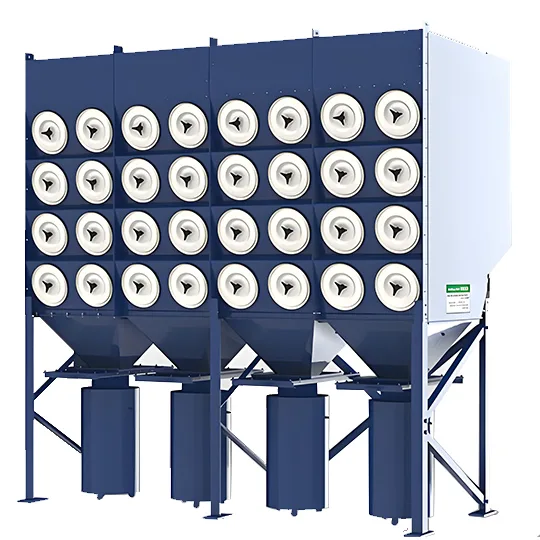
- Cartridge dust collector
- Pulse-cleaning system
- Fan and control panel
- Dust bin or collection drawer
- Differential pressure monitoring
In a well-designed system, smoke should be captured before it escapes into the workshop. If visible smoke spreads from the cutting table, the problem may be weak source capture, poor table zoning, leaking ducts, dirty filters, low fan pressure, or unsuitable collector sizing.
Main Components and Their Roles
| System Part | Main Function | What Happens If It Is Wrong |
|---|---|---|
| Cutting table capture | Pulls smoke from the cutting zone before it spreads | Smoke escapes into the workshop |
| Ductwork | Moves contaminated air to the collector | Airflow loss, dust settlement, weak suction |
| Spark control | Reduces hot particles before filtration | Burn marks, filter damage, safety risk |
| Filter cartridges | Capture fine metal fume and particles | Dust leakage, clogging, high pressure drop |
| Pulse cleaning | Removes dust cake from cartridge surface | Fast airflow loss and short filter life |
| Fan system | Provides airflow against total resistance | Insufficient capture or excessive energy use |
| Dust bin | Collects removed dust for disposal | Dust re-entrainment or messy maintenance |
Each part affects the others. A strong fan cannot fully solve poor table capture. Good filter cartridges cannot solve spark damage. A compact collector cannot work reliably if the dust load is higher than the filter area can handle.
Smoke, Metal Fume, and Fine Particles: What Is the Difference?
In daily communication, many people simply say “smoke.” In practice, laser cutting emissions may include different particle types.
Smoke is the visible cloud created near the cutting zone. It may include fine particles, vaporized metal compounds, oxides, and condensed fumes.
Metal fume usually refers to very fine particles formed when vaporized metal cools and condenses. These particles can be difficult to capture if airflow is weak or filter media is not suitable.
Fine particles include oxide dust, micron-size particulates, and small solids created during melting, oxidation, and slag formation.
Sparks and hot particles are larger and hotter than fine fume. They may damage filter cartridges if they travel directly into the collector.
Slag and coarse debris usually settle faster, but they can still enter the extraction path if table design or pre-separation is poor.
The dust collector must handle these materials differently. Fine fume needs good filtration and stable airflow. Sparks need upstream protection. Coarse debris needs proper collection and discharge.
Why Filter Cartridges Are Common in Laser Cutting
Laser cutting dust collectors often use cartridge filters because cartridges provide large filtration area in a compact structure. The pleated media design allows more filter surface to fit inside a smaller collector body.
This is useful for laser cutting workshops because the dust is fine, the airflow demand can be high, and floor space may be limited.
However, filter cartridges are not selected by size alone. The cartridge should match:
- Dust particle size and loading
- Required filtration efficiency
- Filter media structure
- Pulse-cleaning performance
- Moisture or oil mist condition
- Spark and temperature exposure
- Seal design and installation method
- Required service life and maintenance access
Fine laser cutting fume may enter deeply into ordinary filter media. Once the dust is embedded inside the media, pulse cleaning becomes less effective. The result is higher pressure drop, weak suction, and frequent cartridge replacement.
For this reason, cartridge media for laser cutting should support surface loading and dust release, not only high initial efficiency.
How Airflow Affects Workshop Air Quality
Airflow is the foundation of laser cutting fume control. If airflow is too weak, smoke escapes from the cutting table and spreads into the workshop. If airflow is too high, the system may waste energy, increase noise, disturb the cutting zone, and load the filter cartridges faster.
The goal is not maximum airflow. The goal is controlled airflow at the cutting source.
For flatbed laser cutting, table zoning is especially important. A zoned extraction table opens suction near the active cutting area instead of pulling air through the entire table. This helps concentrate airflow where smoke is generated.
Poor airflow often appears as smoke leakage at the table edge, haze around the machine, weak suction after a few days, or operators needing to open doors or windows to clear the air.
A good airflow design should consider table size, active extraction area, duct resistance, fan static pressure, filter loading, damper operation, and the expected pressure drop when filters are dirty.
Pressure Drop: The Warning Signal Inside the Collector
Differential pressure shows how much resistance air meets as it passes through the filter cartridges. When filters are clean, pressure drop is low. As dust builds on the cartridge surface, pressure drop rises.
A healthy collector does not keep pressure drop at zero. Some dust cake is normal. The problem is when pressure drop rises too quickly or cannot return after pulse cleaning.
Fast pressure drop increase may indicate:
- Filter cartridges are overloaded
- Fine fume is penetrating the media
- Pulse cleaning is weak
- Compressed air is wet or unstable
- Dust is sticky because of oil, moisture, or coating residue
- The collector has too little filter area
- Airflow per cartridge is too high
- Filters are near the end of service life
Pressure drop should be monitored as part of normal operation. It helps maintenance teams decide when to clean, inspect, or replace filter cartridges before suction becomes too weak.
Spark Control Should Come Before the Filter Cartridges
Laser cutting can produce sparks, hot particles, and small molten fragments. These particles should be reduced before they reach the filter cartridges.
A filter cartridge should not be treated as the first defense against sparks.
Spark control may include table design, drop-out space, inlet baffles, spark traps, pre-separation, proper duct layout, temperature monitoring, and safe dust discharge. The exact method depends on the cutting material, dust load, process temperature, and safety review.
This is especially important when cutting aluminum, coated metal, oily sheet, galvanized sheet, or mixed metals. Some metal dust streams may need additional combustible dust review. A flame-retardant cartridge may help reduce risk, but it does not replace system-level spark and fire protection.
The practical rule is simple:
Stop hot particles before they reach the filter media.
Common Laser Cutting Dust Collector Problems
| Field Problem | Likely Cause | Practical Direction |
|---|---|---|
| Smoke escapes from the table | Weak capture airflow, open zones, duct leakage, dirty filters | Check table zoning, fan duty, duct resistance, and filter loading |
| Filter cartridges clog quickly | Fine fume, heavy dust load, oil mist, moisture, weak pulse cleaning | Review media, filter area, pulse system, and compressed air quality |
| Pressure drop rises too fast | Overloaded cartridges or poor dust release | Check airflow per cartridge and cleaning settings |
| Burn marks on cartridges | Sparks or hot particles entering the filter stage | Add or improve spark control before filtration |
| Workshop haze remains | Capture point is too weak or airflow is unbalanced | Review table capture and duct layout |
| Dust leaks after filter change | Poor cartridge seal or damaged gasket | Check cartridge fit, seal surface, and installation method |
| Maintenance cost is high | Frequent filter changeout, downtime, energy use, or compressed-air waste | Optimize airflow, pulse cleaning, filter area, and dust discharge |
The correction is not always a larger collector. Sometimes the real issue is table leakage, poor duct balance, unsuitable cartridge media, weak pulse cleaning, or sparks reaching the filter section.
Omela Filtration Application Lessons
Case 1: Flatbed Fiber Laser Cutting with Workshop Haze
A metal fabrication workshop had visible smoke escaping from one side of the cutting table. The dust collector was running, but operators still noticed haze near the machine.
The review showed that the issue was not only filter capacity. The cutting table had uneven capture, and too much air was being pulled from inactive zones. After adjusting the extraction logic and reviewing airflow distribution, capture became more stable.
Lesson: Smoke escape often starts at the table, not inside the collector. Source capture should be checked before increasing fan size.
Case 2: Fast Filter Cartridge Clogging
A workshop cutting carbon steel and coated sheet experienced short cartridge life. Differential pressure increased rapidly after replacement, and pulse cleaning could not recover airflow effectively.
The review focused on fine fume loading, oil residue on material surfaces, cartridge media behavior, compressed air quality, and pulse-cleaning settings. A better-matched cartridge and cleaning setup helped stabilize the pressure-drop trend.
Lesson: Fine fume plus sticky contamination can blind cartridges quickly. Filter media and pulse cleaning must match the actual dust condition.
Case 3: Burn Marks After Cutting Aluminum
A laser cutting line showed localized burn marks on filter cartridges. The problem appeared after cutting aluminum and mixed materials.
The review suggested that sparks and hot particles were entering the collector too directly. The solution direction focused on upstream spark control, inlet protection, and safer dust collection practices rather than only changing filter cartridges.
Lesson: Filter cartridges should not be the first spark barrier. Hot particles must be controlled before the filtration stage.
Case 4: Central Collector for Multiple Machines
A workshop connected multiple laser cutting machines to one dust collection system. Total fan capacity looked sufficient, but one branch had weak suction while another branch pulled too much air.
The review focused on duct balancing, damper control, active cutting zones, and pressure monitoring. After airflow balancing, capture became more predictable.
Lesson: Multi-machine extraction is an airflow management problem. Total airflow is not enough; distribution matters.
When a Laser Cutting Dust Collector Is Poorly Matched
A poorly matched dust collector may still run, but it will not run efficiently. The workshop may notice visible smoke, frequent cartridge replacement, high pressure drop, dust leakage, unstable airflow, or rising maintenance cost.
Common mismatch patterns include:
The collector has enough airflow when filters are clean, but not enough airflow after cartridges load with dust.
The fan has a high free-air rating, but cannot overcome duct resistance, dirty-filter resistance, and spark-control resistance.
The cartridge media captures dust well at first, but fine fume penetrates too deeply and cannot be cleaned by pulse jet.
The cutting table leaks too much air, so suction is not concentrated near the active cutting zone.
The system ignores sparks, so hot particles damage filter media before the end of normal service life.
The maintenance team replaces cartridges by time only, without tracking differential pressure trends.
What to Check Before Choosing a System
Before selecting or upgrading a laser cutting dust collector, collect the basic operating data first.
- Laser power, cutting table size, and number of cutting heads
- Material type, plate thickness, cutting speed, and daily working hours
- Smoke condition: light smoke, heavy smoke, visible escape, or workshop haze
- Dust type: carbon steel, stainless steel, aluminum, galvanized sheet, coated metal, or mixed metal
- Existing duct size, fan power, airflow, pressure drop, cartridge size, cartridge quantity, service life, and photos or videos of the process
This information helps determine the required airflow, filter area, cartridge media, spark-control method, pressure-drop target, and maintenance strategy.
Final Engineering View
A laser cutting dust collector should be selected from the cutting zone outward.
If smoke escapes from the table, check source capture and airflow distribution. If suction drops after several days, check pressure drop and filter loading. If cartridges show burn marks, check spark control. If cartridges clog too quickly, check fine fume, oil mist, moisture, media structure, pulse cleaning, and filter area.
The best laser cutting dust collector is not defined by one airflow number or one filter cartridge specification.
It is defined by how well the whole system works together:
capture the smoke, move the air, protect the cartridges, control pressure drop, discharge dust safely, and maintain workshop air quality.
For workshops comparing a new system or troubleshooting an existing collector, the laser cutting dust collector solution page can be used as a practical starting point for reviewing airflow, filter cartridges, spark protection, and maintenance requirements.
FAQ
What is a laser cutting dust collector?
A laser cutting dust collector is a source-capture filtration system that removes smoke, fine metal fume, oxide particles, sparks, and dust from laser cutting tables or enclosures.
Why does laser cutting create smoke and metal fume?
Laser cutting uses high heat to melt, oxidize, or vaporize metal. As the hot material cools, it can form smoke, fine metal oxide fume, dust, and small solid particles.
Why are filter cartridges used in laser cutting dust collectors?
Filter cartridges provide large filtration area in a compact structure. They are suitable for capturing fine metal fume when the media, airflow, pulse cleaning, and sealing are correctly matched.
Why do laser cutting filter cartridges clog quickly?
They may clog quickly because of fine fume penetration, heavy dust load, oil mist, moisture, weak pulse cleaning, high filtration velocity, or insufficient filter area.
How does pressure drop affect dust collector performance?
Pressure drop shows filter resistance. If pressure drop rises too quickly, airflow may drop, smoke capture may weaken, and filter cartridges may need inspection or replacement.
Are sparks dangerous for filter cartridges?
Yes. Sparks and hot particles can damage cartridge media and may create safety risks. Spark control should be placed before the filter cartridges.
What information is needed to choose a laser cutting dust collector?
Provide laser power, cutting table size, material type, plate thickness, working hours, smoke condition, duct layout, spark risk, current filter details, pressure drop trend, and photos or videos of the process.
Author

Jessica Ma – Senior Filtration Engineer, Omela Filtration
Jessica Ma is a senior filtration engineer at Omela Filtration, specializing in dust and liquid filtration. With over 15 years of experience, she focuses on optimizing baghouse performance, enhancing filtration efficiency, and developing high-performance solutions for industrial dust collectors and precision liquid filtration applications.