
Key Takeaways
- A laser cutting dust collector should be treated as a complete extraction system—from the cutting table and ductwork to spark control, filter cartridges, fan, pulse cleaning, and dust discharge—not simply as a filtration cabinet.
- Cartridge dust collectors are widely used for fine metal fume because pleated cartridges provide large filtration area in a compact structure, but filter media must still be matched to spark exposure, dust loading, pressure drop, and the actual metal being cut.
- Filter cartridges should not be the first barrier expected to stop sparks or hot metal particles. Hot-particle control should begin upstream of the filtration section.
- Localized burn marks, small holes, or repeated heat damage on cartridges often indicate an upstream spark-control problem rather than simply defective filter media.
- Anti-static and flame-retardant cartridge properties can support system protection, but neither makes the complete dust collection system automatically fireproof or explosion-proof.
- Aluminum, mixed-metal production, accumulated dust, duct deposits, pressure-drop trends, and dust-discharge practices can all change the risk profile.
Why Fire Risk Starts Before the Dust Collector
Laser cutting generates more than visible smoke.
Depending on material type, plate thickness, cutting speed, assist gas, table design, and operating duty, the process can produce fine metallic fume, oxide particles, sparks, molten droplets, and small hot fragments.
The extraction system is designed to pull airborne material away from the cutting zone.
That creates an important engineering path:
cutting zone → downdraft table → ductwork → spark control → collector inlet → filter cartridges
The same airflow that captures smoke can also transport a sufficiently small hot particle downstream.
This is why a fire problem should not be investigated only inside the collector.
The engineering question is whether an ignition source can remain hot long enough to reach accumulated dust or loaded filter media.
Omela’s current laser cutting system design follows the same principle: spark-control devices and hot-particle separation are placed before the cartridge section, while fan duty must account for the resistance of the complete installed system.
Fire and Dust Explosion Are Not the Same Event
A cartridge with a small burn hole does not automatically mean the system has a dust-explosion hazard.
A normal fire requires three basic conditions:
fuel + oxygen + ignition source
For a combustible-dust deflagration, two additional conditions become important:
dust dispersion + confinement
Together, these conditions are often described as the dust explosion pentagon.
| Condition | Cartridge / Dust Fire | Dust Deflagration |
|---|---|---|
| Combustible material | Required | Required |
| Ignition source | Required | Required |
| Oxygen | Required | Required |
| Sufficient dispersed dust | Not always | Required |
| Confinement | Not always | Normally important |
The distinction matters because a dust collector and its connected ductwork can provide both concentrated dust and confined volume.
Therefore, the collector should not be considered only a box containing filters.
It is part of the process system.
How Hot Particles Reach the Filter Cartridges
Not every spark produced at the cutting table reaches the collector.
Large molten particles may fall beneath the cutting table. Some sparks lose energy after striking table structures, baffles, or duct surfaces.
Others may remain entrained.
How far they travel depends on several interacting variables:
particle size and temperature, airflow velocity, duct length, direction changes, residence time, table drop-out space, and upstream spark-control design.
A published industrial accident investigation documented an ember entering a dust extraction conduit and traveling into equipment containing combustible aluminum dust. The resulting event then propagated back through connected ductwork.
The process involved sanding rather than laser cutting, but the airflow lesson is directly relevant:
If an extraction system can transport fine process particles, it may also transport certain hot particles.
Duct distance alone should therefore not be treated as a reliable spark-control method.
Why Loaded Filter Cartridges Are Vulnerable
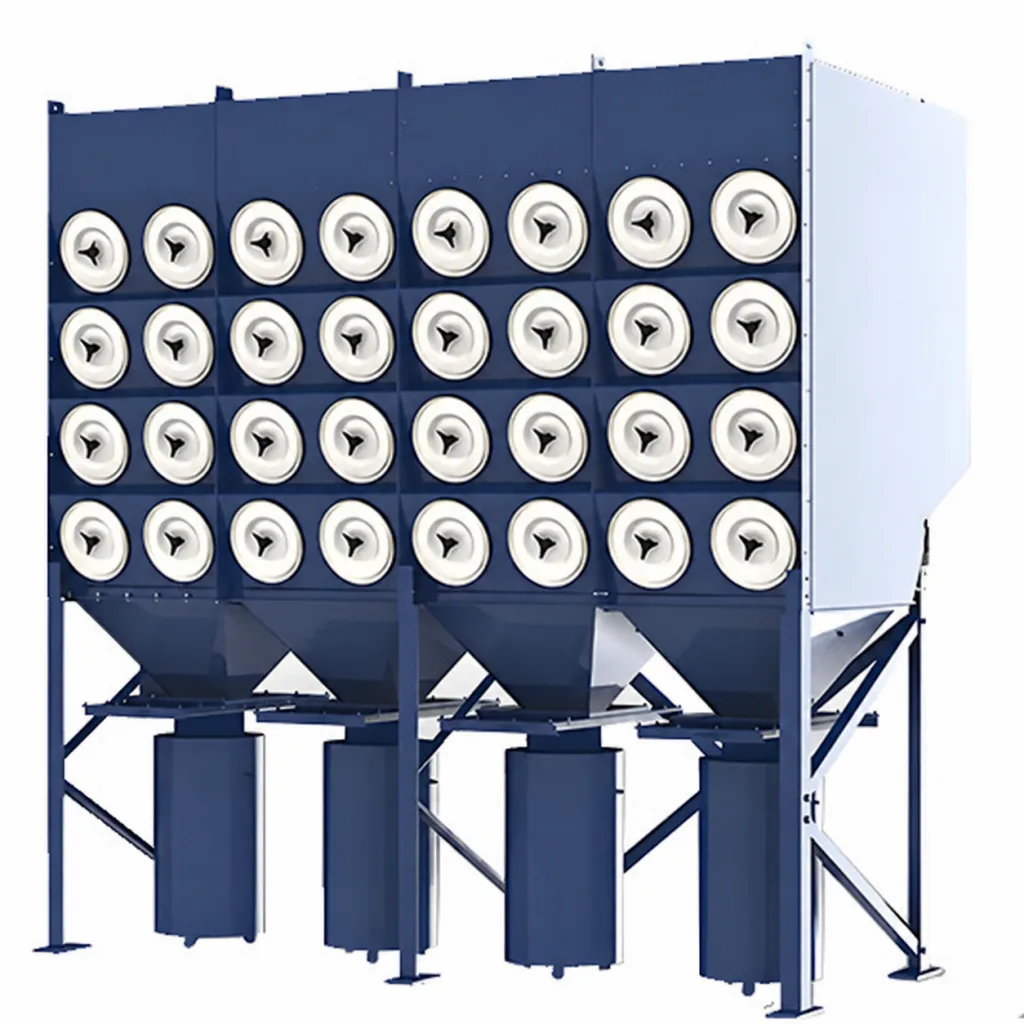
Cartridge collectors are effective for laser cutting fume because pleated filter media provides a large surface area within a compact collector.
During operation, fine metallic fume accumulates on the cartridge surface and between the pleats.
Pulse cleaning removes part of this dust cake, but the operating cartridge still contains captured process material.
If a sufficiently hot particle reaches the filtration section, several forms of damage may occur:
localized scorching, small holes, seal damage, smoldering deposits, or a larger cartridge fire.
This leads to one of the most useful troubleshooting rules:
Burn marks are evidence, not necessarily the root cause.
If the same cartridge position repeatedly develops black spots or burn holes, replacing the filters may only remove the visible symptom.
The better investigation moves upstream:
Where did the hot particle originate?
How did it leave the cutting table?
Did the system have adequate drop-out space or spark separation?
Was there a direct duct path to the filter section?
Omela’s existing laser cutting guidance similarly recommends inspecting the spark path when repeated cartridge heat damage appears rather than assuming a different filter material alone will solve the problem.
Anti-Static and Flame-Retardant Media Solve Different Problems
Filter-media terminology can create false confidence.
Anti-static media helps manage electrostatic charge when correctly integrated into an appropriately conductive and grounded system.
Flame-retardant media is designed to provide greater resistance to ignition or flame propagation than ordinary untreated media.
These properties address different mechanisms.
Anti-static does not mean fireproof.
Flame-retardant does not mean spark-proof.
Most importantly:
Neither should turn the cartridge into the first spark arrestor in the system.
For laser cutting, filter media should be selected as part of the total protection strategy, together with source capture, duct design, spark control, pulse cleaning, dust discharge, and any additional protection required by the actual dust hazard.
Spark Control Should Begin Upstream
A hot particle is generally easier to manage before it reaches accumulated dust on the filter media.
Depending on the process, upstream control may involve table drop-out space, inlet baffles, spark traps, pre-separation chambers, direction changes, temperature monitoring, or other engineered protection.
But no single spark-control device solves every application.
A simple baffle may remove large hot fragments while allowing smaller particles to remain airborne.
More effective separation may introduce greater airflow resistance.
That creates an important connection between safety and dust-collector sizing:
Spark-control resistance must be included in the fan static-pressure calculation.
Omela’s current laser cutting system guidance specifically includes table resistance, ducts, elbows, spark-control components, loaded cartridges, and outlet components when determining fan duty.
If a spark-control device protects the filters but reduces table suction below the required capture level, the system is still not correctly balanced.
Metal Type Changes the Risk
Carbon steel, stainless steel, galvanized sheet, aluminum, and coated metals do not create identical particle streams.
Aluminum requires particular attention because bulk sheet and finely divided aluminum dust behave very differently.
NIOSH describes finely divided aluminum dust as easily ignited and states that it may cause explosions.
That does not mean that every aluminum laser-cutting application automatically presents the same explosion risk.
Actual behavior depends on the dust produced by the real process, including particle size, composition, concentration, dispersion, moisture, and operating conditions.
For applications where the consequences could be significant, representative dust testing and an appropriate hazard review provide much better information than simply assuming the behavior from the bulk metal.
Lessons from Published Industrial Incidents
Several documented incidents are useful because they show how ignition sources, residual metal dust, and collection equipment can interact.
| Situation | What Happened | Practical Lesson |
|---|---|---|
| Steel and aluminum laser cutting | Different metals were processed through the same extraction system without adequate cleaning, followed by a collector and duct fire | Material changeover and residual dust matter |
| Ember transported through ductwork | A hot ember traveled through an extraction conduit into equipment containing aluminum dust | Ductwork can transport ignition sources as well as dust |
| Aluminum residue followed by steel processing | Aluminum remained inside a wet collection system; later steel processing generated sparks and a flash fire | Wet collection does not eliminate mixed-metal concerns |
A documented laser-cutting case is particularly relevant. Steel and aluminum were processed through the same system without sufficient cleaning between materials, and a fire developed in the collector and connecting duct.
Another accident involved aluminum buildup inside a wet collection system. Steel was subsequently processed, sparks were generated, and a flash fire resulted.
These cases occurred under different equipment and process conditions, so they should not be treated as predictions for every laser cutting system.
They demonstrate a more general principle:
An ignition source becomes more serious when it reaches accumulated material inside connected equipment.
Mixed-Metal Cutting Requires Special Attention
Mixed production is common in fabrication shops.
A laser may process carbon steel for several days, stainless steel on another shift, and aluminum the following week.
The cutting machine can change materials quickly.
The dust collection system does not automatically reset.
Residual material may remain in the cutting table, ductwork, spark-control chamber, cartridge pleats, hopper, and waste container.
That means a collection system effectively retains part of the history of previous production.
When material changes, operators should consider what remains inside the system, what ignition sources the new process may introduce, whether cleaning is needed, and whether the different dust streams are compatible with the existing collection arrangement.
A production changeover is also a dust-management changeover.
Wet Collection Is Not Automatically Risk-Free
Wet collection can be appropriate for certain combustible-metal applications.
However, the word “wet” should not be interpreted as “no fire risk.”
The documented incident involving aluminum buildup followed by spark-producing steel processing shows that residual metal, material changeover, cleaning, and process compatibility remain important even when a wet collector is used.
Reactive-metal applications may also require review of sludge management, ventilation, metal-water interaction, and potential gas generation.
The correct question is therefore not simply:
Dry collector or wet collector?
It is:
Which complete collection system is appropriate for the actual metal dust, process conditions, and assessed hazard?
Ductwork Is Part of the Protection System
Many maintenance teams inspect cartridges and hoppers carefully while paying less attention to the duct network.
That can leave an important part of the system unexamined.
Ductwork can transport hot particles, accumulate deposits, provide a confined path, and in some events carry flame or pressure between connected equipment.
Long horizontal runs, dead zones, unsuitable velocity, deposits, and difficult-to-clean sections should therefore be part of inspection and maintenance planning.
A clean collector cabinet does not guarantee a clean extraction system.
Pressure Drop Can Provide Useful Clues
Differential pressure is normally monitored because it shows how much resistance the filter cartridges add to the airflow system.
As fine laser fume accumulates, pressure drop rises.
Pulse cleaning should release surface dust and help maintain a relatively stable operating range.
If the pressure drop after cleaning gradually becomes higher and higher, the cartridges may be retaining increasing amounts of material or the cleaning system may no longer be recovering effectively.
This is primarily a filtration and airflow issue.
It can also provide useful information about what is happening inside the collector.
High ΔP alone does not prove a combustible-dust hazard.
But a rising pressure-drop baseline deserves more attention if it appears together with burn marks, heavy deposits, smoke events, or changes in processed materials.
Protect the System in the Right Sequence
A practical review can follow five steps:
- Understand the cutting process. Confirm materials, thickness range, assist gas, cutting duty, operating hours, and frequency of material changeover.
- Understand the particle stream. Determine whether the extraction system handles fine fume, coarse hot fragments, oily or coated particles, or potentially combustible dust.
- Control ignition sources before filtration. Review table drop-out, spark travel, duct geometry, baffles, spark separation, grounding, and other relevant controls.
- Match the collector to the actual hazard. Consider cartridge media, collector configuration, dust discharge, isolation, monitoring, and any additional fire or deflagration protection required.
- Maintain the complete dust path. Inspection should include the cutting table, ductwork, spark-control stage, cartridges, hopper, and collected-dust handling.
This is more useful than starting with the question:
Which fireproof cartridge should we buy?
No filter cartridge can compensate for every upstream process problem.
Small Fires and Burn Marks Should Not Become Normal
A small abnormal event can gradually become accepted as routine.
One cartridge gets a small burn hole.
The hopper briefly smells of smoke.
A spark is occasionally visible near the collector inlet.
Production continues, so the event is treated as minor.
The danger is that the underlying ignition pathway remains active.
Repeated cartridge burn marks or smoke events should therefore be investigated for root cause rather than simply added to the normal replacement schedule.
Useful questions include whether the event always occurs with the same material, same cutting thickness, same duct branch, or same filter location.
Patterns often provide more useful information than the damaged cartridge alone.
Common Design and Maintenance Mistakes
- Treating the filter cartridge as the first spark barrier.
- Assuming flame-retardant media makes the complete system fireproof.
- Assuming anti-static media prevents ignition from hot particles.
- Adding spark-control equipment without including its resistance in fan sizing.
- Changing between ferrous and non-ferrous metals without considering residual dust.
- Inspecting filter cartridges while ignoring duct deposits.
- Replacing burned cartridges repeatedly without investigating the hot-particle path.
- Assuming wet collection automatically removes all combustible-metal concerns.
- Accepting repeated smoke, burn marks, or small fire events as normal operation.
The common theme is that fire protection cannot be reduced to one filter specification.
Current Standards Should Be Checked for the Actual Application
Combustible-dust requirements and standards evolve.
For systems handling known or suspected combustible metal dust, the applicable current standards, local regulations, dust properties, collector configuration, location, connected ductwork, and operating procedures should all be reviewed.
The required protection may differ substantially between a routine carbon-steel laser application and a process producing potentially combustible aluminum dust.
For consequential combustible-dust applications, qualified safety and fire-protection professionals should be involved where required.
Final Engineering View
Laser cutting dust collector fire risk is easiest to understand as a chain:
hot particle → airflow transport → accumulated dust → ignition → fire or deflagration → propagation
A reliable system tries to break that chain as early as practical.
Good cutting-table design helps keep smoke under control while allowing larger debris to drop out.
Suitable upstream spark control reduces the number and energy of hot particles that continue toward the collector.
Correct fan sizing maintains the required extraction airflow after duct, spark-control, and loaded-filter resistance are included.
Appropriate cartridges capture fine fume without being asked to serve as the primary spark arrestor.
Regular inspection and dust discharge reduce unnecessary accumulation.
And material changeovers should be reviewed because carbon steel, stainless steel, aluminum, galvanized sheet, and coated materials do not automatically create the same dust conditions.
The most important principle is simple:
Do not ask the filter cartridge to solve a problem that should have been controlled before the hot particle reached the filtration stage.
For ordinary carbon-steel laser cutting, this may mainly mean protecting cartridges from spark damage and maintaining reliable smoke capture.
For aluminum, mixed metals, or dust known or suspected to be combustible, the review may extend into representative dust testing, collector configuration, isolation, fire or deflagration protection, dust handling, and current safety requirements.
The correct strategy starts with the actual material and process—not simply with the words “laser cutting dust collector.”
FAQ
Can sparks from laser cutting reach the dust collector?
Yes. Some hot particles may remain entrained in the extraction airflow. Whether they reach the collector depends on particle temperature and size, airflow, duct geometry, distance, and upstream separation.
Are flame-retardant filter cartridges enough to prevent a collector fire?
No. Flame-retardant media can contribute to the overall protection strategy, but it does not replace upstream hot-particle control, appropriate collector configuration, dust management, or any additional protection required by the actual hazard.
Are anti-static cartridges fireproof?
No. Anti-static media addresses electrostatic charge. It does not prevent ignition caused by glowing particles, molten fragments, or other thermal ignition sources.
What do burn holes in laser cutting cartridges indicate?
Repeated localized holes or heat marks can indicate spark or hot-particle carryover into the filter section. The upstream path should be investigated before assuming that changing cartridge media alone will solve the problem.
Is aluminum laser cutting dust always explosive?
No. Finely divided aluminum dust can be combustible and explosible under suitable conditions, but actual risk depends on the specific dust generated by the process, including particle properties, concentration, dispersion, moisture, and other conditions.
Can carbon steel and aluminum use the same laser cutting dust collector?
A multi-material system may be possible when the complete system and operating practices are appropriately evaluated for those materials. Residual dust, cleaning requirements, ignition sources, collector design, and applicable combustible-dust requirements should all be considered.
Is a wet collector always safer for aluminum?
No. Wet collection can be appropriate in certain applications, but it still requires correct engineering for the metal being processed, including material compatibility, accumulated sludge, ventilation, cleaning, and possible reactive conditions.
Author

Jessica Ma – Senior Filtration Engineer, Omela Filtration
Jessica Ma is a senior filtration engineer at Omela Filtration, specializing in dust and liquid filtration. With over 15 years of experience, she focuses on optimizing baghouse performance, enhancing filtration efficiency, and developing high-performance solutions for industrial dust collectors and precision liquid filtration applications.