
Key Takeaways
- Start with the liquid, contaminant, and filtration objective—not the cartridge name. Omela’s industrial filter cartridges cover depth filtration, high-flow filtration, membrane filtration, and activated-carbon adsorption for different process duties.
- High flow filter cartridges are primarily selected when large system flow, low pressure drop, fewer elements, and smaller housing footprint are important.
- Pleated membrane filter cartridges are used where controlled pore size, high retention efficiency, bioburden control, or final/pre-final filtration is required.
- Melt-blown filter cartridges provide graded-density depth filtration for sediment and suspended solids, while string wound filter cartridges offer depth loading with greater flexibility in yarn and core materials.
- Carbon cartridges solve a different problem: adsorption of chlorine, taste, odor, color, and certain dissolved organic contaminants. They should not be selected as if they were ordinary sediment filters.
Start with the Filtration Job, Not the Cartridge Catalog
Industrial filter cartridges may all look like cylindrical replaceable elements, but they do not perform the same job.
A process may need to remove heavy suspended solids before a pump, reduce fine sediment before an RO membrane, control microorganisms before beverage filling, process hundreds of cubic meters per hour with minimal pressure loss, or remove residual chlorine before sensitive downstream equipment.
Each objective points toward a different cartridge structure.
The first selection question should therefore be: What must the filtration stage accomplish?
Before choosing a cartridge, define:
- The liquid being filtered
- Contaminant type and particle-size distribution
- Suspended-solids concentration
- Required filtrate quality
- Flow rate
- Temperature and viscosity
- Chemical composition and pH
- Allowable pressure drop
- Downstream equipment requiring protection
- Desired changeout interval
Once those conditions are clear, cartridge type becomes much easier to select.
Five Cartridge Types Solve Different Problems
A useful way to compare industrial cartridges is by filtration mechanism, rather than appearance.
| Cartridge Type | Main Mechanism | Typical Strength | Common Applications |
|---|---|---|---|
| High Flow | Large-area pleated particle filtration | Very high flow with fewer elements | RO pretreatment, desalination, power, process water |
| Pleated Membrane | Precision surface/membrane filtration | High retention and final filtration | Food & beverage, pharmaceuticals, electronics, fine chemicals |
| Melt-Blown | Graded-density depth filtration | Fine sediment and bulk particle removal | Water, RO pretreatment, general process liquids |
| String Wound | Wound depth filtration | Solids loading and material flexibility | Cooling water, chemicals, oils, industrial water |
| Carbon | Adsorption + some particle control | Chlorine, odor, taste, organics | Municipal water, beverage water, RO pretreatment |
These five cartridge types are complementary rather than interchangeable.
A carbon cartridge cannot replace a high-capacity sediment stage. A 0.2 μm membrane cartridge should not normally be asked to handle heavy raw-water sediment. A high-flow cartridge may reduce element count dramatically, but it still needs an appropriate micron rating and enough contaminant capacity.
Step 1: Define What You Are Removing
The nature of the contamination usually narrows the cartridge choice immediately.
If the problem is mainly sand, rust, silt, scale, or suspended particulate, depth filtration is often a practical starting point.
Melt-blown cartridges use thermally formed fibers to create a graded-density structure. Larger contaminants can load in the more open outer region while finer particles are retained deeper in the media.
String wound cartridges create depth through layers of yarn around a supporting core. Their structure can provide substantial internal contaminant storage and allows greater flexibility in yarn and core materials.
If the requirement is high-precision final filtration, however, pleated membrane cartridges are usually more relevant.
If the target is dissolved chlorine, taste, odor, or adsorbable organics, activated carbon is required because ordinary particulate filters cannot solve the same problem.
Particle filtration and adsorption are fundamentally different treatment mechanisms.
Step 2: Choose the Micron Rating from the Downstream Requirement
Micron rating is important, but it is one of the most misunderstood cartridge specifications.
A smaller number is not automatically better.
Going from 20 μm to 5 μm or from 5 μm to 1 μm generally increases the amount of particulate the filter must retain and may increase hydraulic resistance and replacement frequency.
The correct rating should be selected according to what the downstream process actually needs.
For general clarification, a relatively coarse depth filter may be appropriate.
For membrane pretreatment, tighter filtration may be required.
For critical final filtration, an absolute-rated membrane element may be necessary.
Do not select 1 μm simply because it sounds safer than 5 μm.
If 5 μm provides adequate protection, unnecessarily tightening the rating can increase pressure drop and operating cost without providing useful process value.
For RO pretreatment, industry guidance commonly places cartridge filtration near the end of the pretreatment train. DuPont recommends an absolute pore size below 10 μm as a minimum safety filtration step and commonly recommends 5 μm absolute, with tighter filtration considered where specific colloidal fouling risks exist.
The important point is that the cartridge is a protection stage, not a replacement for proper upstream clarification.
Step 3: Understand Nominal vs Absolute Filtration
Two cartridges labeled “5 micron” are not necessarily equivalent.
Depth cartridges are often specified with nominal retention ratings, while membrane and other precision cartridges may be defined using more stringent absolute or efficiency-based ratings.
The actual retention performance depends on how the manufacturer defines the rating.
Therefore, for critical applications, ask:
- What removal efficiency is associated with the micron rating?
- Is the rating nominal or absolute?
- At what test conditions was it measured?
- Is retention consistent throughout the cartridge life?
- Is integrity testing required?
The micron number alone does not tell you the complete filtration performance.
This distinction becomes particularly important in RO membrane protection, beverage stabilization, pharmaceutical processing, and other applications where particle or microbial breakthrough has higher consequences.
Step 4: Match Flow Rate to Filter Area
Industrial filtration is a hydraulic problem as much as a filtration problem.
Every cartridge creates resistance.
When flow through an element increases, pressure drop generally increases. As the cartridge collects contaminants, resistance rises further.
This is why cartridge quantity cannot be determined from micron rating alone.
For large water-treatment systems, high-flow cartridges are designed specifically to solve this problem.
Large-diameter pleated elements provide substantially more effective media area and much higher flow per element than conventional small-diameter cartridges. Omela high-flow cartridges, for example, are designed around high throughput with fewer elements and smaller housings.
This can reduce:
- Number of cartridges
- Housing size
- Changeout labor
- Disposal volume
- Maintenance time
High flow does not mean “push as much liquid as possible through one cartridge.”
The correct design still considers allowable clean ΔP, dirty ΔP, solids load, desired service life, and a reasonable safety margin.
Step 5: Use Differential Pressure as an Operating Signal
Differential pressure is one of the most useful indicators of cartridge condition.
A clean filter starts at a relatively low ΔP.
As contamination accumulates, resistance increases.
Eventually, one or more symptoms appear:
- Flow begins to decline
- Pump demand increases
- Downstream pressure becomes unstable
- Cartridge changeout frequency increases
- The system reaches its defined terminal ΔP
A rapidly rising differential pressure is not always a cartridge problem.
It may indicate that upstream treatment has changed.
For example, if an RO safety cartridge that normally operates for several months suddenly plugs in two weeks, replacing it with another identical cartridge may only reset the symptom.
The real issue may be higher turbidity, coagulant carryover, biological loading, iron, colloids, or failure of an upstream filter.
Used cartridges can provide valuable evidence. Color, loading pattern, surface deposits, gelatinous contamination, and depth penetration may all help identify what changed upstream.
Step 6: Match Cartridge Type to Solids Loading
Low-solids and high-solids applications should not be treated the same way.
For relatively high suspended-solids loading, a depth filter can often use more of its media volume before reaching terminal pressure drop.
Melt-blown cartridges provide graded-density depth filtration.
String wound cartridges create multiple winding channels and are frequently considered where solids loading is heavier or particle sizes are broad.
Pleated cartridges offer greater surface area and can provide high flow, but depending on their media construction they may not be the ideal first stage for every heavily contaminated liquid.
One expensive fine filter doing all the filtration work is usually poor system design.
A staged system is often more economical:
coarse solids removal → intermediate filtration → final or membrane protection.
This keeps the most precise and expensive downstream element from carrying contamination that should have been removed earlier.
Step 7: Decide When High Flow Makes Sense
High-flow elements become attractive when system throughput is large enough that conventional 2.5-inch cartridges would require many elements in parallel.
Typical examples include:
- Large RO systems
- Desalination pretreatment
- Power plant water treatment
- Municipal process water
- Beverage process water
- Chemical utility water
The advantage is not only flow.
Reducing 50 conventional cartridges to a much smaller number of large-format elements may reduce vessel complexity, replacement labor, inventory, and waste.
A published power-generation case demonstrates the underlying principle. A plant upgraded its filtration arrangement using a small number of large-diameter high-flow cartridges to handle a demanding condensate application. The larger-format system reduced the number of elements and simplified maintenance while maintaining the required filtration duty.
Lesson: For large industrial flows, cartridge count and changeout labor can be as important as micron rating.
Step 8: Use Pleated Membranes for Precision and Final Filtration
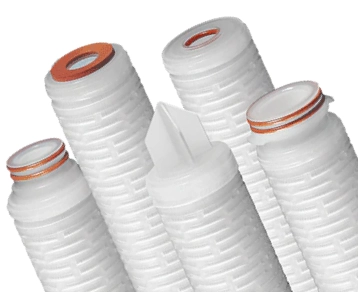
Pleated membrane cartridges are designed for applications where retention consistency matters more than raw dirt capacity.
Common media include PES, PTFE, PVDF, and Nylon.
The membrane is pleated to create a large filtration area within a compact cartridge while maintaining a controlled pore structure.
Typical applications include:
- Beverage final filtration
- Bottled water
- Pharmaceutical process water
- Electronics and ultrapure water
- Fine chemicals
- Bioburden reduction
- Final filtration before packaging
PES is commonly used for aqueous liquid filtration, while PTFE is valuable where stronger chemical compatibility or hydrophobic behavior is required.
A published beverage-filtration application uses PES membrane cartridges specifically for final filtration and retention of spoilage microorganisms before packaging.
Lesson: Membrane cartridges belong near the clean end of the treatment train, where upstream filters have already removed the bulk solids.
Using an expensive membrane cartridge directly on turbid feed water usually leads to short service life and unnecessary operating cost.
Step 9: Use Carbon When the Problem Is Dissolved, Not Visible
Carbon cartridges should not be selected by the same logic as sediment filters.
Activated carbon works primarily by adsorption.
EPA identifies granular activated carbon as useful for taste- and odor-producing compounds, natural organic matter, VOCs, synthetic organic compounds, and disinfection-byproduct precursors.
In cartridge systems, carbon is commonly used for:
- Chlorine reduction
- Taste and odor control
- Organic adsorption
- Color reduction
- Process-water polishing
- RO membrane protection from oxidants
Carbon performance depends heavily on flow and contact time.
If water passes too quickly, adsorption performance may decrease even if hydraulic flow looks acceptable.
Carbon capacity is also finite.
Water can continue flowing through a carbon cartridge after its adsorption performance has already declined.
This means replacement decisions should consider chlorine breakthrough, treated volume, contaminant loading, and water-quality testing—not pressure drop alone.
Step 10: Check Fluid Chemistry, Temperature, and Viscosity
A cartridge that performs well in ambient-temperature water may behave very differently in hot oil or chemical solution.
Media compatibility should always be checked against:
- Chemical type
- Concentration
- pH
- Temperature
- Exposure duration
- Cleaning chemicals
- Sterilization conditions
Polypropylene is widely used because of its broad usefulness in water and many industrial fluids.
PES, PTFE, Nylon, fiberglass, cotton, and stainless steel expand the available application range.
String wound cartridges are particularly flexible because both yarn and core materials can be changed.
Pleated membrane filters also provide multiple polymer options for critical chemical and high-purity applications.
Viscosity is equally important.
Higher-viscosity liquids create more hydraulic resistance through the same filter.
Flow data based on water should not automatically be applied to oil, syrup, coatings, resin, adhesive, or viscous chemical fluids.
Industrial Filter Cartridge Selection Matrix
| Process Requirement | Starting Cartridge Direction |
|---|---|
| Heavy sediment / mixed solids | String wound or melt-blown |
| Fine sediment prefiltration | Melt-blown |
| Very high water flow | High flow cartridge |
| RO safety filtration | High flow / suitable precision cartridge |
| Final high-purity filtration | Pleated membrane |
| Microbial control | Validated pleated membrane |
| Chlorine / odor / organics | Carbon cartridge |
| High-viscosity liquid | Review wound/depth construction and hydraulics |
| Aggressive chemical | Select media by compatibility |
| Large plant with high changeout labor | Consider high-flow format |
This matrix is a starting point rather than a substitute for process data.
Application Lessons from Real Industrial Filtration
RO Pretreatment: Frequent Cartridge Changes Can Signal an Upstream Problem
RO technical guidance treats the final cartridge as a safety device rather than the main solids-removal stage.
When cartridges require unusually frequent replacement, the first question should therefore be:
What changed upstream?
Higher turbidity, colloidal loading, biological growth, or media-filter breakthrough may be sending more contamination to the final cartridges.
Lesson: Do not solve an upstream pretreatment problem by continuously buying more cartridges.
Power Generation: Cartridge Structure Can Change Operating Cost
A published 775 MW combined-cycle power plant case reported repeated high differential pressure and premature plugging in a condensate filtration system using string-wound elements.
The filtration configuration was later changed to a different engineered depth structure better suited to the operating and backwash conditions, substantially extending throughput between cleaning cycles.
Lesson: Filter construction must match the actual loading and hydraulic conditions; the cheapest replacement element may not provide the lowest operating cost.
Beverage Final Filtration: Protect the Membrane Stage
In beverage processing, membrane cartridges can be used as the final filtration step for microbial stabilization.
Because these filters are designed for precision retention, upstream clarification and prefiltration become important for service life.
Lesson: The final filter should perform final filtration—not bulk solids removal.
Carbon Filtration: Normal Flow Does Not Mean the Carbon Is Still Active
Carbon adsorption capacity gradually becomes exhausted.
A carbon cartridge can continue passing water even after chlorine or odor begins to break through.
Lesson: Adsorption filters should be monitored by treatment performance as well as pressure drop.
Common Filter Cartridge Selection Mistakes
| Mistake | Why It Causes Problems | Better Approach |
|---|---|---|
| Selecting only by micron rating | Ignores efficiency, dirt load, and hydraulics | Match rating to filtration goal |
| Choosing the finest available cartridge | Creates unnecessary ΔP and short life | Use only the accuracy required |
| Ignoring solids loading | Causes premature plugging | Review feed-water condition |
| Using final filters as prefilters | Increases replacement cost | Use staged filtration |
| Sizing only by clean flow | Ignores dirty-filter resistance | Size for operating ΔP |
| Ignoring viscosity | Underestimates hydraulic resistance | Use actual fluid conditions |
| Choosing material by price | Can lead to chemical degradation | Verify media/core/seal compatibility |
| Replacing carbon only by ΔP | Adsorption may fail before hydraulic blockage | Monitor breakthrough |
| Copying the previous cartridge | Repeats an old sizing mistake | Review the actual process |
What Data Should Be Sent with an RFQ?
A reliable filter-cartridge recommendation normally requires more than a part number.
Provide:
- Liquid name and composition
- Process stage
- Required flow rate
- Operating pressure
- Allowable differential pressure
- Temperature
- Viscosity
- pH and chemical conditions
- Particle-size distribution if available
- Turbidity or suspended-solids data
- Required micron rating
- Nominal or absolute retention requirement
- Current cartridge type and quantity
- Cartridge dimensions and end connections
- Housing details
- Existing cartridge service life
- Reason for replacement or current operating problem
- Downstream equipment requiring protection
For troubleshooting, photos of the used cartridge can also be useful.
Final Engineering View
There is no single “best” industrial filter cartridge.
High Flow, Pleated Membrane, Melt-Blown, String Wound, and Carbon cartridges solve different filtration problems.
High Flow is mainly a hydraulic and maintenance solution for large-volume filtration.
Pleated Membrane is a precision-filtration solution for critical final or pre-final stages.
Melt-Blown provides economical graded-density depth filtration for sediment and suspended solids.
String Wound provides depth loading with flexible yarn and core construction.
Carbon provides adsorption for chlorine, odor, color, and dissolved organic contaminants.
The correct selection depends on the interaction between:
contaminant → required retention → flow → filter area → pressure drop → fluid chemistry → service life → downstream protection.
That is more useful than selecting from a catalog by micron rating alone.
A correctly selected cartridge should deliver the required filtrate quality while maintaining stable flow, acceptable differential pressure, predictable service life, and manageable replacement cost.
When those four outcomes are balanced, the cartridge is doing what an industrial filtration system actually needs it to do.
FAQ
Which industrial filter cartridge should I use for sediment removal?
Melt-blown and string wound depth cartridges are common starting points. Melt-blown cartridges are particularly useful for fine sediment and graded-depth filtration, while string wound cartridges can be useful where solids loading is heavier or material flexibility is required.
When should I use a high-flow cartridge?
High-flow cartridges are most useful when total system flow is large and reducing cartridge quantity, housing size, pressure drop, and changeout labor provides an operational advantage.
What is the difference between nominal and absolute micron ratings?
Nominal and absolute ratings describe different retention expectations, but definitions vary by manufacturer. For critical filtration, verify the stated removal efficiency and test method instead of relying only on the micron number.
Which filter cartridge is used before RO membranes?
RO pretreatment commonly uses disposable cartridge filtration as a final safety stage. The correct rating and cartridge format depend on upstream treatment, flow, fouling risk, and membrane requirements.
When should pleated membrane cartridges be used?
Pleated membrane cartridges are appropriate for high-purity, final or pre-final filtration where controlled pore size, high retention, microbial control, or validated filtration performance is required.
What is a carbon filter cartridge used for?
Carbon cartridges use activated carbon adsorption to reduce chlorine, taste, odor, color, and certain organic contaminants. They solve a different treatment problem from ordinary sediment cartridges.
Why do industrial filter cartridges plug quickly?
Common causes include excessive solids loading, micron rating that is too fine, insufficient filter area, excessive flow per cartridge, high viscosity, biological loading, or problems in upstream treatment.
When should a filter cartridge be replaced?
Replacement should consider differential pressure, flow loss, filtrate quality, contamination breakthrough, treated volume, and process-specific maintenance requirements rather than a fixed calendar interval alone.
Author

Jessica Ma – Senior Filtration Engineer, Omela Filtration
Jessica Ma is a senior filtration engineer at Omela Filtration, specializing in dust and liquid filtration. With over 15 years of experience, she focuses on optimizing baghouse performance, enhancing filtration efficiency, and developing high-performance solutions for industrial dust collectors and precision liquid filtration applications.