
Key Takeaways
- High flow filter cartridges are used in RO pretreatment to remove suspended particles before water reaches sensitive RO membranes.
- Compared with many standard cartridge systems, large-diameter pleated cartridges provide higher flow per element, larger filtration area, lower pressure drop, and fewer cartridge changeouts.
- In RO pretreatment, the goal is not only particle removal. The filter cartridge must help control SDI, turbidity, pressure drop, membrane fouling risk, and replacement cost.
- The right high flow cartridge should be selected by flow rate, micron rating, inlet water quality, solids load, pressure window, housing design, seal material, and changeout strategy.
- A high flow cartridge cannot fix poor upstream pretreatment. Coagulation, multimedia filtration, UF, bag filtration, or other pretreatment steps may still be needed depending on feed water condition.
- High flow filter cartridges, filter cartridges, and water and wastewater filtration solutions should be reviewed together when designing or upgrading RO pretreatment.
Why RO Pretreatment Needs the Right Cartridge Filter
Reverse osmosis membranes are designed to separate dissolved salts and very small contaminants from water. They are not designed to handle heavy suspended solids, high turbidity, large particle loads, or unstable pretreatment conditions.
That is why cartridge filtration is commonly placed before RO membranes as a final protective barrier. If particles, colloids, rust, sand, biofilm fragments, or upstream filter breakthrough reach the RO system, membrane fouling may increase. The result can be higher feed pressure, higher differential pressure, lower permeate flow, more frequent cleaning, and shorter membrane life.
High flow filter cartridges are used when the RO pretreatment system needs high throughput without installing a large number of small standard cartridges. Their large-diameter pleated structure provides more filtration area per element, which helps reduce initial pressure drop and extend operating time before changeout.
The key point is simple: RO pretreatment filtration should protect membrane performance, not only remove visible dirt.
What Makes High Flow Filter Cartridges Different?
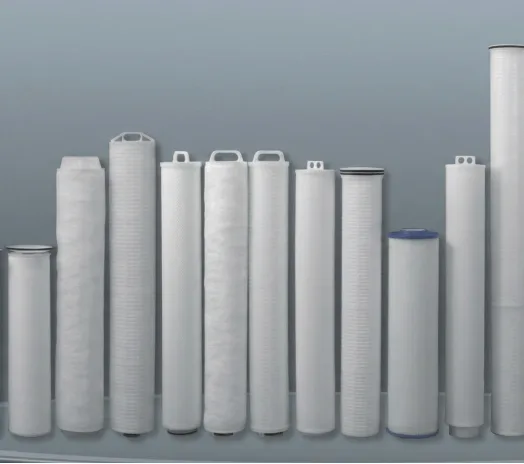
High flow filter cartridges are large-diameter pleated filter elements. Instead of relying on many small cartridges installed in a large multi-cartridge housing, a high flow design allows each element to handle much more flow.
A typical high flow cartridge uses a pleated media pack supported by an internal core and end-cap sealing structure. Water passes through the media, particles are captured, and filtered water continues toward the RO system or downstream process.
The practical advantages come from three design features.
First, the large diameter increases the available media area. More area means the same flow can be distributed across a larger surface, reducing the load on each section of media.
Second, the pleated structure creates more filtration area inside a compact element. This helps lower initial pressure drop compared with using a small surface area for the same flow.
Third, fewer elements may be needed for the same system flow. Fewer cartridges can reduce housing size, changeout labor, inventory complexity, and downtime.
This is why high flow cartridges are often used in RO pretreatment, desalination, power plant water, municipal water, industrial process water, food and beverage water, and wastewater polishing systems.
High Flow Cartridges vs Standard Cartridge Systems
| Selection Factor | Standard Cartridge System | High Flow Cartridge System | Practical Meaning |
|---|---|---|---|
| Element size | Smaller diameter cartridges | Large-diameter pleated cartridges | High flow cartridges handle more water per element |
| Number of elements | More cartridges may be needed | Fewer cartridges may achieve the same total flow | Changeout labor and housing size may be reduced |
| Filtration area | Depends on cartridge count and media type | Larger media area per element | Lower loading per element can improve service life |
| Pressure drop | Can rise quickly when overloaded | Often lower at the same design flow when properly sized | Pressure drop control supports RO stability |
| Maintenance | More individual cartridges to replace | Fewer elements to handle | Faster changeout and simpler inventory |
| Best use | Smaller systems, polishing, moderate flow | Large RO pretreatment and high-flow process water | Selection depends on flow, solids load, and required water quality |
High flow cartridges are not automatically better in every system. They are most useful when the plant needs high flow, stable pretreatment, fewer elements, lower pressure drop, and predictable changeout intervals.
Flow Rate: Do Not Size by Maximum Flow Alone
Flow rate is usually the first number engineers check, but it should not be the only one. A cartridge may be rated for a high flow under clean-water conditions, but real RO pretreatment water may contain suspended solids, colloids, biological matter, rust, silt, or upstream media carryover.
The real design question is not:
What is the maximum flow this cartridge can handle?
The better question is:
What flow can this cartridge handle while maintaining stable pressure drop and acceptable filtrate quality over time?
For RO pretreatment, the filter should be sized with enough safety margin. If flow per cartridge is too high, particles load the media faster, pressure drop rises faster, and changeout becomes more frequent. If flow per cartridge is more moderate, the system may run longer and protect the RO membrane more consistently.
This is especially important in systems with variable feed water, such as surface water, seawater, reclaimed water, cooling tower side streams, and industrial wastewater reuse.
Pressure Drop: The Operating Cost Signal
Pressure drop is one of the most important operating signals in RO pretreatment. It shows how much resistance the water meets as it passes through the cartridge filter.
When a cartridge is clean, pressure drop should be low. As particles load into the media, pressure drop rises. If the filter plugs too quickly, the plant may see lower flow, higher pump load, more frequent changeout, and less stable RO feed conditions.
A low initial pressure drop is useful, but the full pressure-drop trend matters more. A good cartridge should load gradually and predictably. Sudden pressure-drop spikes may indicate feed water changes, upstream process upset, biofouling, high solids, incorrect micron rating, or housing bypass.
In RO pretreatment, pressure drop is not only a filter issue. It can affect the whole water system because higher resistance may increase pump energy and reduce stable feed pressure to the membrane skid.
Common RO Pretreatment Problems and Practical Corrections
| Field Problem | Possible Cause | Practical Direction |
|---|---|---|
| Cartridge plugs too quickly | High suspended solids, colloids, biofilm, or upstream filter breakthrough | Improve upstream pretreatment or increase filter area |
| Pressure drop rises fast | Micron rating too fine, flow per element too high, or water quality unstable | Recheck flow rate, filter area, and changeout setpoint |
| RO membranes foul early | Pretreatment is not removing enough particles or SDI is unstable | Review cartridge rating, sealing, and upstream pretreatment |
| Frequent changeout | Cartridge stage is handling too much dirt | Add or improve coarse pretreatment before cartridges |
| Filtrate quality unstable | Bypass, seal failure, wrong micron rating, or inconsistent feed water | Inspect housing seat, O-rings, cartridge fit, and water quality |
| Replacement cost too high | Too many elements, short service life, or poor staging | Consider larger-area cartridges and better loading distribution |
The correction is not always “choose a finer filter.” In many cases, a finer cartridge will plug faster. A better solution may be larger filtration area, improved upstream pretreatment, better housing sealing, or a more suitable micron rating.
Micron Rating: Protect the Membrane Without Overloading the Filter
Micron rating should match the RO pretreatment target. A cartridge that is too coarse may allow harmful particles to reach the membrane. A cartridge that is too fine may blind too quickly and increase replacement cost.
For many RO systems, cartridge filtration is used as the final pretreatment step before the membrane. The upstream system may include screens, multimedia filters, activated carbon, ultrafiltration, bag filters, chemical dosing, or other treatment steps depending on the water source.
A practical selection logic is:
- Use coarser upstream filtration to remove larger particles and reduce cartridge loading.
- Use high flow cartridges as the final or near-final particulate barrier before RO.
- Match micron rating to SDI, turbidity, membrane supplier requirements, and actual fouling history.
- Avoid using one cartridge stage to solve every water-quality problem.
- Track pressure drop and filtrate quality together, not separately.
The best micron rating is the one that protects the membrane while still allowing a stable and economical cartridge service life.
Membrane Protection: Focus on SDI, Turbidity, and Fouling Risk
RO membrane protection is the main reason cartridge filtration matters. In many systems, operators monitor turbidity, SDI, pressure drop, feed pressure, permeate flow, and cleaning frequency to judge pretreatment performance.
If pretreatment is weak, fine particles and colloids can reach the membranes. This can increase fouling and lead to more frequent chemical cleaning. If cartridge filters are poorly sealed, bypass can allow particles downstream even when the micron rating looks correct on paper.
For high flow cartridges, membrane protection depends on both media performance and system design. The cartridge must fit correctly in the housing, seal properly, withstand pressure changes, and load evenly. Uneven loading, damaged seals, collapsed media, or incorrect installation can reduce protection.
The filtration goal should be expressed as a system target:
stable RO feed quality, controlled SDI, predictable pressure drop, and reduced membrane fouling risk.
Replacement Cost: Look Beyond Cartridge Price
Replacement cost is often misunderstood. The cartridge unit price is only one part of the total cost.
In RO pretreatment, total replacement cost includes cartridge price, number of elements, changeout labor, downtime, disposal, inventory, pressure-drop-related energy cost, membrane cleaning cost, and the risk of shortened membrane life.
A lower-priced cartridge may cost more if it plugs quickly or allows bypass. A higher-capacity cartridge may save money if it reduces changeout frequency and stabilizes RO operation. A large-diameter high flow design may also reduce labor because fewer elements need to be removed and installed.
The better cost question is:
How much does it cost to produce clean RO feed water at stable quality and pressure?
This shifts the decision from purchase price to operating value.
Omela Filtration Application Lessons
| Application Situation | What It Shows | Practical Lesson |
|---|---|---|
| Large RO pretreatment system with many cartridge changes | Standard elements may create high labor and downtime when flow demand is large | High flow cartridges can reduce element count and simplify maintenance |
| Surface water or variable feed water | Water quality changes can cause fast pressure-drop rise | Cartridge selection should be based on worst-case feed conditions, not only clean-water flow |
| RO system with frequent membrane cleaning | Pretreatment may not be controlling SDI, turbidity, or particle carryover well enough | Review upstream pretreatment, cartridge micron rating, sealing, and changeout timing |
| High pressure drop before expected service life | Flow per element may be too high or solids loading may be underestimated | Increase filtration area or improve upstream solids removal |
| Unstable filtrate quality after cartridge replacement | Sealing or installation may be inconsistent | Check O-rings, cartridge fit, housing seat, and installation procedure |
These application lessons point to one conclusion: high flow filter cartridges should be selected as part of the RO pretreatment system, not as isolated replacement elements.
When High Flow Cartridges Make Sense
High flow filter cartridges are especially useful when the system has large water volume, limited floor space, high labor cost for changeout, or a need to reduce the number of installed elements.
They also make sense when the plant wants lower pressure drop and more stable operation than a crowded standard cartridge housing can provide.
However, high flow cartridges are not a substitute for proper upstream treatment. If feed water contains heavy solids, algae, biological matter, oil, scale, or high turbidity, the cartridge stage may need protection from earlier filtration steps.
The best use case is a system where upstream pretreatment has already reduced the largest contaminants, and the high flow cartridges are used to stabilize RO feed quality before the membrane skid.
Information to Collect Before Selection
Before choosing high flow filter cartridges for RO pretreatment, collect:
- Water source: seawater, brackish water, surface water, municipal water, well water, reclaimed water, or process water
- System flow rate, peak flow rate, and operating hours
- Required micron rating or current cartridge rating
- Inlet turbidity, SDI, suspended solids, and fouling history
- Existing pretreatment steps before the cartridge filter
- Clean pressure drop and changeout pressure drop
- Cartridge size, length, flow direction, end cap, O-ring material, and housing type
- Current cartridge service life and replacement frequency
- RO membrane cleaning frequency, feed pressure trend, and differential pressure trend
- Current problem: high ΔP, short service life, membrane fouling, bypass, collapse, or high replacement cost
- Photos of current cartridges, housing, seals, and used cartridge loading pattern
This information helps determine whether the process needs a different micron rating, more filter area, improved sealing, better upstream pretreatment, or a change in replacement strategy.
Final Engineering View
High flow filter cartridges are valuable in RO pretreatment because they combine large filtration area, high flow capacity, low pressure drop, and fewer elements.
But the cartridge alone does not define pretreatment success.
A stable RO pretreatment system depends on water source, upstream treatment, cartridge micron rating, filter area, housing seal, pressure-drop control, SDI monitoring, changeout timing, and membrane fouling history.
The best high flow cartridge is not simply the one with the highest rated flow.
It is the one that can protect the RO membrane, maintain stable feed quality, control pressure drop, and reduce the real replacement cost over time.
FAQ
What are high flow filter cartridges used for in RO pretreatment?
High flow filter cartridges are used to remove suspended particles before water enters the RO membrane system. They help control particle loading, reduce fouling risk, and support stable RO feed water quality.
Why use high flow cartridges instead of many standard cartridges?
High flow cartridges provide larger filtration area and higher flow per element. This can reduce the number of cartridges, simplify housing design, lower changeout labor, and help control pressure drop.
What micron rating is suitable for RO pretreatment?
The suitable micron rating depends on feed water quality, SDI target, turbidity, upstream pretreatment, membrane requirements, and fouling history. Many systems use cartridge filtration as the final particle barrier before RO membranes.
Why do RO pretreatment cartridges plug quickly?
Fast plugging may be caused by high suspended solids, colloids, biological matter, poor upstream filtration, too fine a micron rating, high flow per element, or unstable feed water quality.
How does pressure drop affect RO pretreatment cost?
Higher pressure drop can increase pump load, reduce flow stability, shorten cartridge life, and increase changeout frequency. It can also affect RO system stability if feed pressure becomes difficult to maintain.
Can high flow cartridges protect RO membranes by themselves?
High flow cartridges can help protect RO membranes, but they cannot replace all upstream pretreatment. If feed water has high turbidity, algae, oil, scale, or heavy solids, additional pretreatment may be needed.
What information is needed to quote high flow filter cartridges?
Provide water source, system flow, micron rating, turbidity, SDI, pretreatment steps, pressure drop, cartridge size, flow direction, end cap, O-ring material, housing type, service life, current problem, and photos.
Author

Jessica Ma – Senior Filtration Engineer, Omela Filtration
Jessica Ma is a senior filtration engineer at Omela Filtration, specializing in dust and liquid filtration. With over 15 years of experience, she focuses on optimizing baghouse performance, enhancing filtration efficiency, and developing high-performance solutions for industrial dust collectors and precision liquid filtration applications.