
Key Takeaways
- Cartridge dust collectors can be a good fit for dry metal grinding dust when the process generates fine airborne particulate that can be captured close to the source and released effectively during pulse cleaning.
- Grinding, buffing, and polishing do not generate one uniform dust stream. The collector may receive fine airborne dust, heavier abrasive particles, sparks, and irregular fragments at the same time.
- Source capture should be designed around the grinding operation itself. Downdraft tables, backdraft capture, enclosed hoods, and local extraction points behave differently depending on workpiece size, grinder position, operator movement, and the distance between the dust source and capture surface.
- Heavy abrasive particles should not be allowed to impact filter cartridges directly at high velocity. Inlet baffles, drop-out sections, or pre-separation can reduce wear and improve dust distribution before fine particles reach the cartridges.
- Filter media should be selected for dust behavior, not only filtration efficiency. Abrasion resistance, dust release, surface loading, static properties, moisture, and pulse-cleaning response all affect cartridge life.
- Anti-static media is not explosion protection, and flame-retardant media is not spark control. Combustible metal dust requires a complete process and hazard review.
- A conventional dry cartridge collector should not automatically be used for aluminum, magnesium, titanium, or other potentially combustible metal dust simply because it performs well on ordinary steel grinding dust.
- A stable system balances source capture → duct transport → heavy-particle and spark control → filter area → pulse cleaning → fan static pressure → dust discharge.
Grinding Dust Is Not One Type of Dust
Grinding is often treated as a simple dust-producing process.
In reality, the dust stream can contain several very different particle groups at the same time.
A grinding wheel, abrasive belt, flap disc, or polishing process may generate:
- fine airborne metal dust
- larger metal fragments
- abrasive-wheel particles
- oxide particles
- sparks and hot particles
- coating or surface-finish residue
The relative amount of each depends on the material, abrasive, contact pressure, grinding speed, workpiece geometry, and whether the operation is grinding, deburring, buffing, or polishing.
This matters because fine airborne dust and heavy abrasive particles should not be treated as the same filtration problem.
Fine dust needs efficient source capture and filtration.
Heavy particles need enough transport velocity to move through the duct, but they can also cause wear if they strike cartridge media directly.
Sparks and hot fragments introduce another design question entirely.
The right place to start is therefore the grinding process, not the dust collector model number.
What Makes Metal Grinding Different from Welding Fume?
Welding fume is generally dominated by very fine airborne particulate.
Grinding dust is usually more mixed.
A grinder can generate fine respirable material while also throwing relatively large particles away from the contact point with substantial momentum.
This creates two simultaneous requirements:
Capture the fine fraction before it spreads into the breathing zone.
and
Manage the larger abrasive fraction without allowing it to damage ductwork or filter cartridges unnecessarily.
That is why a collector designed successfully for welding fume should not automatically be assumed to be ideal for a heavy grinding station.
The airflow requirement, inlet arrangement, pre-separation, cartridge construction, and hopper design may all need to change.
Source Capture Comes Before Filter Selection
A high-efficiency cartridge cannot capture dust that never reaches the collector.
For grinding operations, source capture may use:
| Capture Method | Best Fit | Main Limitation |
|---|---|---|
| Downdraft table | Small to medium parts worked over a surface | Capture decreases as work moves farther above or away from the table |
| Backdraft table / booth | Vertical or larger workpieces | Requires good positioning relative to dust direction |
| Local hood | Fixed grinder or predictable dust source | Hood placement must stay close to the operation |
| Partial enclosure | Repetitive grinding or robotic cells | Requires enough opening for work without excessive leakage |
| Central ducted system | Multiple grinding stations | Branch balancing and simultaneous airflow become important |
The most important point is that capture depends on geometry.
A downdraft table may work well when the grinding point is directly over the perforated surface.
The same table may perform poorly if the workpiece is tall, if the operator grinds near the edge, or if the dust is thrown horizontally away from the table.
This is why simply increasing collector airflow does not always solve a source-capture problem.
Air has to move from the dust source toward the capture opening before the dust can be filtered.
A Published Field Evaluation: Capture Changed with Position
A published industrial hygiene evaluation examined aluminum sanding on a downdraft worktable.
The airflow pattern was not equally effective across the complete table.
Capture was weaker near the ends than near the center, and effectiveness decreased as the sanding operation moved farther above the table surface.
Inspectors also found a damaged filter element in the downdraft system.
After the damaged filter was replaced, visual smoke testing indicated that capture improved.
The lesson is useful for any grinding installation:
A collector can be running while actual source capture is still poor.
Table position, workpiece height, filter condition, and airflow distribution all affect what the operator experiences at the grinding point.
Heavy Abrasive Particles Need Inlet Protection
Pleated filter cartridges provide a large media area in a compact collector.
That is useful for fine grinding dust.
But pleated media is not the ideal first impact surface for high-velocity metal fragments.
If heavy particles enter the collector directly and repeatedly strike the same cartridge section, several problems may develop:
- localized media wear
- damaged pleats
- uneven dust loading
- accelerated cartridge replacement
- high pressure drop in the most heavily loaded cartridges
A better inlet arrangement allows part of the heavy fraction to lose velocity before reaching the media.
Depending on the system, this may involve:
inlet baffle → drop-out zone → downward airflow → pre-separation → cartridge section
The objective is not necessarily to remove every large particle before filtration.
It is to prevent the cartridge from becoming the first hard surface struck by the most abrasive material.
Duct Velocity Has Two Competing Jobs
Grinding-dust ductwork has to perform two tasks.
First, it must transport the captured particulate.
Second, it must avoid creating excessive static-pressure loss.
If velocity is too low, heavier particles may settle in horizontal duct sections.
If velocity is pushed unnecessarily high, pressure loss, noise, abrasive wear, and fan energy increase.
Therefore, duct diameter should be selected from the actual airflow and dust behavior rather than simply matching the nearest available pipe size.
Horizontal runs, sharp elbows, abrupt transitions, and branch connections deserve particular attention where the dust contains larger abrasive particles.
Repeated impact can wear the outer radius of elbows and other high-turbulence areas.
A grinding dust system should therefore be designed for transport and durability, not airflow alone.
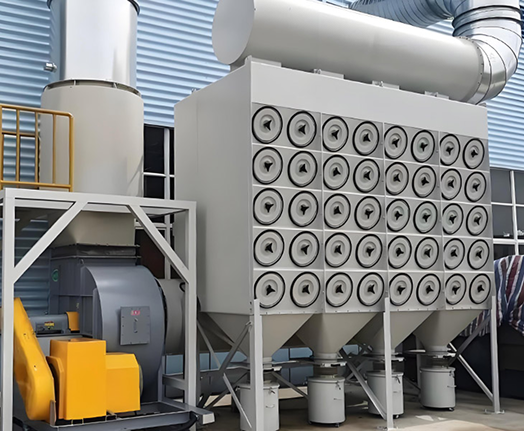
Filter Media Selection for Grinding Dust
The best filter media depends on the dust.
For relatively dry general metal grinding, durable polyester-based cartridge media may be a practical starting point.
Where fine particulate dominates, surface-loading media such as nanofiber or membrane-style cartridges can help keep fine dust closer to the media surface and support more effective pulse release.
For more abrasive conditions, mechanical durability becomes increasingly important.
A simplified selection framework is:
| Dust Condition | Media Direction to Evaluate | Main Reason |
|---|---|---|
| General dry grinding dust | Durable polyester / blended cartridge media | Balance durability and cleanability |
| Fine dry metal dust | Nanofiber or membrane surface-loading media | Improve surface retention and dust release |
| Abrasive mixed particle sizes | Mechanically robust cartridge + inlet protection | Reduce wear |
| Static-sensitive dust | Anti-static option where justified | Support static-control strategy |
| Spark-risk process | Flame-retardant media may be considered | Additional resistance to ignition, not spark prevention |
Media selection should not be separated from the inlet design.
A more abrasion-resistant cartridge may last longer, but allowing heavy particles to impact it directly is still poor system design.
Anti-Static Does Not Mean Fireproof
This distinction is especially important in metal grinding.
Anti-static media can help control electrostatic charge when correctly integrated into a conductive and grounded system.
Flame-retardant media can provide improved resistance to ignition or flame propagation.
Neither means:
- sparks can safely enter the collector
- combustible dust no longer needs hazard assessment
- explosion protection is unnecessary
- mixed metal dusts can automatically share one collector
The filter cartridge is one component inside the system.
It should not be expected to compensate for an unsafe upstream process.
Spark Control Should Happen Before Filtration
Ferrous grinding commonly generates visible sparks.
Many of those sparks cool quickly.
But the important question is not whether most sparks cool.
It is whether a sufficiently energetic particle can enter a dust concentration capable of ignition.
For appropriate applications, the system may use:
- spark deflection
- inlet baffles
- drop-out chambers
- longer controlled transport paths
- pre-separation
- process-specific spark detection or extinguishing
Every added device creates some airflow resistance.
That resistance must be included in fan selection.
A spark-control device that reduces filter damage but causes inadequate source capture is not a complete solution.
Mixed-Metal Grinding Deserves Special Attention
A fabrication shop may grind carbon steel in the morning and aluminum later in the same area.
Operationally, that may seem simple.
From a dust-collection perspective, it may not be.
Residual dust can remain in:
- capture tables
- ducts
- collector inlets
- cartridges
- hoppers
- dust bins
This becomes especially important where one material produces sparks and another generates a combustible fine dust.
A published workplace incident involved a dry dust collector receiving aluminum and steel grinding/polishing dust.
Heat and sparks generated by the steel operation ignited aluminum dust accumulated in the collector.
The result was a severe fire with multiple injuries and a fatality.
The practical lesson is clear:
Changing the workpiece does not automatically reset the dust collection system.
Aluminum Grinding Is Not Just “Steel Grinding with Different Dust”
Fine aluminum dust can present a combustible-dust hazard under suitable conditions.
That does not mean every aluminum grinding operation is automatically explosive.
Actual risk depends on the dust produced by the process, particle size, concentration, dispersion, moisture, ignition sources, and collection method.
But it does mean that an ordinary dry cartridge collector selected for carbon-steel grinding should not automatically be reused for aluminum simply because the airflow is sufficient.
Representative dust testing and a documented hazard assessment may be necessary.
Depending on the application and applicable requirements, combustible-metal grinding may require a dedicated collection strategy, different collector architecture, isolation, venting, wet collection, or other engineered controls.
A Published Deburring Case: Fugitive Aluminum Dust Became the Warning Sign
In another publicly documented metalworking facility, employees were grinding and deburring aluminum and other alloys.
Dust was not being effectively contained at the source.
Visible deposits accumulated across equipment, shelving, floors, ductwork, and overhead surfaces.
Testing confirmed that the collected aluminum-containing dust was explosible.
The corrective strategy included a dedicated downdraft table for aluminum work and a specially designed wet collection system for combustible metal dust.
The broader lesson is not that every aluminum application must use exactly the same equipment.
It is this:
When combustible metal dust escapes the capture system and begins accumulating around the room, filtration is no longer only an air-quality problem.
Source capture, dedicated process control, housekeeping, and the collector safety concept all have to work together.
Filter Area Controls How Hard the Cartridges Work
A cartridge collector can have the correct airflow and still have too little filter area.
Filtration velocity can be thought of simply as:
airflow distributed across the available filter media area
If airflow remains constant while filter area decreases, the media has to work harder.
For grinding dust, excessive filtration velocity can contribute to:
- fast pressure-drop increase
- stronger dust penetration into the media
- poor pulse-cleaning recovery
- short cartridge life
- unstable source capture as resistance increases
Heavy dust loading makes this even more important.
A collector used for occasional touch-up grinding and the same collector used on a continuous production deburring line may require very different filter area even if the extraction airflow is similar.
Uneven Cartridge Loading Is a Diagnostic Clue
Not all filters inside a collector necessarily load at the same rate.
If the cartridges nearest the inlet become dirty or damaged much faster than the others, the cause may be airflow distribution rather than media quality.
Direct inlet momentum can push heavy particles toward one section of the collector.
This produces localized loading and abrasion.
Typical signs include:
- one cartridge row showing much higher dust accumulation
- repeated wear in the same location
- uneven differential-pressure behavior
- cartridges near the inlet failing earlier than downstream cartridges
In these cases, replacing the cartridges with the same design may reproduce the same failure.
The inlet arrangement should be reviewed.
Pulse Cleaning Should Restore Permeability, Not Make the Filter Look New
Pulse cleaning uses short bursts of compressed air to release accumulated dust from the cartridge surface.
The objective is not to return the cartridge to a visually clean condition after every pulse.
The objective is to keep differential pressure within a stable operating range.
If pressure drop keeps rising despite frequent pulsing, possible causes include:
- excessive dust loading
- filtration velocity that is too high
- weak compressed-air supply
- pulse-valve problems
- dust embedded deeply in the media
- moisture or oil contamination
- unsuitable media
- poor inlet distribution
Simply increasing pulse frequency can sometimes consume more compressed air without solving the underlying cause.
Differential-pressure-controlled cleaning is often more informative than cleaning only on a fixed timer.
Pressure Drop Should Be Read as a Trend
One differential-pressure reading tells you the condition at one moment.
The trend tells you how the system is behaving.
A useful operating pattern is:
clean baseline → gradual loading → pulse recovery → stable operating range
Problems appear when the pattern changes.
For example:
DP rises rapidly after every cartridge change
Possible issue: too much dust loading or too little filter area.
DP drops after a pulse but immediately rises again
Possible issue: heavy dust generation or poor dust discharge.
DP never returns near the previous baseline
Possible issue: media blinding or embedded fine dust.
Suction weakens while DP increases
Possible issue: the fan no longer has enough static-pressure margin for the loaded-filter condition.
This is why pressure-drop history is more useful than simply asking how many months a cartridge lasted.
The Fan Must Overcome the Complete System
A fan should not be selected from an airflow number alone.
The required duty includes resistance from:
capture hood / table → ductwork → elbows → pre-separation → spark control → collector inlet → loaded filter cartridges → clean-air outlet
The fan may be capable of the required airflow at low resistance but deliver far less once the real system is connected.
This can create a confusing situation:
The collector looks large enough.
The motor runs normally.
The cartridges are installed correctly.
But dust still escapes from the grinding station.
The real issue may be insufficient airflow at the actual installed static pressure.
Dust Discharge Is Part of Filter Performance
Pulse cleaning only moves dust off the cartridges.
The material still has to leave the collector.
Heavy grinding dust can accumulate quickly in the hopper and bin.
If discharge capacity is insufficient, dust can build back into the filtration section or become re-entrained.
A grinding collector should therefore be reviewed for:
- hopper volume
- dust-bin capacity
- emptying frequency
- safe removal procedure
- maintenance access
- expected daily dust loading
A small drawer may be convenient for occasional grinding.
It may be impractical for continuous heavy deburring.
Three Published Lessons from Metal Grinding Operations
| Published Situation | What Happened | Engineering Lesson |
|---|---|---|
| Aluminum sanding on a downdraft table | Capture effectiveness changed with table position and workpiece height; a damaged filter also reduced performance | Capture geometry and filter condition matter as much as collector airflow |
| Steel and aluminum grinding connected to one dry collector | Sparks/heat from ferrous grinding ignited accumulated aluminum dust | Mixed-metal dust and ignition sources must be reviewed together |
| Aluminum deburring with poor dust control | Fugitive dust accumulated around the room and was confirmed explosible | Source capture, dedicated collection strategy, housekeeping, and hazard review must work together |
These cases point to one consistent conclusion:
Grinding dust collection problems rarely begin at the cartridge alone.
Common Grinding Dust Collector Mistakes
- Selecting the collector before understanding the grinding process.
- Assuming every metal grinding dust behaves the same way.
- Using a downdraft table without checking where the operator actually grinds.
- Sending heavy abrasive particles directly onto pleated cartridges.
- Reusing welding-fume filtration assumptions for high-dust grinding.
- Choosing filter media only by filtration efficiency.
- Treating anti-static or flame-retardant media as a complete safety solution.
- Mixing combustible and spark-generating metal dust without a proper review.
- Increasing pulse frequency instead of investigating high pressure drop.
- Sizing the fan by airflow without calculating installed static pressure.
What Information Should Be Collected Before Selecting the System?
A reliable grinding dust collector RFQ should include:
- Metal being ground
- Grinding, deburring, polishing, or sanding process
- Grinder type and abrasive type
- Number of workstations
- Workpiece dimensions
- Manual or robotic operation
- Capture arrangement
- Required or existing airflow
- Duct dimensions and routing
- Dust loading
- Visible sparks or hot particles
- Whether different metals share the system
- Available compressed air
- Existing differential-pressure trend
- Required operating hours
- Collector installation location
- Dust disposal method
- Any combustible-dust test data already available
For existing problem systems, photographs of the grinding station, duct route, collector inlet, used cartridges, and retained dust are especially useful.
Final Engineering View
Metal grinding dust collection can be understood as a chain:
Grinding Source → Source Capture → Dust Transport → Heavy-Particle Control → Spark Control → Cartridge Filtration → Pulse Cleaning → Fan → Dust Discharge
Every stage influences the next.
Poor capture allows fine dust to escape into the workshop.
Low duct velocity allows heavier particles to settle.
High-velocity abrasive particles can damage the collector inlet and filter media.
Poor spark control exposes accumulated dust to ignition sources.
Too little filter area causes pressure drop to increase rapidly.
Weak pulse cleaning shortens cartridge life.
An undersized fan loses source capture as filter resistance rises.
Poor hopper capacity simply moves the maintenance problem from the filter to the dust bin.
That is why the most useful question is not:
“Which cartridge dust collector should I buy for grinding?”
It is:
“What dust does this grinding process actually generate, how should it be captured, and what must happen to the heavy particles, fine dust, and sparks before they reach the filter cartridges?”
Once those questions are answered, collector size, media type, cartridge area, inlet design, pulse cleaning, fan duty, and safety strategy become much easier to define.
Frequently Asked Questions
Are cartridge dust collectors suitable for metal grinding dust?
Yes, they can be well suited to dry, fine, non-sticky grinding dust when airflow, filter area, media, pulse cleaning, inlet design, and dust characteristics are properly matched. Heavy abrasive or combustible metal dust may require additional controls or a different collection concept.
What filter media is best for grinding dust?
There is no single best media. Durable polyester-based cartridges may suit general dry grinding, while nanofiber or membrane-style media may improve surface filtration and dust release for fine particulate. Abrasive, static-sensitive, moist, or combustible dust requires additional review.
Why do grinding dust cartridges wear out near the inlet?
Heavy particles and high inlet velocity can repeatedly impact the same filter area, causing uneven loading and mechanical wear. Inlet baffles, drop-out zones, or pre-separation may help reduce direct impact.
Why does differential pressure rise quickly during grinding?
Possible causes include high dust loading, insufficient filter area, unsuitable media, poor pulse cleaning, embedded fine dust, moisture, oil contamination, or uneven inlet airflow.
Can aluminum and steel grinding share the same dust collector?
This should not be assumed safe. Residual combustible aluminum dust can interact with sparks or hot particles generated during ferrous grinding. Mixed-metal collection requires a documented review of dust hazards, ignition sources, applicable standards, and system design.
Does anti-static filter media make a grinding dust collector explosion-proof?
No. Anti-static media can support static-charge control but does not replace combustible-dust assessment, grounding, spark control, isolation, venting, suppression, or other protection measures required by the actual application.
Author

Jessica Ma – Senior Filtration Engineer, Omela Filtration
Jessica Ma is a senior filtration engineer at Omela Filtration, specializing in dust and liquid filtration. With over 15 years of experience, she focuses on optimizing baghouse performance, enhancing filtration efficiency, and developing high-performance solutions for industrial dust collectors and precision liquid filtration applications.