
Key Takeaways
- High differential pressure in a baghouse means air is finding it harder to pass through the filter bags, usually because of heavy dust cake, filter bag blinding, weak cleaning, moisture, sticky dust, or an overloaded air-to-cloth ratio.
- Dust collector filter bags should be selected by dust type, particle size, temperature, moisture, gas chemistry, abrasion, cleaning method, and emission target.
- In a pulse jet baghouse, stable pressure drop depends on filter media, dust cake release, compressed air quality, pulse settings, hopper discharge, and correct filtration area.
- PTFE membrane filter bags can help when fine dust penetrates into the felt, causing internal blinding, unstable pressure drop, or emission problems.
- Filter bag cages also affect pressure drop because rough, bent, corroded, or wrong-size cages can disturb bag cleaning and shorten bag life.
- For replacement filter bags or high pressure-drop troubleshooting, send dust type, temperature, moisture, gas chemistry, air volume, pressure-drop trend, cleaning settings, bag size, cage photos, and failure photos to contact Omela Filtration.
What High Differential Pressure Means
Differential pressure is the pressure difference between the dirty-air side and the clean-air side of a baghouse dust collector. In simple terms, it shows how difficult it is for air to pass through the filter bags and the dust layer on the bag surface.
When the system is healthy, pressure drop usually stays within a stable working range. It may rise slowly as dust builds on the bag surface, then drop again after pulse cleaning. This rise-and-clean cycle is normal.
The problem starts when pressure drop keeps rising, stays high after cleaning, rises too fast after startup, or changes suddenly. This usually means the baghouse is no longer breathing properly. Airflow becomes weaker, the fan works harder, dust capture at pickup points may get worse, and the filter bags may fail earlier.
EPA explains that fabric filters collect particles on the filter media and that fine-particle capture depends strongly on the dust cake formed on the filter surface. As dust builds up, pressure drop increases, so the filter material must be cleaned periodically by shaking, reverse air, or pulse jet cleaning.
Dust Cake Is Necessary, But It Must Stay Breathable
A baghouse needs a dust cake. A thin and even dust cake helps capture fine particles and improves filtration efficiency. A brand-new bag that is too clean may not filter fine dust as effectively as a bag with a stable dust layer.
However, dust cake becomes a problem when it is too thick, too sticky, too wet, or too compacted. At that point, air cannot pass through easily. The fan must work harder, pressure drop rises, and the pulse cleaning system may struggle to remove the dust.
Omela’s dust filter bag page also explains that dust forms a stable “dust cake” on the media surface and that filter media properties, air-to-cloth ratio, temperature, chemical composition, and cleaning method together determine filter bag performance.
The goal is not to keep filter bags completely clean. The real goal is to maintain a stable dust cake that helps filtration while still allowing enough airflow.
Why Pressure Drop Keeps Rising
High differential pressure usually comes from several factors working together. Sometimes the filter bag material is wrong. Sometimes the cleaning system is weak. Sometimes the dust is wet, sticky, oily, or too fine. Sometimes the baghouse is simply handling more air or dust than it was designed for.
| Cause | What Happens Inside the Baghouse | What You May See On Site |
|---|---|---|
| Heavy dust cake | Too much dust stays on the bag surface | Pressure drop rises slowly and does not return to normal |
| Filter bag blinding | Fine dust blocks pores inside the media | Pressure remains high even after pulse cleaning |
| Weak pulse cleaning | Dust cake is not removed effectively | Pressure rises again soon after cleaning |
| Moisture or condensation | Dust becomes sticky, hard, or mud-like | Sudden pressure increase after startup or shutdown |
| Sticky or oily dust | Dust adheres to the media and does not release well | Bags look glazed, coated, or unevenly cleaned |
| Air-to-cloth ratio too high | Too much air passes through too little filter area | Fast dust loading, frequent pulsing, short bag life |
| Poor hopper discharge | Collected dust re-enters the airflow | Pressure rises even when the cleaning system works |
| Wrong filter media | Media does not match dust, temperature, or chemistry | High pressure drop, emissions, blinding, or early failure |
Omela’s maintenance article notes that moisture, oil, and particulate in the compressed air supply can damage pulse-jet cleaning systems and filter bags; moisture is especially harmful because it can cause diaphragm deterioration, filter bag blinding, and corrosion of internal components.
Filter Bag Blinding: When Dust Enters the Media
Filter bag blinding means dust is no longer only sitting on the surface. Fine particles, sticky materials, oil mist, moisture, or chemical deposits enter the filter media and block the internal pore structure.
This is more serious than normal dust cake buildup. Surface dust can often be removed by pulse cleaning, but internal blinding is much harder to reverse. A blinded bag may look partly cleaned on the outside after pulsing, but airflow is still poor because the inside of the media is blocked.
Omela’s dust properties article explains that particle size controls whether dust forms a stable cake or penetrates the media. It also notes that 1–5 μm particles have high penetration risk, while submicron dust may require a PTFE surface layer for difficult capture conditions.
For fine dust or dust that easily enters the felt, PTFE membrane can be useful. Omela explains that PTFE membrane filter media changes filtration behavior by keeping more particles at the surface, reducing internal pore blockage, and helping the system reach a more stable operating pressure drop.
Pulse Cleaning Should Be Balanced
Pulse cleaning removes dust cake by sending short bursts of compressed air into the filter bags. If the pulse is too weak, dust does not release. If the pulse is too frequent or too strong, the bags may suffer extra mechanical stress.
EPA’s pulse-jet fact sheet explains that fabric filter size is related to air-to-cloth ratio, and that sufficient fabric area is needed to avoid unacceptable pressure drop. It also describes pulse-jet cleaning as a method that removes dust cake from the filter bags during operation.
In the field, weak cleaning can come from low compressed-air pressure, wet compressed air, oil in the air line, damaged pulse valves, blocked blow pipes, wrong pulse interval, or poor alignment between the blow pipe and bag opening.
Over-cleaning can also create problems. If the dust cake is removed too aggressively, the filter bags lose the protective dust layer and may face more abrasion. More pulsing also means more movement between the bag and cage, which can shorten service life. Omela’s filter bag cleaning article makes the same point: effective cleaning is not about removing all dust, but about maintaining a stable, porous dust cake that protects the fabric and controls emissions.
Air-to-Cloth Ratio: When the Collector Is Overloaded
Air-to-cloth ratio means how much air passes through a certain amount of filter cloth area. If the air volume is too high for the available bag area, dust loads the bags too quickly.
This is like asking a small filter to do the work of a large one. The bags collect dust faster than the pulse system can clean them. Pressure drop rises, cleaning becomes more frequent, and bag life becomes shorter.
High air-to-cloth ratio may happen when production capacity increases, fan speed is changed, more pickup points are connected, bags are removed from service, or the original collector was undersized.
In this case, changing filter bags alone may not solve the problem. The system may need more filtration area, lower airflow, better inlet distribution, pleated bags, additional compartments, or different operating settings.
EPA notes that air-to-cloth ratio depends on particulate loading, particulate characteristics, and cleaning method; high particulate loading requires more fabric area to avoid heavy dust cake and excessive pressure drop.
Moisture and Sticky Dust Can Make Pressure Drop Rise Quickly
Moisture is one of the most common reasons pressure drop suddenly becomes unstable. When gas temperature falls below the dew point, moisture condenses and turns dry dust into sticky dust. Sticky dust does not release well during pulse cleaning.
This can happen after shutdown, during cold startup, after rain leakage, when compressed air contains water, or when the process gas contains moisture or acid gas.
Sticky dust can form hard cake on the bag surface, block the filter pores, bridge between bags, corrode cages, and build up in the hopper. Once this happens, simply increasing pulse pressure may not help.
Omela’s dust properties article identifies moisture, condensation below acid dew point, resinous or oily dust, and over-cleaning that drives fines into the media as common causes of baghouse blinding. It also lists PTFE membrane surface filtration, hopper insulation, and optimized pulse-jet timing as possible strategies.
For these applications, the solution may include dew point control, insulation, heating, dry compressed air, better hopper discharge, water/oil repellent treatment, PTFE coating, or PTFE membrane filter bags.
Field-Based EEAT Lessons Integrated into High-DP Troubleshooting
Real baghouse problems usually do not come from one single cause. Omela’s published field references and technical articles show that pressure drop must be understood together with dust behavior, filter media, cleaning method, and operating environment.
| Field / Technical Reference | What Happened | Practical Lesson for High DP |
| Cement kiln baghouse retrofit | Omela reported a 5000 t/d cement kiln retrofit using PPS + PTFE membrane filter bags, with stable emissions below 5 mg/Nm³, 24 months of continuous operation without unplanned bag failures, and about 18% pressure drop reduction compared with previous standard PPS felt. | Fine, hot, chemically active dust should be matched with surface filtration and suitable base media, not selected only by bag size. |
| Thermal power plant dust filtration | Omela’s PTFE thermal power plant article explains that PTFE filter bags offer chemical inertness, high temperature tolerance, surface filtration, low ash adhesion, and more stable pressure-drop behavior over long campaigns. | In acidic, hot, or long-cycle flue gas, stable DP depends on chemical resistance, ash release, cleaning strategy, and controlled operating conditions. |
| Low-resistance PTFE membrane media | Omela’s low-resistance PTFE membrane article explains that stable pressure drop can reduce fan energy consumption, motor loading, and long-term operating resistance in high-airflow dust collection systems. | High DP is not only a maintenance issue; it also affects energy cost and long-term operating cost. |
| Baghouse maintenance diagnosis | Omela’s maintenance guide states that daily differential pressure tracking is one of the most useful health indicators because it can reveal blinding, cleaning problems, air leaks, and increased dust loading before visible failures appear. | DP trends should be recorded and compared against a baseline after new bag installation. |
| Filter bag cleaning practice | Omela’s cleaning article explains that cleaning should restore permeability and maintain stable differential pressure, but improper cleaning can shorten bag life, increase emissions, and raise energy consumption. | More cleaning is not always better; cleaning must match the dust, media, and system design. |
These references support a practical conclusion: high differential pressure should not be treated as a simple “change the bags” signal. It is a system diagnosis issue.
How to Read Pressure Drop Trends
A single pressure-drop value is helpful, but the trend is more important. Maintenance teams should record normal operating pressure after new bags are installed, then compare future readings with that baseline.
| Pressure-Drop Pattern | Possible Meaning | What to Check First |
| Slowly rising over weeks or months | Normal loading, aging bags, or gradual blinding | Bag age, dust cake, pulse cleaning, outlet emissions |
| Rising quickly after startup | Moisture, sticky dust, process change, or high dust load | Dew point, hopper dust, compressed air, inlet temperature |
| Staying high after pulse cleaning | Blinded bags or weak cleaning | Pulse valves, air pressure, media surface, bag condition |
| Suddenly dropping very low | Bag leak, poor sealing, or bypass | Snap band, tube sheet, broken bags, outlet dust |
| Fluctuating sharply | Unstable process or cleaning control issue | Fan, damper, pulse sequence, hopper discharge |
| High pressure with weak suction | System resistance is too high | Duct blockage, bag condition, fan capacity, air volume |
| High pressure with frequent pulsing | Collector is overloaded or media is unsuitable | Dust load, filter area, air-to-cloth ratio, media finish |
Low pressure drop should not always be seen as good. If pressure suddenly drops while dust appears at the outlet, there may be a broken bag, poor snap-band sealing, a tubesheet leak, or airflow bypass.
How Omela Products Help Control High Pressure Drop
Omela’s role is not only to supply replacement filter bags. A better approach is to match the filter media, surface treatment, bag construction, cage, and operating conditions.
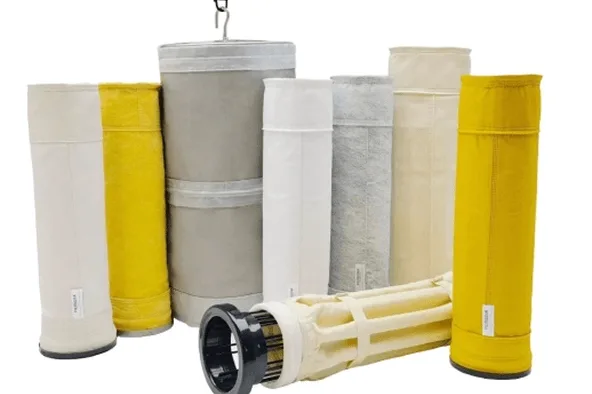
For dry and normal-temperature dust, polyester filter bags may be a cost-effective choice. For humid or hydrolysis-sensitive dust, acrylic or other suitable media may be reviewed. For sulfur-containing or acidic flue gas, PPS or PPS with PTFE membrane may be considered. For hot gas, aramid, P84, fiberglass, FMS, PTFE, or composite media may be needed depending on the real temperature and chemistry.
For fine dust, PTFE membrane helps keep more dust on the surface. For oily or sticky dust, water and oil repellent treatment may improve dust release. For combustible fine powder, anti-static filter bags may be required. For moisture, corrosion, or high-temperature environments, cage coating and cage material should also be checked.
Omela’s dust filter bag page lists polyester, acrylic, PPS, aramid, P84, PTFE, fiberglass, PTFE membrane, singed/glazed surface, calendering, anti-static treatment, and oil/water repellent finishes as available material and treatment directions for different dust collection conditions.
Filter bag cages should not be ignored. Omela explains that filter bag cages support the bag shape under airflow and pressure, and that cage shape, material, coating, collar, venturi, and joint design affect baghouse performance and bag life.
Common Mistakes When Handling High Pressure Drop
The first mistake is replacing bags without checking why the old bags failed. If the real problem is moisture, poor cleaning, high air-to-cloth ratio, or hopper re-entrainment, the new bags may quickly develop the same pressure problem.
The second mistake is increasing pulse pressure too much. Stronger cleaning may temporarily reduce dust cake, but it can also increase bag wear, cage abrasion, and compressed-air cost.
The third mistake is choosing the finest filter media without considering airflow. Finer media may improve emission control, but if the dust load is high and the collector is small, pressure drop may rise too fast.
The fourth mistake is ignoring the cage. A rough, bent, rusty, or wrong-size cage can disturb cleaning and damage the bag from the inside.
The fifth mistake is ignoring temperature and dew point. A filter bag that works well in dry conditions may blind quickly when moisture or condensation appears.
To Request a Quote
For high differential pressure troubleshooting or replacement filter bag selection, please send:
- Dust collector type and application
- Dust type, particle size, concentration, and dust behavior
- Working temperature and peak temperature
- Moisture, dew point risk, oil mist, acid gas, alkali, sulfur, or corrosive components
- Air volume and air-to-cloth ratio, if available
- Current pressure-drop range and trend
- Pulse pressure, pulse interval, pulse width, and cleaning mode
- Current filter bag material, size, top style, and bottom design
- Current bag service life and failure pattern
- Cage material, cage condition, and cage photos
- Hopper discharge condition and dust cake photos
- Outlet emissions, visible dust, or leak-test results
- Quantity and delivery destination
With this information, Omela can help compare filter media, surface treatments, PTFE membrane options, bag construction, and matched cage solutions for your baghouse system.
Omela Engineering View
High differential pressure is not just a filter bag problem. It is a system signal.
It may mean the dust cake is too heavy, the bags are blinded, the pulse cleaning is weak, the dust is wet or sticky, the air-to-cloth ratio is too high, the hopper is not discharging, the filter media is unsuitable, or the cages are damaging the bags.
The right solution starts with the question: why is airflow resistance increasing?
For fine dust, PTFE membrane or surface-treated media may help. For sticky or wet dust, dew point control and water/oil repellent treatment may be more important. For high dust loading, more filter area or lower filtration velocity may be needed. For weak cleaning, the pulse system must be repaired before new bags are installed.
A stable baghouse depends on filter bags, dust cake, pulse cleaning, air volume, cages, hopper discharge, and maintenance working together. Omela Filtration helps customers evaluate these factors and choose filter bags that solve the actual pressure-drop problem, not just replace the old bags.
FAQ
What is differential pressure in a baghouse dust collector?
Differential pressure is the pressure difference between the dirty-air side and the clean-air side of the filter bags. It shows how much resistance the airflow meets as it passes through the filter media and dust cake.
What causes high differential pressure in a baghouse?
High differential pressure is commonly caused by excessive dust cake, filter bag blinding, weak pulse cleaning, wet or sticky dust, high air-to-cloth ratio, hopper re-entrainment, wrong filter media, or blocked airflow paths.
What is filter bag blinding?
Filter bag blinding happens when fine dust, sticky particles, oil, moisture, or chemical deposits block the pores inside the filter media. Blinded bags often remain high in pressure drop even after pulse cleaning.
Does higher pulse pressure solve high pressure drop?
Not always. Higher pulse pressure may remove more dust cake, but it can also damage filter bags, increase abrasion, create holes, and shorten service life. Pulse settings should be optimized, not simply increased.
How does air-to-cloth ratio affect differential pressure?
A high air-to-cloth ratio means too much airflow is passing through too little filter area. This loads the bags faster, makes cleaning harder, increases pressure drop, and may shorten bag life.
Can PTFE membrane filter bags reduce high pressure drop?
PTFE membrane filter bags can help when fine dust penetrates into the felt and causes internal blinding. They keep more dust on the media surface and can improve dust release, but the baghouse design and cleaning system must also be suitable.
What information is needed to select replacement bags for high pressure-drop problems?
Provide dust type, temperature, moisture, chemistry, air volume, pressure-drop trend, cleaning settings, bag size, current media, cage condition, failure photos, hopper condition, emission target, and quantity.
Author

Jessica Ma – Senior Filtration Engineer, Omela Filtration
Jessica Ma is a senior filtration engineer at Omela Filtration, specializing in dust and liquid filtration. With over 15 years of experience, she focuses on optimizing baghouse performance, enhancing filtration efficiency, and developing high-performance solutions for industrial dust collectors and precision liquid filtration applications.