
Key Takeaways
- FMS filter bags are designed for high-temperature, abrasive, and chemically complex baghouse dust collection, especially where heat, dust load, corrosion, and mechanical wear appear together.
- FMS is a composite fiberglass-based filter media, often combining alkali-free glass fiber with high-temperature fibers or surface treatments to improve thermal stability, abrasion resistance, and dust release.
- Typical applications include cement kilns, clinker coolers, steel furnaces, smelting plants, waste-to-energy systems, and other high-temperature dust collectors.
- The right dust collector filter bags should be selected by continuous temperature, peak temperature, dust abrasiveness, gas chemistry, moisture, oxygen content, air-to-cloth ratio, and cleaning method.
- Filter bag cages should be checked together with FMS bags because rough, bent, corroded, or wrong-size cages can shorten bag life even when the media is correct.
- FMS is not a universal replacement for every high-temperature baghouse. PPS, aramid, P84, PTFE, fiberglass with PTFE membrane, or PTFE membrane filter bags may be better depending on the actual dust and flue gas conditions.
Why High-Temperature Dust Collection Needs More Than a Standard Filter Bag
High-temperature baghouse dust collection is rarely only about temperature. In real plants, filter bags may also face abrasive particles, acidic or alkaline flue gas, thermal cycling, high dust loading, moisture, oxygen, sparks, and unstable pressure drop.
EPA explains that fabric filters remove particles by depositing them on fabric material, and that fine-particle collection depends strongly on the dust cake formed on the filter surface. As dust builds up, pressure drop increases, so the filter material must be cleaned periodically by shaking, reverse air, or pulse jet cleaning.
This is why a high-temperature filter bag must be selected as part of a system. If the media is chosen only by maximum temperature, but the dust is abrasive, the gas is corrosive, or the pulse cleaning is too aggressive, the bag may still fail early.
FMS filter bags are often considered when heat, abrasion, and difficult flue gas chemistry appear at the same time.
What Are FMS Filter Bags?
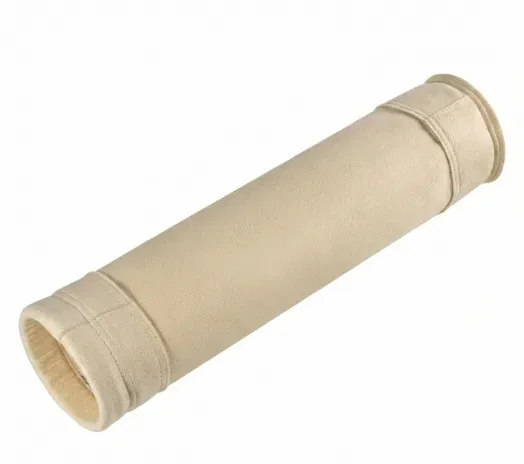
FMS filter bags are composite high-temperature dust collector bags based on fiberglass media. Compared with standard needle felt or ordinary fiberglass bags, FMS media is usually engineered with a fiberglass base plus high-temperature fibers, surface treatments, or membrane options to improve stability in harsh baghouse environments.
Omela’s FMS product page describes FMS composite media as combining alkali-free glass fiber with high-temperature felts such as P84. It is positioned for repeated thermal cycling, abrasive dust, corrosive flue gas, cement kilns, steel furnaces, waste-to-energy systems, and smelting operations.
In practical terms, FMS is not simply “fiberglass.” It is better understood as heavy-duty composite filter media for baghouses where standard polyester, acrylic, or ordinary felt bags may not survive long enough.
What Problems Is FMS Designed to Solve?
| Problem | Why It Matters | How FMS Helps |
|---|---|---|
| High temperature | Standard media may shrink, harden, melt, or lose strength | Fiberglass composite structure improves thermal stability |
| Abrasive dust | Cement clinker, slag, lime, mineral dust, and metal oxides can wear bag surfaces | Heavier composite media and surface finish help improve wear resistance |
| Corrosive flue gas | Acidic, alkaline, or chemically active gas can weaken media and cages | Media and surface treatment can be matched to gas chemistry |
| Thermal cycling | Startup, shutdown, and process upsets stress the fabric structure | Dimensional stability helps reduce deformation |
| High dust load | Heavy dust cake increases pressure drop and cleaning demand | Correct finish and cleaning compatibility support dust release |
| Mechanical stress | Pulse cleaning and cage contact can damage weak media | FMS requires matched cage design and controlled cleaning |
EPA’s pulse-jet fabric filter fact sheet notes that gas temperatures up to about 260°C, with surges around 290°C, can be handled with appropriate fabric material, and that spray cooling or dilution air may be used to reduce gas temperature before the fabric limit is exceeded. This supports one important point: temperature rating must be matched to real operating conditions, not selected from a catalog alone.
Where FMS Filter Bags Are Commonly Used
FMS filter bags are commonly used where the dust collector handles hot, abrasive, or chemically demanding gas streams.
In cement kilns and clinker coolers, the dust can be alkaline, abrasive, heavy, and temperature-variable. Omela’s cement industry page identifies rotary kiln gas, clinker cooler vent air, kiln bypass gas, and raw mill baghouses as difficult sections because they involve high temperature, abrasive dust, chemical aggression, and thermal shock.
In steel furnaces and smelting plants, the dust stream may contain hot metal oxide fumes, abrasive particles, corrosive vapor, and spark risk. Omela’s metal-industry filtration article emphasizes that a steel sinter strand, electric arc furnace, aluminum melting furnace, zinc oxide line, copper smelter, lead processing plant, and foundry dust collector may all require different filter media because their temperature, dust load, gas chemistry, moisture, abrasion, and emission targets differ.
In waste-to-energy and incineration systems, flue gas can be chemically aggressive and variable. FMS may be considered where hot ash, corrosive components, and abrasive dust appear together, but chemical compatibility still needs review.
In mineral processing, lime kilns, and high-dust-load baghouses, the key problem is often mechanical wear. Even when gas chemistry is not severe, heavy abrasive dust can shorten bag life if the media, cage, and inlet design are not suitable.
FMS vs Fiberglass, PPS, Aramid, P84, and PTFE
FMS should be compared with other high-temperature filter media before selection. The goal is not to choose the “strongest” material on paper, but the most suitable material for the actual gas stream.
| Filter Media | Better For | Watch Point |
|---|---|---|
| FMS | High-temperature, abrasive, mixed flue gas conditions | Must verify gas chemistry, pulse cleaning, and cage condition |
| Fiberglass | High-temperature dry gas and stable operation | Sensitive to flexing, rough cages, and handling damage |
| PPS | Moist, acidic, sulfur-containing flue gas | Oxidation risk under high oxygen and high temperature |
| Aramid / Nomex | Hot, relatively dry dust collection | Sensitive to acid gas and hydrolysis |
| P84 | Fine dust, low-emission targets, good dust release | Higher cost; chemistry review needed |
| PTFE | Severe chemical corrosion and high-value emission control | Higher cost; structure and system design must justify it |
| PTFE membrane media | Fine particles, surface filtration, lower dust penetration | Requires careful installation and compatible base media |
Omela’s dust filter bag page lists polyester, acrylic, PPS, aramid, P84, PTFE, fiberglass, and FMS as different media options, each with different temperature, chemical, mechanical, and cost profiles.
For example, FMS may be a strong candidate when heat and abrasion are the main problems. But if the main issue is acid condensation, severe chemical corrosion, or ultra-fine emission control, another media or surface treatment may be more suitable.
Temperature Is Important, But Peak Temperature Is Not Enough
Many plants ask only one question: “What temperature can this filter bag handle?” That is useful, but not enough.
For FMS filter bags, selection should consider both continuous temperature and instant peak temperature. Continuous temperature affects long-term aging and strength loss. Peak temperature affects sudden shrinkage, hardening, or thermal damage. Thermal cycling can also stress the bag, especially when the furnace, kiln, or smelting line frequently starts and stops.
Omela’s FMS page describes FMS composite media as suitable for long-term service in the 200°C range and instant peaks around 280°C, depending on construction and operating conditions. However, this should not be treated as a universal promise for every plant. Gas chemistry, moisture, dust load, oxygen content, and cleaning stress can all change real service life.
Low temperature can also be risky. EPA notes that when acid gases are present, low operating temperatures may allow condensation, which can corrode metal parts and cause bag blinding that blocks airflow. Fabric filters are also susceptible to high-temperature damage.
Abrasion, Dust Cake, and Pulse Cleaning
Abrasive dust is one of the main reasons plants consider FMS filter bags. Cement dust, clinker dust, slag dust, lime dust, mineral dust, and metal oxide dust can wear filter bags from the outside. At the same time, rough cages or poor cage alignment can wear bags from the inside.
Pulse cleaning is another important factor. EPA explains that pulse-jet cleaning uses a short burst of compressed air that flexes the fabric and dislodges dust cake. The same fact sheet notes that baghouse performance depends on fabric choice, cleaning frequency and method, and particulate characteristics.
Omela’s filter bag cleaning article also warns that different media respond differently to cleaning energy. It notes that FMS has a fiberglass core and requires controlled cleaning, while fiberglass media is more sensitive to mechanical stress.
The practical rule is simple: FMS needs controlled cleaning, not aggressive cleaning. Too little cleaning causes high pressure drop. Too much cleaning increases fabric flexing, cage wear, and mechanical fatigue.
Air-to-Cloth Ratio and Baghouse Sizing
FMS bags cannot compensate for an undersized dust collector. If too much air passes through too little filter area, the dust cake forms too quickly, the cleaning system works too often, and the bags experience higher mechanical stress.
EPA states that practical fabric filter application requires a large fabric area to avoid unacceptable pressure drop. Baghouse size is determined by air-to-cloth ratio, and the proper ratio depends on particulate loading, particulate characteristics, and cleaning method. High particulate loading requires a larger baghouse to avoid a heavy dust cake and excessive pressure drop.
For cement kilns, steel furnaces, and smelting plants, this means a filter bag upgrade should be reviewed together with air volume, filtration velocity, dust loading, pulse-cleaning capacity, hopper discharge, and inlet airflow distribution.
Cage Condition Is Critical for FMS Bags
Because FMS contains fiberglass-based composite media, cage quality matters. A rough weld, burr, rust spot, bent wire, poor venturi fit, or wrong cage diameter can damage the bag during pulse cleaning.
Omela’s stainless steel cage page explains that cages maintain bag shape, stabilize airflow, and withstand pulse-jet cleaning impacts. It also highlights smooth welds, burr-free finish, correct wire diameter, vertical wire count, ring spacing, and corrosion resistance as important factors for long service life.
For high-temperature, abrasive, or corrosive baghouses, cage inspection should be done before installing new FMS bags. Reusing damaged cages can turn a good media selection into an early failure.
Based Field and Technical Lessons
| Source / Field Reference | What It Shows | Practical Lesson |
|---|---|---|
| Omela FMS filter bag page | FMS is positioned for cement kilns, steel furnaces, waste-to-energy systems, and smelting operations where high temperature, abrasive dust, or corrosive flue gas is present. | FMS should be selected for combined stress conditions, not only because the process is hot. |
| Omela cement industry application | Cement kiln and clinker cooler systems may face 180–260°C operation, peak temperatures, alkaline dust, chlorides, abrasion, and thermal shock. | Cement plants need different media by process section, not one universal bag specification. |
| Omela 200 t/d cement kiln case | A kiln baghouse with unstable DP, visible emissions, and frequent bag failures was upgraded with media, cage/hardware, pulse cleaning, and leak-detection work. | Bag life is a system outcome involving media, cages, cleaning, sealing, and operating data. |
| EPA fabric filter guidance | Dust cake improves particle capture, but dust buildup increases pressure drop and requires cleaning. | FMS performance depends on dust cake control, not just fabric temperature rating. |
| EPA pulse-jet fact sheet | Fabric filter performance depends on fabric choice, cleaning method, particulate characteristics, air-to-cloth ratio, and dust loading. | Filter bag selection should be linked to baghouse design and operating conditions. |
These sources point to the same engineering conclusion: FMS filter bags work best when the baghouse is reviewed as a complete system.
Common FMS Baghouse Problems and Corrections
| Field Symptom | Possible Cause | What to Check |
|---|---|---|
| High pressure drop | Heavy dust cake, blinding, weak cleaning, high air-to-cloth ratio | Pulse system, dust moisture, filtration velocity, media surface |
| Abrasion holes | High inlet velocity, abrasive dust, rough cage, bag movement | Inlet baffle, cage finish, bag-to-cage fit, dust loading |
| Bag shrinkage or hardening | Temperature peaks or chemical attack | Actual inlet temperature, oxygen, acid/alkali gas, peak events |
| Outlet dust | Bag leak, poor sealing, worn tubesheet, damaged cage | Snap band, seams, cage condition, fluorescent leak testing |
| Short service life | Wrong media or system overload | Dust chemistry, pulse cleaning, air-to-cloth ratio, cage condition |
| Cage-line wear | Cage abrasion or excessive pulsing | Cage wire smoothness, diameter, vertical alignment, pulse pressure |
The safest correction is not always to choose a heavier or more expensive bag. The better correction is to identify the failure pattern first.
When FMS May Not Be the Best Choice
FMS should not be selected blindly for every high-temperature dust collector.
If the gas is moist and sulfur-containing, PPS or PPS with PTFE membrane may be more suitable, depending on oxygen and temperature. If the main issue is ultra-fine emission control, P84 or PTFE membrane media may be reviewed. If the gas is severely corrosive, PTFE may be safer. If the temperature is only moderate and the dust is dry, polyester with PTFE membrane may be more economical.
This is why Omela’s metal-industry guidance emphasizes that filter bag selection should be based on dust source and operating conditions, not simply on the industry name.
How Omela Helps with FMS Filter Bag Selection
Omela can support FMS filter bag selection by checking media structure, temperature range, surface finish, bag construction, cage fit, and operating data.
For cement and lime plants, the focus may be abrasive alkaline dust, thermal cycling, clinker dust, and pressure-drop stability. For steel and smelting plants, the focus may shift toward metal oxide fume, corrosive vapor, spark risk, and emission control. For waste-to-energy and incineration, acid gas, fine ash, temperature fluctuation, and chemical compatibility must be reviewed carefully.
Omela can also help compare FMS with fiberglass, PPS, aramid, P84, PTFE, PTFE membrane, and matched cage options so the final recommendation fits the actual baghouse instead of only matching a generic temperature number.
To Request a Quote
For FMS filter bags, please send:
- Industry and process: cement kiln, clinker cooler, steel furnace, smelter, boiler, incinerator, mineral plant, or other
- Dust type, particle size, abrasiveness, and dust load
- Continuous operating temperature and peak temperature
- Gas chemistry: SOx, NOx, oxygen, moisture, acid gas, alkali, chloride, fluoride, or corrosive components
- Air volume and air-to-cloth ratio, if available
- Current pressure drop and pressure-drop trend
- Cleaning method: pulse jet, reverse air, shaker, or other
- Current filter bag material, diameter, length, top style, and bottom design
- Cage material, diameter, length, coating, venturi type, and cage condition
- Current failure problem: abrasion, high DP, blinding, shrinkage, leakage, corrosion, or short life
- Emission target, quantity, and delivery destination
- Photos of used bags, dust cake, cages, tubesheet, and failure points
With this information, Omela can help determine whether FMS, fiberglass with PTFE membrane, PPS, aramid, P84, PTFE, or another composite media is the better direction.
Omela Engineering View
FMS filter bags are best understood as heavy-duty composite media for high-temperature baghouses where heat, abrasion, and difficult gas conditions appear together.
The right question is not simply “Is FMS better?” The better question is: What is destroying the current filter bags?
If the main problems are high temperature, abrasive dust, thermal cycling, and mixed flue gas, FMS may be a strong candidate. If the main issue is acid condensation, fine-particle penetration, severe chemical corrosion, or an undersized collector, the solution may require another media, PTFE membrane, cage upgrades, better cleaning control, or system adjustment.
A reliable baghouse depends on filter media, dust properties, pressure drop, pulse cleaning, air-to-cloth ratio, cages, installation, and maintenance working together. Omela Filtration helps customers evaluate these factors before recommending FMS filter bags or alternative high-temperature filter media.
FAQ
What are FMS filter bags?
FMS filter bags are composite fiberglass-based dust collector bags designed for high-temperature, abrasive, and chemically complex baghouse conditions. They are often used where heat, abrasion, thermal cycling, and corrosive flue gas appear together.
What temperature can FMS filter bags handle?
The temperature depends on the media construction and operating conditions. FMS is commonly used in high-temperature baghouse systems, often around the 200°C operating range with higher short-term peaks depending on design. Actual selection must confirm continuous temperature, peak temperature, gas chemistry, and cleaning stress.
Where are FMS filter bags commonly used?
FMS filter bags are commonly used in cement kilns, clinker coolers, steel furnaces, smelting plants, waste-to-energy systems, lime kilns, mineral processing lines, and other high-temperature dust collection systems.
What is the difference between FMS and fiberglass filter bags?
Fiberglass filter bags are based mainly on glass fiber media. FMS is a composite media that usually combines fiberglass with high-temperature fibers, surface treatments, or finishing technologies to improve performance under heat, abrasion, and complex flue gas conditions.
Are FMS filter bags suitable for corrosive flue gas?
FMS may be considered for some corrosive flue gas conditions, but gas chemistry must be reviewed carefully. Moisture, acid dew point, oxygen, chlorides, fluorides, alkali, and sulfur compounds can all affect media life and cage corrosion.
Why do FMS filter bags fail early?
FMS bags may fail early because of excessive temperature peaks, abrasive dust, high air-to-cloth ratio, aggressive pulse cleaning, moisture condensation, corrosive gas, rough cages, poor installation, or wrong media selection.
What information is needed to quote FMS filter bags?
Provide process type, dust characteristics, continuous and peak temperature, gas chemistry, moisture, air volume, air-to-cloth ratio, cleaning method, current bag size, cage condition, failure photos, emission target, quantity, and destination.
Author

Jessica Ma – Senior Filtration Engineer, Omela Filtration
Jessica Ma is a senior filtration engineer at Omela Filtration, specializing in dust and liquid filtration. With over 15 years of experience, she focuses on optimizing baghouse performance, enhancing filtration efficiency, and developing high-performance solutions for industrial dust collectors and precision liquid filtration applications.