
Key Takeaways
- Depth, pleated, and membrane describe different characteristics. Depth describes particle capture within a porous structure, pleated describes a folded construction, and membrane refers to a defined separation medium. A cartridge can be both pleated and depth-type, or both pleated and membrane-type. Start with the full range of industrial liquid filter cartridges, not the label alone.
- Depth media can distribute particles through a graded structure. PP melt-blown depth cartridges often serve as economical particulate prefilters, although performance depends on the actual contaminant and retention grade.
- Pleating creates area but does not guarantee capacity. Accessible pleat spacing, media permeability, and particle-loading behavior determine whether a pleated depth design offers lower pressure drop or more useful throughput than another cartridge.
- A final membrane must meet a verified quality requirement. Pleated membrane filter cartridges may provide tightly specified particulate or microbial retention, but a nominal micron number alone is not a sterilizing claim.
- Prefiltration and service life are process decisions. High viscosity, gels, solids concentration, and particle-size distribution can shorten the life of any cartridge. Investigate why liquid filter cartridges plug too quickly before moving to a finer or more expensive grade.
Three Filter Descriptions, Not Three Mutually Exclusive Technologies
A plant may compare a 5 µm melt-blown cartridge, a 5 µm pleated polypropylene element, and a 0.2 µm membrane cartridge. That shortcut can fail when retention efficiency, flow rate, or contaminant load differs.
The first clarification is structural. Depth filtration generally holds contaminants within a porous medium, sometimes using progressively finer layers. Pleating folds a sheet or composite to put more material into the available cartridge volume. Membrane filtration uses a defined microporous separation layer, often supported by nonwoven material and frequently pleated. A pleated glass-fiber prefilter may itself be a depth filter; a pleated PES cartridge may be a membrane filter.
Product names are not comparable test conditions. Select by liquid chemistry, contaminants, retention, flow, differential pressure, and the defined duty of each stage.
How Each Construction Captures and Stores Contamination
Conventional Depth Cartridges: Loading Through a Porous Matrix
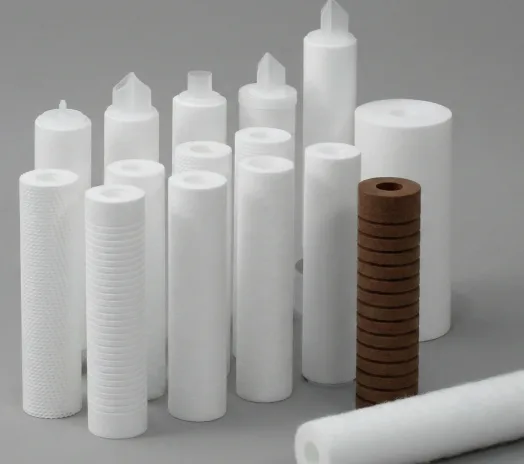
Melt-blown and string-wound cartridges are familiar depth-filter examples. A graded polypropylene structure may have more open outer layers that accept larger particles while deeper layers retain smaller material. If the contaminant distribution matches the gradient, useful solids can accumulate throughout a substantial portion of the media rather than forming a dense layer at the surface immediately.
Gels, emulsions, and fine particles can still block depth media quickly. A finer grade can raise resistance, and nominal ratings may permit some target particles to pass. Test against actual feed and terminal differential pressure.
Pleated Depth Cartridges: More Area with Some Internal Loading
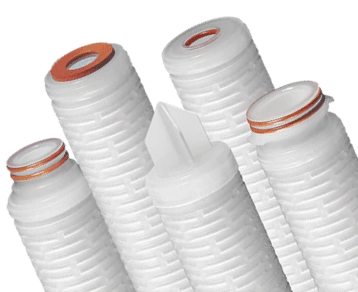
Pleated polypropylene, glass-fiber, and multilayer media can offer substantial area within a compact element. The media may capture particles both near the surface and within its thickness. This can be advantageous where a process needs a finer prefilter at a moderate-to-high flow per housing.
Advertised area is not necessarily effective area. Closely packed pleats may restrict flow into valleys and cause uneven loading. Consider spacing, support layers, and permeability, not just pleat count.
Pleated Membrane Cartridges: Defined Retention at the Final Stage
PES, PVDF, Nylon, and suitably constructed PTFE membrane elements use thin microporous media with support structures. Many applications select these elements for final particle control, low-bioburden processing, or validated microbial retention. The exact claim depends on membrane grade, test method, sealing arrangement, and process validation.
Particles, colloids, proteins, or gels can rapidly foul membrane pores even at modest turbidity. A well-matched prefilter may be more useful than additional membrane area.
| Comparison factor | Conventional depth | Pleated depth | Pleated membrane |
|---|---|---|---|
| Typical construction | Melt-blown fibers or wound yarn | Folded PP or glass-fiber composite | Pleated PES, PVDF, Nylon or PTFE membrane with support layers |
| Main retention behavior | Capture within porous thickness | Surface and depth loading, grade-dependent | Defined membrane retention, often surface-dominant |
| Useful operating role | Bulk sediment or general prefiltration | Fine prefiltration at selected flow | Final particle or validated microbial control |
| Dirt capacity | Can be strong with suitable graded media | Depends on accessible area and depth structure | Highly dependent on upstream feed quality |
| Hydraulic behavior | Requires model-specific ΔP curve | Area can help, but pleat crowding matters | May be sensitive to pore blockage and viscosity |
| Most important verification | Retention and loading trial | Pressure-drop and throughput trial | Retention validation, integrity where applicable, and throughput |
This table describes typical design roles, not a ranking of filtration efficiency, service life, or product quality.
Dirt Loading and Dirt-Holding Capacity Are Not the Same
Dirt loading describes the contaminants arriving at the element, commonly expressed as a concentration or a mass rate. Dirt-holding capacity describes how much material an element can retain before a specified limiting condition, such as terminal differential pressure or loss of required output quality. Capacity therefore depends on the test dust or real process contaminants, flow, liquid viscosity, and changeout criterion.
Suppose an illustrative process operates at 20 m³/h with suspended solids of 6 mg/L. The incoming mass is 20,000 L/h × 6 mg/L = 120 g/h. If an assumed 70% of that mass is captured, the bank retains 84 g/h. Neither figure tells us when the cartridges will plug: we also need to know how that mass accumulates, where it deposits, and the pressure rise at the operating flow.
Real pressure drop may rise before laboratory dirt-capacity limits are reached. An open grade may last longer yet pass critical particles. Judge throughput and outlet quality together.
Micron Rating: Nominal, Absolute, and Validated Retention
Two cartridges labeled ‘5 µm’ may deliver different results. Nominal ratings generally indicate performance defined by a supplier-specific test and efficiency threshold; the word nominal does not establish one internationally universal percentage. Absolute ratings also require the test method and efficiency to be stated. A rating without a test basis is insufficient for critical process design.
Where beta-ratio testing is appropriate, βx is the number of upstream particles of size x or greater divided by the corresponding downstream count. The efficiency is (1 − 1/βx) × 100%. For example, βx = 100 means 99% removal for that size under the specified test conditions. This is a calculation example, not a performance claim for any Omela cartridge.
For membrane final filtration, pore rating alone does not prove sterility or microbial retention. A sterilizing-grade application requires a suitable challenge validation, integrity-test limits where applicable, and controls covering the assembled process. Chemical compatibility and adsorption behavior also matter: a cartridge that retains particles could still be unsuitable for the liquid or product.
Request the actual retention test basis, not a finer number alone.
Pressure Drop, Flow Rate, and When to Replace Cartridges
A new cartridge’s clean differential pressure is only the starting point. At the same flow, filter resistance usually rises as retained particles obstruct flow paths. At constant pump pressure, flow may instead fall. Both trends can be misread if operators compare readings taken at different flow rates or temperatures.
Use grade-specific flow–ΔP data at operating viscosity and temperature. Pleat geometry and membrane-fouling behavior matter as much as nominal area.
Changeout differential pressure is an operating criterion; maximum allowable cartridge differential pressure is a separate mechanical limit. The housing has its own allowable pressure rating. The plant must establish changeout rules that also protect filtrate quality and cartridge integrity rather than simply waiting for the highest displayed pressure.
| Observation | Possible interpretation | What to verify |
|---|---|---|
| High clean ΔP | Flow per element too high, viscous fluid, restrictive grade | Correct viscosity, model-specific flow curve, installed quantity |
| Fast ΔP rise | High particle load, gels, unsuitable media, missing prefilter | Representative feed sample and used-element inspection |
| Stable ΔP but poor outlet quality | Wrong retention grade, bypass, sealing damage | Particle counts, gaskets, housing and integrity checks |
| Good initial flow but short life | Contaminants concentrate at accessible surface or pores | Total treated volume and fouling trial |
| Frequent membrane changes | Insufficient upstream protection | Prefilter performance and downstream quality trend |
Only clean or reuse cartridges when their design and validated procedure permit it.
Prefiltration vs. Final Filtration: Choose the Sequence
A practical staged system assigns different tasks to different filters. A coarse strainer or bag may remove large debris first. A depth cartridge may then retain a broad range of suspended material. A pleated depth cartridge can serve as a finer protective stage where the flow and particle distribution justify it. A validated membrane cartridge may finally control fine particles or organisms that the product specification requires removed.
Not every process needs four stages. An overly fine prefilter wastes pressure and capacity; one too coarse may not protect the membrane. Select the simplest sequence that meets quality and throughput targets.
For process water, prioritize downstream protection. For beverages, consider haze, bioburden, adsorption, and cleaning. For high-purity chemicals, compatibility, extractables, and seal integrity may outweigh low initial ΔP.
What Published Industrial Cases and Research Teach Us
The following examples are from third-party published field reports and research, not Omela installations. They illustrate the importance of testing under real conditions, not universal performance advantages for any cartridge type.
Animal-Serum Processing: Depth Staging Before Final Membranes
An industrial serum processor reported batches taking up to 48 hours to filter 30 liters, with inconsistent gel behavior and mid-batch cartridge changes. In comparative small-scale tests extrapolated to a 10-inch element, a 1 µm polypropylene depth medium was projected to treat 7 liters, while a 1 µm fiberglass depth medium was projected to treat 33 liters. A coarser 10 µm fiberglass option was projected to treat 65 liters under the study conditions.
The process was redesigned around separate particle-removal, clarification, prefiltration, and PES membrane stages. The supplier’s field report states that a 30-liter batch was then completed in less than 24 hours, with overall throughput more than doubling. This was a combined process change, not proof that one filter medium is universally superior.
Engineering lesson: the same nominal micron rating does not establish equal process throughput. Different depth structures and a properly ordered prefilter train can materially affect the loading reaching a final membrane.
Arizona Water Reuse: Different Cartridge Prefilters Changed RO Performance
A 2026 peer-reviewed on-site study at a municipal water-reuse campus compared a conventional string-wound cartridge with an electropositive cartridge on parallel reverse-osmosis test units. Over eight weeks, the test units operated at approximately 500 gallons per day and 25–40% recovery.
The electropositive-cartridge configuration maintained roughly 20% higher RO permeate flux and required 13–18% less system energy than the string-wound configuration under the tested conditions. Membrane examination showed less fouling. These were downstream RO membrane results, not a sterilizing cartridge comparison; pilot recovery differed from full scale.
Engineering lesson: a cartridge’s value cannot be evaluated from micron rating or purchase price alone. Its effect on downstream fouling and operating energy may be decisive.
Cyprus Desalination: Cartridge Selection Changed Water Production and Cost
At a full-scale desalination facility in Cyprus, researchers compared seven commercial cartridge filter types used as protective filtration ahead of reverse osmosis. They tracked treated-water production, product quality, and operating cost under the study conditions.
The researchers reported that the best-performing cartridge type delivered about 34% greater produced-water volume than the comparison baseline, while a modeled replacement of the worst-performing option with the best could reduce cartridge-filtration operating costs by about 39.3%. The cost reduction was an analysis-based estimate, not a guaranteed saving from every cartridge substitution. It did not rank cartridge categories universally.
Engineering lesson: compare actual production volume, filtered-water quality, pressure requirements, replacement intervals, and cost per cubic meter—not just the cartridge’s initial price.
Practical Selection Checklist
- Define the duty: liquid chemistry, temperature, viscosity, maximum flow, batch size, particle distribution, suspended solids, gels, and biological requirements.
- Specify retention: required particle or organism removal, acceptable outlet quality, nominal/absolute test basis, and membrane integrity requirements where applicable.
- Match construction to the stage: conventional depth for suitable bulk loading, pleated depth for fine protective filtration, and membrane for validated final performance when needed.
- Compare hydraulic and loading data: clean ΔP, throughput to a defined changeout limit, quality throughout the run, and allowable mechanical differential pressure.
- Validate a real sample: record pressure and flow against volume processed, inspect used elements, check downstream quality, and calculate replacement cost per acceptable liter.
Final Engineering Recommendation
There is no universal winner between depth, pleated depth, and membrane cartridges because the labels describe overlapping structural and separation features. The correct choice depends on what a specific filtration stage must remove, how the liquid fouls the media, and what downstream performance must be protected.
Choose retention first, then confirm flow and pressure drop using appropriate test data. Use a staged train only when it improves verified performance. Most importantly, select by qualified outlet quality and useful treated volume before changeout—not by a micron number or advertised surface area in isolation.
FAQ
Are Pleated Filter Cartridges Always Surface Filters?
No. Pleating describes a folded construction, not a single capture mechanism. Some pleated cartridges use depth media, while others use microporous membranes. Check the media structure and validated retention behavior of the exact model.
Which Cartridge Has the Highest Dirt-Holding Capacity?
No category always has the highest capacity. It depends on contaminant size and composition, media structure, flow, viscosity, and the terminal pressure-drop or quality criterion. Compare elements in a representative loading test.
Is a 5 Micron Depth Filter Equivalent to a 5 Micron Pleated Filter?
Not necessarily. The two products may use different nominal or absolute rating methods and retention efficiencies. Confirm the test basis, particle-removal requirement, pressure-drop curve, and process fluid before substituting one for the other.
When Is a Membrane Cartridge Needed for Final Filtration?
Use a membrane when the final process requires a defined fine-particle or validated microbial retention performance that other stages cannot reliably provide. Membrane micron rating alone does not prove sterilizing performance; application-specific validation may be necessary.
How Does Prefiltration Extend Membrane Cartridge Life?
An appropriate prefilter reduces the particles, gels, or other foulants reaching the final membrane, potentially slowing pressure-drop rise and increasing useful throughput. Its benefit must be verified against the actual fluid and acceptable final-filtrate quality.
Author

Jessica Ma – Senior Filtration Engineer, Omela Filtration
Jessica Ma is a senior filtration engineer at Omela Filtration, specializing in dust and liquid filtration. With over 15 years of experience, she focuses on optimizing baghouse performance, enhancing filtration efficiency, and developing high-performance solutions for industrial dust collectors and precision liquid filtration applications.