
Key Takeaways
- Filter bags and filter cartridges are both used in industrial liquid filtration, but they are not interchangeable. Filter bags are better for high solids loading and prefiltration, while filter cartridges are better for finer and more consistent filtration.
- Bag filtration is usually more practical when the liquid contains visible particles, sludge, gels, fibers, oil impurities, resin lumps, pigments, scale, or other bulk contaminants.
- Cartridge filtration is usually selected when the process needs clearer filtrate, lower turbidity, final polishing, or protection for sensitive downstream equipment.
- In many water, chemical, food, oil, coating, resin, and process liquid systems, the best solution is not “bag or cartridge,” but bag filtration first, cartridge filtration second.
- A good filtration decision should consider solids load, particle size, micron rating, flow rate, viscosity, pressure drop, housing fit, changeout frequency, and total operating cost.
Why This Comparison Matters
In industrial liquid filtration, many problems start because the filter type is selected too late. A plant may focus first on micron rating, housing size, or replacement price, then later discover that the filter plugs too quickly, pressure drop rises too fast, flow becomes unstable, or downstream equipment still needs better protection.
Filter bags and filter cartridges can both remove particles from liquids, but they work best in different positions. A filter bag is often better at handling dirty liquids and larger solids. A filter cartridge is often better at producing cleaner liquid after the heavier contamination has already been reduced.
The real question is not:
Which one is better?
The better question is:
What does the liquid need at this filtration stage?
A filter bag may be the right answer before a pump, before a cartridge filter, or after a process tank. A cartridge may be the right answer before a membrane, filling line, spray nozzle, polishing step, or sensitive downstream process. In many systems, using both gives the most stable result.
What Bag Filtration Does Best
Bag filtration uses a filter bag installed inside a pressure housing. Liquid enters the housing, passes through the bag media, and particles are captured before the liquid exits the system.
The biggest strength of bag filtration is dirt-holding capacity. It is usually more forgiving when the liquid has variable solids loading, coarse particles, soft gels, fibers, sludge, pigment clusters, resin particles, carbon, scale, or process debris.
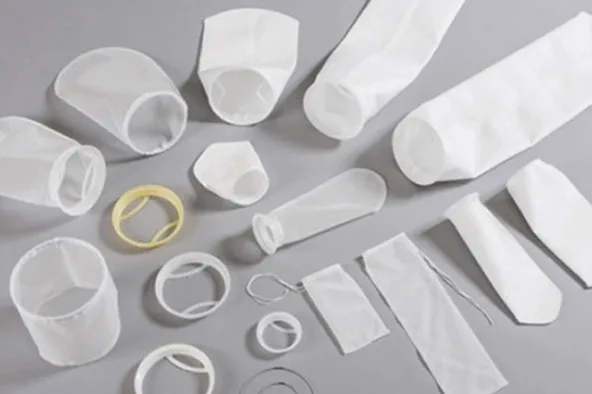
Bag filtration is commonly used when the process needs practical particle removal rather than ultra-fine polishing. It is also useful when operators need fast changeout, simple maintenance, and reasonable consumable cost.
A filter bag can work through two main mechanisms. Felt bags provide depth filtration, where particles are trapped inside the fiber structure. Mesh bags provide surface filtration, where particles are stopped mainly at the mesh openings. This gives bag filtration flexibility across many liquids, from process water and wastewater to coatings, oils, resins, chemicals, syrup, and general industrial fluids.
The limitation is precision. Standard bag filtration may not provide the same fine, stable retention expected from cartridge filtration. When the final liquid quality requirement becomes tighter, a cartridge stage may be needed downstream.
What Cartridge Filtration Does Best
Cartridge filtration uses a cylindrical filter element installed inside a cartridge housing. Depending on the construction, the cartridge may use depth media, pleated media, membrane media, or multilayer media.
The biggest strength of cartridge filtration is consistent fine retention. It is often selected when the liquid has already been partly cleaned and now needs polishing, lower turbidity, finer particle control, or downstream equipment protection.
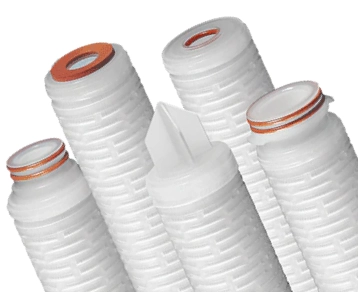
Cartridges are commonly used before RO membranes, spray nozzles, heat exchangers, beverage polishing systems, fine chemical processes, water treatment stages, and final clarification points. In these locations, the cartridge is not just catching dirt. It is protecting the next process step.
The limitation is loading. If a cartridge receives too much coarse solid, sludge, gel, fiber, or high-viscosity contamination, it can blind quickly. This increases pressure drop, shortens service life, increases labor, and raises operating cost.
A cartridge is often a better finisher than a first-stage dirt catcher.
Filter Bags vs Filter Cartridges: Practical Comparison
| Selection Factor | Filter Bags | Filter Cartridges | Practical Meaning |
|---|---|---|---|
| Main role | Bulk solids removal and prefiltration | Fine filtration and polishing | Bags reduce the load; cartridges improve the final result |
| Solids loading | Better for heavier or variable solids | Better after coarse solids are reduced | Dirty liquids often need bag filtration first |
| Micron rating | Commonly used for coarse to medium filtration | Better for finer and more controlled filtration | Finer filtration usually favors cartridges |
| Flow behavior | Practical for high-load and high-flow duties | More sensitive to solids load and media area | Overloaded cartridges can lose flow quickly |
| Pressure drop | Usually more forgiving at coarser ratings | Can rise quickly with fine media or heavy solids | Loading rate matters more than micron rating alone |
| Maintenance | Simple changeout and lower handling complexity | May require more careful element replacement | Maintenance cost depends on changeout frequency |
| Cost logic | Often lower cost for dirty streams | Higher precision but potentially higher replacement cost | Total cost depends on system design, not only element price |
| Best use | Dirty liquids, prefiltration, high solids, process protection | Polishing, fine retention, final clarity, downstream protection | Many systems use both stages |
A simple field rule is useful:
Use filter bags when the liquid is dirty. Use filter cartridges when the liquid needs to be cleaner.
The Selection Logic: Start from the Liquid
A reliable selection should start with the liquid, not with the filter catalog.
If the liquid contains visible solids, sludge, fibers, gels, resin lumps, pigment clusters, rust, scale, food particles, carbon, oil impurities, or variable contamination, a filter bag is usually the safer first stage. It reduces the burden before the liquid reaches finer equipment.
If the liquid is already relatively clean but still needs better clarity, lower turbidity, finer retention, or final product protection, a filter cartridge becomes more important. The cartridge stage should not be forced to handle all the dirt from the process.
If the liquid has both heavy contamination and fine final requirements, the best solution is often a staged system. The bag handles the bulk load. The cartridge controls the final quality.
How Micron Rating Can Mislead Selection
Micron rating is important, but it should not be the only selection standard. A finer filter is not always a better filter.
A fine cartridge may catch smaller particles, but if the incoming liquid contains heavy solids, it may plug quickly. A coarse bag may last longer, but it may not deliver the clarity required for final polishing. A very fine bag may look like a compromise, but in high-solids or high-viscosity liquids, it may blind too fast to be practical.
| Filtration Task | Better Starting Direction |
| Remove visible debris, fibers, gels, or coarse solids | Filter bag |
| Reduce particle load before a finer stage | Filter bag |
| Improve clarity or reduce turbidity | Filter cartridge |
| Protect membranes, nozzles, or final process equipment | Filter cartridge after prefiltration |
| Balance dirty liquid with fine final quality | Filter bag + filter cartridge |
The correct micron rating should be selected according to the smallest harmful particle, the solids load, the viscosity, the allowable pressure drop, and the purpose of the filtration stage.
Pressure Drop Shows Whether the System Is Working
Pressure drop is one of the clearest signs of filter loading. As particles collect inside a filter bag or cartridge, resistance increases. If the filter is too fine, too small, poorly supported, poorly sealed, or overloaded, pressure drop rises faster than expected.
High pressure drop may cause lower flow rate, higher pump load, shorter filter life, frequent changeout, bypass risk, or unstable downstream performance.
This is why cost control should not be based only on replacement price. A cheaper filter may cost more if it plugs quickly, causes downtime, or fails to protect downstream equipment. A more precise cartridge may also become expensive if it is used without a bag prefilter and must be replaced too often.
The better cost question is:
Which filtration setup gives stable flow and clean liquid at the lowest total operating cost?
Why Staged Filtration Often Works Better
Staged filtration means using more than one filtration level to divide the work. Instead of forcing one filter to remove everything, each stage handles the particle size and loading level it is best suited for.
A typical staged liquid filtration system may use:
- Coarse protection to remove large debris before pumps or process equipment.
- Bag filtration to remove bulk suspended solids, gels, fibers, sludge, or larger particles.
- Cartridge filtration to capture finer particles and stabilize clarity.
- Final polishing or membrane protection when the downstream process is sensitive.
This structure is common in process water, RO pretreatment, chemical liquids, coatings, resins, food and beverage lines, oils, wastewater polishing, and other industrial liquid systems.
The advantage is not only cleaner liquid. Staged filtration can also reduce cartridge loading, slow pressure-drop rise, extend filter life, reduce emergency changeouts, and make maintenance more predictable.
Omela Filtration Application Lessons
| Application Situation | What It Shows | Practical Lesson |
| Process liquid with heavy suspended solids | One fine cartridge may plug too quickly when used as the first filtration stage | Use bag filtration first to reduce solids loading |
| Water or wastewater pretreatment | Different particle sizes require different filtration levels | Combine coarse protection, bag filtration, and cartridge filtration when needed |
| Coatings, resins, and adhesives | Gels, fibers, and agglomerates may overload fine filtration | Use bag filtration for bulk contaminant removal before finer polishing |
| Food, beverage, and oil filtration | Product clarity and flow stability both matter | Select the filter stage according to the quality target and viscosity |
| Sensitive downstream equipment | Membranes, nozzles, filling systems, and heat exchangers need cleaner liquid | Use cartridge filtration after upstream load reduction |
These examples support one practical conclusion: filter bags and filter cartridges should be selected as parts of a filtration process, not as isolated consumables.
Common Problems and Practical Corrections
| Field Problem | Likely Cause | Better Direction |
| Cartridge plugs too quickly | Too much coarse solid reaches the cartridge | Add bag filtration upstream |
| Bag cannot meet clarity target | Bag rating is too coarse or retention is not tight enough | Add cartridge polishing downstream |
| Pressure drop rises fast | Filter is too fine, too small, or overloaded | Increase filter area or use staged filtration |
| Replacement cost is high | Fine filtration stage handles too much dirt | Remove bulk solids earlier with bag filtration |
| Flow is unstable | Viscosity, solids load, or temperature changes | Size filtration for worst-case operating conditions |
| Particles pass downstream | Wrong rating, poor sealing, or housing bypass | Check micron rating, seal, basket, housing seat, and element fit |
| Downstream equipment fouls early | Pretreatment is too weak | Use staged filtration before the sensitive equipment |
The correction is not always a finer filter. In many cases, the better correction is better staging, larger filtration area, lower flow per element, or improved housing sealing.
When Each Option Usually Makes Sense
Filter bags usually make sense when the filtration stage is handling dirty liquid, visible solids, variable particle load, or coarse-to-medium particle removal. They are often used for water, wastewater, chemicals, oils, resins, coatings, syrups, adhesives, and process liquids where the first goal is to reduce solids loading and protect equipment.
Filter cartridges usually make sense when the filtration stage needs finer retention, clearer liquid, lower turbidity, or more consistent downstream protection. They are commonly used after larger solids have already been removed, especially before sensitive equipment or final product-quality steps.
Using both makes sense when the liquid is dirty but the final requirement is cleaner than a bag alone can reliably deliver. The bag reduces the burden. The cartridge improves the final quality. Together, they often make the whole system more stable.
Information to Collect Before Selection
Before choosing filter bags, filter cartridges, or both, collect:
- Liquid type, such as water, chemical, oil, syrup, resin, coating, wastewater, solvent, or process liquid
- Filtration purpose, such as coarse removal, clarification, polishing, membrane protection, filling-line protection, or equipment protection
- Target contaminants, including sand, rust, sludge, gels, fibers, carbon, crystals, colloids, oil impurities, or fine particles
- Required micron rating, flow rate, operating pressure, allowable pressure drop, temperature, and viscosity
- Current housing type, bag size, cartridge size, seal type, service life, failure problem, and photos of filters, housings, baskets, cartridges, and collected solids
This information helps determine whether the process needs a filter bag, a filter cartridge, or a staged filtration design.
Final Engineering View
The best choice is not always filter bags or filter cartridges.
The better question is:
What does the liquid need at this filtration stage?
If the liquid is dirty and the goal is bulk solids removal, a filter bag is often the practical first choice. If the liquid is already partly cleaned and the goal is fine retention or product clarity, a cartridge is often better. If the liquid is dirty but the downstream process needs fine protection, both should be considered.
A well-designed filtration system balances flow rate, solids load, micron rating, pressure drop, changeout labor, housing size, downstream protection, and total operating cost.
Filter bags reduce the load.
Filter cartridges improve the final result.
Used together, they often make the whole system more stable.
FAQ
What is the main difference between filter bags and filter cartridges?
Filter bags are commonly used for bulk solids removal, high-flow prefiltration, and cost-effective particle capture. Filter cartridges are usually used for finer filtration, polishing, consistent retention, and downstream equipment protection.
When should I use a filter bag instead of a cartridge?
Use a filter bag when the liquid has heavier solids loading, larger particles, gels, fibers, sludge, or variable contamination, and when simple maintenance and lower replacement cost are important.
When should I use a filter cartridge instead of a filter bag?
Use a filter cartridge when the process needs finer particle retention, clearer liquid, lower turbidity, downstream equipment protection, final polishing, or more consistent filtration performance.
Can filter bags and filter cartridges be used together?
Yes. A filter bag can be installed upstream to remove larger particles and reduce solids loading, while a cartridge filter downstream provides finer retention and protects sensitive equipment.
Which is better for dirty process liquids?
Filter bags are usually better as the first stage for dirty process liquids because they can handle higher solids loading and are easier to change. A cartridge may be added downstream when finer retention is required.
Which is better for final polishing?
Filter cartridges are usually better for final polishing because they provide finer and more consistent particle retention, especially when upstream solids have already been reduced.
What information is needed to choose between bag and cartridge filtration?
Provide liquid type, contaminants, micron rating, flow rate, pressure, allowable pressure drop, temperature, viscosity, current filter type, housing size, service life, current problems, and photos.
Author

Jessica Ma – Senior Filtration Engineer, Omela Filtration
Jessica Ma is a senior filtration engineer at Omela Filtration, specializing in dust and liquid filtration. With over 15 years of experience, she focuses on optimizing baghouse performance, enhancing filtration efficiency, and developing high-performance solutions for industrial dust collectors and precision liquid filtration applications.