
Key Takeaways
- Choosing the right dust collector filter bags starts with understanding filter bag fabric, not only bag size.
- Common baghouse filter media include polyester, PP, acrylic, PPS, aramid/Nomex, P84, PTFE, fiberglass, FMS, and PTFE membrane laminated media.
- Acrylic filter bags are mainly used for humid and medium-temperature dust collection, while PPS filter bags are usually better for sulfur-containing, acidic, and hotter flue gas.
- Needle-punched felt filter media performance depends on fiber type, fabric weight, air permeability, surface treatment, temperature, chemistry, dust behavior, and cleaning method.
- Filter bag fabric selection should also consider filter bag cages, because poor cage fit or rough cage surfaces can shorten bag life even when the media is correct.
- To choose the right material faster, send operating conditions, bag size, cage photos, and failure photos to contact Omela Filtration.
Why Filter Bag Fabric Material Matters
Filter bag fabric is the working surface of a baghouse dust collector. It affects how the bag captures dust, releases dust cake, resists temperature, handles moisture, survives chemical attack, and withstands cleaning stress.
In a fabric filter or baghouse, dust-laden gas passes through fabric bags or cartridges. Dust builds on the media surface and forms a dust cake, which becomes an important part of fine-particle capture; as dust accumulates, pressure drop rises and the bags must be cleaned periodically by methods such as shaking, reverse air, or pulse jet cleaning.
This is why material selection is not only a catalog decision. A polyester bag, PPS bag, acrylic bag, PTFE bag, or fiberglass bag may look similar from the outside, but their behavior in moisture, heat, acid gas, oxygen, abrasion, and cleaning cycles can be very different.
Material Name Is Only the Starting Point
Many users ask, “Which filter bag material is best?” The better question is: which fabric matches the working condition?
A material name such as polyester, PPS, acrylic, PTFE, or fiberglass only tells part of the story. The same base fiber can perform differently depending on felt weight, scrim, air permeability, surface treatment, sewing thread, membrane lamination, bag top style, cage fit, and cleaning method.
For example, polyester can be reliable and economical for dry normal-temperature dust, but it is not ideal for hot humid acidic gas. PPS can be strong in sulfur-containing flue gas, but oxidation risk must be reviewed. PTFE has excellent chemical resistance, but it may not be necessary for a simple dry mineral dust application.
Omela’s material and design guide emphasizes that filter bag options should be selected as a complete configuration, including material, surface finish, snap ring, seams, reinforcement, and matched cages—not as isolated features.
Filter Bag Fabric Material Comparison
| Fabric Material | Typical Strength | Main Limitation | Common Applications |
|---|---|---|---|
| Polyester / PE | Economical and widely used | Poor in hot humid acidic conditions | Cement mill, mining, woodworking, quarry, general dust |
| Polypropylene / PP | Good low-temperature chemical resistance | Low temperature limit | Chemical dust, low-temperature acid/alkali dust |
| Acrylic | Good moisture and hydrolysis resistance | Not suitable for high temperature | Humid medium-temperature dust, spray dryers, coal mills |
| PPS | Good in sulfur-containing and acidic flue gas | Oxidation risk under high oxygen and heat | Boilers, biomass, WtE, chemical flue gas |
| Aramid / Nomex | Good medium-high temperature resistance | Sensitive to acid hydrolysis | Asphalt plants, hot gas filtration |
| P84 | Good fine dust capture | Higher cost and chemistry limitations | Cement kilns, incineration, fine dust |
| PTFE | Excellent chemical resistance | Higher cost | Corrosive gas, waste incineration, chemical plants |
| Fiberglass | High-temperature stability | Sensitive to flexing and mechanical stress | Cement kilns, steel, high-temperature flue gas |
| FMS | Composite high-temperature performance | Must match chemistry and cleaning method | Steel, cement, furnace, abrasive hot gas |
| PTFE Membrane | Surface filtration and easier dust release | Higher cost and handling requirements | Fine dust, sticky dust, low-emission baghouses |
This table is useful for first screening, but it should not replace process review. EPA fact sheets note that baghouse performance depends on the fabric chosen, cleaning frequency and method, particulate characteristics, and air-to-cloth ratio.
Polyester Filter Bags: The General-Purpose Workhorse
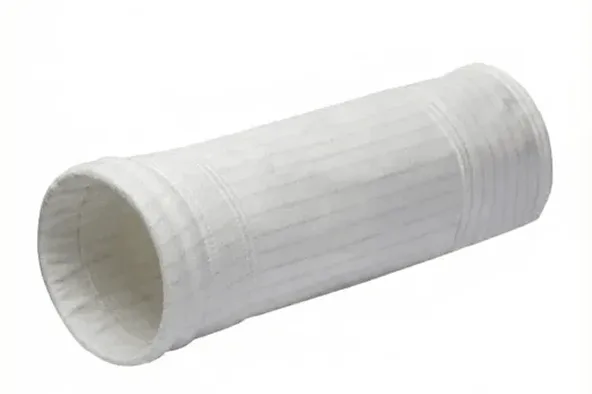
Polyester is one of the most common filter bag fabrics for industrial dust collectors. It offers good mechanical strength, stable filtration performance, and attractive cost for dry, normal-temperature, non-corrosive dust.
Polyester is commonly used in cement mills, mining, quarrying, woodworking, grain handling, general manufacturing, and powder processing. It can also be treated with singeing, calendering, water and oil repellent finish, anti-static fiber, or PTFE membrane to improve performance in specific applications.
The main weakness of polyester is hydrolysis. In hot humid conditions, especially with acidic gas or condensation, polyester may lose strength and fail early.
Polypropylene Filter Bags: Useful for Low-Temperature Chemical Dust
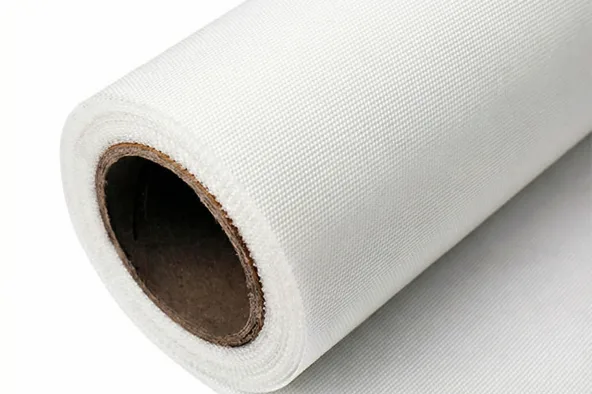
Polypropylene filter bags are usually considered for low-temperature applications where chemical compatibility is more important than heat resistance. PP can perform well in some acid, alkali, and chemically active dust streams, but it should not be pushed into high-temperature or oxidizing environments.
PP is not a universal dust filter media. Its temperature limit is lower than polyester, acrylic, PPS, aramid, P84, PTFE, or fiberglass, so the actual gas composition and operating temperature must be confirmed.
For dust collection, PP is more of a special-condition material than a general high-temperature baghouse media.
Acrylic Filter Bags: Moisture Resistance for Medium-Temperature Dust
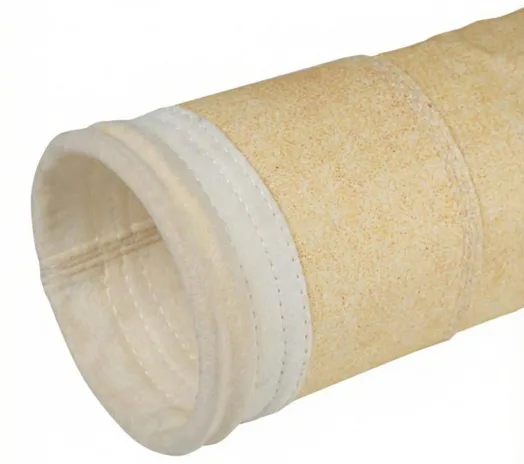
Acrylic filter bags are selected when moisture resistance and hydrolysis resistance matter. They are often used in humid gas streams, spray drying, coal mills, cement-related processes, and medium-temperature dust collection where polyester may be damaged by moisture.
Acrylic is not a high-temperature material. Its value is strongest when the temperature remains moderate, but the gas contains moisture or mild acidity.
If the process is too hot, acrylic may harden, shrink, or lose strength. If the gas chemistry is too aggressive, PPS or PTFE may be safer.
PPS Filter Bags: Strong Candidate for Sulfur-Containing Flue Gas
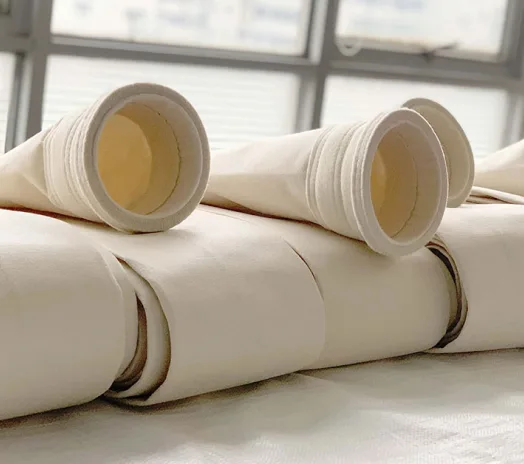
PPS is widely used in power plants, biomass boilers, waste-to-energy systems, chemical flue gas, and sulfur-containing dust collection. Its main advantage is stability in moist, acidic, and sulfur-containing environments where polyester or acrylic may not last long enough.
PPS is especially useful when moisture, acid gas, and medium-to-high temperature occur together. However, PPS must be checked for oxidation risk.
This is why PPS selection should include oxygen level, sulfur content, temperature, dew point, cleaning method, and startup/shutdown conditions. Choosing PPS only because “the gas is acidic” is not enough.
Aramid / Nomex Filter Bags: Medium-High Temperature Hot Gas Filtration
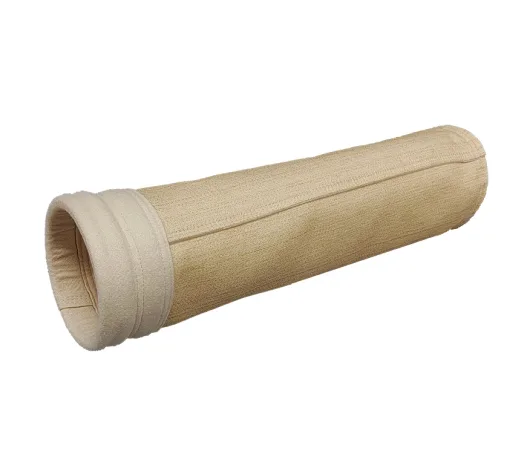
Aramid, commonly known by the Nomex trade name, is often used in asphalt mixing plants and hot gas filtration systems. It can handle higher temperature than polyester and acrylic, which makes it suitable for many medium-high temperature dust collection applications.
Its limitation is chemical sensitivity. Acid gas, moisture, and hydrolysis can reduce service life.
In asphalt plants, aramid may work well when the main challenge is hot mineral dust and temperature fluctuation. But in stronger acid gas or sulfur-containing flue gas, PPS, PTFE, P84, or fiberglass may be more suitable.
P84 Filter Bags: Fine Dust Capture and High Filtration Efficiency
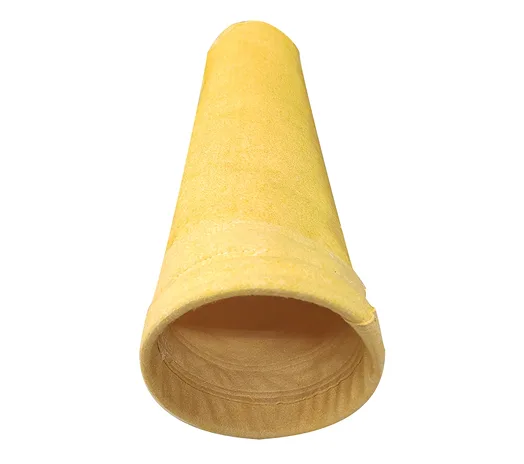
P84 is a polyimide fiber known for high filtration efficiency and good fine-particle capture. Its fiber shape helps improve dust interception, especially in applications where emission control is important.
P84 is often considered for cement kilns, waste incineration, metallurgical plants, and high-temperature fine dust collection. It can also be blended with other fibers or used in composite filter media.
The main concern is cost and chemistry. P84 should be selected when its fine filtration and high-temperature performance are needed, not simply as a premium replacement for every baghouse.
PTFE Filter Bags: Severe Chemical and Corrosive Conditions
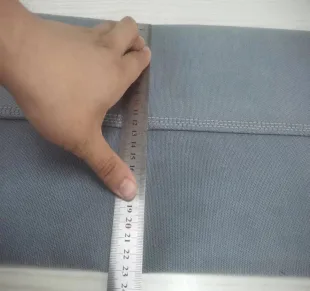
PTFE filter bags are used when chemical resistance is the main concern. PTFE can resist many acids, alkalis, solvents, and corrosive components better than most common filter bag fibers.
PTFE is suitable for waste incineration, chemical plants, corrosive flue gas, high-moisture gas, and severe industrial exhaust where other fibers may degrade quickly. It can be made as PTFE felt or used as a PTFE membrane laminated surface.
The disadvantage is cost. In many normal dust collection systems, PTFE may be more than the process requires.
Fiberglass Filter Bags: High-Temperature Stability with Careful Handling
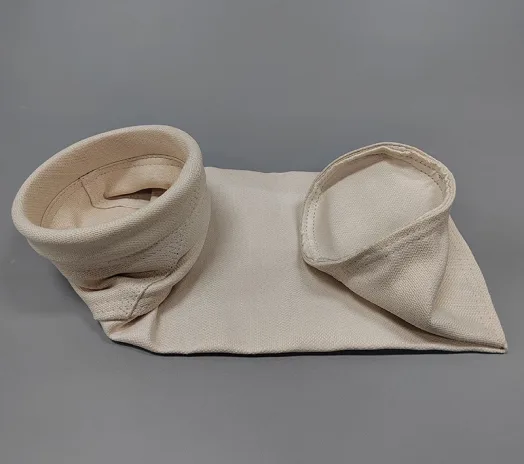
Fiberglass is a traditional high-temperature filter bag material. It is used in cement kilns, steel plants, power plants, carbon black, lime kilns, and high-temperature mineral dust collection.
Fiberglass has strong heat resistance and dimensional stability, but it is sensitive to flexing, abrasion, and improper cleaning. If cleaning is too aggressive, if cages are rough, or if the bag flexes excessively, fiberglass may fail from mechanical damage.
EPA operation and maintenance material notes that cleaning mechanisms such as shaking, reverse air, and pulse jet are used to remove dust cake, and poor cleaning can increase filter drag. This is especially important for fiberglass and other high-temperature media because the baghouse must be designed and maintained as a complete system.
FMS Filter Bags: Composite Media for Harsh High-Temperature Dust
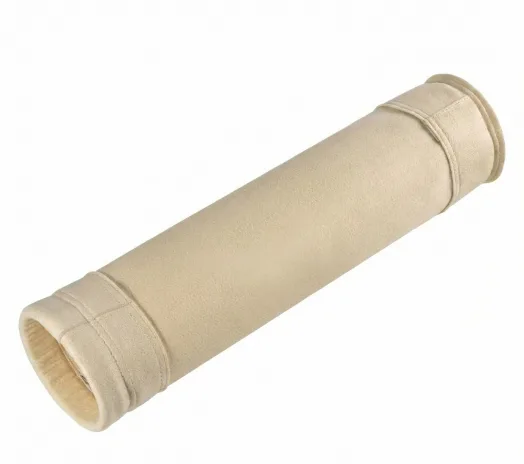
FMS is a composite high-temperature filter media, often combining fiberglass with other high-performance fibers. It is used where heat, abrasion, chemical exposure, and heavy dust loading occur together.
FMS can be considered for steel, cement, smelting, furnace, and other demanding industrial dust collection systems. Its advantage is the balance of high-temperature performance and composite mechanical properties.
Like fiberglass and P84, FMS must be matched with the cleaning method, cage condition, temperature range, gas chemistry, and surface treatment.
PTFE Membrane Is a Surface Layer, Not Just a Material Name
PTFE membrane is not the same as a 100% PTFE felt bag. A PTFE membrane is a thin surface filtration layer laminated onto filter media such as polyester, PPS, aramid, fiberglass, or PTFE felt.
The membrane helps capture fine particles at the surface, reduce dust penetration into the felt, improve dust cake release, and support lower emissions. It is especially useful for fine dust, sticky dust, low-emission requirements, and applications where dust release is difficult.
But PTFE membrane does not fix every problem. If the air-to-cloth ratio is too high, compressed air is wet, cages are damaged, or condensation occurs, the membrane may still blind or fail.
Surface Treatments and Finishes
Surface treatment can change how a filter bag behaves in the field. Two bags made from the same base fabric may perform very differently if one is singed, calendered, PTFE impregnated, water and oil repellent, anti-static, or membrane laminated.
Common finishing options include singeing to remove surface fibers, calendering to smooth the surface, heat setting for dimensional stability, water and oil repellent treatment for moisture and oil mist, anti-static treatment for combustible dust risk, PTFE impregnation for improved chemical and dust-release behavior, and PTFE membrane for surface filtration.
These treatments should be chosen for a specific problem. Anti-static treatment helps when dust has electrostatic risk, but it does not solve chemical attack; PTFE membrane helps with fine dust and dust release, but it does not solve wrong cage fit.
How to Choose Filter Bag Fabric by Working Condition
A practical filter bag fabric decision should start from the process problem.
If the dust is dry, normal temperature, and non-corrosive, polyester may be enough. If the gas is humid but moderate in temperature, acrylic may be considered. If the flue gas is sulfur-containing, acidic, moist, and hotter, PPS is often a stronger candidate.
If the gas is highly corrosive, PTFE should be reviewed. If the temperature is high and the gas is relatively dry, aramid, fiberglass, P84, FMS, or PTFE may be compared.
If abrasion is the main problem, the media strength matters, but inlet design and cage condition may matter even more. If emissions are the main concern, membrane media or fine filtration media may be needed.
If pressure drop is the main concern, the solution may involve air-to-cloth ratio, dust cake control, cleaning settings, or surface treatment rather than changing only the fiber. EPA fact sheets explain that air-to-cloth ratio, particulate loading, particulate characteristics, and cleaning method affect baghouse sizing and pressure drop.
Common Material Selection Mistakes
The first mistake is selecting only by temperature. Temperature is important, but moisture, oxygen, acid gas, dust behavior, and cleaning method may be equally important.
The second mistake is using the old material again without asking why it failed. If the old bag failed because of abrasion, chemical attack, condensation, cage wear, or high pressure drop, repeating the same material will likely repeat the same failure.
The third mistake is over-selecting a premium material. PTFE, P84, or composite media may be unnecessary if the system is a dry normal-temperature dust collector.
The fourth mistake is ignoring the filter bag cage. A rough, rusty, bent, or oversized cage can destroy a new filter bag quickly.
The fifth mistake is assuming surface treatment can solve system design problems. Treatments help, but they cannot fully correct wrong airflow, excessive filtration velocity, wet compressed air, poor hopper discharge, or damaged cages.
To Request a Quote
For filter bag fabric material selection, please send:
- Application or industry
- Dust type and particle size
- Working temperature and peak temperature
- Moisture level and dew point risk
- Acid gas, alkali, sulfur, oxygen, solvent, or corrosive components
- Dust abrasiveness, stickiness, and concentration
- Bag diameter, length, top style, and bottom design
- Current filter bag material and surface treatment
- Cleaning method and differential pressure trend
- Cage material, cage condition, and cage photos
- Current service life and failure photos
- Quantity and delivery destination
With this information, Omela can compare polyester, PP, acrylic, PPS, aramid/Nomex, P84, PTFE, fiberglass, FMS, and PTFE membrane options based on real operating conditions.
Omela Engineering View
Filter bag fabric selection should be practical, not theoretical. The best fabric is not always the most expensive one; it is the material that matches the actual baghouse environment and gives stable pressure drop, reliable dust release, acceptable emissions, and reasonable service life.
For general dry dust, polyester may be the most practical. For humid medium-temperature gas, acrylic may be enough. For sulfur-containing, acidic, and hotter flue gas, PPS is often a better candidate.
For severe corrosion, PTFE should be reviewed. For high-temperature mineral dust, fiberglass, P84, FMS, aramid, or composite media may be considered.
A good recommendation should explain both sides: why one material is suitable and why another may fail. That is the real value of a filter bag fabric material guide.
FAQ
What is filter bag fabric?
Filter bag fabric is the filtration media used to make dust collector filter bags. It may be needle-punched felt, woven fabric, membrane-laminated media, or composite media, depending on the dust collector and working conditions.
Which filter bag fabric is most common?
Polyester is one of the most common filter bag fabrics for normal-temperature, dry, non-corrosive dust collection because it is economical, strong, and widely available.
What is the difference between PPS and acrylic filter bags?
Acrylic is mainly used for humid and medium-temperature dust collection. PPS is usually selected for hotter, more acidic, sulfur-containing, and chemically aggressive flue gas.
When should PTFE filter bags be used?
PTFE filter bags should be considered when the gas stream contains severe acid, alkali, corrosive chemicals, moisture, or high chemical attack that may damage other filter media.
Is PTFE membrane the same as PTFE felt?
No. PTFE felt is a base filter media made from PTFE fibers. PTFE membrane is a thin surface filtration layer laminated onto media such as polyester, PPS, aramid, fiberglass, or PTFE felt.
Why do filter bag cages affect fabric life?
Filter bag cages support the bag during filtration and cleaning. If the cage is rusty, rough, bent, oversized, or poorly matched, it can cause abrasion, holes, poor cleaning, and early filter bag failure.
What information is needed to choose filter bag fabric?
To choose the right fabric, provide temperature, dust type, moisture, gas chemistry, oxygen level, acid or alkali condition, dust abrasiveness, bag size, cleaning method, cage condition, current service life, and failure photos.
Author

Jessica Ma – Senior Filtration Engineer, Omela Filtration
Jessica Ma is a senior filtration engineer at Omela Filtration, specializing in dust and liquid filtration. With over 15 years of experience, she focuses on optimizing baghouse performance, enhancing filtration efficiency, and developing high-performance solutions for industrial dust collectors and precision liquid filtration applications.