
Key Takeaways
- Chemical resistant filter bags should be selected by chemical compatibility first, then by micron rating, temperature, viscosity, pressure drop, flow rate, and housing fit.
- A filter bag that works well in one acid, alkali, or solvent may fail in another concentration or temperature range, so the exact chemical name, concentration, and operating temperature must be confirmed before selection.
- Liquid filter bags can use PP, PE/polyester, nylon mesh, PTFE, stainless steel mesh, felt, mesh, welded, or sewn constructions depending on the liquid and contamination target.
- PP is commonly reviewed for many compatible acids and alkalis, PE/polyester for stronger mechanical stability, nylon mesh for surface filtration, PTFE for aggressive chemicals, and stainless steel mesh for reusable, hot, or high-pressure filtration.
- Chemical filtration failure often comes from material mismatch, fast blinding, excessive differential pressure, poor sealing, damaged baskets, or using one filter bag for both coarse and fine filtration.
- The best filter bag is not simply the finest or most expensive one. It is the bag that removes the target contaminant while staying chemically stable and maintaining safe, consistent flow.
Why Chemical Filtration Is Different from Ordinary Liquid Filtration
Chemical filtration is not just about removing dirt from a liquid. In acid, alkali, solvent, resin, catalyst, electroplating, wastewater, or specialty chemical streams, the filter bag itself becomes part of the process environment.
A filter bag may have the correct size and micron rating, but still fail if the fabric reacts with the liquid, softens in solvent, swells at higher temperature, sheds fibers, or does not seal properly inside the housing.
A chemical filtration reference emphasizes that media selection should consider micron rating, chemical and thermal compatibility, differential pressure, and system integration; it also notes that even a suitable media can fail if the ring or sealing mechanism does not match the housing.
This is why chemical filter bag selection should start from the liquid itself:
What is the chemical? What is the concentration? What is the temperature? What contaminant must be removed?
What Chemical Resistant Filter Bags Are Used For
Chemical resistant filter bags are used to remove solid or semi-solid contaminants from industrial process liquids. Typical contaminants include suspended solids, gels, carbon, catalyst particles, scale, fibers, sludge, resin fragments, undissolved powders, and process debris.
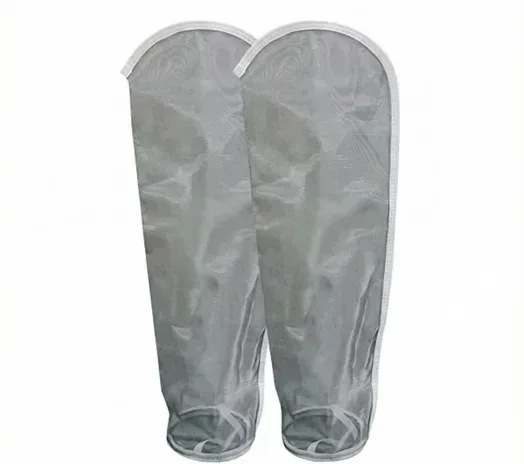
In a liquid bag filter system, the process liquid flows through a filter bag installed inside a housing. Particles are captured either on the surface of a mesh bag or within the depth structure of a felt bag. Liquid filter bag performance depends on media selection, micron rating, permeability, chemical compatibility, temperature limits, and sealing inside the housing.
In practice, chemical filter bags may be used for:
- Protecting pumps, spray nozzles, valves, or downstream cartridges
- Removing catalyst or activated carbon after reaction
- Filtering plating baths, acids, alkalis, solvents, or cleaning liquids
- Clarifying resins, coatings, oils, adhesives, or chemical intermediates
- Prefiltering wastewater or process liquids before finer treatment
The goal is not always ultra-fine filtration. Sometimes the better goal is stable flow, safe operation, and removal of the particles that actually cause process problems.
The First Question: Is the Material Compatible?
Chemical compatibility is the foundation. PP, PE/polyester, nylon, PTFE, and stainless steel each have useful areas, but none of them is universal.
The exact chemical concentration matters. A weak acid and a concentrated acid may behave very differently. Temperature also changes compatibility, because many materials lose strength or chemical resistance as temperature rises. The reference article specifically warns that chemical, concentration, and operating temperature must be cross-checked together before material selection.
| Material | Common Strength | Main Watch Point |
|---|---|---|
| PP / Polypropylene | Often practical for many acids, alkalis, wastewater, and general chemical filtration | Limited by temperature and aggressive solvents |
| PE / Polyester | Better mechanical stability and higher temperature tolerance than PP in many process liquids | Not ideal for strong alkali or some harsh chemicals |
| Nylon Mesh | Stable surface filtration, low fiber shedding, reusable mesh structure | Not recommended for strong acids or highly corrosive conditions |
| PTFE | Excellent resistance to aggressive acids, alkalis, solvents, and high temperature | Higher cost; should be used when chemistry requires it |
| Stainless Steel Mesh | Reusable, rigid, high-temperature, high-pressure filtration | Acid/chloride corrosion must be checked by grade and condition |
Nylon mesh bags, for example, are useful for precise surface filtration, medium-viscosity liquids, oils, solvents, coatings, inks, chemicals, and wastewater, but strong acids, strong alkalis, and highly corrosive environments may require other media. PTFE filter bags are often reviewed for more aggressive chemical environments because PTFE has strong acid-base resistance, oxidation resistance, and high temperature stability.
Felt or Mesh: Two Different Filtration Behaviors
Material tells you what the bag is made from. Construction tells you how the bag captures particles.
Felt bags provide depth filtration. Particles are captured inside a fiber structure, so felt bags usually have higher dirt-holding capacity. They are useful when the liquid contains mixed particle sizes, soft solids, sludge, or bulk contamination.
Mesh bags provide surface filtration. Particles are mainly stopped at the mesh opening. Mesh bags are useful for hard particles, coarse solids, agglomerates, gels, and classification-type filtration. The reference article also makes this distinction: needle-punched felt provides depth filtration, while woven mesh provides surface filtration with more uniform pore sizes.
A practical rule:
- Use felt when dirt-holding capacity matters.
- Use mesh when defined opening size, high flow, and surface capture matter.
- Use staged filtration when one bag cannot handle both coarse solids and fine polishing.
Micron Rating: Finer Is Not Always Better
Micron rating should match the filtration purpose. A finer bag may catch smaller particles, but it may also blind quickly, increase pressure drop, reduce flow, and shorten service life.
For example, a coarse chemical stream with scale, gel, or catalyst fines may first need a larger micron bag. A final product transfer line may need a finer bag. A solvent or high-purity chemical may require more controlled retention. A viscous resin or adhesive may need more filtration area rather than simply a finer rating.
The reference article warns against over-specifying micron rating and explains that overly fine media can blind constantly when the process does not require that level of filtration.
In many chemical systems, a coarse-to-fine setup is more stable than one very fine bag. The first stage protects the second stage, reduces pressure spikes, and helps extend total filter life.
Viscosity, Flow Rate, and Differential Pressure
Chemical liquids do not all flow like water. Heavy chemicals, resins, adhesives, oils, and viscous process liquids create more resistance through the filter media.
The higher the viscosity, the lower the effective flow rate through the same bag size. The reference article gives a practical comparison: a standard Size 2 housing may handle much more water than a thick polymer or resin, because high-viscosity fluids move slowly and create higher resistance.
Differential pressure is also important. As particles load into the filter bag, pressure drop rises. If the pressure becomes too high, the bag can deform, rupture, or force contaminants downstream. The same reference recommends monitoring inlet and outlet pressure rather than changing bags only by calendar schedule.
A stable chemical filtration setup should control:
- Flow rate through each bag
- Maximum allowable pressure drop
- Viscosity at actual operating temperature
- Dirt-loading rate
- Support basket condition
- Change-out timing
Sealing and Housing Fit Can Decide the Result
A good filter bag cannot work if liquid bypasses it. Bypass happens when unfiltered liquid escapes around the bag ring, through a damaged housing seat, or through a poor seal.
The reference article notes that a damaged seating surface, wrong ring style, or dimensional mismatch can allow bypass even when the media itself is suitable. Liquid filter bag guidance also notes that welded construction can prevent needle-hole bypass and reduce thread contamination risk in stricter chemical or high-purity processes.
For chemical filtration, the ring material should also be checked. A stainless steel ring may corrode in some acidic systems. A plastic ring may not seat correctly in a housing designed for a metal ring. A PTFE ring may be needed when the liquid is highly aggressive.
Common Chemical Filtration Problems and Corrections
| Field Problem | Possible Cause | Better Direction |
|---|---|---|
| Bag softens or swells | Media is not compatible with solvent or chemical | Recheck chemical, concentration, and temperature |
| Bag blinds too quickly | Rating too fine, fluid too viscous, gels or heavy solids present | Use staged filtration, larger bag, or lower flow velocity |
| Particles pass downstream | Micron rating too coarse or housing bypass | Check rating, ring seal, basket, and housing seat |
| Bag ruptures | Excessive differential pressure or damaged basket | Add pressure gauges and inspect support basket |
| Fiber contamination | Untreated felt, thread release, or poor seam choice | Use singed, glazed, welded, or low-shedding media |
| Short service life | Wrong material, high temperature, abrasion, or chemical attack | Review full operating conditions, not only bag size |
| Unstable flow | Temperature or viscosity changes | Size for startup and worst-case viscosity |
The correction is not always a more expensive material. Often, the better correction is better staging, larger filtration area, lower flow velocity, correct ring selection, or better change-out control.
Material Notes by Application
For acid filtration, PP may be suitable for many compatible acid streams, but strong, hot, or aggressive acids may require PTFE. Stainless steel should be checked carefully because some acids can attack metal.
For alkali filtration, PP, nylon, PTFE, or stainless steel may be considered depending on concentration, temperature, and particle load. Polyester is usually less suitable in strong alkali.
For solvent filtration, the solvent type is critical. Some plastics can swell, weaken, or leach in aggressive solvents. PTFE is often reviewed when solvent compatibility is uncertain or when the process is high-purity.
For catalyst and activated carbon removal, dirt-holding capacity and pressure drop matter as much as chemical resistance. A bag that is chemically compatible may still plug quickly if the particle load is heavy.
For electroplating and metal finishing, corrosion, temperature, particle type, and bath chemistry should be reviewed together. PP, PTFE, stainless steel mesh, or other compatible media may be suitable depending on the bath.
Information to Collect Before Selection
Before choosing a chemical resistant filter bag, collect the following process data:
- Chemical name, mixture, and concentration
- Acid, alkali, solvent, oil, resin, catalyst, wastewater, or plating bath type
- Operating temperature and peak temperature
- Viscosity at operating temperature
- Target contaminants: hard particles, gels, catalyst, carbon, sludge, scale, fibers, or suspended solids
- Required micron rating or current filter rating
- Flow rate and operating pressure
- Initial and maximum allowable differential pressure
- Housing size, bag size, support basket, ring type, and gasket material
- Current problem: blinding, bypass, rupture, swelling, fiber shedding, poor clarity, or frequent change-out
- Photos of current bags, housing, basket, ring seat, and failed bags
This information helps determine whether the issue is media compatibility, micron rating, pressure drop, housing fit, or process loading.
Final Engineering View
Chemical resistant filter bag selection should not start with the question, “Which material is strongest?”
It should start with three simpler questions:
What liquid is being filtered?
What contaminant must be removed?
What failure or quality problem must be prevented?
PP, PE/polyester, nylon mesh, PTFE, and stainless steel all have useful roles. But every material has limits. A bag that works in mild acid may fail in strong solvent. A mesh bag that removes hard particles may not hold fine gels. A PTFE bag may be chemically excellent but unnecessary when PP can safely do the job.
The best chemical resistant filter bag is the one that balances chemical stability, particle removal, flow, pressure drop, sealing, service life, and safe operation.
FAQ
What are chemical resistant filter bags used for?
Chemical resistant filter bags are used to remove particles, gels, catalyst, carbon, sludge, scale, fibers, and suspended solids from acids, alkalis, solvents, resins, wastewater, oils, plating baths, and industrial process liquids.
Which filter bag material is best for acid filtration?
There is no single best material for all acids. PP may work for many compatible acid streams, while PTFE is often reviewed for strong, hot, or aggressive acids. Stainless steel should be checked carefully because some acids can corrode metal.
Which filter bag material is best for alkali filtration?
PP, nylon, PTFE, or stainless steel may be considered depending on alkali type, concentration, temperature, and particle load. Polyester is usually less suitable for highly alkaline liquids.
Are PTFE filter bags suitable for solvents?
Yes. PTFE filter bags are often used for aggressive solvents and high-purity chemical systems because PTFE offers strong chemical resistance and high-temperature stability.
When should stainless steel filter bags be used?
Stainless steel filter bags are useful for reusable filtration, high-temperature liquids, high-pressure systems, abrasive particles, viscous liquids, and some corrosive chemical streams. The stainless grade and chemical compatibility must still be confirmed.
Why do chemical filter bags blind quickly?
Fast blinding may be caused by high viscosity, too fine a micron rating, gelatinous contaminants, heavy solids, low operating temperature, insufficient filter area, or excessive flow velocity.
What information is needed to choose chemical resistant filter bags?
Provide chemical type, concentration, temperature, viscosity, target contaminants, micron rating, flow rate, pressure drop limit, housing size, ring type, current problems, and photos.
Author

Jessica Ma – Senior Filtration Engineer, Omela Filtration
Jessica Ma is a senior filtration engineer at Omela Filtration, specializing in dust and liquid filtration. With over 15 years of experience, she focuses on optimizing baghouse performance, enhancing filtration efficiency, and developing high-performance solutions for industrial dust collectors and precision liquid filtration applications.