
Key Takeaways
- Carbon filter cartridges are used in water treatment when chlorine removal, taste and odor control, organic adsorption, color reduction, or final polishing is required.
- Activated carbon works mainly by adsorption, meaning many dissolved organic compounds and odor-causing substances are held on the carbon surface rather than removed only by mechanical straining.
- In broader liquid filtration systems, filter cartridges may be used before or after carbon cartridges to control sediment, protect downstream equipment, and stabilize pressure drop.
- In RO pretreatment, carbon cartridges can help reduce oxidants and organic loading, while high flow filter cartridges may be used where large flow capacity and low pressure drop are required.
- Carbon filtration should not be selected only by cartridge size. The real performance depends on carbon type, contact time, flow rate, chlorine level, organic load, pressure drop, cartridge structure, and replacement timing.
What Are Carbon Filter Cartridges?
Carbon filter cartridges are liquid filtration elements filled with or made from activated carbon. They are commonly used in water treatment systems to reduce chlorine, taste, odor, color, organic compounds, and some trace contaminants that affect water quality.
Unlike sediment filters, carbon cartridges do not mainly work by trapping particles based on size. Their main function is adsorption. Activated carbon has a highly porous structure with a large internal surface area. As water flows through the cartridge, suitable molecules are attracted to and held on the carbon surface.
Carbon filtration is mainly a chemical adsorption step, not just a particle filtration step.
This difference matters because a carbon cartridge may not remove suspended solids efficiently if it is used alone. In many systems, sediment filtration is placed before carbon filtration to protect the carbon from dirt loading and premature blockage.
What Carbon Cartridges Commonly Help Reduce
Carbon cartridges are often selected when the problem is related to taste, odor, oxidants, dissolved organics, or color rather than only visible particles.
Common treatment targets include:
- Free chlorine taste and odor
- Unpleasant organic odors
- Natural organic matter
- Some volatile organic compounds
- Some color-causing organic substances
- Process-water odor or discoloration
- Oxidants that may affect downstream equipment
- Final polishing before use, filling, or RO treatment
A carbon cartridge is most useful when the target contaminant can be adsorbed by activated carbon.
However, carbon should not be treated as a universal filter. Hardness, dissolved salts, heavy sediment, and many inorganic contaminants may require other treatment steps.
Why Activated Carbon Is Used in Water Treatment
Activated carbon is widely used because it can improve water quality in several practical ways. It can reduce chlorine taste, control unpleasant odor, adsorb many organic compounds, reduce certain color-causing substances, and protect downstream equipment.
In municipal water, chlorine or chloramine may be used for disinfection. Residual chlorine can create taste and odor problems in drinking water or process water. In industrial systems, chlorine and oxidants may also affect sensitive downstream membranes, resins, or process materials.
Activated carbon is often selected when the target problem is chemical taste, odor, organic matter, color, or oxidant reduction.
For drinking water, food and beverage, electronics, cosmetics, RO pretreatment, industrial process water, and polishing filtration, carbon cartridges can be a compact and convenient option when the flow rate and contaminant load are suitable.
Chlorine Removal: One of the Most Common Uses
Chlorine removal is one of the most common reasons for using carbon filter cartridges. Water may contain residual chlorine after disinfection, especially in municipal supply systems. While chlorine is useful for microbial control, it can create an unpleasant taste and odor or interfere with certain industrial processes.
Activated carbon can reduce free chlorine through reactions and adsorption on the carbon surface. The actual performance depends on water flow rate, cartridge size, carbon quality, contact time, chlorine concentration, temperature, and how much carbon capacity has already been used.
Chlorine removal depends heavily on contact time. If water passes through the cartridge too quickly, performance can drop.
This is why simply installing a carbon cartridge is not enough. The cartridge must be sized for the flow rate, and it must be replaced before breakthrough occurs.
Taste, Odor, Organics, and Color Control
Taste and odor problems are common in drinking water, bottled water, beverage processing, and industrial process water. Odor may come from chlorine, organic matter, algae-related compounds, storage tanks, pipe systems, or process contamination.
Carbon filter cartridges are often used as a polishing step because activated carbon can adsorb many odor-causing compounds at low concentrations. This can make water more acceptable for beverages, food processing, rinse water, laboratory water, and general process applications.
Color reduction is often related to organic matter, tannins, dyes, humic substances, or process residues. Carbon cartridges may help when the color source is adsorbable, but performance depends on the type and concentration of the compound.
Carbon filtration can reduce many organic and color-causing substances, but it has limited capacity and will eventually reach breakthrough.
Breakthrough means the carbon surface has become saturated enough that contaminants begin passing through. At that point, the cartridge must be replaced or regenerated depending on system design.
Carbon Filter Cartridges in RO Pretreatment
RO membranes are sensitive to oxidants, organic fouling, suspended solids, and biological activity. Carbon cartridges are often used in pretreatment to reduce free chlorine and some organic load before water reaches the RO system.
If chlorine is not controlled, it may damage certain RO membranes. If organic load is high, the membrane may foul faster. Carbon filtration can help reduce these risks when properly selected and maintained.
In RO pretreatment, carbon cartridges are part of a protection strategy, not the whole pretreatment system.
A typical pretreatment train may include sediment filtration, carbon filtration, antiscalant dosing, softening, cartridge filtration, or other steps depending on feed water quality. If the water contains high suspended solids, carbon cartridges should not be used as the first dirt-loading stage.
Carbon Cartridge Types and Selection Direction
| Cartridge Type | Main Strength | Common Use Direction | Watch Point |
|---|---|---|---|
| Carbon block cartridge | More controlled flow path, adsorption plus some particle reduction | Drinking water, polishing, compact systems, point-of-use filtration | Pressure drop may rise faster if upstream sediment control is poor |
| Granular activated carbon cartridge | Good adsorption capacity and lower resistance in some systems | Taste, odor, chlorine, organics, general polishing | Channeling and carbon fines should be controlled |
| Sediment + carbon combination cartridge | Combines particle capture and carbon adsorption in one element | Small systems with limited housing space | May clog faster if solids load is high |
| High-capacity carbon cartridge | Longer contact time or larger carbon volume | RO pretreatment, process water, higher treated volume | Needs correct sizing by flow rate and breakthrough target |
The cartridge structure should match the actual problem: adsorption target, flow rate, pressure drop, sediment load, and replacement plan.
A small cartridge may work well for low-flow polishing, but it may not provide enough contact time for higher-flow industrial water systems.
Flow Rate, Contact Time, and Pressure Drop
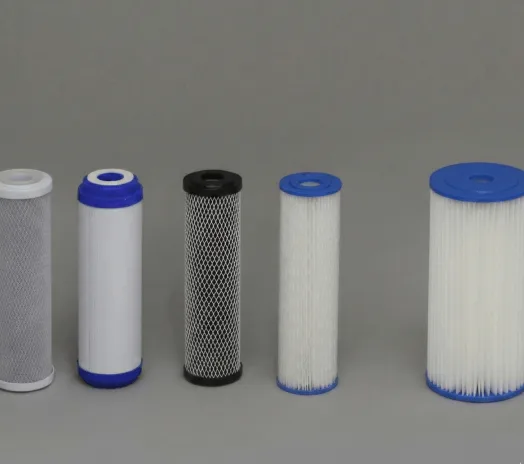
Carbon filtration is strongly affected by flow rate. If the water moves too quickly, contact time becomes too short and adsorption performance may decrease. If the flow is too slow, the cartridge may work well but the system may not meet production demand.
Pressure drop is also important. As the cartridge loads with particles or biofilm, resistance can rise. In carbon block cartridges, fine pore structure may increase pressure drop if upstream filtration is poor. In granular carbon cartridges, carbon fines or trapped sediment can also restrict flow.
A carbon cartridge should be selected by both adsorption performance and hydraulic performance.
The practical balance is to provide enough carbon contact time while maintaining stable flow and acceptable pressure drop.
When Carbon Cartridges Plug Too Quickly
A carbon cartridge may plug quickly when it is asked to do too much. Common causes include poor sediment prefiltration, high turbidity, iron or manganese particles, biofilm, scale, organic overload, incorrect flow rate, or cartridge operation beyond its design range.
Fast pressure-drop rise usually means the cartridge is receiving solids or biological loading, not only dissolved organics. In that case, replacing the carbon cartridge may restore flow temporarily but will not remove the root cause.
If a carbon cartridge clogs quickly, check upstream water quality before changing to another carbon model.
Better prefiltration, periodic flushing, correct cartridge sizing, and water-quality testing may be needed.
Common Problems and Practical Corrections
| Field Problem | Likely Cause | Practical Direction |
|---|---|---|
| Chlorine taste returns | Carbon capacity exhausted or flow too high | Check treated volume, contact time, and replacement interval |
| Odor improves at first, then returns | Adsorption breakthrough | Test water quality and replace cartridge before breakthrough |
| Pressure drop rises quickly | Sediment, iron, biofilm, or poor prefiltration | Improve upstream sediment control |
| Water color reduction is unstable | Organic load changes or carbon is saturated | Review influent quality and carbon capacity |
| RO membrane performance declines | Chlorine or organic load not controlled well | Verify chlorine removal and pretreatment sequence |
| Black carbon fines appear | Loose carbon fines or insufficient flushing | Flush cartridge and review cartridge structure |
The correction is not always “use more carbon.” In many cases, the better direction is correct contact time, better prefiltration, lower solids load, and more reliable replacement timing.
Common Selection Mistakes
A common mistake is choosing a carbon filter cartridge only by length, such as 10 inch, 20 inch, 30 inch, or 40 inch. Cartridge size matters, but it does not tell the whole story.
Another mistake is assuming carbon removes everything. Activated carbon is useful for many taste, odor, chlorine, and organic problems, but it is not a universal water treatment technology. It is not the best tool for all dissolved minerals, hardness, salts, bacteria, heavy sediment, or every chemical contaminant.
A third mistake is ignoring replacement timing. A carbon cartridge may still allow water to pass after adsorption capacity is exhausted. Flow alone does not prove the cartridge is still removing chlorine or organics.
Carbon cartridges should be replaced based on contaminant breakthrough, pressure drop, treated water volume, operating time, and water-quality testing where needed.
Omela Filtration Application Lessons
Case 1: Chlorine Taste After Municipal Water Pretreatment
A process water system used municipal water but operators noticed chlorine taste and odor in the final stream. The existing sediment filter removed particles, but it did not address residual chlorine.
The review focused on carbon cartridge contact time, flow rate, and replacement timing.
Lesson: Sediment filters and carbon filters solve different problems. Chlorine taste usually needs adsorption or dechlorination, not only particle filtration.
Case 2: RO Membrane Protection with Unstable Feed Water
A water treatment line used carbon filtration before RO membranes, but membrane performance became unstable. The review found that carbon filtration was helpful, but upstream suspended solids were reaching the carbon stage and causing pressure-drop rise.
The better direction was to strengthen prefiltration and monitor chlorine breakthrough before the RO system.
Lesson: Carbon cartridges can protect RO membranes, but they should be supported by proper sediment control and regular testing.
Case 3: Color Reduction in Process Water
A process water stream showed light color and organic odor. Carbon filtration improved the appearance at first, but the effect decreased over time.
The review showed that the cartridge had reached adsorption breakthrough. The solution direction was to define a replacement interval based on treated volume and water-quality checks.
Lesson: Carbon adsorption has a finite capacity. Clear water flow does not always mean the carbon is still effective.
Case 4: Fast Carbon Cartridge Clogging
A facility replaced carbon cartridges frequently because pressure drop increased quickly. The used cartridges showed signs of sediment and biological loading.
The review focused on upstream filtration, turbidity, flow rate, and system hygiene.
Lesson: Carbon cartridges can clog from solids even when the main treatment target is chlorine or organics.
Pre-Selection Checklist
Before choosing carbon filter cartridges, collect the following information:
- Water source: municipal water, well water, surface water, process water, or wastewater polishing
- Treatment target: chlorine, taste, odor, color, organics, VOCs, oxidants, or RO protection
- Flow rate and daily treated volume
- Chlorine or chloramine level
- Turbidity, sediment, iron, manganese, or color condition
- pH, temperature, and pressure
- Required cartridge size and housing type
- Carbon block or granular carbon preference
- Upstream filtration steps
- Downstream equipment such as RO membrane, resin bed, UV, filling line, or process tank
- Current problem: odor, chlorine breakthrough, color return, high pressure drop, short service life, or unstable product water quality
This information helps determine carbon type, cartridge structure, flow capacity, contact time, pressure-drop limit, and replacement schedule.
Final Engineering View
Carbon filter cartridges are valuable in water treatment because they can reduce chlorine, improve taste and odor, adsorb many organic compounds, reduce certain color problems, and protect downstream systems such as RO membranes.
But they should not be selected as a universal filter.
A reliable carbon filtration system should balance activated carbon type, cartridge structure, flow rate, contact time, pressure drop, upstream prefiltration, water chemistry, contaminant target, and replacement timing.
For drinking water, process water, beverage lines, RO pretreatment, industrial water polishing, and odor or color control, carbon cartridges can provide stable performance when the system is correctly sized and maintained.
The best carbon cartridge is not simply the one with the most carbon or the finest rating. It is the cartridge that removes the target contaminants, maintains stable flow, avoids early clogging, and reaches predictable service life under real water conditions.
FAQ
What are carbon filter cartridges used for?
Carbon filter cartridges are used to reduce chlorine, taste, odor, organic compounds, color-causing substances, and some oxidants in water treatment and process water systems.
How do carbon filter cartridges work?
They mainly work by adsorption. Activated carbon has a porous surface that can hold many dissolved organic compounds, taste and odor compounds, and chlorine-related substances as water passes through.
Can carbon filter cartridges remove chlorine?
Yes. Activated carbon is commonly used to reduce free chlorine in municipal water, process water, beverage water, and RO pretreatment systems.
Can carbon filter cartridges remove color from water?
They may reduce some color problems when the color is caused by adsorbable organic compounds, tannins, dyes, or process residues. Performance depends on the contaminant type and carbon capacity.
Are carbon cartridges enough for RO pretreatment?
They can help reduce chlorine and organic load before RO membranes, but they are usually only one part of pretreatment. Sediment control, scale control, pressure monitoring, and water testing may also be needed.
Why do carbon filter cartridges clog quickly?
Fast clogging may be caused by high turbidity, sediment, iron particles, biofilm, scale, poor upstream filtration, excessive flow rate, or using the carbon cartridge as the first dirt-loading stage.
When should carbon filter cartridges be replaced?
They should be replaced based on treated water volume, contaminant breakthrough, pressure drop, operating time, water-quality testing, and the service target of the system.
Author

Jessica Ma – Senior Filtration Engineer, Omela Filtration
Jessica Ma is a senior filtration engineer at Omela Filtration, specializing in dust and liquid filtration. With over 15 years of experience, she focuses on optimizing baghouse performance, enhancing filtration efficiency, and developing high-performance solutions for industrial dust collectors and precision liquid filtration applications.