
Key Takeaways
- A laser cutting dust collector for aluminum should be selected around the actual particle stream, cutting duty, source capture, spark exposure, filter area, and combustible-dust assessment—not only laser power.
- Fine aluminum-containing particles can present a combustible-dust hazard under certain conditions. The actual risk should be evaluated from representative process dust rather than assumed from the bulk aluminum sheet alone.
- Cartridge dust collectors can provide compact, high-area filtration for fine metal fume, but aluminum applications require additional review of ignition sources, dust accumulation, filter media, grounding/bonding, collector configuration, and dust discharge.
- Filter cartridges should be selected for fine-particle capture, surface loading, pulse-cleaning recovery, differential-pressure stability, and compatibility with the complete safety design.
- Spark traps, inlet baffles, drop-out sections, housekeeping, and dust discharge can reduce risk, but no single component replaces a complete combustible-dust hazard assessment.
Aluminum Cutting Needs More Than a Standard Fume Collector
Aluminum is widely laser cut for enclosures, automotive parts, battery components, structural panels, electronics, architectural products, and many other fabricated parts.
From a dust-collection perspective, however, aluminum should not simply be treated as another version of carbon steel.
Laser cutting can produce a mixture of fine metal-containing particles, oxides, smoke-like fume, sparks, hot fragments, and process residue. Particle characteristics also change with alloy, sheet condition, cutting parameters, assist gas, thickness, and production intensity.
The source article also highlights why aluminum behaves differently during cutting: it has high thermal conductivity, forms a stable oxide layer, and behaves differently from ordinary carbon steel at the cut front. Those process differences can also change the particulate stream reaching the extraction system.
For Omela-style system selection, the starting point is therefore not “aluminum needs model X.” It is “what is entering the dust collection system under this actual cutting condition?”
Fine Aluminum Particles and Fume
Laser cutting fume contains particles much smaller than the visible slag and debris left below the cutting table.
The finest fraction can stay airborne and move rapidly through the extraction system.
That creates two different engineering concerns.
First is air-quality control. Fine particulate needs to be captured at the source before it spreads into the workshop.
Second is collector loading. Fine fume can load filter media very differently from coarse particles. If airflow per cartridge is too high or the media is poorly matched, fine particulate can penetrate deeper into the filter structure and cause rapid differential-pressure growth.
A suitable system therefore needs to balance:
- Cutting-table capture
- Airflow and static pressure
- Effective filter area
- Particle-loading rate
- Cartridge media
- Pulse cleaning
- Differential-pressure control
- Dust discharge
Enough fan airflow without enough filter area is not a properly sized filtration system.
When Does Aluminum Dust Become a Combustible-Dust Concern?
Bulk aluminum sheet is not the same hazard as finely divided aluminum particulate.
Particle size changes the available surface area dramatically. NIOSH describes finely divided aluminum dust as easily ignited and capable of producing explosions.
A combustible-dust event generally requires several conditions to come together:
| Factor | Why It Matters |
|---|---|
| Combustible particulate | Provides fuel |
| Sufficiently fine/dispersible dust | Allows rapid combustion |
| Air/oxidizer | Supports combustion |
| Ignition source | Starts the event |
| Sufficient concentration | Allows flame propagation |
| Confinement | Can create damaging pressure rise |
Laser cutting systems can potentially supply several pieces of this combination: fine particulate, enclosed ductwork or collector volume, and hot particles or sparks.
However, not every aluminum laser-cutting dust sample has identical explosibility.
Particle size, oxide content, contamination, alloy composition, moisture, and other process factors can change its behavior.
That is why representative dust testing and a formal dust-hazard review are more useful than assuming that every aluminum cutting application has exactly the same risk.
Source Capture Comes First
The safest particle is usually the one captured before it spreads through the building.
Laser cutting dust collection should therefore begin at the cutting table or machine enclosure.
Important factors include:
- Table dimensions
- Downdraft or side extraction
- Active extraction-zone size
- Damper arrangement
- Cutting-head location
- Table leakage
- Duct connection position
- Production duty
A properly zoned cutting table can concentrate extraction close to the active cutting area instead of pulling large volumes of unnecessary air through the entire table.
Increasing collector airflow cannot fully compensate for poor source-capture design.
The table, ductwork, collector, filters, and fan should be treated as one airflow system.
Spark and Hot-Particle Control
Filter cartridges should not be the first component expected to stop sparks.
Depending on the application, upstream measures may include:
- Table drop-out space
- Inlet baffles
- Spark traps
- Pre-separation chambers
- Direction changes that reduce direct particle impact
- Monitoring and suppression systems where required by the hazard assessment
The objective is to reduce the number of hot particles reaching the filter section.
If cartridges show localized burn marks, small holes, or repeated heat damage, simply changing to another media may not solve the root problem.
Repeated cartridge burn marks are often a reason to inspect the spark path before changing the filter specification.
Spark-control equipment also adds system resistance, so it must be included in fan and static-pressure calculations.
Dry Cartridge Collector or Wet Collection?
There is no universal answer.
Dry cartridge filtration can provide high surface area and effective fine-particle capture, but combustible-metal applications require proper evaluation of collector configuration, ignition control, explosion protection, isolation, dust handling, and applicable codes.
Wet collection is also used in some combustible-metal applications.
An OSHA consultation case involving aluminum dust confirmed the dust was explosive; the facility subsequently installed dedicated aluminum source capture and a wet collector specifically designed for combustible metal dust.
But this should not be simplified to:
Aluminum + water = automatically safe.
Aluminum interacting with water can produce hydrogen under certain conditions. Published combustible-metal guidance therefore includes requirements addressing water level, hydrogen generation, sludge handling, ventilation, and safe system design.
The correct collector type should follow the dust-hazard evaluation, process conditions, local regulations, and engineering design—not a generic rule that dry or wet is always better.
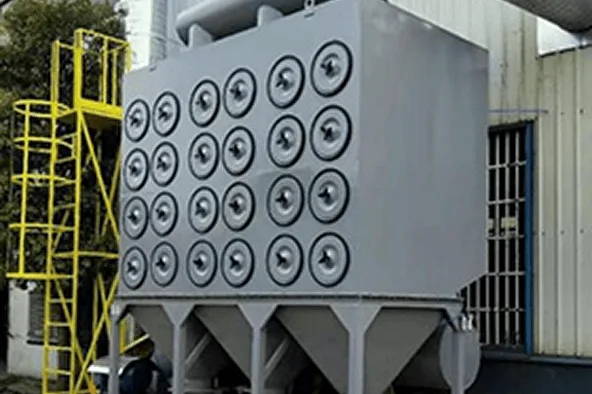
Filter Cartridge Selection
Where a dry cartridge system is appropriate, filter selection still matters.
Laser fume tends to favor media that keeps fine particles near the surface instead of allowing excessive depth penetration.
Useful filter-selection questions include:
- Is the media suitable for fine fume?
- Does it support surface loading and effective dust release?
- Is the available filter area sufficient?
- What filtration velocity will each cartridge see?
- Does the system require conductive or anti-static properties?
- Is flame-retardant performance relevant?
- How does the media respond to oil or coating residue?
- What differential-pressure range is expected?
Anti-static or flame-retardant media should be viewed as part of the overall safety design—not as a substitute for combustible-dust engineering controls.
Cartridge quantity and media area are also important.
A collector with too little effective media may initially capture smoke well, but pressure drop can rise quickly as the filters load.
Pressure Drop and Cartridge Life
Differential pressure is one of the most useful indicators of collector condition.
As fine particulate loads the cartridges, resistance increases. Pulse cleaning should release surface dust and keep resistance within the intended operating range.
Watch for:
- Rapid pressure increase
- Continuous pulse cleaning
- Poor pressure recovery after cleaning
- Weak table suction
- Short cartridge life
- Smoke escape increasing as filters load
If pressure drop rises rapidly, investigate filter area, media, dust concentration, pulse cleaning, compressed-air quality, and any sticky process residue.
A collector should maintain acceptable airflow at normal loaded-filter resistance—not only with brand-new cartridges.
Mixed Metals Need Special Attention
One of the most important lessons from historical aluminum-dust incidents is the danger of assuming that different metal dusts can always share the same collection system.
An OSHA accident investigation documented a dry dust collector containing both aluminum and steel dust. Heat and sparks generated by the steel process ignited accumulated aluminum dust, causing a fatal fire and injuries.
Another OSHA investigation documented an aluminum-dust collection system where an ember traveled through the ductwork into the collection equipment and initiated an explosion that injured workers.
These cases were not laser-cutting cases specifically, but the engineering lesson is highly relevant.
Do not assume that switching between aluminum and ferrous metals is only a production-scheduling issue. It can also change the ignition and dust-compatibility conditions inside the extraction system.
For mixed-metal operations, review segregation, cleaning procedures, collector suitability, ignition sources, duct contamination, and applicable combustible-dust requirements.
Dust Discharge and Housekeeping Matter
Capturing aluminum particulate does not make the hazard disappear.
It moves the material into:
- Filter cartridges
- Hoppers
- Dust drawers
- Ductwork
- Spark chambers
- Disposal containers
These areas need regular inspection.
Dust accumulation can increase both pressure-drop and safety problems. Fugitive dust around the collector can also become part of the combustible-dust hazard.
Housekeeping should therefore cover the cutting machine, table, duct inspection points, collector, surrounding floor and surfaces, and collected-dust handling procedure.
A dust collector is not safe simply because it successfully removes dust from the air. The captured material still needs controlled handling.
Application Lessons
Case 1: Shared Aluminum and Steel Dust
A documented metalworking incident involved a dry collector receiving both aluminum and steel dust.
Sparks associated with the steel process ignited the aluminum dust inside the collection equipment.
Lesson: Mixed-metal collection can introduce ignition scenarios that are not obvious from the individual machines alone.
Case 2: Ember Reached the Collector
In another documented aluminum-dust incident, an ignition source generated at a metalworking machine traveled through the extraction duct to the collection equipment.
The combustible dust inside the system then became involved in an explosion.
Lesson: Source capture is necessary, but the extraction path must also control ignition propagation.
Case 3: Dust Testing Changed the Control Strategy
During an OSHA consultation, aluminum dust accumulated around a metal-finishing operation was tested and confirmed to be explosible.
The facility moved to dedicated aluminum source capture and a collector designed specifically for combustible metal dust.
Lesson: Testing the actual process dust is more useful than guessing hazard level from the bulk material.
Case 4: Continuous Aluminum Laser Cutting Overloaded Standard Filters
A published fabrication case described all-day aluminum laser cutting where the existing collection approach struggled with rapidly loading cartridges.
The redesigned system combined more appropriate airflow and filter area with internal particle deflection, spark control, surface-loading cartridges, and automatic cleaning.
Lesson: Aluminum laser fume problems are often system-sizing problems—not simply filter-brand problems.
Aluminum Laser Cutting Dust Collector Selection Checklist
Before selecting a system, collect:
- Aluminum alloy and sheet thickness
- Laser type and power
- Cutting-table dimensions
- Active extraction-zone size
- Daily cutting hours
- Assist gas
- Other metals cut on the same machine
- Estimated airflow
- Duct dimensions and route
- Fine-dust loading condition
- Spark and hot-particle history
- Cartridge media and total filter area
- Expected differential-pressure range
- Pulse-cleaning design
- Dust discharge method
- Indoor or outdoor collector location
- Combustible-dust test data if available
- Applicable local safety requirements
This information allows the system to be evaluated as a complete extraction and filtration process rather than simply selecting a collector by fan size.
Common Selection Mistakes
| Mistake | Why It Matters | Better Approach |
|---|---|---|
| Selecting only by laser power | Does not define particle load or extraction demand | Review table, material and production duty |
| Treating aluminum like carbon steel | Ignores different dust and ignition behavior | Evaluate aluminum-specific process conditions |
| Using filter media as the spark arrestor | Hot particles can reach cartridges | Control sparks upstream |
| Ignoring filter area | Can cause rapid pressure-drop rise | Review filtration velocity |
| Assuming anti-static media solves combustible dust | Media is only one part of the system | Use complete hazard-based design |
| Mixing metal dusts without review | Can create incompatible ignition conditions | Assess segregation and collector suitability |
| Assuming wet collection automatically removes all risk | Aluminum-water systems have their own hazards | Use purpose-designed engineering controls |
| Ignoring captured dust | Dust remains a hazard after collection | Plan discharge and housekeeping |
Final Engineering View
Aluminum laser cutting dust collection should not be treated as simply another fine-dust application.
The system must manage source capture, very fine particulate, airflow, filter loading, sparks, hot particles, differential pressure, collected dust, and potential combustible-dust hazards.
At the same time, the design should avoid exaggerated assumptions.
Not every aluminum laser fume stream has identical explosibility, and not every workshop requires the same collector configuration.
The correct engineering approach is to characterize the real process dust, identify potential ignition sources, evaluate the cutting and extraction system as a whole, and then select the appropriate collector and filter technology.
For dry cartridge systems, that means enough filter area, suitable surface-loading media, effective pulse cleaning, differential-pressure monitoring, controlled spark entry, and safe dust discharge.
For applications where combustible-metal risk is significant, the system must also satisfy the applicable hazard assessment, dust testing, collector configuration, explosion/fire protection, housekeeping, and local code requirements.
The best aluminum laser cutting dust collector is therefore not simply the unit with the largest fan or the finest filter.
It is the system that captures particles at the source, maintains stable airflow, keeps the filters operating predictably, controls ignition risks, and handles the collected aluminum dust safely.
FAQ
Is aluminum laser cutting dust combustible?
Finely divided aluminum can be combustible and may be explosible under suitable conditions. Actual risk depends on particle size, composition, concentration, dispersion, and ignition conditions, so representative dust testing may be required.
Can a cartridge dust collector be used for aluminum laser cutting?
Potentially, but the complete system must be evaluated for the specific dust hazard, spark exposure, filter area, media, collector design, dust handling, and applicable safety requirements.
Should aluminum and steel use the same dust collector?
This should not be assumed to be safe. Historical incidents show that sparks from ferrous-metal processing can ignite aluminum dust in shared collection equipment. Mixed-metal collection requires specific engineering review.
Does anti-static filter media make aluminum dust collection safe?
No. Anti-static media may be one component of the design, but it does not replace source capture, grounding/bonding, ignition control, explosion protection, isolation, housekeeping, or dust-hazard assessment.
Is a wet dust collector always safer for aluminum?
No. Wet collection is used for combustible metals, but aluminum can react with water and generate hydrogen under some conditions. Wet systems therefore need to be designed specifically for the application.
What data is needed to size an aluminum laser cutting dust collector?
Provide alloy, thickness, laser power, cutting-table size, active extraction zone, working hours, other metals processed, duct layout, spark history, airflow requirements, filter area, dust characteristics, and any combustible-dust test data.
Author

Jessica Ma – Senior Filtration Engineer, Omela Filtration
Jessica Ma is a senior filtration engineer at Omela Filtration, specializing in dust and liquid filtration. With over 15 years of experience, she focuses on optimizing baghouse performance, enhancing filtration efficiency, and developing high-performance solutions for industrial dust collectors and precision liquid filtration applications.