
Key Takeaways
- Liquid filter bags are widely used to remove suspended solids, gels, particles, oil droplets, and contaminants from industrial process liquids, including adhesives, resins, coatings, inks, and sealants.
- Adhesive filtration is different from water filtration because glue and sealants are often viscous, sticky, shear-sensitive, temperature-dependent, and prone to gels, fibers, cured particles, lumps, and agglomerates.
- Polypropylene liquid filter bags are practical for many adhesives, resins, coatings, and chemical liquids where chemical resistance and cost efficiency matter.
- Polyester liquid filter bags are useful when adhesive filtration requires higher mechanical strength, dimensional stability, and resistance to process stress.
- Mesh filter bags and nylon liquid filter bags are often suitable for removing gels, fibers, lumps, and oversized particles with lower pressure drop.
- For hot, abrasive, reusable, or highly viscous adhesive systems, stainless steel liquid filter bags may be considered.
- To choose the right adhesive filter bag faster, send viscosity, temperature, adhesive type, solvent or water base, target contaminants, micron rating, flow rate, housing size, pressure drop limit, and current clogging photos to contact Omela Filtration.
Why Adhesive Filter Bags Matter
Adhesives, glues, sealants, and resins are often used in applications where product consistency matters. A small gel, cured particle, fiber, skin fragment, lump, or agglomerate can block a nozzle, damage a pump, scratch a coated surface, create visible defects, affect bead uniformity, or cause customer complaints after packaging.
Unlike clean water, adhesive products often have higher viscosity and more complex flow behavior. Some adhesives are water-based. Some are solvent-based. Some contain fillers, tackifiers, rubber, polymers, pigments, plasticizers, or functional additives. Some become thicker when temperature drops. Some begin to cure when exposed to air, moisture, heat, or catalyst contamination.
Omela explains that a liquid filter bag removes suspended solids, gels, particles, oil droplets, or contaminants from industrial process liquids, and that performance depends on media selection, micron rating, permeability, chemical compatibility, temperature limits, and housing sealing. For adhesive filtration, all of these factors matter even more because sticky and viscous liquids can increase pressure drop and shorten bag life.
What Are Adhesive Filter Bags?
Adhesive filter bags are liquid filter bags used to remove unwanted solids from glue, sealants, resins, hot melts, latex adhesives, pressure-sensitive adhesives, construction adhesives, silicone sealants, polyurethane sealants, epoxy systems, and related high-viscosity fluids.
They are commonly installed before filling machines, mixing tanks, coating heads, dispensing nozzles, packaging lines, transfer pumps, storage tanks, or downstream cartridge filters. Their role is not to change the adhesive formulation. Their role is to remove harmful oversized contaminants while keeping flow stable and product quality consistent.
In practice, adhesive filter bags may be used for coarse prefiltration, final filtration before packaging, batch transfer filtration, recirculation loop filtration, or protection of nozzles and coating equipment.
What Contaminants Are Common in Glue and Sealants?
Adhesive filtration usually targets contaminants that are larger, harder, or more disruptive than the normal formulation components.
Common contaminants include gels from polymer reaction or ageing, partially cured particles from skin formation, fibers from packaging or wiping materials, lumps from poor dispersion, undissolved additives, rubber crumbs, agglomerated fillers, pigment clusters, tank scale, gasket fragments, and dirt from raw materials or transfer lines.
The most important point is that not every visible particle should be treated the same way. A hard cured particle behaves differently from a soft gel. A long fiber behaves differently from a round granule. A compressible lump behaves differently from a sharp mineral filler. This is why adhesive filter bag selection should start with contaminant behavior, not only with a micron number.
Why Adhesive Filtration Is Difficult
Adhesives are difficult to filter because viscosity increases resistance through the filter media. Omela’s high-viscosity liquid filtration guide explains that higher viscosity can reduce flow, increase clean differential pressure, shorten filter life, and add load to the pump and support basket. It also notes that performance depends on viscosity, flow rate, pressure drop, particle characteristics, chemical compatibility, filtration area, housing size, and seal construction.
Temperature is another important factor. Many adhesives, resins, oils, syrups, and coatings become less viscous when heated. If the process allows controlled heating, filtration may become easier. But the filter bag media, sealing ring, gasket, basket, housing, and adhesive chemistry must all tolerate the operating temperature.
A tile adhesive filtration case from Lubropoint also shows why high-viscosity adhesive systems cannot be treated like low-viscosity water. The case describes tile adhesive as a high-viscosity thixotropic material with contaminant loading that varies over time, requiring a filtration approach matched to both viscosity and changing solids load.
Mesh vs Felt Filter Bags for Adhesives
For adhesive filtration, the first practical choice is often mesh versus felt.
Mesh filter bags are surface filters. They have more open, defined pores and are often used to catch gels, fibers, lumps, agglomerates, and oversized solids. They usually create lower pressure drop than dense felt media and can be easier to clean or reuse in some applications. Omela’s mesh filter bag page describes mesh bags as suitable for removing hard particles, gels, debris, and contaminants from low- to medium-viscosity liquids, including paints, inks, varnishes, resins, adhesives, and specialty industrial fluids.
Felt filter bags are depth filters. They are better when the adhesive contains a broader distribution of fine particles and when higher dirt-holding capacity is needed. PP felt and polyester felt are common choices, but felt media may increase pressure drop more quickly in highly viscous or gel-rich adhesives.
A practical rule is simple: use mesh when the main problem is oversized gels, fibers, lumps, or agglomerates; use felt when the main problem is finer suspended solids and general clarification.
Adhesive Filter Bag Material Selection
| Filter Bag Material | Best Use in Adhesives | Main Advantage | Watch Point |
|---|---|---|---|
| PP Felt | Water-based adhesives, resins, chemicals, general glue filtration | Chemical resistance and cost efficiency | Lower temperature than polyester or metal mesh |
| Polyester Felt | Coatings, emulsions, resins, adhesives with mechanical stress | Strength and dimensional stability | Check alkali and chemical compatibility |
| Nylon Mesh | Gels, fibers, lumps, reusable surface filtration | Precise openings and low fiber shedding | Check acids and solvent compatibility |
| PP / PE Mesh | Coarse gels, agglomerates, low pressure drop | Open structure and high flow | Not ideal for fine polishing |
| PTFE | Aggressive chemicals, solvents, specialty adhesive systems | Broad chemical resistance | Higher cost |
| Stainless Steel Mesh | Hot adhesives, abrasive particles, washable systems | Reusable, strong, temperature resistant | Higher initial cost and coarser filtration |
PP filter bags are often selected for adhesives because they offer broad chemical compatibility and economical single-use filtration. Omela lists paints, inks, coatings, adhesives, and resins among typical PP liquid filter bag applications, with micron options from 0.5–200 µm and compatibility with standard housings and sealing rings.
Polyester filter bags are useful when stronger mechanical performance and higher temperature tolerance are needed. Omela’s polyester liquid filter bag page lists coatings, inks, adhesives, emulsions, resins, and polymer solutions as applications where polyester bags help remove gels, agglomerates, and oversized pigments while supporting stable colour, viscosity, and process consistency.
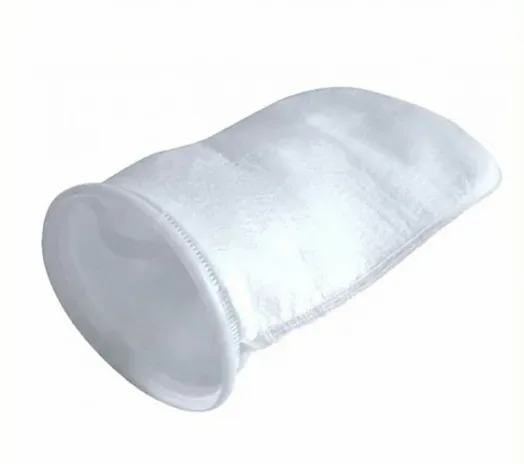
For reusable or high-temperature adhesive filtration, stainless steel mesh can be considered. Omela describes stainless steel filter bags as suitable for viscous liquids such as resins, coatings, adhesives, and polymer solutions, especially where durability, high temperature, high pressure, or repeated washing is required.
How to Choose the Right Micron Rating
Micron rating should be based on the smallest harmful contaminant, not the smallest available filter bag.
If the adhesive contains large lumps, skins, fibers, or gel pieces, a coarse mesh bag may be enough. If it contains smaller gel particles or pigment agglomerates, a finer mesh or felt bag may be needed. If the adhesive is used for precision coating, dispensing, or fine nozzle application, a staged filtration system may be safer than one very fine bag.
Choosing a micron rating that is too fine can create high pressure drop, slow filling speed, short bag life, pump overload, bypass risk, or adhesive heating. Choosing a micron rating that is too coarse can allow gels or particles to reach the nozzle, coating head, or final package.
For high-viscosity adhesives, staged filtration is often better. For example, a coarse mesh bag may first remove large lumps and fibers, while a finer felt or high-efficiency bag performs final polishing before packaging.
Bag Size and Housing Selection
The filter housing is as important as the filter bag. A correctly selected bag cannot perform well if the housing, basket, inlet design, or available filter area is too small.
For low-to-medium flow adhesive lines, a single-bag housing may be enough. For higher flow, higher viscosity, or heavier contaminant loading, a Size #2 bag, multi-bag housing, or parallel housing may be needed. Omela’s high-viscosity guide notes that Size #2 housings generally provide lower velocity and more filter area than Size #1, while multi-bag systems distribute flow across several bags and reduce pressure drop through each individual bag.
A duplex housing is useful when production should not stop during bag changeout. One side can remain in service while the other side is isolated for replacement.
In adhesive production, this matters because stopping a line can allow product to cool, skin, cure, settle, or thicken. A good housing design can reduce changeout downtime and improve production stability.
Sealing Ring, Seam, and Bypass Control
Adhesive filtration requires reliable sealing. If adhesive bypasses the filter bag, unfiltered gels and particles may still reach the filling line or dispensing nozzle.
Proper sealing between the bag and housing is a common industry concern. Solventum’s 3M bag filter documentation states that proper sealing in the housing is necessary to prevent fluid bypass and downstream contamination. It also describes welded seams as a way to avoid particle bypass through sewn holes in certain high-performance bag constructions.
For adhesive products, welded seams may be useful when fiber migration, bypass, or cleanliness is critical. Sewn bags are economical and widely used, but the process should confirm whether seam holes, thread compatibility, or fiber shedding could affect the final product.
Ring selection should match both the housing and the adhesive chemistry. Plastic rings may be suitable for many low-to-medium temperature applications. Stainless steel rings may be preferred where temperature, mechanical stress, or chemical exposure is higher.
Common Adhesive Filtration Problems and Corrections
| Problem | Likely Cause | Practical Correction |
| Filter bag plugs quickly | Micron rating too fine, viscosity too high, gel load too heavy | Use staged filtration, larger housing, or coarser mesh prefilter |
| Gels pass downstream | Micron rating too coarse or poor sealing | Check mesh size, ring seal, housing basket, and bypass points |
| Flow becomes unstable | Viscosity fluctuation or temperature change | Control process temperature and review pump capacity |
| Nozzle clogging continues | Wrong contaminant target or final filter too coarse | Analyse particle size and use final polishing stage |
| Bag ruptures or collapses | Pressure too high, no basket support, wrong bag size | Check support basket, pressure limit, and housing fit |
| Product contamination | Fiber shedding, seam bypass, incompatible media | Use monofilament mesh, welded construction, or compatible media |
The best correction is not always “use a finer bag.” In adhesive filtration, better results often come from using the right stage sequence, larger filter area, better housing fit, and more suitable media construction.
Application Scenarios for Adhesive Filter Bags
In water-based adhesive production, PP felt or PP mesh may be practical because chemical compatibility and cost control are often important. The main targets may be gels, skins, fibers, tank dirt, or agglomerated additives.
In sealant production, viscosity and curing behaviour become more important. Coarse mesh filtration may be used to remove lumps, skins, and foreign particles before filling cartridges, sausages, pails, or drums.
In resin and polymer filtration, polyester felt, PP felt, nylon mesh, stainless steel mesh, or high-efficiency multilayer media may be selected depending on temperature, solvent content, particle size, and pressure drop limits.
In coatings or adhesive-related formulated products, filtration protects nozzles, coating heads, spray systems, and final appearance. A filter that is too coarse may allow surface defects, while a filter that is too fine may reduce production speed.
Step-by-Step Selection Logic
Start with the adhesive type. Confirm whether it is water-based, solvent-based, hot-melt, epoxy, polyurethane, silicone, acrylic, rubber-based, filled, pigmented, or reactive.
Next, define the contaminant. Are you removing soft gels, cured particles, fibers, lumps, filler agglomerates, pigment clusters, skins, or foreign solids? Each behaves differently during filtration.
Then review viscosity and temperature. If the adhesive becomes much thinner at higher temperature, controlled heating may improve filtration, but only if the media and seals can tolerate the temperature.
After that, choose media structure. Use mesh for coarse gels, fibers, and lumps. Use felt for finer suspended solids. Use stainless steel mesh for hot, abrasive, reusable, or high-pressure filtration. Use PTFE when chemical compatibility is the main concern.
Finally, check housing size, pressure drop, support basket, sealing ring, gasket material, changeout method, and cleaning/reuse requirements. The filter bag, housing, and process conditions must work together.
Common Mistakes to Avoid
The first mistake is choosing a micron rating only by guesswork. Adhesive contaminants should be checked by particle size, shape, hardness, and whether they are compressible.
The second mistake is using a very fine felt bag as the first filtration step. This can cause immediate plugging when the adhesive contains lumps or gel clusters.
The third mistake is ignoring viscosity. A filter that works well on water may create excessive pressure drop with thick glue or sealant.
The fourth mistake is ignoring sealing. If the ring does not fit the housing correctly, contaminants may bypass the bag.
The fifth mistake is ignoring temperature. Many adhesives change viscosity with temperature, and some media or rings cannot tolerate higher temperatures.
The sixth mistake is replacing bags too late. Once pressure drop rises too much, bag rupture, bypass, pump strain, or production instability may follow.
To Request a Quote
For adhesive filter bags, please send:
- Adhesive, glue, sealant, resin, or coating type
- Water-based, solvent-based, hot-melt, reactive, or filled formulation
- Viscosity at operating temperature
- Operating temperature and allowable temperature range
- Target contaminants: gels, cured particles, fibers, lumps, skins, agglomerates, pigments, or foreign solids
- Required micron rating or current filter rating
- Flow rate and operating pressure
- Initial and maximum allowable pressure drop
- Housing size, bag size, support basket, ring type, and gasket material
- Current filter bag material and service life
- Current problem: plugging, bypass, rupture, nozzle clogging, poor appearance, or frequent changeout
- Quantity and delivery destination
- Photos of current filter bags, housing, contaminants, and failed bags
With this information, Omela can help compare PP felt, polyester felt, nylon mesh, PP/PE mesh, PTFE, stainless steel mesh, high-efficiency multilayer bags, and matching filter bag housings.
Omela Engineering View
Adhesive filter bag selection should focus on product consistency and process stability.
For gels, fibers, cured particles, skins, and lumps, mesh bags often provide lower pressure drop and more predictable coarse removal. For finer suspended solids, felt bags may be better. For high-temperature, reusable, abrasive, or solvent-rich adhesive systems, stainless steel mesh or PTFE may need to be reviewed.
The best adhesive filter bag is not always the finest bag. It is the bag that removes harmful contaminants without creating unacceptable pressure drop, frequent changeout, product loss, or production delay.
Omela Filtration helps customers choose liquid filter bags, mesh filter bags, felt bags, stainless steel filter bags, filter cartridges, and filter housings based on adhesive type, viscosity, contaminant size, temperature, chemistry, flow rate, and filtration target.
FAQ
What are adhesive filter bags used for?
Adhesive filter bags are used to remove gels, cured particles, fibers, lumps, skins, agglomerates, and foreign solids from glue, sealants, resins, coatings, and other viscous industrial liquids.
Should I use mesh or felt filter bags for adhesive filtration?
Mesh bags are usually better for coarse gels, fibers, lumps, and agglomerates because they provide surface filtration and lower pressure drop. Felt bags are better for finer suspended solids and depth filtration.
What micron rating is suitable for glue and sealants?
The best micron rating depends on the smallest harmful contaminant and the application. Coarse mesh may be enough for lumps and fibers, while finer felt or multilayer bags may be needed for polishing before filling or dispensing.
Why do adhesive filter bags clog quickly?
Fast clogging is usually caused by high viscosity, excessive gel loading, too fine a micron rating, insufficient filter area, low operating temperature, or poor prefiltration.
Can stainless steel filter bags be used for adhesives?
Yes. Stainless steel mesh filter bags may be used for hot, abrasive, high-pressure, reusable, or high-viscosity adhesive systems where polymer media may not provide enough durability.
How can I reduce pressure drop in adhesive filtration?
Use a coarser prefilter, larger bag size, multi-bag housing, controlled operating temperature, mesh media for coarse contaminants, or staged filtration instead of one very fine filter bag.
What information is needed to quote adhesive filter bags?
Provide adhesive type, viscosity, temperature, chemistry, target contaminants, micron rating, flow rate, pressure drop limit, housing size, ring type, current problems, quantity, and photos.
Author

Jessica Ma – Senior Filtration Engineer, Omela Filtration
Jessica Ma is a senior filtration engineer at Omela Filtration, specializing in dust and liquid filtration. With over 15 years of experience, she focuses on optimizing baghouse performance, enhancing filtration efficiency, and developing high-performance solutions for industrial dust collectors and precision liquid filtration applications.