
Key Takeaways
- The fundamental distinction in high-temperature filter media is construction, not just fiber: woven fabrics (interlaced yarn) and non-woven needle felts (randomly entangled fibers compacted by needling) filter differently and suit different applications.
- Woven fiberglass cloth is the standard for high-temperature, high-volume applications like cement kilns and sinter plants — it tolerates 260°C continuous, resists acid when PTFE-treated, and handles large gas volumes at low air-to-cloth ratios with reverse-air or low-pressure pulse cleaning.
- Non-woven needle felts (PPS, P84, glass felt) provide higher depth-filtration capacity and better dust cake support, making them suited to pulse-jet systems with higher air-to-cloth ratios and finer dust loads.
- PTFE membrane lamination transforms woven fiberglass into a surface-filtration medium capable of 99.99%+ efficiency and sub-5 mg/Nm³ emissions — the configuration used in most modern ultra-low-emission cement and steel installations.
- Acid-resistant PTFE-impregnated woven fiberglass (black in appearance after treatment) retains over 80% of its tensile strength after acid exposure, making it the right choice for sinter plant and coal-fired flue gas with high SOx content.
- Material selection should be driven by the combination of temperature, gas chemistry, dust load, cleaning mechanism, and emission target — not by temperature alone.
In high-temperature industrial dust collection — sinter plants, cement kilns, steel furnaces, coal-fired boilers — the filter media decision involves a choice that’s often misunderstood: woven versus non-woven construction. These two filter media families both handle high temperatures, both come in glass fiber versions, and both can be PTFE-treated. But they filter differently, they suit different cleaning systems, and choosing the wrong one for your application produces predictable problems.
Add to this the polymer needle felts — PPS, P84, aramid — that overlap with glass fiber in parts of the temperature range, and the selection question becomes genuinely complex. A sinter plant engineer evaluating filter media for a baghouse upgrade isn’t just choosing a fiber. They’re choosing a construction type, a surface treatment, and a cleaning-system match, all of which interact.
This article breaks down the differences clearly: how woven and non-woven media are constructed, how that construction drives filtration behavior, where each type fits, and how glass fiber compares to polymer felts like PPS and P84. The focus throughout is on the high-temperature applications where this choice matters most — with particular attention to sinter plant dust collection in the steel industry.
The Core Distinction: Woven Fabric vs. Non-Woven Needle Felt
Woven Filter Cloth
Woven filter media is made by interlacing continuous yarns — warp (lengthwise) and weft (crosswise) — on a loom, exactly like conventional textile weaving. The result is a fabric with a regular, ordered structure: a grid of interlaced yarns with defined openings between them.
In filtration terms, woven cloth filters primarily through the dust cake that builds up on its surface, with the woven structure acting as the support scaffold for that cake. The fabric itself has relatively open pores; it’s the accumulated dust layer that does most of the fine filtration. This is why woven media typically shows higher initial emissions until the dust cake establishes, and why it relies on maintaining a stable dust cake for consistent performance.
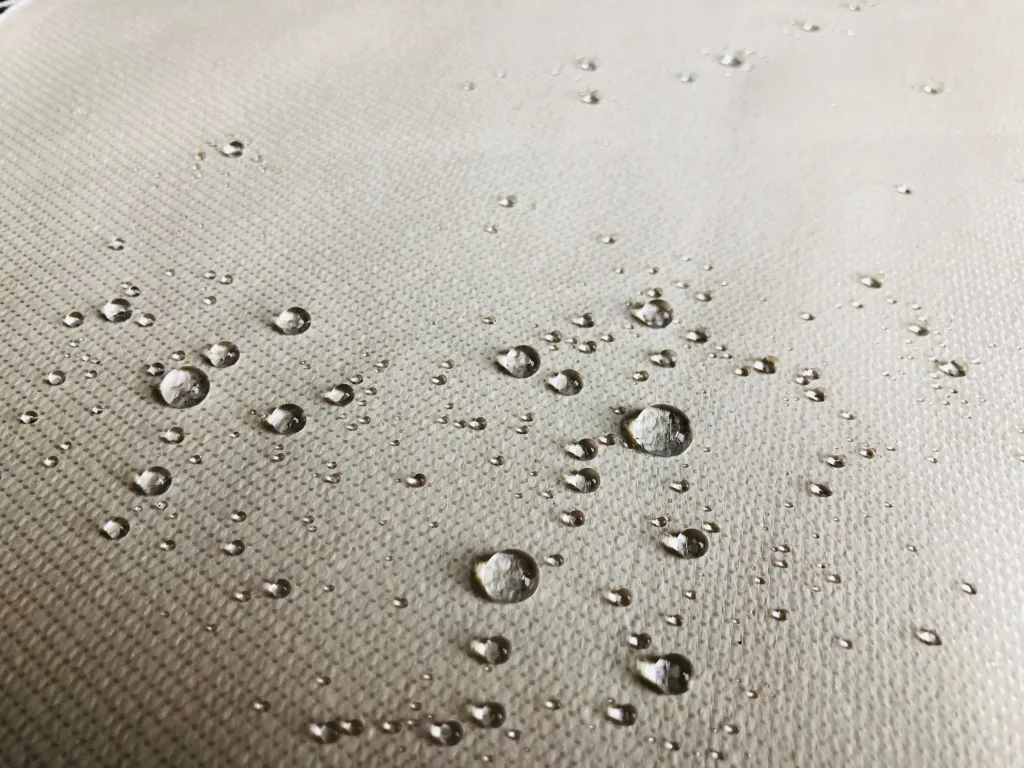
Woven fiberglass filter cloth is the dominant filter media in large-scale high-temperature applications — cement kilns, sinter plants, and large coal-fired boilers — for a specific set of reasons: it’s mechanically strong, dimensionally stable at high temperature, available in large continuous widths for big bags, and economical to produce at scale. The interlaced yarn structure gives it high tensile strength, which matters in long bags (6–8 meters) where the bag must support its own weight and the dust load.
Non-Woven Needle Felt
Non-woven needle felt is made differently. Loose staple fibers are carded into a web, layered, and then mechanically compacted by thousands of barbed needles punching through the web, entangling the fibers into a dense, three-dimensional mat. There’s no woven structure — the fibers are randomly oriented and held together by mechanical entanglement, often around a woven scrim that provides tensile strength.
The result is a filter medium that filters through its depth as well as its surface. The dense, randomly entangled fiber structure intercepts particles throughout the felt thickness, not just at the surface. This gives needle felt higher dust-holding capacity and the ability to capture fine particles more effectively than woven cloth without relying as heavily on the dust cake.
PPS needle-punched felt, P84 needle felt, aramid felt, and fiberglass needle felt are all non-woven media. The polymer felts (PPS, P84, aramid) dominate the moderate-to-high temperature range, and glass needle felt extends into the higher temperature range while offering the depth-filtration characteristics that woven glass cloth lacks.
How Construction Drives Cleaning System Match
The single most important practical consequence of the woven/non-woven distinction is which cleaning system each suits.
Woven Cloth → Reverse Air and Low-Pressure Cleaning
Woven fiberglass cloth is mechanically strong in tension but more vulnerable to the flex fatigue of aggressive cleaning. Glass fiber, in particular, can suffer fiber breakage under repeated sharp flexing. For this reason, woven glass cloth is typically used with gentler cleaning methods: reverse-air cleaning (where a counter-flow of air gently collapses the bag) or low-pressure pulse systems. These methods operate at lower air-to-cloth ratios — typically below 1.0 m/min — which is why woven-cloth baghouses are physically larger for a given gas volume.
This is the standard configuration for cement kiln and sinter plant baghouses: large reverse-air or low-pressure-pulse systems running woven fiberglass bags at low face velocity, handling very large gas volumes (often 500,000 to 1,000,000 m³/h) with long service life.
Non-Woven Felt → Pulse-Jet Cleaning
Non-woven needle felts tolerate the mechanical shock of high-pressure pulse-jet cleaning much better than woven glass cloth. The entangled fiber structure flexes without the fiber-breakage vulnerability of woven glass. This makes needle felts the standard choice for pulse-jet baghouses, which operate at higher air-to-cloth ratios (1.0–2.0 m/min or higher) and are therefore more compact for a given gas volume.
PPS, P84, and aramid felts are almost always used in pulse-jet systems. This is a key practical point: if your baghouse is a high-velocity pulse-jet design, polymer needle felt or glass needle felt is usually the appropriate media family, not woven glass cloth.
Where Glass Fiber Beats Polymer Felts — and Where It Doesn’t
Glass fiber and polymer felts (PPS, P84, aramid) overlap in the upper temperature range, which creates genuine selection questions. Here’s how they actually compare:
Temperature
Glass fiber handles 260°C continuous — higher than PPS (160°C) and at the same level as P84 (240°C continuous, 260°C peak). For applications above 200°C continuous, glass fiber and P84 are the realistic options; PPS and aramid are out of range.
Oxidation Resistance
Glass fiber is inorganic and doesn’t oxidize. In high-temperature oxidizing environments — sinter plant flue gas, some furnace applications — this is a significant advantage over organic polymer felts, which can degrade through oxidation at elevated temperatures. This is one reason glass fiber is favored in sinter and high-temperature steel applications.
Mechanical Flexibility
This is where glass fiber loses. Glass fiber is brittle compared to polymer fibers; it doesn’t tolerate flex fatigue and aggressive pulse-jet cleaning as well. Polymer felts (PPS, P84) are far more flexible and durable under high-frequency cleaning. For applications requiring frequent, aggressive cleaning, polymer felt often outperforms glass fiber on service life despite the temperature being within glass fiber’s range.
Filtration Efficiency
Plain woven glass cloth has lower inherent filtration efficiency than needle felt (it relies on the dust cake). But PTFE-membrane-laminated glass cloth reverses this completely — surface filtration at the membrane delivers 99.99%+ efficiency, matching or exceeding the best needle felt configurations.
Acid Resistance
Both glass fiber and polymer felts can be made acid-resistant through treatment. Acid-resistant PTFE-impregnated woven fiberglass — which has a distinctive black appearance after the acid-resistant treatment — retains over 80% of its warp and weft tensile strength after acid exposure, making it suitable for high-SOx flue gas. This acid-resistant black glass cloth is widely used in sinter plant and coal-fired applications where SO₂/SO₃ content would degrade untreated media. For a direct comparison of the two glass constructions, see our article on non-woven fiberglass vs. woven fiberglass filter bags.
PTFE Membrane Lamination: The Game-Changer for Woven Glass
The biggest performance shift in woven fiberglass filter media over the past two decades has been PTFE membrane lamination.
A plain woven fiberglass bag relies on its dust cake for fine filtration and shows elevated emissions during the dust-cake formation period. Laminating an expanded PTFE microporous membrane onto the woven glass surface changes the filtration mechanism entirely — from dust-cake-dependent depth/surface filtration to true surface filtration at the membrane.
The membrane has an extremely high pore density (on the order of 10⁹ pores per cm²) with controlled, uniform pore size. Particles are intercepted at the membrane surface from the first moment of operation — no break-in period, no dust-cake dependency. Filtration efficiency reaches 99.99%+ on fine particles, and graded efficiency data shows essentially 100% capture above 1 μm. The smooth, non-stick PTFE surface also releases dust cleanly, lowering pressure drop and reducing cleaning energy.
This is the configuration used in most modern ultra-low-emission cement and steel installations targeting sub-10 mg/Nm³ or sub-5 mg/Nm³. The PTFE membrane on a woven fiberglass substrate combines the high temperature tolerance and mechanical strength of glass cloth with the surface-filtration efficiency of a membrane. For more on membrane filter media performance, see applications of PTFE membrane filter bags.
Bag Construction Details That Determine Real-World Performance
For high-temperature woven glass bags specifically, fabrication quality is critical because glass fiber is less forgiving of stress concentrations than polymer felt.
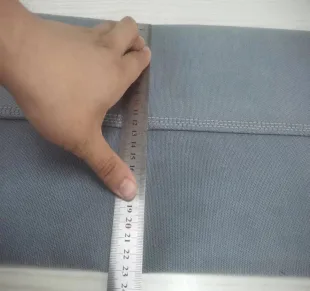
Edge-bound seam construction wraps the bag seam to improve sealing and prevent the pinhole leakage that’s particularly problematic in ultra-low-emission applications. Pinhole sealing treatment — applying coating or heat-laminated PTFE tape along the seam — closes the needle holes that would otherwise become leak paths.
45° angled cuff seam at the bag mouth seats more tightly against the tube sheet than a straight seam. Straight-seam bag mouths are a common source of dust leakage and often can’t meet current ultra-low-emission requirements; the angled cuff design closes this gap.
Reinforced bottom with edge-bound construction prevents dust from directly scouring the bottom seam, and an added reinforcement layer improves abrasion resistance at the bag bottom — the area most exposed to incoming dust impact in bottom-inlet baghouses.
These details matter more for glass cloth than for polymer felt because glass fiber’s brittleness means that a stress concentration at a poorly constructed seam is more likely to propagate into a failure.
Application Focus: Sinter Plant Dust Collection (Steel Industry)
Sinter plants — where iron ore fines, coke breeze, and flux are agglomerated into sinter for blast furnace feed — present one of the more demanding dust collection environments in the steel industry. The sintering process generates large volumes of flue gas carrying iron-bearing dust, with significant SOx content from the coke combustion and high, fluctuating temperatures.
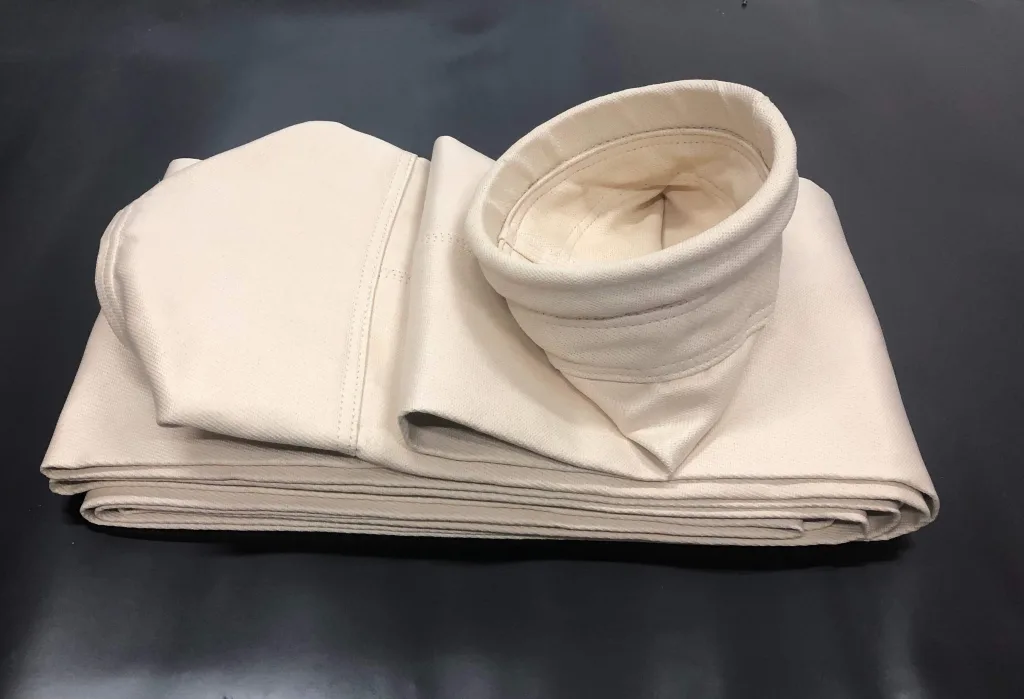
The filter media requirements for sinter plant baghouses:
High temperature tolerance with oxidation resistance — the flue gas is hot and oxidizing, favoring glass fiber over organic polymer felts in the windbox/main exhaust applications.
Acid resistance — significant SOx content means acid dew point risk, favoring acid-resistant PTFE-treated glass cloth (the black acid-resistant variant) over untreated media.
High gas volume handling — sinter plant exhaust volumes are large, favoring woven glass cloth in reverse-air or low-pressure-pulse configurations at low air-to-cloth ratios.
Ultra-low emission capability — modern sinter plants face stringent particulate limits, favoring PTFE-membrane-laminated glass cloth for surface filtration efficiency.
The typical specification for sinter plant main exhaust dust collection is therefore acid-resistant PTFE-membrane woven fiberglass — combining temperature tolerance, oxidation resistance, acid resistance, large-volume handling, and ultra-low emission capability in a single media. For sinter cooler and material handling points with lower temperatures and different dust characteristics, polymer felts (PPS) or even polyester may be appropriate depending on the specific conditions. For broader steel industry context, see our articles on steel plant production filter bags and iron and steel plant filter bag case studies.
Verified Project Data: Woven Fiberglass in High-Temperature Applications
Documented project performance illustrates how woven fiberglass (membrane and acid-resistant variants) performs across high-temperature applications:
Cement kiln tail, 5,000 T/D, Sichuan. PTFE-membrane woven fiberglass bags (Φ160×6000mm, 5,632 bags), 960,000 m³/h gas volume, air-to-cloth ratio below 0.85 m/min, gas temperature 100–150°C, SOx below 200 mg/m³. Verified dust emissions: 3–5 mg/m³. In operation since March 2020.
Coal-fired boiler (chemical plant), 2×150 T/H, Yunnan. Acid-resistant PTFE-membrane woven fiberglass (Φ130×7500mm, 4,200 bags total), 330,000 m³/h, air-to-cloth ratio below 0.86 m/min, gas temperature 120–165°C, SOx below 400 mg/m³ — high enough to require the acid-resistant variant. Verified dust emissions: below 10 mg/m³. In operation since May 2019.
Mine-heat furnace (steel), 12,500 KVA, SH Steel. PTFE-membrane woven fiberglass (Φ130×6000mm, 2,160 bags), 325,000 m³/h, air-to-cloth ratio below 1.05 m/min, gas temperature 100–200°C. Verified dust emissions: below 10 mg/m³. In operation since September 2019.
Carbide slag air separation, Anhui HS. PTFE-membrane woven fiberglass (Φ160×6000mm, 4,600 bags), 640,000 m³/h, gas temperature 120–200°C, with extremely high inlet dust concentration (below 1,000 g/m³). Verified emissions: below 10 mg/m³. In operation since October 2019.
These cases share a pattern: large gas volumes, low air-to-cloth ratios, high or fluctuating temperatures, and ultra-low emission targets — exactly the envelope where PTFE-membrane woven fiberglass is the optimal choice over polymer needle felts.
Quick Selection Reference
| Factor | Woven Fiberglass | Glass Needle Felt | PPS Felt | P84 Felt |
|---|---|---|---|---|
| Construction | Interlaced yarn | Needled fiber mat | Needled fiber mat | Needled fiber mat |
| Continuous temp | 260°C | 260°C | 160°C | 240°C |
| Oxidation resistance | Excellent | Excellent | Moderate | Moderate |
| Mechanical flexibility | Low (brittle) | Low–moderate | High | High |
| Cleaning system | Reverse air / low-pulse | Pulse / reverse air | Pulse-jet | Pulse-jet |
| Air-to-cloth ratio | Low (<1.0) | Low–moderate | Moderate–high | Moderate–high |
| Best for | Large-volume, high-temp, cement/sinter | High-temp pulse-jet | Coal power, high-sulfur | High-temp pulse-jet, fine dust |
| With PTFE membrane | 99.99%+, sub-5 mg/Nm³ | 99.99%+ | 99.99%+ | 99.99%+ |
The decision logic: start with temperature (eliminates options out of range), then oxidation/acid chemistry (favors glass in oxidizing/high-SOx environments), then cleaning system (woven glass for reverse-air/low-pulse large-volume systems; felt for pulse-jet), then emission target (PTFE membrane for sub-10 mg/Nm³).
For help matching media to your specific application, see our overview of fiberglass filter bag properties and applications, or contact our engineering team for a working condition analysis.
Frequently Asked Questions
What is the difference between woven and non-woven filter media?
Woven filter media is made by interlacing warp and weft yarns on a loom, creating an ordered fabric structure that filters primarily through the dust cake on its surface. Non-woven needle felt is made by mechanically entangling loose fibers into a dense mat through needle-punching, creating a structure that filters through its depth as well as its surface. Woven media is mechanically strong and suited to large-volume, low-velocity, gentle-cleaning applications; non-woven felt has higher dust-holding capacity and suits higher-velocity pulse-jet cleaning. The two are not interchangeable — the right choice depends on temperature, cleaning system, dust load, and emission target.
Is woven fiberglass or PPS felt better for high-temperature dust collection?
It depends on the specific conditions. Woven fiberglass handles higher continuous temperatures (260°C vs. 160°C for PPS), resists oxidation, and excels in large-volume reverse-air or low-pressure-pulse systems — making it the standard for cement kilns and sinter plants. PPS felt is more flexible, more durable under aggressive pulse-jet cleaning, and well-suited to coal-fired boiler and high-sulfur applications within its temperature range. For applications above 200°C continuous, glass fiber (or P84) is the realistic choice; for pulse-jet systems within PPS’s temperature range, PPS felt often gives better service life.
What is acid-resistant fiberglass filter cloth and when is it needed?
Acid-resistant fiberglass is woven glass cloth treated with an acid-resistant PTFE impregnation, giving it a distinctive black appearance after treatment. It retains over 80% of its tensile strength after acid exposure, compared to untreated glass cloth which degrades significantly. It’s needed in applications with high SOx content and acid dew point risk — sinter plants, coal-fired boilers, and some chemical processing flue gas — where untreated glass fiber would be chemically attacked and fail prematurely.
Why is PTFE membrane lamination used on woven fiberglass?
Plain woven fiberglass relies on its dust cake for fine filtration and shows elevated emissions before the cake forms. Laminating an expanded PTFE microporous membrane onto the woven glass surface converts it to true surface filtration — particles are captured at the membrane from the first moment of operation, achieving 99.99%+ efficiency and enabling sub-5 mg/Nm³ emissions. The membrane also releases dust cleanly, lowering pressure drop and cleaning energy. This combination of glass fiber’s temperature tolerance with membrane surface filtration is the standard for modern ultra-low-emission cement and steel installations.
What filter media is best for sinter plant dust collection?
For sinter plant main exhaust dust collection, acid-resistant PTFE-membrane woven fiberglass is typically the optimal choice. It combines the high temperature tolerance and oxidation resistance needed for hot, oxidizing sinter flue gas; the acid resistance needed for the significant SOx content; the large-volume handling capability of woven cloth in reverse-air or low-pressure-pulse systems; and the ultra-low emission capability of PTFE membrane surface filtration. Lower-temperature points such as sinter coolers and material handling may use polymer felts (PPS) or polyester depending on conditions.
Can I use the same filter bags for both reverse-air and pulse-jet baghouses?
Generally no. Reverse-air systems use gentler cleaning and lower air-to-cloth ratios, favoring woven cloth with lighter handling requirements. Pulse-jet systems impose high mechanical shock and operate at higher face velocities, favoring needle felt that tolerates the flex fatigue. Using woven glass cloth in an aggressive pulse-jet system risks fiber breakage and premature failure; using lightweight reverse-air media in a high-velocity pulse-jet system causes accelerated wear. The bag specification — fabric type, weight, and construction — must match the cleaning mechanism.
Author

Jessica Ma – Senior Filtration Engineer, Omela Filtration
Jessica Ma is a senior filtration engineer at Omela Filtration, specializing in dust and liquid filtration. With over 15 years of experience, she focuses on optimizing baghouse performance, enhancing filtration efficiency, and developing high-performance solutions for industrial dust collectors and precision liquid filtration applications.