
Key Takeaways
- Pleated membrane filter cartridges are used for high-precision liquid filtration, especially when the process needs stable final filtration, fine particle removal, microbial control, or high-purity output.
- PES, PTFE, Nylon, and PVDF membranes are not interchangeable. Each material has different wettability, chemical compatibility, flow behavior, adsorption tendency, and application range.
- Pleated membrane filter cartridges are typically selected by micron rating, membrane material, liquid chemistry, flow rate, pressure drop, temperature, seal material, and final product quality target.
- For broader cartridge options, filter cartridges should be reviewed together with membrane cartridges when comparing prefiltration, final filtration, depth filtration, and high-purity liquid filtration needs.
- When the upstream liquid contains heavy solids, gels, fibers, or high turbidity, liquid filter bags may be used before membrane cartridges to reduce loading and extend service life.
- The best cartridge is not always the finest one. It is the cartridge that can meet the required retention target while maintaining stable flow, low extractables, chemical compatibility, and predictable changeout intervals.
What Are Pleated Membrane Filter Cartridges?
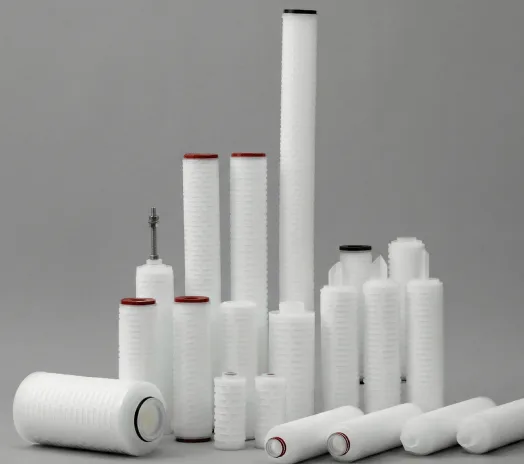
Pleated membrane filter cartridges are precision liquid filtration elements made by folding microporous membrane media into a cartridge structure. The pleated design increases available filtration area inside a compact element, while the membrane provides a controlled pore structure for fine particle retention.
Unlike depth filters, which capture particles throughout a thicker media structure, membrane cartridges mainly work through surface filtration. Particles larger than the membrane pore size are retained on or near the membrane surface, while clean liquid passes through the cartridge.
Pleated membrane cartridges are usually used when the process requires repeatable retention, high purity, low contamination risk, and stable final product quality.
They are common in pharmaceuticals, food and beverage, bottled water, electronics, fine chemicals, RO/UPW systems, solvents, process water, and other applications where ordinary coarse filtration is not enough.
Why Final Filtration Needs a Membrane Cartridge
Final filtration is the last critical particle-control step before the liquid enters filling, packaging, storage, membrane systems, sensitive equipment, or a high-purity process.
At this stage, the filter is not only removing visible particles. It may also be controlling haze, colloids, bacteria, spoilage organisms, fine gels, submicron particles, or trace contamination that can affect the final product.
A pleated membrane cartridge is often selected for final filtration because it offers:
- Controlled pore size
- High surface area
- Stable fine-particle retention
- Low fiber shedding
- Good flow capacity in a compact cartridge
- Compatibility with sanitary or high-purity systems
- Suitability for integrity testing in critical applications
However, final filtration should not receive all contaminants from the process. If the liquid contains heavy solids, gels, crystals, fibers, or high turbidity, the membrane cartridge can plug quickly. In that case, upstream prefiltration may be needed.
A final membrane cartridge should protect product quality, not carry the full solids load of the process.
PES, PTFE, Nylon, and PVDF: How the Membranes Differ
Membrane chemistry determines how the cartridge behaves in real production. PES, PTFE, Nylon, and PVDF may look similar from the outside, but they are used for different liquids and process conditions.
| Membrane Material | General Strength | Common Use Direction | Watch Point |
|---|---|---|---|
| PES | High flow, hydrophilic, low protein binding | Aqueous liquids, buffers, beverages, pharmaceutical process water, final filtration | Not the first choice for aggressive solvents |
| PTFE | Excellent chemical resistance, hydrophobic or treated hydrophilic options | Solvents, aggressive chemicals, air/gas venting, tank vents, corrosive liquids | Hydrophobic PTFE may need wetting for aqueous liquids |
| Nylon | Good mechanical strength and solvent compatibility | Solvents, chemicals, water-based liquids, some food and beverage processes | May adsorb certain compounds; compatibility should be checked |
| PVDF | Good chemical resistance and low extractables | Fine chemicals, electronics, UPW, some food and pharmaceutical uses | Compatibility should be verified for strong oxidizers or special solvents |
The membrane material should be selected by the liquid chemistry first, then by micron rating and flow requirement.
A 0.2 μm PES cartridge and a 0.2 μm PTFE cartridge may have the same nominal pore size, but they do not behave the same in water, solvents, acids, gas venting, or high-purity chemical service.
PES Membrane Cartridges: A Common Choice for Aqueous Final Filtration
PES membrane cartridges are widely used in aqueous liquid filtration because PES is naturally hydrophilic. This means water-based liquids can pass through the membrane more easily without special wetting steps.
PES is often considered when the process needs high flow, low protein binding, low extractables, and reliable fine-particle retention. It is commonly used in pharmaceutical process water, buffers, beverages, bottled water, cosmetics, and high-purity water systems.
In food and beverage applications, PES may be used where final clarity, microbial control, taste neutrality, and stable flow are important. In pharmaceutical and biotech applications, PES is often selected where adsorption of valuable ingredients must be minimized.
PES is usually a strong starting point for aqueous final filtration where flow rate and low adsorption are important.
PTFE Membrane Cartridges: Better for Aggressive Chemicals and Gas Venting
PTFE has excellent chemical resistance and is often selected for aggressive solvents, acids, alkalis, oxidizing chemicals, vent filtration, and air/gas applications.
PTFE membranes are naturally hydrophobic. This makes them useful for gas venting and tank vent protection because they can resist water wetting while allowing air or gas to pass. For liquid filtration, PTFE may be hydrophilic-treated or pre-wetted depending on the application.
PTFE is often used when other membranes may swell, degrade, or leach under aggressive chemical conditions.
PTFE is often the safer membrane choice when chemical compatibility is the main selection risk.
However, PTFE can be more expensive than other membrane options, so it should be selected when its chemical resistance or hydrophobic behavior is truly needed.
Nylon Membrane Cartridges: Useful for Solvents and General Process Liquids
Nylon membrane cartridges offer good strength, cleanliness, and compatibility with many water-based and solvent-based liquids. They are often used for chemicals, solvents, electronics liquids, food and beverage streams, and general process filtration.
Nylon is naturally hydrophilic, so it can work well with aqueous liquids. It also has useful solvent compatibility in many applications.
The main watch point is adsorption. Nylon may bind certain compounds more than PES or PTFE, so it should be reviewed carefully when the liquid contains sensitive active ingredients, proteins, dyes, additives, or analytes.
Nylon can be a practical membrane for solvent and process filtration, but adsorption and chemical compatibility should be checked before final use.
Micron Rating: 0.1 μm, 0.2 μm, 0.45 μm, or 1.0 μm?
Micron rating tells you the approximate pore size or retention rating of the membrane. In final filtration, common ratings may include 0.1 μm, 0.2 μm, 0.45 μm, and 1.0 μm, depending on the product and quality target.
A finer micron rating can improve retention, but it can also increase pressure drop and reduce service life if the upstream liquid is not clean enough.
| Micron Rating | Typical Use Direction | Selection Logic |
|---|---|---|
| 0.1 μm | Very fine particle or high-purity polishing | Use when very tight retention is required and upstream filtration is strong |
| 0.2 μm | Critical final filtration and microbial control applications | Common in high-purity and validated processes |
| 0.45 μm | Clarification, fine particle reduction, beverage polishing | Often used where clarity and flow balance matter |
| 1.0 μm and above | Pre-final filtration or particle protection | Useful when the final membrane needs upstream protection |
The finest membrane is not always the best choice. If a 0.2 μm cartridge receives high turbidity, gels, or colloids, it may plug quickly. A staged system may perform better: coarse filter first, prefilter second, membrane cartridge last.
Chemical Compatibility: More Than the Membrane Itself
Chemical compatibility is one of the most important selection factors for pleated membrane cartridges. But compatibility is not only about the membrane.
A complete cartridge includes membrane, support layers, core, cage, end caps, adapters, O-rings, and sometimes bonding or thermal welding areas. If any component is not compatible with the liquid, the cartridge may swell, crack, leak, shed extractables, or fail prematurely.
Before selecting a cartridge, review:
- Liquid composition
- Solvent or acid/alkali concentration
- pH range
- Operating temperature
- Cleaning or CIP chemicals
- Sanitization method
- O-ring material
- Housing connection type
- Contact time and batch frequency
A chemically compatible membrane can still fail if the seal, end cap, or support material is not compatible with the process liquid.
This is especially important in fine chemicals, solvents, electronics, pharmaceutical liquids, and aggressive cleaning cycles.
Flow Rate and Pressure Drop
Pleated membrane cartridges are designed to provide more surface area than flat sheet media, which helps improve flow capacity and reduce pressure drop. But flow performance still depends on fluid viscosity, pore size, membrane material, cartridge length, pleat structure, solids loading, and upstream filtration quality.
A clean water flow test does not always represent real production. Syrup, protein solutions, solvents, oils, chemical intermediates, and colloid-rich liquids can behave very differently.
If pressure drop rises quickly, possible causes include:
- Micron rating too fine
- Poor upstream prefiltration
- High colloid or gel load
- Excessive flow per cartridge
- Viscous liquid
- Incompatible membrane material
- Cartridge near end of service life
Pressure drop should be monitored as a process signal, not only as a replacement alarm.
A stable pressure-drop trend usually means the membrane, flow rate, and upstream protection are well matched.
Final Filtration vs Prefiltration
Final filtration and prefiltration should not be confused.
Prefiltration removes larger particles, gels, fibers, rust, carbon, resin fragments, and general process solids before the final membrane stage. Final filtration controls smaller particles, fine haze, microorganisms, or high-purity requirements.
For many systems, the best design is staged:
- Coarse filtration removes large solids.
- Depth or pleated prefilters reduce particle load.
- Pleated membrane cartridges provide final filtration.
- The final product or downstream process receives more stable liquid quality.
A membrane cartridge should not be forced to do the work of every upstream filter.
Good prefiltration protects the final membrane and can reduce total replacement cost.
Omela Filtration Application Lessons
Case 1: Beverage Final Filtration with Fast Cartridge Blocking
A beverage line needed clearer product before filling, but the membrane cartridges blocked faster than expected.
The review showed that the final membrane was receiving too much upstream haze and fine pulp. Instead of choosing a finer membrane, the better direction was to improve prefiltration before the final cartridge stage.
Lesson: In beverage filtration, membrane life often depends on upstream solids control, not only membrane pore size.
Case 2: Fine Chemical Filtration with Solvent Compatibility Problems
A fine chemical process used a membrane cartridge that looked suitable by micron rating, but the cartridge life was unstable.
The review focused on solvent compatibility, O-ring material, temperature, and cleaning chemicals. The issue was not only the membrane rating; the full cartridge construction needed to match the chemistry.
Lesson: For chemicals and solvents, membrane selection must include seals, end caps, and operating temperature.
Case 3: High-Purity Water System with Pressure Drop Rise
A high-purity water loop showed gradual pressure-drop increase at the final membrane stage.
The review suggested that the final cartridge was catching particles from upstream equipment and periodic maintenance activities. More stable upstream prefiltration and a defined replacement limit helped reduce unplanned changeouts.
Lesson: Final membrane cartridges protect quality, but they should not become the first dirt-loading stage.
Case 4: Air/Gas Vent Filtration with Wetting Risk
A tank vent application required particle and microbial control while allowing gas flow.
The review focused on hydrophobic membrane behavior, moisture exposure, airflow, and housing orientation. A membrane suitable for liquid filtration was not automatically suitable for vent filtration.
Lesson: Gas venting and liquid final filtration may need different membrane behavior, even when the micron rating looks similar.
Common Selection Mistakes
| Mistake | Why It Causes Problems | Better Direction |
|---|---|---|
| Selecting only by micron rating | The membrane may be chemically unsuitable or plug quickly | Review material, flow, chemistry, and solids load together |
| Using final membrane without prefiltration | Rapid pressure drop and short service life | Add or improve upstream filtration |
| Ignoring O-ring compatibility | Swelling, leakage, or contamination risk | Match seals to liquid and cleaning chemicals |
| Treating PES, PTFE, and Nylon as interchangeable | Different wettability and adsorption behavior | Select by fluid type and application |
| Replacing cartridges only by time | Changes in feed quality may shorten or extend life | Track pressure drop and filtrate quality |
| Using hydrophobic PTFE for aqueous liquids without review | Poor wetting and low flow may occur | Confirm hydrophilic treatment or wetting method |
The correction is not always “use a finer cartridge.” In many cases, better staging, better compatibility review, or a different membrane material gives a more stable result.
Information to Collect Before Selection
Before choosing pleated membrane filter cartridges, collect:
- Liquid type: water, beverage, solvent, chemical, pharmaceutical liquid, electronics liquid, or process fluid
- Filtration purpose: clarification, bioburden control, sterile filtration, final polishing, venting, or equipment protection
- Required micron rating or current cartridge rating
- Flow rate, batch size, and operating pressure
- Allowable pressure drop and replacement pressure limit
- Operating temperature and viscosity
- pH, solvents, cleaning chemicals, and sanitization method
- Current prefiltration steps
- Cartridge size, length, end cap, adapter, and housing type
- O-ring material requirement
- Current problem: short life, high pressure drop, compatibility issue, bypass, product loss, or unstable quality
- Photos of current cartridge, housing, seal, and used filter appearance
This information helps determine whether PES, PTFE, Nylon, PVDF, or another membrane type is more suitable.
Final Engineering View
Pleated membrane filter cartridges are critical in final filtration because they help control small particles, colloids, microorganisms, haze, and high-purity liquid quality.
But the best cartridge cannot be selected by micron rating alone.
A reliable selection should balance:
membrane material, chemical compatibility, micron rating, flow rate, pressure drop, prefiltration, seal material, integrity requirement, and final product quality target.
PES is often useful for aqueous high-flow applications. PTFE is stronger for aggressive chemicals and gas venting. Nylon is practical for many solvent and process liquid applications. PVDF may be considered where chemical resistance and low extractables are important.
The best final filtration system is not the one with the tightest membrane. It is the one that delivers stable outlet quality, predictable cartridge life, safe compatibility, and manageable replacement cost.
FAQ
What are pleated membrane filter cartridges used for?
Pleated membrane filter cartridges are used for final or pre-final filtration where fine particles, colloids, microorganisms, haze, or high-purity liquid quality must be controlled.
What is the difference between PES, PTFE, and Nylon membrane cartridges?
PES is commonly used for aqueous liquids and low adsorption needs. PTFE is selected for aggressive chemicals, solvents, and gas venting. Nylon is useful for many solvents and process liquids but should be checked for adsorption and compatibility.
What micron rating is common for final filtration?
Common membrane ratings include 0.1 μm, 0.2 μm, 0.45 μm, and 1.0 μm. The correct rating depends on the product quality target, liquid cleanliness, upstream prefiltration, and required retention level.
Is a finer membrane cartridge always better?
No. A finer membrane may increase pressure drop and shorten service life if the upstream liquid contains high solids, gels, colloids, or haze. A staged filtration system is often more stable.
Why do membrane filter cartridges plug quickly?
Fast plugging may be caused by poor prefiltration, high turbidity, colloids, gels, viscosity, too fine a micron rating, high flow per cartridge, or an unsuitable membrane material.
How should chemical compatibility be checked?
Check the membrane, support layers, core, cage, end caps, O-rings, adhesives or welds, operating temperature, pH, solvents, cleaning chemicals, and contact time.
What information is needed to quote pleated membrane filter cartridges?
Provide liquid type, filtration purpose, micron rating, flow rate, pressure drop limit, temperature, viscosity, chemical composition, current prefilters, cartridge size, end cap, O-ring material, housing type, and current filtration problem.
Author

Jessica Ma – Senior Filtration Engineer, Omela Filtration
Jessica Ma is a senior filtration engineer at Omela Filtration, specializing in dust and liquid filtration. With over 15 years of experience, she focuses on optimizing baghouse performance, enhancing filtration efficiency, and developing high-performance solutions for industrial dust collectors and precision liquid filtration applications.