
Key Takeaways
- Both melt-blown filter cartridges and string wound filter cartridges are depth filters, but they create their internal filtration structure differently.
- Melt-blown cartridges typically use a graded-density polypropylene fiber matrix, allowing larger particles to load in more open outer layers while finer particles are retained deeper inside the cartridge.
- String wound cartridges use yarn wound around a supporting core. Their performance depends on yarn material, winding density, winding pattern, and core construction.
- Dirt-holding capacity cannot be judged by cartridge type alone. Particle-size distribution, solids concentration, micron rating, flow rate, viscosity, cartridge length, and replacement differential pressure all influence service life.
- Industrial filter cartridge selection should begin with the liquid and contaminant load—not simply the cartridge name or micron number.
Start with the Liquid and Solids Load, Not the Cartridge Name
Melt-blown and string wound cartridges can look very similar once installed in a filter housing.
Both are cylindrical depth filters. Both are widely used for sediment removal, process water, RO pretreatment, cooling water, chemicals, and general industrial liquid filtration.
But their internal structures are different.
That difference changes how particles enter the media, where contaminants are stored, how pressure drop develops, and how long the cartridge remains useful before replacement.
The practical question is not “Which cartridge is better?” It is “Which depth-filter structure matches this liquid, this contaminant, and this operating condition?”
A 5 μm melt-blown cartridge and a 5 μm string wound cartridge should not automatically be expected to produce the same filtration behavior.
Micron rating is only one part of the selection.
How Melt-Blown Depth Filtration Works
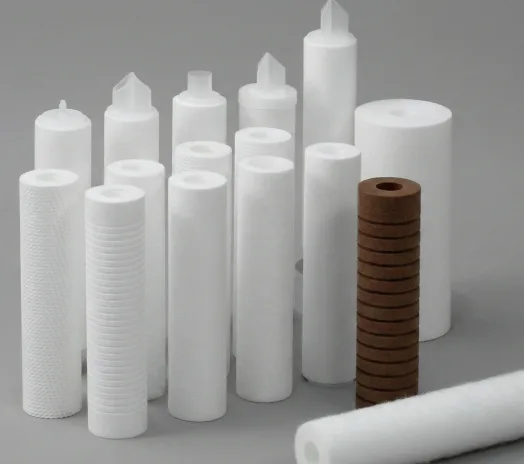
Melt-blown cartridges are commonly produced from polypropylene.
Molten polymer is formed into fine fibers and deposited into a cylindrical depth structure. By controlling fiber size and density during production, the cartridge can be built with larger pore spaces toward the outside and progressively tighter layers toward the center.
This creates graded-density depth filtration.
Larger suspended solids are captured in the more open outer zones, while smaller particles can penetrate farther into the media before being retained.
The objective is to use more of the available filter depth instead of loading only the external surface.
Typical characteristics include:
- All-polypropylene construction
- Thermally bonded fibers
- No wound yarn
- Progressive pore structure
- Fine sediment retention
- Good compatibility with many water and process-liquid duties
- Disposable depth filtration
- Common use before RO and UF systems
The strength of melt-blown filtration is progressive particle capture through the depth of the fiber matrix.
This makes it particularly useful for fine sediment, silt, rust, suspended particulate, and colloidal-type contamination where economical depth filtration is required.
How String Wound Depth Filtration Works
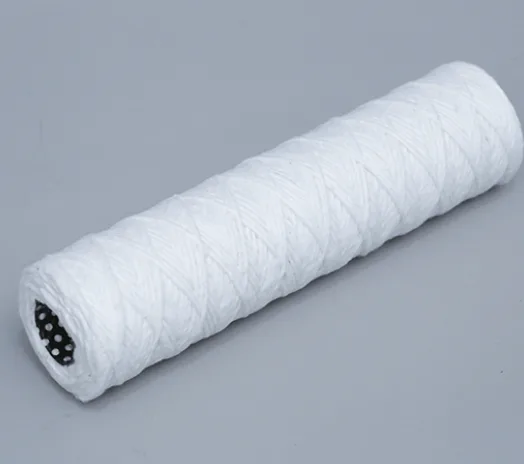
A string wound cartridge is produced by winding filtration yarn around a supporting core.
The winding creates intersecting flow channels through the cartridge body. The outer structure can remain relatively open while the inner layers become progressively tighter.
As liquid moves inward, particles are retained at different depths.
The construction also provides another advantage: material flexibility.
Depending on the application, the winding media may be polypropylene, cotton, polyester, nylon, fiberglass, or another suitable fiber. The core may also be selected according to temperature, pressure, and chemical conditions.
String wound performance depends on both the winding media and the supporting core.
This makes the design useful for water filtration as well as more demanding industrial liquids where solids loading, viscosity, temperature, or chemical compatibility need additional consideration.
Melt-Blown vs String Wound: Quick Comparison
| Selection Factor | Melt-Blown | String Wound |
|---|---|---|
| Filter structure | Thermally formed fiber matrix | Yarn wound around a core |
| Filtration type | Depth filtration | Depth filtration |
| Density control | Graded fiber density | Winding density and pattern |
| Common media | Mainly polypropylene | PP, cotton, polyester, nylon, fiberglass |
| Supporting core | Coreless or supported designs | Normally uses a core |
| Fine sediment | Strong application fit | Depends on winding design |
| Heavy suspended solids | Good with correct sizing | Often a strong application fit |
| High-viscosity liquids | Requires hydraulic review | Often considered with suitable yarn/core |
| Chemical flexibility | Mainly governed by PP | Can vary yarn and core materials |
| RO pretreatment | Widely used | Widely used |
| Service life | Depends on dirt load and ΔP | Depends on dirt load and ΔP |
The table provides a selection direction, not an absolute ranking.
Individual cartridge designs may perform very differently even when they share the same nominal micron rating.
Dirt-Holding Capacity: Avoid a Simple Winner
Dirt-holding capacity is one of the most common reasons these two cartridge types are compared.
It is also one of the easiest areas to oversimplify.
String wound cartridges can provide substantial void space inside the wound structure, which can make them effective for high suspended solids and mixed particle sizes.
Melt-blown cartridges can distribute contamination through multiple graded-density layers, allowing the media depth to be used progressively rather than loading one surface.
So which holds more dirt?
There is no universal answer without defining the contaminant and operating conditions.
Dirt capacity is affected by:
- Particle-size distribution
- Solids concentration
- Particle shape
- Media construction
- Micron rating
- Cartridge diameter and length
- Flow velocity
- Liquid viscosity
- Terminal differential pressure
A system carrying fine silt does not load a cartridge in the same way as water containing rust flakes, sand, fibers, scale, or mixed debris.
For selection, ask:
What kind of dirt must the cartridge hold, and how does that dirt behave inside a depth filter?
Micron Rating Is Not the Whole Specification
A typical comparison may look like this:
Melt-blown cartridge: 5 μm
String wound cartridge: 5 μm
That does not necessarily mean the cartridges are interchangeable.
Many industrial depth cartridges are nominally rated. Their actual particle-removal efficiency can differ according to the media structure and manufacturing method.
Two cartridges with the same nominal rating may have different:
- Retention efficiency
- Pore-size distribution
- Dirt-loading pattern
- Clean pressure drop
- Final pressure drop
- Contaminant unloading behavior
- Service life
Micron rating identifies the approximate particle-size target; it does not fully describe filtration performance.
If downstream protection is critical, confirm the retention requirement rather than selecting only by the number printed on the cartridge.
Pressure Drop Tells You How the Cartridge Is Loading
Pressure drop is one of the most useful operating indicators in liquid cartridge filtration.
A clean cartridge starts with relatively low resistance.
As particles accumulate through the depth structure, differential pressure increases.
Eventually, the system may experience reduced flow, increased pump load, or reach the plant’s defined cartridge replacement pressure.
Both melt-blown and string wound cartridges can provide stable differential-pressure behavior when properly matched to the liquid.
Both can also plug rapidly when:
- Micron rating is too fine
- Solids loading is underestimated
- Flow per cartridge is too high
- Upstream treatment is unstable
- Liquid viscosity is higher than expected
Selecting a finer cartridge than the process actually requires can increase pressure drop without creating meaningful process value.
Pressure-drop behavior should therefore be evaluated together with removal accuracy and service life.
Flow Rate and Liquid Viscosity
Water data should not automatically be applied to every industrial liquid.
Oil, resin, coating, ink, syrup, adhesive, and many chemical fluids have higher viscosity than water.
Higher viscosity increases resistance through the filter structure.
Pressure drop may rise further when:
- Temperature decreases
- Micron rating becomes finer
- Flow rate increases
- Cartridge length is too short
- Contaminant loading increases
String wound cartridges can be useful in demanding process-fluid applications because the yarn and supporting core can be adapted to the operating condition.
Melt-blown polypropylene can also be used with compatible process liquids, but hydraulic performance should be evaluated at the real operating viscosity and temperature.
Material and Chemical Compatibility
Polypropylene melt-blown cartridges provide useful compatibility across many water-treatment and industrial-liquid applications.
However, polypropylene is not suitable for every fluid or temperature.
String wound cartridges provide more options because both the yarn and core material can be changed.
Before selection, check:
- Liquid chemistry
- Chemical concentration
- pH
- Operating temperature
- Exposure time
- Winding-media compatibility
- Core material
- Seal or gasket material
Chemical compatibility applies to the entire cartridge construction—not only the filtration fiber.
This becomes especially important in chemical processing, oils, coatings, plating solutions, and elevated-temperature service.
Which Is Better for RO Pretreatment?
Both cartridge types are commonly used before reverse-osmosis membranes.
The decision should begin with feed-water quality.
Melt-blown cartridges are often a practical choice when:
- Fine sediment and silt are important
- Consistent polypropylene construction is preferred
- The cartridge acts as a polishing prefilter
- Fine suspended solids must be reduced before membranes
- Economical disposable depth filtration is required
String wound cartridges are often considered when:
- Suspended solids are relatively high
- Particle sizes vary widely
- Rust, sand, scale, or mixed debris is present
- A supporting core is required
- High dirt loading is the main filtration challenge
RO pretreatment should be selected according to what reaches the cartridge—not simply because an RO membrane is installed downstream.
If upstream clarification or media filtration becomes unstable, either cartridge type can experience unexpectedly short service life.
Field Application Lessons
High-Solids Seawater Pretreatment
In a published seawater desalination application, high suspended-solids loading caused frequent cartridge replacement and unstable differential pressure.
The filtration strategy used a longer string wound depth cartridge to provide more available dirt-storage volume and improve solids handling.
The reported result was longer service intervals and more stable operating pressure.
Lesson: For heavily loaded water, available depth volume and solids-loading behavior may matter more than the micron number alone.
Seasonal Turbidity Before SWRO
Another seawater RO application experienced sharply reduced cartridge life during periods of elevated seasonal turbidity.
Investigation showed that more contamination was reaching the security filtration stage because upstream treatment conditions had changed.
The solution required both improved upstream control and appropriate depth filtration.
Lesson: A cartridge cannot compensate indefinitely for poor or unstable upstream pretreatment.
Industrial Cooling Water with Mixed Solids
Cooling-water systems may carry corrosion products, rust, scale, and suspended solids covering a broad particle-size range.
Where dirt loading is substantial, a properly designed string wound cartridge can provide a useful depth-loading structure while the core supports the cartridge under operating pressure.
Lesson: In high-volume industrial water, service interval and maintenance frequency may be more important than cartridge purchase price.
Fine Sediment Before Sensitive Equipment
Where the feed is dominated by fine suspended particles rather than large debris, graded-density melt-blown media can distribute contamination progressively through the cartridge depth.
This makes it useful before membranes, nozzles, finer polishing filters, and other equipment sensitive to particulate fouling.
Lesson: Melt-blown filtration is particularly useful when economical fine-sediment control and downstream protection are the main objectives.
Practical Selection Guide
| Process Condition | Starting Direction |
|---|---|
| Fine silt and suspended sediment | Melt-blown |
| General water prefiltration | Either, after feed review |
| High suspended-solids load | Consider string wound |
| Broad particle-size distribution | Consider string wound |
| RO/UF pretreatment | Either, depending on feed water |
| High-viscosity process liquid | Review string wound and hydraulic conditions |
| Chemical service | Select by complete material compatibility |
| Higher temperature | Review wound media and core options |
| Fine final filtration | Consider pleated or membrane filtration instead |
This table is a starting point rather than a substitute for process data.
Information to Collect Before Selection
Before choosing between melt-blown and string wound cartridges, collect:
- Liquid type
- Required flow rate
- Operating pressure
- Operating temperature
- Viscosity
- Particle-size distribution
- Approximate suspended-solids concentration
- Required micron rating
- Nominal or absolute retention requirement
- Initial and maximum allowable differential pressure
- Cartridge dimensions
- Housing configuration
- Chemical compatibility requirements
- Current cartridge service life
- Downstream equipment requiring protection
If an existing filter plugs too quickly, inspect the used cartridge as well.
A cartridge loaded only at the outside surface indicates a different problem from one that contains contamination through its full depth.
Final Engineering View
Melt-blown and string wound filter cartridges are both proven depth-filtration technologies.
Neither should automatically be described as better in every application.
Melt-blown cartridges provide a controlled fiber matrix and are particularly useful for fine sediment, general water treatment, RO pretreatment, and economical process-liquid clarification.
String wound cartridges use layered yarn around a supporting core and are particularly useful where heavy suspended solids, broad particle sizes, viscosity, temperature, or material flexibility influence selection.
The correct cartridge is the one that matches the liquid, contaminant load, required filtration accuracy, flow rate, operating pressure, chemistry, and replacement target.
Do not choose by micron rating alone.
Compare depth structure, solids load, pressure-drop development, flow rate, viscosity, chemical compatibility, service interval, and total changeout cost.
That engineering approach is usually more useful than simply asking whether melt-blown or string wound is “better.”
FAQ
Are melt-blown and string wound cartridges both depth filters?
Yes. Both capture particles through the thickness of the filtration structure rather than relying only on a flat surface, although their internal constructions are different.
Which cartridge has higher dirt-holding capacity?
There is no universal answer. Dirt capacity depends on construction, particle-size distribution, solids loading, micron rating, flow rate, cartridge dimensions, and terminal differential pressure.
Is melt-blown better for fine sediment?
Graded-density melt-blown cartridges are widely used for progressive fine-sediment filtration. Actual retention efficiency should still be confirmed for the selected product.
When is string wound commonly selected?
String wound cartridges are often considered for high suspended solids, mixed particle sizes, viscous process liquids, or applications where yarn and supporting-core materials need to be selected independently.
Can both cartridge types be used before RO membranes?
Yes. Both are used in RO pretreatment. Feed-water turbidity, suspended solids, particle-size distribution, upstream treatment, and required service life should determine the final selection.
When should a depth cartridge be replaced?
Replacement should normally consider differential pressure, flow reduction, filtrate quality, treated volume, and the process’s validated maintenance limit rather than calendar time alone.
Author

Jessica Ma – Senior Filtration Engineer, Omela Filtration
Jessica Ma is a senior filtration engineer at Omela Filtration, specializing in dust and liquid filtration. With over 15 years of experience, she focuses on optimizing baghouse performance, enhancing filtration efficiency, and developing high-performance solutions for industrial dust collectors and precision liquid filtration applications.