
Key Takeaways
- Industrial cartridge dust collectors are compact dust collection systems that use pleated filter cartridges to capture fine airborne dust, fumes, and dry particles.
- Cartridge dust collectors are commonly used for welding fume, laser and plasma cutting, grinding dust, blasting dust, powder handling, food powders, chemical powders, and general manufacturing dust.
- Filter cartridges should be selected by dust type, particle size, airflow, filtration area, moisture, oil mist, static risk, spark exposure, and required pressure-drop stability.
- For laser or plasma cutting applications, a dedicated laser cutting dust collector should also consider source capture, table extraction, spark control, pulse cleaning, and cartridge life.
- Cartridge collectors are strong for fine dry dust and compact workshop layouts, but they are not the best choice for every dust stream. Sticky, wet, hot, abrasive, or very heavy dust loading may require pre-separation or another dust collection design.
- The best system is not simply the one with the highest airflow. It is the collector that balances air volume, filter area, dust loading, pulse cleaning, pressure drop, safety, and maintenance cost.
What Is an Industrial Cartridge Dust Collector?
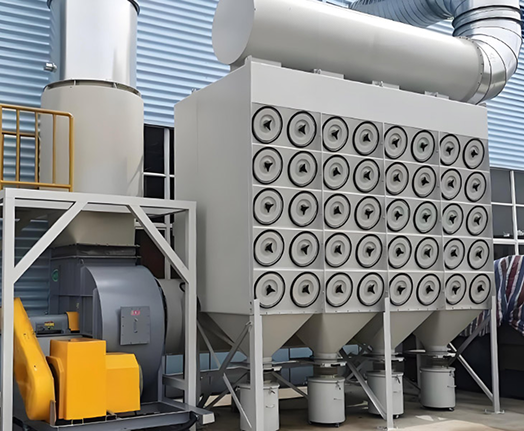
An industrial cartridge dust collector is a dust collection system that removes airborne particles from workshop or process air using pleated filter cartridges.
Dust-laden air enters the collector through an inlet. The air passes through cartridge filters, where dust is captured on the filter surface. Cleaned air then exits through the clean-air side, while collected dust falls into a hopper, drawer, or dust bin during cleaning.
A cartridge dust collector is mainly designed for fine, dry, airborne dust and fume applications where compact structure and large filter area are important.
Compared with a traditional baghouse, a cartridge collector uses shorter pleated cartridges instead of long fabric filter bags. The pleated structure increases filtration area inside a smaller housing. This makes cartridge collectors useful in workshops where floor space or height is limited.
How Cartridge Dust Collectors Work
A cartridge dust collector usually works in five steps.
First, contaminated air is captured from the source through a hood, enclosure, downdraft table, machine connection, or duct system.
Second, the dust-laden air enters the collector body. A good inlet design helps distribute air and reduce direct dust impact on the filter cartridges.
Third, particles are captured on the outside surface of the cartridges. Fine dust forms a dust cake on the filter media.
Fourth, compressed-air pulse cleaning sends short bursts of air into the cartridges. This pulse expands or shocks the media, releasing part of the dust cake.
Fifth, dislodged dust falls into the hopper or dust bin for disposal.
The filter cartridge, pulse-cleaning system, airflow path, and dust discharge must work together. If one part is poorly matched, pressure drop rises and filter life becomes unstable.
Main Components of a Cartridge Dust Collector
| Component | Main Function | Why It Matters |
|---|---|---|
| Dirty-air inlet | Brings dust-laden air into the collector | Poor inlet design can cause uneven cartridge loading |
| Filter cartridges | Capture fine particles and fumes | Media area and cleanability affect pressure drop and service life |
| Pulse-cleaning system | Removes dust cake from cartridge surfaces | Weak or excessive pulsing can shorten filter life |
| Compressed-air header | Supplies pulse-cleaning air | Wet or oily air can reduce cleaning performance |
| Clean-air chamber | Collects filtered air before discharge | Poor sealing can cause dust bypass |
| Hopper or dust drawer | Collects removed dust | Poor discharge can cause re-entrainment |
| Differential pressure gauge | Shows filter resistance | Helps judge loading, cleaning, and replacement timing |
| Fan and controls | Move air through the system | Must overcome duct, filter, and system resistance |
Why Filter Cartridges Are Used
Filter cartridges are popular because their pleated design provides large media area in a compact shape. This allows the collector to handle fine dust without needing a very tall baghouse-style structure.
Cartridge media may include cellulose blends, spunbond polyester, nanofiber-coated media, PTFE membrane media, anti-static media, flame-retardant media, or oil- and moisture-resistant options depending on the dust stream.
The right filter cartridge should be selected by dust behavior, not only by cartridge size.
Fine welding fume, laser cutting smoke, dry powder, abrasive dust, oily dust, and moisture-containing dust do not load the cartridge in the same way. A filter that works well for clean dry powder may fail early in oily or spark-heavy applications.
Pulse Cleaning and Dust Cake Release
Pulse cleaning is one of the most important features of a cartridge dust collector. During operation, dust builds up on the cartridge surface and increases resistance. The pulse system uses compressed air to remove part of the dust cake and keep airflow stable.
A good pulse-cleaning system should clean the cartridges enough to control pressure drop without damaging the media or wasting compressed air.
Common pulse-cleaning problems include:
- Low compressed-air pressure
- Wet or oily compressed air
- Damaged diaphragm valves
- Blocked blow tubes or nozzles
- Poor pulse timing
- Cleaning too often or too rarely
- Dust re-entrainment after cleaning
Pulse cleaning should be controlled by real filter loading, not only by a fixed habit or random setting.
If pressure drop does not fall after pulsing, the problem may be fine dust blinding, sticky dust, poor compressed air, weak valves, or unsuitable filter media.
Pressure Drop: The Main Operating Signal
Pressure drop is the resistance across the filter cartridges. When filters are clean, pressure drop is low. As dust collects on the media, pressure drop rises. Pulse cleaning should bring it back into a stable operating range.
A normal cartridge collector does not run at zero pressure drop. A light dust cake is normal and can even help filtration. The problem is when pressure drop rises too fast, stays high after cleaning, or causes suction loss at the dust source.
Pressure drop is the collector’s health signal. It shows whether airflow, filter media, dust loading, and pulse cleaning are working together.
If the pressure-drop trend is ignored, operators may only notice the problem after smoke escapes, suction becomes weak, filters clog, or production is affected.
Dust Loading: Why Some Filters Fail Early
Dust loading means how much dust enters the collector over time. A cartridge collector can handle fine dust well, but it must have enough filter area for the real dust load.
High dust loading can come from continuous production, high particle concentration, poor source capture, no pre-separation, heavy grinding, blasting, powder transfer, or cutting operations with large fume volume.
When dust loading is too high, the cartridges may clog quickly, pulse cleaning becomes more frequent, pressure drop rises, and filter replacement cost increases.
A collector with enough airflow but too little filter area may work at startup and fail after several days of loading.
For heavy dust applications, a cyclone, drop-out box, spark trap, or other pre-separation stage may be used before the cartridge collector to reduce the load on the filters.
Cartridge Dust Collector vs Baghouse Dust Collector
| Comparison Point | Cartridge Dust Collector | Baghouse Dust Collector |
|---|---|---|
| Filter element | Pleated filter cartridges | Fabric filter bags |
| Structure | Compact, lower height | Larger housing, often taller |
| Best fit | Fine dry dust, welding fume, laser cutting, grinding, powder handling | High dust loading, large air volume, high-temperature or heavy industrial dust |
| Filter area | High area in compact elements | High area through many long bags |
| Maintenance | Cartridge replacement is usually faster | Bag replacement may require more labor |
| Watch point | Sensitive to sticky dust, sparks, moisture, and high loading | Larger footprint and more structural planning |
| Typical concern | Cartridge clogging and pressure drop rise | Bag life, cage condition, emissions, and dust cake control |
Both systems are useful. The correct choice depends on dust type, air volume, temperature, moisture, particle size, emissions target, space, and maintenance ability.
Common Applications
Industrial cartridge dust collectors are often used where fine particles need to be captured close to the source.
Typical applications include:
- Welding fume extraction
- Laser and plasma cutting smoke
- Grinding and polishing dust
- Powder coating overspray
- Blasting and sanding dust
- 3D printing powder handling
- Food powder handling
- Chemical powder mixing or packaging
- Pharmaceutical powder control
- Battery material processing
- General manufacturing dust collection
Cartridge collectors are especially useful when the dust is fine, dry, and suitable for pulse-cleaned surface filtration.
However, some applications need extra review. Wet, oily, sticky, combustible, hot, or spark-heavy dust may require special filter media, pre-separation, spark control, explosion protection, or another collector type.
Common Problems and Practical Corrections
| Problem | Likely Cause | Practical Direction |
|---|---|---|
| Filters clog quickly | High dust loading, sticky dust, fine particle blinding | Increase filter area, improve pre-separation, review media |
| Pressure drop stays high | Pulse cleaning is weak or dust is embedded in media | Check compressed air, valves, pulse settings, and filter condition |
| Dust leaks after cartridge change | Seal or gasket problem | Check cartridge fit, gasket compression, and clean-side dust |
| Suction becomes weak | Filter loading, duct restriction, fan static pressure issue | Review pressure drop, duct layout, and fan performance |
| Burn marks on cartridges | Sparks or hot particles entering collector | Improve spark control before filtration |
| Uneven cartridge loading | Poor inlet design or duct impact | Add inlet protection or improve airflow distribution |
| Maintenance cost is high | Frequent cartridge replacement or compressed-air waste | Optimize pulse cleaning, filter media, and loading rate |
The correction is not always a larger fan or new filters. In many cases, the root cause is filter area, dust behavior, pulse cleaning, inlet airflow, or upstream process conditions.
Filter Media Selection
Filter media selection should start with dust properties. The same collector body can perform very differently depending on the cartridge media.
For general dry dust, economical cellulose or polyester-blend media may be enough. For abrasive or slightly moisture-exposed dust, spunbond polyester may offer better durability. For fine fume, nanofiber or membrane-style media may help keep dust on the surface and improve dust release. For static-sensitive or combustible dust, anti-static media may be considered as part of a complete safety review. For spark-risk applications, flame-retardant media may help, but it should not replace spark control.
Filter media cannot solve every system problem. It must be matched with airflow, filtration velocity, pulse cleaning, and dust loading.
If dust is oily, wet, sticky, or hot, media selection should be reviewed carefully before assuming a standard cartridge will work.
Omela Filtration Application Lessons
Case 1: Welding Fume with High Pressure Drop
A fabrication workshop had stable capture at startup, but pressure drop climbed quickly after several weeks. The cartridges were loading with fine metal fume, and the pulse-cleaning cycle could not fully recover airflow.
The review focused on filter media, airflow per cartridge, pulse valve condition, and compressed-air quality.
Lesson: Fine fume applications need both suitable media and enough effective filter area.
Case 2: Laser Cutting with Burn Marks on Cartridges
A metal cutting line showed localized burn marks on cartridge media. The issue appeared mainly during spark-heavy cutting.
Replacing cartridges reduced the symptom temporarily, but the root issue was hot particles reaching the filter section too directly.
Lesson: Spark control should be reviewed before changing filter specifications.
Case 3: Grinding Dust with Uneven Filter Loading
A grinding process created uneven dust impact on the first row of cartridges. Some cartridges failed earlier than others.
The review suggested that inlet airflow distribution and dust impact were part of the problem. Better inlet protection and airflow distribution helped reduce uneven loading.
Lesson: Cartridge life depends on airflow distribution, not only filter material.
Case 4: Powder Handling with Short Cartridge Life
A powder transfer system had frequent filter changeouts because dust loading was higher than expected. The collector airflow was acceptable, but the filter area was not enough for the actual loading rate.
The review focused on dust concentration, production hours, filter area, hopper discharge, and pulse cleaning.
Lesson: Dust loading and production schedule should be part of collector selection.
Maintenance Checks
Before replacing cartridges again, operators should check:
- Differential pressure before and after pulse cleaning
- Compressed-air pressure and air quality
- Pulse valve and diaphragm condition
- Cartridge seals and gasket compression
- Dust bin or hopper buildup
- Inlet airflow and dust impact pattern
- Moisture, oil, or sticky dust on used filters
- Sparks, burn marks, or media damage
- Duct leakage or dust settlement
- Changes in production material or working hours
Used cartridges often reveal the real problem. Their surface condition, weight, color, burn marks, dust pattern, and pleat loading can show whether the issue is fine dust, sticky dust, moisture, sparks, weak cleaning, or uneven airflow.
Information Needed Before Selection
Before selecting an industrial cartridge dust collector, collect the following information:
- Dust source and application
- Dust type, particle size, and dust concentration
- Air volume requirement or capture point details
- Working hours and production schedule
- Temperature, moisture, oil mist, or sticky dust condition
- Spark risk or combustible dust concern
- Existing duct layout and fan information
- Required emission or indoor air quality target
- Filter cartridge size, media type, and current service life if replacing an existing system
- Differential pressure trend and current maintenance problems
- Photos or videos of the process, dust source, collector, used filters, and dust discharge
This information helps determine collector size, filter area, cartridge media, pulse-cleaning design, safety options, and maintenance strategy.
Final Engineering View
Industrial cartridge dust collectors are useful because they combine compact structure, large filtration area, pulse-cleaning operation, and efficient fine dust capture.
But successful operation depends on more than the collector housing.
A reliable system must match the dust source, airflow, filter area, cartridge media, pulse cleaning, pressure drop, dust discharge, and maintenance plan.
The best cartridge dust collector is not simply the most compact or highest-airflow model. It is the system that keeps dust capture stable, pressure drop predictable, cartridge life reasonable, and maintenance manageable.
For fine dry dust, welding fume, laser cutting smoke, grinding dust, and powder handling, a well-selected cartridge collector can improve workshop air quality, protect equipment, reduce downtime, and control long-term replacement cost.
FAQ
What is an industrial cartridge dust collector?
An industrial cartridge dust collector is a dust collection system that uses pleated filter cartridges to capture airborne dust, fumes, and fine particles from industrial processes.
How does a cartridge dust collector work?
Dust-laden air enters the collector, passes through pleated filter cartridges, and particles are captured on the cartridge surface. Pulse cleaning then releases dust into a hopper or bin.
What are cartridge dust collectors used for?
They are commonly used for welding fume, laser and plasma cutting, grinding, powder coating, blasting, powder handling, food powders, chemical powders, and general manufacturing dust.
What causes high pressure drop in cartridge dust collectors?
High pressure drop may be caused by filter loading, fine dust blinding, sticky dust, moisture, weak pulse cleaning, high filtration velocity, insufficient filter area, or poor compressed-air quality.
How often should filter cartridges be replaced?
Replacement timing depends on dust loading, pressure-drop trend, filter condition, emissions, airflow performance, and manufacturer guidance. Filters should not be replaced only by calendar time.
Are cartridge dust collectors suitable for combustible dust?
They may be used for some combustible dust applications only when the system is properly reviewed for dust hazards, explosion protection, grounding, isolation, filter media, and local safety requirements.
What information is needed to quote a cartridge dust collector?
Provide dust type, process source, airflow requirement, particle size, dust loading, temperature, moisture, spark risk, working hours, duct layout, emission target, current filter details, and photos or videos.
Author

Jessica Ma – Senior Filtration Engineer, Omela Filtration
Jessica Ma is a senior filtration engineer at Omela Filtration, specializing in dust and liquid filtration. With over 15 years of experience, she focuses on optimizing baghouse performance, enhancing filtration efficiency, and developing high-performance solutions for industrial dust collectors and precision liquid filtration applications.