
Key Takeaways
- Liquid filter bags are commonly used in wastewater treatment to remove suspended solids, sand, rust, fibers, gels, oil droplets, and process contaminants before downstream equipment.
- For water and wastewater systems, Omela recommends reviewing water & wastewater treatment filtration solutions by process stage, because raw water intake, pretreatment, polishing, RO/UF protection, and sludge filtrate have different filtration goals.
- Polypropylene liquid filter bags are often selected for wastewater because PP offers cost-effective chemical resistance, good compatibility with acids and alkalis, and micron ratings from 0.5–200 µm.
- Polyester liquid filter bags are useful when wastewater contains abrasive solids, higher mechanical stress, oils, emulsions, or higher operating temperature.
- Mesh filter bags are suitable for coarse solids, fibers, debris, and reusable surface filtration, especially when low pressure drop and easy cleaning are more important than fine polishing.
- For finer or more sensitive systems, wastewater filter bags can be used upstream of filter cartridges to reduce cartridge loading, protect RO/UF membranes, and lower replacement cost.
- To choose the right wastewater filter bag faster, send flow rate, liquid type, suspended solids load, target micron rating, pH/chemistry, temperature, bag housing size, sealing ring type, current pressure drop, and failure photos to contact Omela Filtration.
Why Wastewater Treatment Filter Bags Matter
Wastewater filtration is rarely a clean and stable process. The liquid may contain suspended solids, rust, sand, fibers, gels, biological flocs, oil droplets, sludge carryover, pigment particles, scale, or chemical residues. If these contaminants are not controlled, they can clog nozzles, damage pumps, foul cartridges, overload membranes, reduce process water quality, and increase maintenance cost.
A liquid filter bag is installed inside a bag filter housing. As wastewater flows through the bag, particles are captured either on the surface of a mesh structure or inside the depth of a felt media. Omela explains that liquid filter bag performance depends on media selection, micron rating, permeability, chemical compatibility, temperature limits, and how well the bag fits and seals inside the housing.
This is why wastewater filter bag selection should not start with price only. The better starting point is: what problem are we trying to solve—coarse solids, fine suspended solids, membrane protection, oil-in-water contamination, variable turbidity, high flow, or frequent clogging?
What Are Wastewater Treatment Filter Bags?
Wastewater treatment filter bags are replaceable filtration elements used to remove particles and contaminants from industrial or municipal wastewater streams. They are often used as pretreatment, intermediate filtration, polishing filtration, or equipment protection.
In many industrial plants, filter bags are used before pumps, nozzles, heat exchangers, spray systems, activated carbon units, cartridge filters, UF/RO membranes, or discharge polishing stages. Omela’s wastewater application page notes that wastewater streams often vary in pollutant load, solids content, and organic matter, depending on source. It also lists PP felt liquid filter bags in 10 µm, 25 µm, and 50 µm as options for water and wastewater filtration stages.
Compared with cartridge filters, bag filters usually have higher dirt-holding capacity and simpler changeout. Compared with screens or strainers, they can provide finer filtration when the right felt or multilayer media is selected.
Where Filter Bags Fit in Wastewater Treatment
Filter bags are not designed to replace every wastewater treatment process. They work best as a practical solids-removal step inside a broader system.
In raw water intake or coarse pretreatment, mesh bags or strainers may remove sand, debris, fibers, and large suspended solids. In industrial wastewater pretreatment, PP or PE felt bags can remove finer suspended solids before downstream treatment. In RO/UF pretreatment, filter bags can reduce the load on cartridge filters, but they should not normally be treated as a direct replacement for final membrane-protection cartridges. Omela’s wastewater filtration guidance also states that liquid filter bags are effective as an upstream pretreatment stage before cartridge filters, helping remove larger suspended solids and reduce overall operating cost.
In polishing filtration, a finer bag may be used to improve clarity or protect sensitive equipment. In sludge handling or dewatering filtrate, bags may be used as a guard filter to catch polymer gels, flocs, fibers, or unexpected solids carryover.
Wastewater Filter Bag Material Selection
| Material | Best Use in Wastewater | Main Strength | Main Limitation |
|---|---|---|---|
| Polypropylene / PP Felt | General wastewater, chemicals, acids, alkalis, utility water | Chemical resistance and cost efficiency | Lower temperature range than PE/PTFE |
| Polyester / PE Felt | Industrial wastewater, cooling water, oily water, abrasive solids | Mechanical strength and higher temperature tolerance | Lower alkali resistance than PP |
| Nylon Mesh / NMO | Coarse solids, fibers, gels, reusable surface filtration | Accurate mesh openings and good strength | Not ideal for all acids |
| PP / PE Mesh | Coarse filtration, high flow, low pressure drop | Washable, open structure, low resistance | Not ideal for fine polishing |
| PTFE | Strong acid, alkali, solvent, high-temperature wastewater | Broad chemical and temperature resistance | Higher cost |
| Stainless Steel Mesh | Reusable filtration, hot liquid, abrasive particles | Durable and washable | Higher initial cost and coarser filtration |
PP felt bags are often the first material to review for wastewater because many wastewater streams involve chemicals, pH variation, and moderate temperature. Omela’s PP liquid filter bag page lists water treatment, wastewater, and utility water filtration as key applications, with typical temperature tolerance up to 80–100°C and micron options from 0.5–200 µm.
Polyester liquid filter bags are more suitable when mechanical strength and higher temperature resistance matter. Omela’s polyester liquid filter bag page lists water treatment and industrial wastewater applications, including the removal of rust, scale, sand, and suspended solids before RO/UF membranes and downstream cartridges.
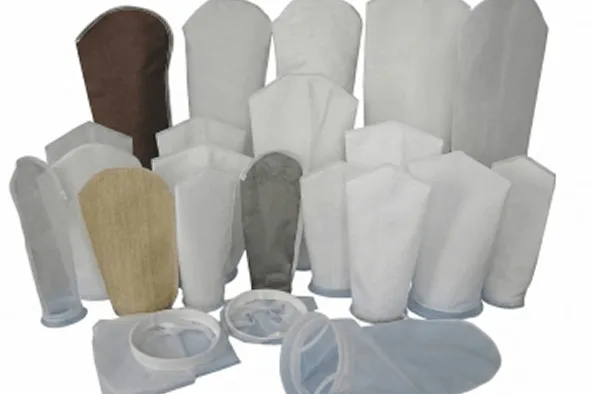
Mesh bags are better when the main target is coarse solids, gels, fibers, or agglomerates. Omela’s mesh filter bags are available in monofilament and multifilament structures, with micron ranges from 30 µm to 1500 µm and standard Sizes #1–#4.
How to Choose the Right Micron Rating
Micron rating controls the approximate particle size the bag is designed to retain. Lower micron ratings capture finer particles, but they also tend to increase pressure drop and may shorten bag life when solids loading is high.
AALfilter’s guide describes common liquid filter bag micron ranges: 1–5 µm for precision filtration, 10–25 µm for general-purpose or pre-filtration, and 50–100 µm for coarse particle removal such as sediment or rust. Zonel’s filter bag size guide also notes that lower micron ratings improve filtration precision but may raise pressure drop and shorten service life, and suggests staged filtration when systems clog too quickly.
For wastewater, a practical micron strategy is usually staged rather than selecting the finest bag immediately. For example, a plant may use 100 µm or 50 µm for bulk solids removal, then 25 µm or 10 µm for downstream protection. If the plant uses RO/UF membranes, the bag filter may serve as an upstream guard stage, while cartridges or membrane-specific pretreatment still handle finer protection.
Practical Micron Rating Guide for Wastewater
| Micron Rating | Typical Wastewater Use | Selection Note |
|---|---|---|
| 100–300 µm | Coarse debris, fibers, sand, scale, large suspended solids | Good for first-stage filtration and low pressure drop |
| 50–100 µm | General wastewater pretreatment, pump protection, cooling water | Balanced choice for many industrial wastewater streams |
| 25–50 µm | Finer suspended solids, process water reuse, cartridge protection | Watch pressure drop if solids load is high |
| 10–25 µm | Polishing, RO/UF pretreatment support, lower turbidity targets | Often needs good upstream solids control |
| 1–10 µm | Fine polishing, high-clarity requirement, sensitive equipment protection | Higher clogging risk; check flow and changeout frequency |
Do not choose 1 µm just because it sounds “better.” In wastewater, a bag that is too fine can plug quickly, increase inlet pressure, reduce flow, and raise labor cost. The correct micron rating is the one that removes the harmful solids while keeping pressure drop and changeout frequency under control.
Bag Size and Housing Fit
Bag size must match the filter bag housing. Standard liquid filter bag sizes are commonly described as Size #1, #2, #3, and #4. Zonel’s guide notes that #2 bags are approximately 7.06 in in diameter and 32 in long, while #1 bags are shorter at about 16.5 in long. Omela’s liquid filter bag page also lists standard liquid bag sizes, including Type 1, Type 2, Type 3, and Type 4, with corresponding diameter, length, and filtration area data.
For industrial wastewater, Size #2 is often the most practical starting point because it provides more filtration area and dirt-holding capacity than Size #1, while still fitting common single-bag and multi-bag housings. Smaller sizes may work for pilot systems, side streams, small batch treatment, or compact equipment protection.
Housing fit is not only about diameter and length. The sealing ring, flange, gasket, basket support, bag opening, and housing cover must all match. If the bag is installed in the wrong housing or the ring does not seal correctly, wastewater can bypass the bag and carry solids downstream.
Sealing Ring, Seam, and Construction
The sealing ring is the point where the filter bag connects to the housing. In wastewater applications, poor sealing can be as serious as wrong micron selection because bypass allows unfiltered solids to pass around the bag.
Common ring and top options include plastic rings, galvanized steel rings, stainless steel rings, molded plastic flanges, drawstring tops, and special custom collars. AALfilter’s article describes common ring choices such as plastic rings, galvanized steel rings, stainless steel rings, and rope closures for bag filter housings. Omela’s liquid filter bag page also describes ring/flange and gasket installation as a key step for secure, bypass-free sealing in the housing.
For general wastewater, plastic or PP rings are often suitable. For higher mechanical load, stainless steel rings may be preferred. For stronger chemicals, temperature, or aggressive liquid conditions, both ring material and gasket compatibility should be reviewed.
Seam construction also matters. Sewn bags are cost-effective and widely used. Welded bags can reduce fiber migration and bypass risk in cleaner or more sensitive applications. In high-solids wastewater, seam strength and burst resistance should be checked, especially when pressure fluctuates.
Filter Bag Housing Selection
A correctly selected filter bag cannot perform well inside an undersized or unsuitable housing. Housing selection affects flow rate, pressure drop, changeout frequency, maintenance safety, and overall system stability.
A single-bag housing is suitable for lower flow rates, pilot systems, batch processes, or moderate solids loading. A multi-bag housing is better for higher total flow, heavier contaminant loading, or longer operating cycles. A duplex housing allows one side to keep running while the other side is isolated for bag changeout, which is useful for continuous wastewater treatment lines.
Omela’s high-viscosity filter bag guide explains that housing selection should consider required flow, viscosity, solids loading, operating pressure, temperature, chemical compatibility, and preferred changeout interval. These same factors apply to wastewater, especially when influent quality changes through the day.
If pressure drop rises too quickly, the problem may be an overly fine micron rating, undersized housing, high solids load, poor upstream screening, unsuitable media, or poor flow distribution—not simply a “bad bag.”
Application Scenarios in Wastewater Filtration
In a metalworking plant, wastewater may contain fine metal particles, oil, rust, and coolant residues. A polyester felt bag or PP felt bag may be used as a guard filter, while oil-related contamination may require special media or upstream separation.
In a food or beverage wastewater system, solids may be soft, organic, and compressible. A bag that is too fine can blind quickly, so staged filtration is often better than jumping directly to 1 µm.
In a coating, ink, or resin wastewater line, the target may be gels, agglomerates, pigments, or polymer particles. Mesh bags or felt bags may be selected depending on whether the plant needs coarse capture, final clarity, or downstream equipment protection.
In RO pretreatment, wastewater bags are often used upstream of cartridge filters to reduce larger suspended solids. Omela notes that polypropylene felt bags in the 10–50 µm range can help remove larger suspended solids and reduce cartridge loading before membrane-related stages.
These scenarios show why wastewater filter bags should be selected by contaminant behavior, not only by liquid name.
Common Problems and How to Avoid Them
| Problem | Likely Cause | Practical Correction |
|---|---|---|
| Pressure drop rises quickly | Micron rating too fine, high solids load, small housing | Use staged filtration or larger/multi-bag housing |
| Frequent bag changeout | High dirt load, wrong media, insufficient filter area | Use Size #2, multi-bag housing, or coarser prefilter |
| Solids pass downstream | Poor ring seal, wrong housing fit, damaged seam | Check sealing ring, basket support, and bag construction |
| Bag ruptures or deforms | Excess pressure, no support basket, wrong bag size | Confirm basket, flow direction, pressure limit, and housing |
| Chemical swelling or failure | Wrong media or ring material | Review pH, solvents, temperature, and chemical compatibility |
| Oil or sticky solids blind the bag | Emulsions, gels, biological flocs, polymer carryover | Consider coarser prefiltration, mesh, or special media |
The goal is not always to capture the finest possible particle in one step. In wastewater treatment, stable flow and predictable changeout are often more valuable than very fine single-stage filtration.
How to Choose Wastewater Filter Bags Step by Step
Start by identifying the wastewater source. Industrial wastewater from machining, coating, food processing, chemical production, plating, mining, or utility water systems will behave differently. Next, define the contaminant: sand, rust, TSS, scale, fibers, gels, oil droplets, biomass, pigment, or sludge carryover.
Then choose the filtration stage. A coarse pretreatment bag may use 100–300 µm mesh, while a polishing or cartridge-protection stage may use 10–50 µm felt. After that, match the media to the chemistry and temperature. PP is often practical for chemical resistance and cost control. PE is stronger where mechanical stress or higher temperature matters. Nylon mesh works well for repeatable surface filtration. PTFE is reserved for aggressive chemicals, solvents, or higher temperatures.
Finally, check housing size, flow rate, pressure drop, support basket, sealing ring, gasket material, and changeout method. A good wastewater filter bag selection is the result of media, micron rating, housing, and operating conditions working together.
To Request a Quote
For wastewater treatment filter bags, please send:
- Wastewater source and application
- Target contaminants: TSS, sand, rust, fibers, gels, oil, sludge, scale, pigments, or chemicals
- Required micron rating or filtration objective
- Flow rate and operating pressure
- Initial and maximum allowable pressure drop
- pH, chemical composition, solvents, oil content, and temperature
- Bag size, housing model, basket type, and sealing ring requirement
- Current filter bag material and service life
- Current problems: clogging, bypass, rupture, high pressure, poor clarity, or frequent changeout
- Quantity and delivery destination
- Photos of the current bag, ring, housing, basket, and installation position
With this information, Omela can help compare PP felt, PE felt, nylon mesh, PP/PE mesh, PTFE, stainless steel mesh, high-efficiency multilayer bags, and matching filter bag housings.
Omela Engineering View
Wastewater treatment filter bags should be selected for the actual wastewater behavior, not only the nominal micron rating.
For coarse suspended solids, mesh bags may provide high flow and low pressure drop. For general wastewater pretreatment, PP felt or PE felt bags are often practical. For chemical wastewater, media compatibility and sealing ring material become more important. For RO/UF protection, bag filters are usually best used as an upstream guard stage before finer cartridges or membrane-specific pretreatment.
The best wastewater filter bag is not always the finest bag. It is the bag that removes the harmful solids, fits the housing correctly, resists the chemistry, maintains stable pressure drop, and supports an economical changeout interval.
FAQ
What filter bag material is best for wastewater treatment?
There is no universal best material. PP felt is often selected for chemical resistance and cost efficiency, PE felt for mechanical strength and higher temperature, nylon mesh for coarse reusable filtration, and PTFE for aggressive chemical wastewater.
What micron rating should I use for wastewater filter bags?
Common wastewater filtration may use 50–100 µm for general pretreatment, 10–50 µm for finer suspended solids or downstream equipment protection, and 100–300 µm for coarse debris, fibers, and first-stage solids removal.
Can filter bags protect RO or UF membranes?
Filter bags can help as an upstream pretreatment stage by removing larger suspended solids and reducing cartridge loading. They should not normally replace the final cartridge or membrane-specific pretreatment required before RO/UF systems.
Why does my wastewater filter bag clog too quickly?
Fast clogging is usually caused by high solids loading, too fine a micron rating, sticky or compressible solids, oil contamination, undersized housing, or insufficient upstream screening.
What is the most common bag size for industrial wastewater filtration?
Size #2 is commonly used in industrial liquid filtration because it provides higher dirt-holding capacity and filtration area than smaller bags while fitting many standard single-bag and multi-bag housings.
How do I choose the right filter bag housing?
Choose the housing based on flow rate, solids loading, viscosity, pressure, temperature, chemical compatibility, number of bags, changeout frequency, and whether the process can stop for maintenance.
What information is needed to quote wastewater filter bags?
Provide wastewater source, contaminant type, micron rating, flow rate, pressure drop, pH, temperature, chemical composition, bag size, housing model, ring type, current problems, quantity, and photos.
Author

Jessica Ma – Senior Filtration Engineer, Omela Filtration
Jessica Ma is a senior filtration engineer at Omela Filtration, specializing in dust and liquid filtration. With over 15 years of experience, she focuses on optimizing baghouse performance, enhancing filtration efficiency, and developing high-performance solutions for industrial dust collectors and precision liquid filtration applications.