
Key Takeaways
- High differential pressure in a laser cutting dust collector is a symptom rather than a diagnosis. Fine fume, filter blinding, excessive dust loading, weak pulse cleaning, moisture, oil residue, or insufficient filter area may all be involved.
- Cartridge dust collectors depend on enough effective filter area, suitable media, stable airflow, and effective pulse cleaning to prevent pressure drop from increasing too quickly.
- Filter cartridges may look relatively clean on the surface while fine particles are already embedded inside the media and restricting airflow.
- Pressure drop should be evaluated as a trend. A rising post-cleaning baseline often provides more useful information than one isolated differential-pressure reading.
- When troubleshooting, verify the pressure reading first, then check pulse cleaning, compressed air, used cartridge condition, dust characteristics, airflow, and filter-area sizing.
What Does High Pressure Drop Actually Mean?
Differential pressure is the resistance across the filter cartridges.
Dirty air enters the collector, passes through the cartridge media, and leaves from the clean-air side. As fine metal fume and dust accumulate on the media, resistance gradually increases.
Some increase is normal. A conditioned dust cake is part of normal filtration.
The problem begins when differential pressure rises much faster than expected, cannot be reduced by normal pulse cleaning, or becomes high enough that the required extraction airflow can no longer be maintained.
High pressure drop matters because it directly affects how much air the fan can move through the filtration system.
When resistance rises, the fan must work against a higher system pressure. If the fan or VFD cannot compensate, airflow at the cutting table falls.
Operators may then notice smoke escaping, slower fume clearing, weak suction, or visible haze around the machine even though the dust collector is still running.
There is no single universal “correct” differential-pressure value for every laser cutting dust collector. Filter media, cartridge design, fan curve, controller settings, and collector construction all affect the normal range.
For troubleshooting, the pressure-drop trend is usually more useful than copying a pressure limit from another machine.
Why Fine Laser Fume Blinds Filter Cartridges
Laser cutting produces extremely fine metal fume. Many particles behave more like smoke than conventional coarse grinding dust.
With suitable surface-loading media, much of this particulate remains near the cartridge surface and can be released during pulse cleaning.
Problems appear when fine particles penetrate deeper into the media structure.
Over time, they block airflow paths inside the filter.
This is commonly called filter blinding.
Blinding becomes more likely when:
- Effective filter area is too small
- Filtration velocity is too high
- Fine fume concentration is heavy
- Cartridge media allows excessive depth loading
- Pulse cleaning is weak
- Sticky oil or coating residue is present
- Cartridges remain in service after cleaning recovery has declined
A blinded cartridge may not recover simply because the pulse pressure is increased.
Once fine particles are embedded inside the media rather than forming a removable surface cake, pulse cleaning has less ability to remove them.
Normal Dust Cake vs Problem Loading
It is useful to distinguish a healthy dust cake from irreversible or difficult-to-clean loading.
With normal loading:
- Pressure drop gradually rises.
- Pulse cleaning is activated.
- Surface dust is released.
- Pressure drop falls.
- The collector continues operating within a relatively stable range.
With problem loading, a different pattern develops.
The pressure rises faster, cleaning cycles become more frequent, and the pressure achieved after cleaning gradually becomes higher.
That rising baseline is an important warning sign.
For example, if a collector normally returns to a stable resistance after cleaning but now never reaches its previous low point, investigate:
- Depth loading
- Sticky contamination
- Ineffective pulse cleaning
- High filtration velocity
- Cartridge end of life
The most important question is not only how high the pressure rises, but how well it recovers after cleaning.
Pulse Cleaning Failure: Check the Basics First
Before assuming the cartridges are defective, verify that the pulse-cleaning system is working correctly.
A typical system includes a controller, solenoid valves, diaphragm valves, compressed-air manifold, and blow tubes.
Common failures include:
- Low compressed-air pressure
- Wet or oily compressed air
- Failed diaphragm valves
- Failed solenoids
- Blocked or misaligned blow tubes
- Incorrect differential-pressure set points
- Controller or timer faults
- Dust re-entrainment after pulsing
If the controller is calling for cleaning but differential pressure does not decrease, first confirm that every valve actually fires and that compressed-air pressure remains stable during repeated pulses.
More frequent pulsing is not automatically better.
If the cartridges are already internally blinded, continuous pulsing may simply increase compressed-air consumption without restoring airflow.
Moisture, Oil Mist, and Sticky Fume
Laser cutting dust is often described as dry metal fume, but real workshops may cut:
- Oily sheet
- Galvanized steel
- Coated metal
- Painted material
- Protective-film sheet
- Mixed metals
Oil mist, coating residue, moisture, and condensed vapor can change the dust cake dramatically.
Instead of remaining dry and easy to release, fine particles may form a sticky layer on the filter surface or inside the pleats.
Typical warning signs include:
- Dark or glazed cartridge surfaces
- Heavy cartridges
- Sticky dust between pleats
- Pressure drop rising soon after replacement
- Little pressure recovery after pulse cleaning
Wet compressed air can create similar problems from the clean side of the filter.
If used cartridges are damp, sticky, or glazed, investigate the process and compressed-air quality before installing another identical set.
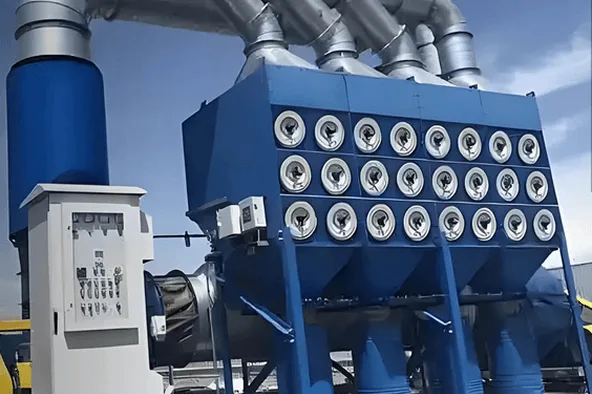
Why High Pressure Drop Causes Airflow Loss
The fan cannot provide unlimited airflow.
A laser cutting extraction system has a system resistance curve, while the fan has its own performance curve. Increasing filter resistance changes the operating point.
If the fan has sufficient reserve capacity or a properly controlled VFD, it may compensate for part of the increase.
If not, airflow declines.
At the cutting table, operators may see:
- Smoke escaping from one side
- Slow fume clearing
- Weak extraction in active zones
- Visible workshop haze
- More residue around the machine
This explains why a system can work very well immediately after new filters are installed and then gradually lose capture performance.
A properly selected system must maintain acceptable extraction after the cartridges reach normal operating resistance—not only when the filters are brand new.
Could the Collector Be Undersized?
High pressure drop can also indicate that the collector has insufficient effective filter area for the real production load.
If too much airflow passes through too little media, filtration velocity increases. Each square meter of media receives more fine fume, cleaning frequency rises, and cartridges may blind faster.
Check whether the process has changed since the collector was originally selected.
Examples include:
- More production shifts
- Higher laser power
- Thicker plate
- More coated materials
- More aluminum or mixed-metal cutting
- Longer daily operating hours
- Higher extraction airflow
- Changes in table zoning
A collector that was adequate for intermittent production can become effectively undersized after production increases.
High Pressure Drop Troubleshooting Table
| Symptom | Likely Cause | What to Check |
|---|---|---|
| Pressure rises quickly after installing new cartridges | Heavy fume loading or excessive filtration velocity | Airflow, filter area, production hours |
| Pressure remains high after pulsing | Filter blinding or weak cleaning | Media condition, valves, compressed air |
| Pulse system does not start correctly | DP control or electrical issue | Controller, sensor, tubing, solenoids |
| Cartridge surface is dark or glazed | Oil or coating contamination | Material surface and process conditions |
| Cartridges are damp or heavy | Moisture or wet compressed air | Dryer, drains, condensation |
| Cleaning runs almost continuously | High loading or saturated filters | Dust load, filter life, media selection |
| Smoke escape increases with pressure | Airflow loss | Fan duty, VFD, filter resistance |
| Some cartridges load faster than others | Uneven airflow distribution | Inlet design, baffles, dust impact |
Verify the Differential-Pressure Reading
Before replacing filters, confirm that the pressure reading itself is correct.
Differential-pressure gauges and controllers rely on pressure taps and tubing.
Possible measurement problems include:
- Blocked pressure taps
- Cracked or disconnected tubing
- Condensation inside sensing lines
- Reversed connections
- Sensor calibration problems
If the display indicates very high pressure drop but actual airflow remains normal, the pulse system behaves normally, and cartridges do not appear heavily loaded, check the measurement system before making expensive changes.
Troubleshooting should always begin by confirming that the symptom being measured is real.
Application Lessons
Case 1: Pressure Drop No Longer Recovered
A metal cutting operation had previously been able to reduce differential pressure through cleaning. After several weeks, however, the filters could no longer return to the earlier operating baseline.
Inspection indicated that fine particulate was penetrating into the media rather than remaining as an easily removable surface layer.
A surface-loading filtration approach improved dust release and stabilized resistance.
Lesson: A steadily rising post-cleaning baseline often indicates depth loading rather than normal surface dust cake.
Case 2: Laser Cutting Filters Caused Production Stops
A laser cutting workshop experienced repeated cartridge clogging. Jet-pulse cleaning could no longer restore airflow effectively, and filter problems eventually caused production interruptions.
The engineering review considered cartridge media, filter area, fume loading, and cleaning behavior rather than simply increasing pulse frequency.
Lesson: When pulse cleaning repeatedly fails, filter media and collector sizing should be reviewed together.
Case 3: Aluminum Cutting Loaded Standard Filters Quickly
A fabrication shop carrying out long-duration aluminum cutting experienced fast cartridge loading.
The process required not only enough airflow but also sufficient filtration area and better control of particulate before it reached the filters.
Lesson: Material type and production duty can change cartridge loading significantly.
Case 4: Fast Cartridge Clogging with Coated Sheet
In mixed metal and coated-sheet applications, fine laser fume can combine with oily or sticky residue.
Pressure drop may then increase rapidly after cartridge replacement, while pulse cleaning becomes progressively less effective.
The review should include filter media, compressed-air quality, pulse settings, effective media area, and the actual sheet condition.
Lesson: Used cartridges and process conditions often reveal more than cartridge specifications alone.
A Practical Troubleshooting Sequence
When differential pressure is high, avoid changing several things at once.
Use a logical sequence:
- Verify the measurement. Check the DP gauge, tubing, pressure taps, controller, and clean-filter baseline.
- Check pulse cleaning. Confirm air pressure, valves, solenoids, blow tubes, and cleaning sequence.
- Inspect the cartridges. Look for glazing, depth loading, moisture, burns, uneven loading, or damaged seals.
- Review the process. Check materials, coatings, oil, production hours, and recent process changes.
- Compare airflow and filter area. Determine whether filtration velocity is suitable for the installed cartridges.
- Check the fan and extraction path. Review VFD settings, table zones, dampers, duct restrictions, and leakage.
- Assess filter end of life. If pressure no longer recovers after effective cleaning, replacement may be necessary.
What Maintenance Teams Should Record
Differential pressure becomes much more useful when it is tracked over time.
Record:
- Clean-filter pressure drop
- Normal operating pressure
- Pressure before and after cleaning
- Cleaning frequency
- Material being cut
- Daily operating hours
- Compressed-air pressure
- Cartridge installation date
- Cartridge replacement date
- Smoke or airflow complaints
- Used cartridge condition
This information makes it much easier to distinguish gradual filter saturation from sudden cleaning-system failure or a change in production.
Final Engineering View
High pressure drop in a laser cutting dust collector is a symptom, not a diagnosis.
The root cause may be fine fume blinding, excessive filtration velocity, heavy dust loading, weak pulse cleaning, wet compressed air, sticky contamination, insufficient filter area, uneven airflow, or an inaccurate differential-pressure reading.
The most useful troubleshooting question is not:
“How do we lower the pressure number?”
It is:
“Why is resistance increasing, and why can the cleaning system no longer return the collector to a stable operating condition?”
A healthy laser cutting dust collection system should maintain source capture as cartridges load, release surface dust effectively during pulse cleaning, keep differential pressure within its intended operating range, and provide predictable cartridge life.
When pressure begins rising faster than normal, investigate early. Waiting until smoke escapes from the cutting table turns a filter problem into a production and workshop air-quality problem.
FAQ
Why does pressure drop increase in a laser cutting dust collector?
Common causes include fine fume loading, filter cartridge blinding, heavy dust loading, insufficient filter area, sticky contamination, moisture, weak pulse cleaning, or cartridges reaching the end of their useful life.
What is filter cartridge blinding?
Filter blinding occurs when fine particles penetrate into the filter media and block internal airflow paths. Unlike a normal surface dust cake, this material may be difficult to remove through pulse cleaning.
Why does pressure drop stay high after pulse cleaning?
The filters may be internally blinded, the dust may be sticky, compressed-air pressure may be insufficient, pulse valves may be faulty, or the cartridges may have reached the end of their effective service life.
Can high pressure drop cause weak laser cutting fume extraction?
Yes. Higher filter resistance increases total system resistance. If the fan cannot compensate, actual airflow decreases and smoke capture at the cutting table becomes weaker.
Should filters be replaced as soon as differential pressure rises?
Not necessarily. First verify the pressure reading and pulse-cleaning system. A moderate rise is normal as filters load. Replacement is generally considered when effective cleaning can no longer restore the intended operating condition.
What information is most useful when troubleshooting high pressure drop?
Record clean and operating pressure drop, pulse-cleaning behavior, compressed-air pressure, material being cut, operating hours, cartridge age, airflow symptoms, and used-filter condition.
Author

Jessica Ma – Senior Filtration Engineer, Omela Filtration
Jessica Ma is a senior filtration engineer at Omela Filtration, specializing in dust and liquid filtration. With over 15 years of experience, she focuses on optimizing baghouse performance, enhancing filtration efficiency, and developing high-performance solutions for industrial dust collectors and precision liquid filtration applications.