
Premature filter bag failure is usually caused by dust behavior, poor installation fit, or an undersized dust collector.
Key Specs Engineers Must Verify:
- Operating Temperature Limit: 130–260 °C (media-dependent)
- Dust Loading & Air-to-Cloth Ratio: typically 0.8–1.5 m/min
- Emission Target: <10 mg/Nm³ (often <5 mg/Nm³ in modern plants)
Omela Filtrations Value: Omela Filtrations engineers filter bags based on real dust conditions, mechanical fit, and collector design margins to prevent early failure and extend service life.
Introduction: Why Filter Bags Fail Prematurely in Industrial Baghouses
Filter bags rarely fail because of “bad luck.” In most industrial baghouses, premature failure comes from predictable engineering causes.
In cement kilns, steel furnaces, asphalt plants, and chemical reactors, filter bags operate under:
- High dust loads
- Aggressive chemistry
- Abrasive particles
- Tight emission limits
A bag that should last 24–36 months may fail in weeks if one key factor is ignored.
At Omela Filtrations, we treat filter bag life as a system outcome:
Dust + Collector Design + Installation Quality = Real Service Life
This article explains the top 3 reasons filter bags fail and how to prevent them.
Technical Core & Omela Insights
Challenges & Macro Trends
Modern filtration systems face harsher conditions than a decade ago:
- Higher production rates → higher dust loading
- Stricter stack limits → finer particle capture required
- More temperature swings → condensation and hydrolysis risk
- Higher air-to-cloth ratios → mechanical fatigue increases
The most common operating stress factors include:
- Temperature excursions above media limits
- Chemical attack from SOx, NOx, acid dew point
- Abrasion from silica-rich dust
- High A/C ratio causing over-cleaning and flex damage
Omela Filtrations designs filter media and bag construction specifically around these realities.
Material Selection
Filter bag failure is often accelerated by incorrect material choice. Below is a practical comparison of common industrial baghouse media:
| Omela Filtrations Filter Media | Max Temp (°C) | Chemical Resistance | Relative Cost | Typical Service Life |
|---|---|---|---|---|
| Polyester (PE) | 130–150 | Low (acid dew point sensitive) | Low | 8–18 months |
| PPS Needle Felt | 190 | Excellent in acid gas, SOx | Medium-High | 18–30 months |
| Nomex (Aramid) | 200–220 | Moderate (hydrolysis risk) | Medium | 16–28 months |
| Fiberglass + PTFE Membrane | 260 | Very high, inert surface | High | 24–40 months |
Engineering rule:
If dust chemistry or temperature is misjudged, no installation quality can save the bag.
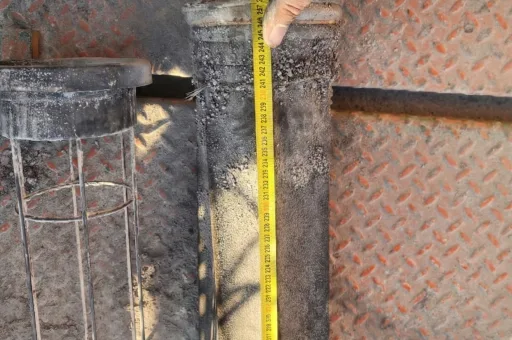
Top 3 Reasons Filter Bags Fail
1. Dust Characteristics (The Root Cause)
Dust is not neutral. It is a mechanical and chemical load on the filter media.
Key dust properties that shorten bag life:
- Fine particles (<2.5 µm): penetrate deep into felt → high ΔP and blinding
- Abrasive dust (silica, clinker): wears fibers → pinholes and leakage
- Sticky dust (asphalt fumes, resins): causes irreversible pore blockage
- Reactive dust (acidic, alkaline): attacks polymer chains
Example:
Cement kiln bypass dust with high alkali salts requires PPS or PTFE, not standard Polyester.
Omela Filtrations performs dust condition matching before recommending media.
2. Poor Fit & Installation (Mechanical Failure Mode)
Even the best filter media fails early if the bag does not fit correctly.
Common installation-related failure points:
- Incorrect bag length → excessive tension
- Loose snap band → dust bypass and cuff wear
- Misaligned cages → abrasion lines and seam damage
- Sharp cage edges → rapid hole formation
A filter bag is a mechanical component.
If it flexes improperly, fatigue cracks develop quickly.
Omela Filtrations supplies reinforced cuffs, precision sewing, and cage compatibility checks to prevent these failures.
3. Undersized Dust Collector (System Overload)
A baghouse designed too small will destroy bags faster than expected.
Undersizing leads to:
- Excessive air-to-cloth ratio (>1.5–1.8 m/min)
- Over-aggressive pulse cleaning
- High dust re-entrainment
- Continuous flexing fatigue
Symptoms of an undersized collector:
- Bags fail uniformly across all rows
- ΔP remains high even after cleaning
- Compressed air consumption rises sharply
Engineering reality:
No filter bag can compensate for insufficient filtration area.
Omela Filtrations supports collector audits to confirm sizing margins.
People Also Ask (Engineering Q&A)
How does air-to-cloth ratio affect filter bag life?
Higher A/C ratio increases dust velocity through the media, causing:
- Faster abrasion
- Higher cleaning frequency
- Increased fabric flex fatigue
Most industrial baghouses perform best around 0.8–1.3 m/min, depending on dust type.
When should I replace filter bags before catastrophic failure?
Replace bags when:
- ΔP stays above 1500–1800 Pa
- Visible emissions rise
- Bag seams show wear
- Cleaning becomes unstable
Preventive replacement avoids downtime and secondary damage.
What is the fastest way to diagnose premature bag failure?
Start with three checks:
- Dust analysis (abrasion, moisture, particle size)
- Installation inspection (cage wear lines, cuff leaks)
- Collector sizing review (A/C ratio and cleaning frequency)
Omela Filtrations can evaluate failure samples and recommend corrective action.
Omela Filtrations Authority & Data
Expert Quote
“Premature bag failure is almost never random. In most cases, dust chemistry, mechanical fit, or collector overload explains the damage pattern. At Omela Filtrations, we engineer filter bags as part of a complete system, not as consumables.”
— Dr. Li, Chief Material Engineer at Omela Filtrations
Performance Data (Field Reference)
In a recent 5000 t/d cement kiln baghouse retrofit, Omela Filtrations supplied PPS + PTFE membrane filter bags:
- Emissions maintained at <5 mg/Nm³
- Stable operation for 24 months
- Bag failure rate reduced by >60% compared with previous standard felt
This is the result of correct dust-driven engineering selection.
Conclusion
Filter bag life expectancy ranges from weeks to 5+ years, but premature failure almost always comes down to:
- Dust characteristics
- Poor fit and installation
- Undersized dust collector design
Correcting these factors reduces total cost of ownership through:
- Longer service intervals
- Lower compressed air use
- Stable emissions compliance
- Fewer shutdowns
Contact Omela Filtrations technical team today for a customized filtration audit and quote.
Author

Jessica Ma – Senior Filtration Engineer, Omela Filtration
Jessica Ma is a senior filtration engineer at Omela Filtration, specializing in dust and liquid filtration. With over 15 years of experience, she focuses on optimizing baghouse performance, enhancing filtration efficiency, and developing high-performance solutions for industrial dust collectors and precision liquid filtration applications.