
Introduction
Many plant managers assume that a dust collector is simply a “baghouse with filter bags.” In reality, this is a critical misunderstanding.
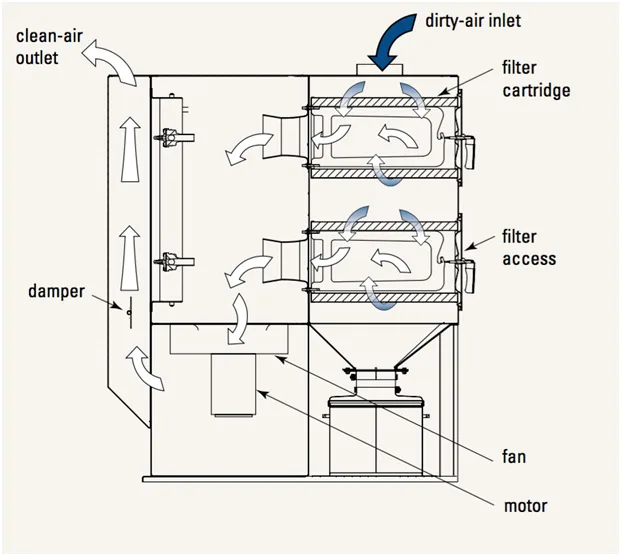
A dust collector is not a single piece of equipment — it is a complete engineered system, where performance depends on how well each component works together.
According to EPA industrial filtration guidelines, a typical dust collection system includes multiple interdependent subsystems, not just the filter unit itself.
Failing to design or maintain any one of these components can lead to:
- Rising pressure drop
- Reduced collection efficiency
- Premature filter failure
- Increased energy consumption
This article breaks down the complete structure of a dust collection system, explains how each part affects performance, and shows how Omela Filtrations approaches system-level optimization.
Omela Filtrations: Challenges & Opportunities
Industrial filtration is becoming more complex due to:
- Higher process temperatures
- More aggressive chemical environments
- Stricter emission regulations
- Demand for lower operating costs
At the same time, many systems are still designed as equipment-based solutions, rather than integrated systems.
Omela Viewpoint Summary (TL;DR)
- A dust collector is a system, not a product
- Most failures originate from system imbalance, not filter bags alone
- Key control variables:
- Airflow distribution
- Pressure drop
- Gas-to-cloth ratio
- Omela Filtrations focuses on:
- Material engineering + system optimization
- Stable operation under harsh conditions
- Long lifecycle performance
What Components Make Up a Complete Dust Collection System?
According to EPA system design references, a complete dust collection system typically includes:
1. Capture System (Hood or Source Extraction)
This is where the process begins.
Function:
- Capture dust at the source
- Prevent dispersion into workspace
Engineering importance:
- Poor hood design = dust escapes before filtration
- Cannot be fixed by upgrading filter bags
2. Ductwork System
Function:
- Transport dust-laden gas to the collector
Key considerations:
- Air velocity must prevent dust settling
- Smooth flow reduces pressure loss
According to EPA:
- Duct design directly affects system pressure drop
3. Pre-Treatment Equipment (Optional but Critical)
Includes:
- Cyclones
- Spray cooling systems
- Dilution air
Function:
- Remove large particles
- Reduce temperature
- Protect filter media
Especially critical in:
- Foundries
- Cement plants
- WTE systems
4. Baghouse (Core Filtration Unit)
This is the “heart” of the system.
Function:
- Separate particles from gas
Working principle:
- Dust cake filtration
According to EPA:
- Efficiency reaches 99–99.9%+ due to dust cake formation
5. Filter Media (The Real Performance Driver)
Types:
- Needle-punched felt
- Woven fabric
- PTFE membrane
Engineering reality:
The filter media determines:
- Pressure drop
- Cleaning behavior
- Service life
6. Cleaning System (Pulse / Reverse Air / Shaker)
Function:
- Remove dust cake
- Maintain airflow
Key insight:
EPA notes that:
- Filtration is a cyclic process (filtering + cleaning)
If cleaning fails → system failure begins
7. Fan System (Energy Core)
Function:
- Drive airflow
Critical fact:
Most energy consumption in a baghouse comes from overcoming pressure drop
8. Dust Discharge System
Includes:
- Hopper
- Screw conveyor
- Rotary valve
Function:
- Remove collected dust
Poor discharge = re-entrainment → efficiency loss
9. Stack / Exhaust System
Function:
- Release clean air
Role:
- Final compliance point
How System Imbalance Leads to Failure
A dust collection system operates as a dynamic equilibrium.
Key Equation (Simplified Understanding)
From EPA filtration theory:
Pressure Drop = System Resistance × Air Velocity
What Happens When Balance Breaks?
| Issue | Result |
|---|---|
| Airflow too high | High pressure drop |
| Cleaning insufficient | Dust buildup |
| Media mismatch | Rapid degradation |
| Duct design poor | Energy loss |
The Most Critical Parameter: Air-to-Cloth Ratio
EPA identifies this as:
The most important design parameter
Omela Filtrations System-Level Optimization Approach
Most suppliers focus only on selling filter bags.
Omela takes a different approach.
1. Material Engineering
- P84 for high temperature
- PTFE for chemical resistance
- Aramid for abrasion
2. System Matching
Instead of generic products:
- Match media to:
- Dust type
- Gas composition
- Temperature
3. Pressure Drop Optimization
- Reduce energy consumption
- Stabilize operation
4. Lifecycle Optimization
- Longer bag life
- Lower replacement cost
Typical Improvements
- 30–50% longer service life
- 5–20% lower pressure drop
- Improved emission stability
Contact Omela Filtrations today to improve your dust collection system performance.
FAQ
What is included in a dust collection system?
A complete system includes:
- Hood
- Ductwork
- Pre-treatment
- Baghouse
- Fan
- Dust discharge system
- Stack
Why is the baghouse not enough?
Because system performance depends on airflow, pressure, and upstream design.
What is the most critical design factor?
The air-to-cloth ratio.
What causes most failures?
System imbalance, not just filter bag issues.
Author

Jessica Ma – Senior Filtration Engineer, Omela Filtration
Jessica Ma is a senior filtration engineer at Omela Filtration, specializing in dust and liquid filtration. With over 15 years of experience, she focuses on optimizing baghouse performance, enhancing filtration efficiency, and developing high-performance solutions for industrial dust collectors and precision liquid filtration applications.