
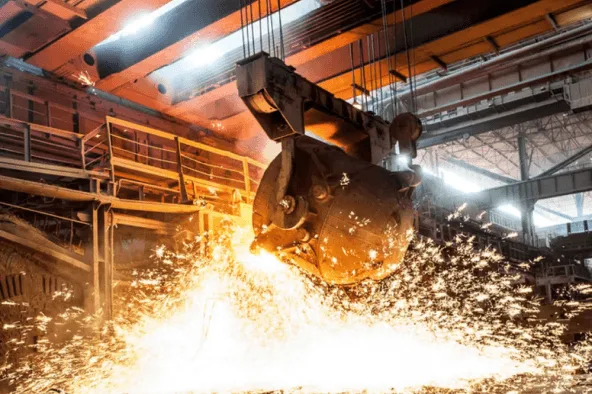
Non-ferrous metal smelting — aluminum, copper, zinc, lead, nickel, tin, and the processing of rare earth catalytic materials — produces some of the most difficult flue gas streams in industrial dust collection. The challenge isn’t just one thing. It’s everything at once: temperatures that routinely operate above 150°C and can spike well above 200°C during process upsets, acid gas concentrations from sulfur dioxide and nitrogen oxides that attack conventional filter media from the inside out, heavy metal fume and aerosol particles that condense as the gas cools through the baghouse, high moisture content from wet feed materials and combustion products, and volatile compounds that crystallize on internal baghouse surfaces as the gas temperature drops below their condensation point.
I’ve worked on baghouse problems across most industrial sectors, and non-ferrous smelting consistently produces the highest rate of premature filter bag failure. The reason is that each individual challenge — temperature, chemistry, particle size, moisture — is manageable with the right media. But when they all arrive simultaneously in the same gas stream, the number of filter media options that can genuinely survive narrows to almost nothing.
This article covers the specific filtration challenges in non-ferrous smelting, what makes PTFE membrane filter bags the correct engineering solution for these applications, and a rare earth catalytic material processing case study that illustrates a failure mode most engineers don’t think to look for.
What Makes Non-Ferrous Smelting Flue Gas Uniquely Destructive
The flue gas from non-ferrous metal smelting contains a combination of contaminants that attack filter bags through multiple mechanisms simultaneously.
The chemistry problem
Sulfur dioxide concentrations in copper and zinc smelting exhaust can be substantially higher than in coal-fired power generation. When SO₂ combines with moisture and oxygen — both of which are present in smelting flue gas — it forms sulfuric acid mist. This isn’t a mild acid exposure. It’s concentrated enough to attack PPS and aramid fibers at the operating temperatures involved. The sulfuric acid degrades the polymer chains in these materials progressively, reducing tensile strength until the bags fail mechanically. The failure timeline depends on the SO₂ concentration and moisture content, but it’s typically months rather than years for non-PTFE media in high-sulfur smelting applications.
Nitrogen oxides add another chemical dimension. In combination with moisture, NOₓ forms nitric acid — a strong oxidizing acid that attacks PPS under conditions where temperatures and concentrations are sufficient. The oxidative degradation mechanism is different from the hydrolytic attack caused by sulfuric acid, but the result for the filter bag is the same: progressive fiber weakening followed by mechanical failure.
The critical point here is that PTFE filter bags don’t just resist these acids moderately well — they’re entirely unaffected by them. PTFE’s carbon-fluorine bonds are among the strongest in organic chemistry. Sulfuric acid, nitric acid, hydrochloric acid, and essentially every other acid and alkali species encountered in smelting exhaust pass over the PTFE surface without any chemical interaction. This isn’t a question of degree or service life extension. It’s a different category of chemical resistance entirely.
The temperature problem
Non-ferrous smelting operates across a wide temperature range that varies by process stage and metal type. Roasting and smelting furnaces produce exhaust at 200–400°C or higher at the furnace exit. By the time the gas reaches the baghouse after cooling and dilution, typical inlet temperatures are in the 150–250°C range — with spikes that can push significantly higher during process upsets or transitions.
This temperature range eliminates polyester (130°C max), acrylic (125°C max), and PPS (160°C max) entirely. Aramid handles 204°C continuous with peaks to 250°C, which puts it at its absolute limit for many smelting applications with no thermal safety margin. Fiberglass handles the temperature comfortably — up to 260°C continuous — but has limitations in the chemical environment that fiberglass alone can’t address.
The practical solution for most non-ferrous smelting baghouses is either PTFE filter bags (continuous to 250°C, peaks to 280°C) or fiberglass filter bags with PTFE membrane lamination — which combines the temperature capability of the fiberglass base with the chemical resistance and surface filtration properties of the PTFE membrane.
The particle problem
Non-ferrous smelting generates two distinct particle populations that create very different filtration challenges.
The first is conventional process dust — furnace charge material, flux, and refractory fragments — in the 5–50 μm range. This is relatively straightforward to capture with any competent filter media and is not usually the cause of emission non-compliance.
The second is metal fume and condensed aerosol. When metals and metal compounds volatilize at furnace temperatures and then condense as the gas cools, they form submicron particles in the 0.01–1 μm range. These particles include lead oxide, zinc oxide, cadmium compounds, arsenic trioxide, and mercury — many of which are classified as hazardous air pollutants under environmental regulations worldwide. These condensed metal fume particles are the hardest fraction to capture and the most important from a regulatory and health perspective.
Standard depth-filtration needle-felt media has inherently limited efficiency for submicron particles — particularly during the period immediately after a cleaning pulse when the protective dust cake has been partially removed. PTFE membrane lamination changes the filtration mechanism from depth to surface, with a biaxially-stretched membrane containing up to 1×10⁹ pores per cm² at 85–93% open porosity. This pore structure captures submicron metal fume particles at the membrane surface with 99.99% efficiency from the first operating cycle — without dependency on dust cake development and without the transient emission spikes after cleaning pulses that characterize depth-filtration media.
For smelting applications where heavy metal emissions are regulated at the microgram level, this distinction between depth and surface filtration is the difference between reliable compliance and marginal performance that produces violations during process upsets or immediately after cleaning cycles.
Three Engineering Advantages That Define PTFE Membrane Performance in Smelting
Structural optimization: the foundation
The PTFE membrane filter bags used in smelting applications are built on a reinforced base substrate — PTFE needle-felt or fiberglass — using high-polymer materials with low adhesion properties and high structural support. The reinforced scrim provides the mechanical backbone that allows the bag to maintain its shape and dimensional stability under the combined thermal and mechanical stress of continuous high-temperature operation and repeated pulse-jet cleaning.
The low-adhesion surface properties of the PTFE membrane are critical in smelting applications because the dust generated in these processes tends to be sticky and cohesive — particularly the condensed metal fume fraction that adheres strongly to conventional media surfaces. A filter media that captures particles efficiently but cannot release them during cleaning will experience progressive pressure drop increase over time, eventually requiring either excessively frequent cleaning pulses (which shorten bag life) or premature replacement. The PTFE membrane’s inherently low surface energy — the same property that makes Teflon non-stick in cookware — prevents dust adhesion and allows the dust cake to release cleanly and completely with each cleaning pulse.
High-efficiency, low-resistance filtration: the operating economics
The PTFE membrane achieves its fine particle capture through a pore structure that is fundamentally different from conventional needle-felt. The biaxially-stretched membrane creates a uniform pore distribution with extremely high pore density — up to 1×10⁹ pores per cm² — at an open porosity of 85–93%. This means the membrane has extremely high permeability to gas flow while maintaining sub-micron particle retention capability.
The practical result is that PTFE membrane filter bags in smelting applications operate at lower differential pressure than conventional media at the same filtration velocity. Lower differential pressure means the induced draft fan draws less power, which in a large smelting baghouse running continuously represents a material energy cost saving over the bag service life. The smooth, non-stick membrane surface also means the differential pressure remains stable over time — it doesn’t climb progressively the way it does with depth-filtration media as particles accumulate within the fiber matrix.
This combination — lower baseline pressure drop plus stable pressure drop over time — makes PTFE membrane filter bags the lower total operating cost option in smelting applications, despite their higher purchase price per bag. The energy saving alone often covers the price premium within the first year of operation.
Extended service life: the maintenance economics
The structural stability of the reinforced PTFE construction, combined with the chemical inertness that eliminates acid-driven fiber degradation, translates directly into longer bag service life. In non-ferrous smelting applications where conventional media (polyester, PPS, even aramid) might last 6–18 months before chemical degradation or paste-blinding forces replacement, PTFE membrane filter bags routinely achieve 2–4 years of continuous service.
The triple-seal bag construction — seamless welding for the body seam, adhesive closure as a secondary seal, and mechanical Tap closure at the bag ends, with double-layer reinforcement at high-stress zones — ensures that the bag integrity matches the media durability. A filter bag where the media can survive for years but the seam fails at 12 months hasn’t solved the problem. The construction must be engineered to the same durability standard as the media itself.
Case Study: Rare Earth Catalytic Material Processing Facility
A rare earth catalytic material manufacturer was experiencing visible stack emissions from one of their processing kilns despite having a relatively new baghouse installation. The plant contacted us because third-party stack testing had shown particulate concentrations approaching or exceeding their compliance limit — a situation that was creating regulatory pressure and raised concerns about the release of rare earth metal compounds into the surrounding area.
On-site inspection revealed two problems that together explained the emission performance.
The first was crystalline deposits on the baghouse cover plate and internal surfaces. The rare earth processing exhaust contains volatile compounds that are gaseous at the kiln exit temperature (150–180°C) but condense and crystallize as the gas cools to 90°C at the stack test point. These crystalline deposits were also forming on the filter bag surfaces and within the clean-air plenum — indicating that volatile compounds were passing through the filter media in gas phase and then condensing downstream. This is not a particle capture failure — no filter bag can capture a compound that’s in vapor phase. It’s a process temperature management issue that requires attention to the gas conditioning system upstream of the baghouse.
The second was improperly installed filter bags. Several bags had not been seated correctly in the tube sheet during the previous installation — the snap bands were not fully engaged, creating bypass leakage around the bag collars. In a baghouse handling rare earth compounds, even minor bypass leakage contributes measurably to stack emissions because the particles involved are very fine and the regulatory limits are tight.
The operating parameters for this baghouse:
| Parameter | Value |
|---|---|
| Fan rated air volume | 43,000 m³/h |
| Kiln outlet temperature | 150–180°C |
| Stack test point temperature | 90°C |
| Oxygen content | 19.2% |
| SO₂ | <10 mg/Nm³ |
| NOₓ | <100 mg/Nm³ |
| Cleaning method | Compartment pulse-jet |
| Cleaning pressure | 0.4–0.5 MPa |
| Filter bag size | 135 × 2,480 mm |
| Total bag count | 960 |
The high oxygen content (19.2%) in this application is noteworthy. Elevated oxygen concentrations accelerate oxidative degradation of PPS fiber — a failure mode that is well documented in applications where O₂ exceeds 15% at operating temperatures above 140°C. This ruled out PPS as a viable long-term option for this installation and reinforced the case for PTFE, which is unaffected by oxygen concentration at any level.
The remediation scope included replacement of all 960 filter bags with PTFE membrane filter bags, correct installation with proper snap band engagement verified on every bag, and fluorescent tracer powder leak detection to confirm complete tube sheet sealing before return to service. The volatile compound crystallization issue was addressed separately through process-side temperature management recommendations.
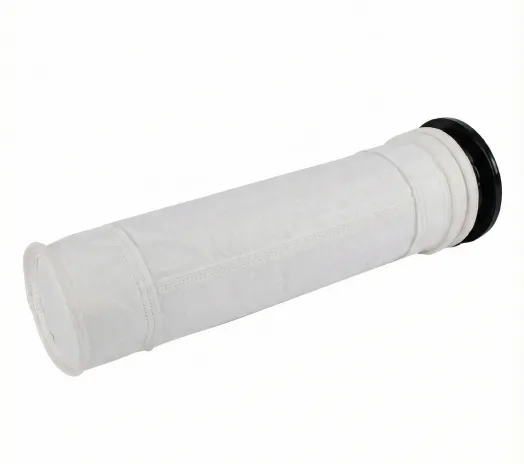
After commissioning with the new PTFE membrane bags, the system achieved stable emission performance well within the compliance limit. The combination of surface filtration for the submicron rare earth particles and complete chemical inertness against the acid gas and high-oxygen environment provides the long-term reliability that this application demands.
For more detail on filter bag service life factors, our article on top 5 factors influencing the service life of dust filter bags covers the key variables that determine how long bags last in demanding applications. For applications with PTFE membrane filtration specifically, our article on applications of PTFE membrane filter bags provides additional technical context.
Filter Media Selection for Non-Ferrous Smelting: the Decision Framework
The material selection for non-ferrous smelting baghouses follows a straightforward elimination logic based on the specific gas conditions at each installation:
Temperature above 160°C continuous → eliminates polyester, acrylic, PPS
Acid gas present (SO₂, HCl, HF) → eliminates aramid under sustained acid exposure; PPS has limitations under strong oxidizing conditions
Oxygen content above 15% → eliminates PPS under oxidative degradation mechanism at operating temperatures above 140°C
Heavy metal fume requiring sub-10 mg/Nm³ compliance → requires PTFE membrane surface filtration rather than depth filtration
Sticky, cohesive dust from condensed metal fume → requires low-adhesion surface (PTFE membrane) to prevent progressive paste-blinding
In practice, most non-ferrous smelting applications end up at PTFE or fiberglass-with-PTFE-membrane through this elimination process. The choice between the two depends primarily on temperature: pure PTFE needle-felt for applications up to 250°C continuous, fiberglass-based with PTFE membrane for applications where the continuous temperature regularly exceeds 200°C and the mechanical strength of the fiberglass base is needed for the higher cleaning pulse loads involved.
Contact Omela Filtration
Omela Filtration supplies PTFE filter bags, fiberglass filter bags, and complete baghouse support services for non-ferrous metal smelting, rare earth processing, and secondary metallurgy applications. Our services include on-site flue gas analysis, filter media selection, professional installation, and fluorescent powder leak detection commissioning.
Author

Jessica Ma – Senior Filtration Engineer, Omela Filtration
Jessica Ma is a senior filtration engineer at Omela Filtration, specializing in dust and liquid filtration. With over 15 years of experience, she focuses on optimizing baghouse performance, enhancing filtration efficiency, and developing high-performance solutions for industrial dust collectors and precision liquid filtration applications.