
Steel production is among the most filtration-intensive industrial processes on earth. A single integrated steelworks can have dozens of separate dust collection points — sintering plants, blast furnaces, basic oxygen furnaces, electric arc furnaces, lime kilns, ladle metallurgy stations, casting lines, rolling mills — and each one generates a flue gas stream with a distinct combination of temperature, dust loading, particle morphology, and chemical composition. The filter bag specification appropriate for one location will fail at another, sometimes within weeks.
This creates a problem that I encounter repeatedly in the field: plants that apply a single filter bag specification across multiple process points because it’s operationally simpler, then spend years dealing with unexplained early failures at specific locations while performance elsewhere is acceptable. The failures aren’t random. They’re predictable once you understand the dust chemistry and thermal profile at each point in the process.
This article covers the filtration challenges at each major steel plant process location, why the standard material choices are what they are, what happens when the wrong media is installed, and how to properly verify a filter bag installation before returning a system to service.
The Steel Plant Dust Problem Is Not One Problem — It’s Eight
The flue gas streams generated across steel production share almost no common characteristics except that they all need to be cleaned before reaching the stack. Understanding what makes each one distinct is the foundation of correct filter media selection.
Sintering plant
Sintering is the process of agglomerating fine iron ore, coke breeze, and flux materials into a porous burden suitable for the blast furnace. The exhaust gas from the sintering strand contains fine particulate matter at temperatures of 120–180°C, significant concentrations of SO₂ from the sulfur in the ore and coke, dioxins and furans from incomplete combustion of organic materials, and heavy metal compounds that volatilize at sintering temperatures and condense on particulate matter as the gas cools. The combination of acid gases, heavy metals, and fine sticky particulate at elevated temperatures makes sintering plant baghouse filtration one of the more demanding applications in the industry.
PTFE filter bags with PTFE membrane lamination are the correct specification for sintering plant applications. PTFE’s complete chemical inertness handles the acid gas and heavy metal compound environment without degradation. The membrane surface provides the fine particle capture needed to retain the sub-micron condensed heavy metal aerosol particles that conventional depth-filtration media pass through. The non-stick surface prevents the sticky dust cake that sintering plant particulate tends to form from blinding the media, which would otherwise cause progressive pressure drop increase over the operating cycle.
PPS is sometimes used at sintering plants where SO₂ concentrations are not extreme and cost pressure is significant. PPS handles sulfur dioxide well at the operating temperatures involved, but its oxidation resistance is limited — in atmospheres with elevated oxygen content, which can occur at some sintering plant exhaust points, PPS degradation accelerates. If the plant uses desulfurization upstream of the baghouse, this partially changes the calculation, but the heavy metal aerosol challenge remains regardless.
Blast furnace cast house
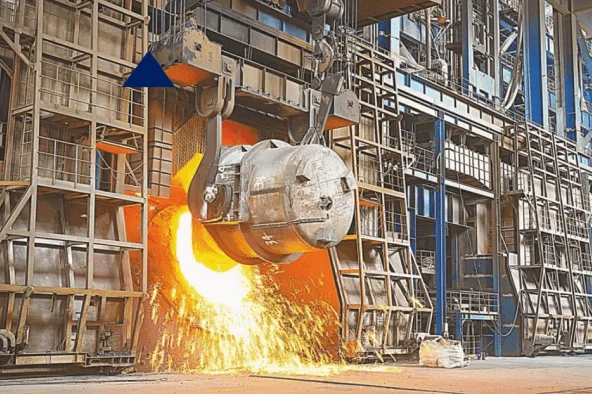
The cast house produces the most visually dramatic dust in steelmaking — the eruptions of red-orange fume that occur when molten iron is tapped from the furnace. This dust is primarily iron oxide, generated as iron droplets and splatter oxidize in contact with air. Temperatures at the collection hood can spike sharply during tapping events, but the average gas temperature at the baghouse inlet is typically in the 100–180°C range depending on how effectively the collection hood captures the plume and how much dilution air is introduced.
The iron oxide dust from cast house operations is chemically relatively benign but physically abrasive. Cast house filter bags fail most commonly through mechanical abrasion at the bag inlet, where the high-velocity dust-laden gas stream causes erosive wear through the media. This is an application where the mechanical properties of the filter media — tensile strength, abrasion resistance, fabric construction — matter more than chemical resistance.
Aramid (Nomex) filter bags perform well in cast house applications because of their combination of mechanical strength, continuous temperature rating to 204°C with peaks to 250°C, and dimensional stability under the thermal cycling that occurs between tapping events. Fiberglass is also used, particularly where temperatures are more elevated, but fiberglass is more susceptible to mechanical damage from the abrasive dust impingement that characterizes cast house collection. The surface treatment of the aramid media — calendering, singeing, or membrane lamination — is chosen based on the specific emission requirement and the dust characteristics at the particular installation.
Basic oxygen furnace secondary emissions
The basic oxygen furnace (BOF) is the primary steelmaking vessel in integrated plants. The primary emissions — the massive plume generated during the oxygen blow — are typically handled by a dedicated gas recovery system rather than a fabric filter. What filtration engineers are concerned with is the secondary emission: the fugitive dust that escapes from the vessel mouth, from tapping operations, and from the ladle during transfer.
BOF secondary emission dust is predominantly iron oxide with some calcium oxide from flux additions, collected at temperatures typically in the 120–200°C range. The main complication is the variable dust loading — secondary emission rates are highest during tapping and skimming, creating peak loads on the baghouse that can be several times higher than the steady-state condition. Filter media for BOF secondary emission systems need sufficient mechanical strength to handle the cleaning pulse frequency required to manage these peaks, while maintaining dimensional stability at the operating temperature.
Aramid is the standard specification here, with PPS used in some applications where the operating temperature is more reliably controlled. The critical point for BOF secondary emission systems is that the cleaning system must be properly tuned for the peak load condition, not just the average — a baghouse that performs adequately under normal operation but cannot handle the peak can cause emission violations at precisely the moments when the most dust is being generated.
Electric arc furnace
The electric arc furnace (EAF) presents one of the most challenging filtration environments in steel production. EAF dust is a complex mixture dominated by zinc oxide — originating from galvanized scrap — along with iron oxide, lead compounds, cadmium, and other heavy metals. The zinc content is significant enough that EAF dust is classified as a hazardous waste in many jurisdictions and must be treated as a secondary zinc source or disposed of accordingly.
Gas temperatures in the primary capture duct can reach 200–300°C or higher during the melt phase, dropping as the gas is diluted and cooled before the baghouse. The EAF operating cycle creates a highly variable duty — temperature, flow rate, and dust loading all change substantially between the charging, melting, refining, and tapping phases. This variability stresses filter media through repeated thermal cycling and cleaning pulse cycles at variable frequency.
Fiberglass filter bags are the standard specification for primary EAF capture systems because of their ability to handle the high temperature peaks during melt phases. Continuous rating up to 260°C with short-term peaks to 280–300°C gives adequate margin for the melt phase temperature excursions. The dimensional stability of fiberglass under thermal cycling — critically, the low shrinkage values — means the bags maintain their fit in the tube sheet seats even after hundreds of thermal cycles, preventing the bypass leakage that causes emission failures in installations using lower-grade media.
For EAF secondary capture and canopy hood systems where temperatures are lower and more uniform, PPS or aramid may be more economical choices. The selection depends on whether heavy metals are present in quantities that warrant the additional chemical resistance of PTFE lamination.
Lime kiln
Lime kilns in steel plants — used to produce quicklime for use as flux in steelmaking — generate very fine calcium oxide and calcium carbonate dust at temperatures of 150–250°C. Lime dust is hygroscopic: it absorbs moisture from the gas stream and can form calcium hydroxide at the bag surface if gas temperature falls toward the dewpoint. Calcium hydroxide is sticky and will paste-blind filter media rapidly if condensation occurs during startup, shutdown, or load reduction.
This hygroscopic behavior is the primary filter bag failure mechanism at lime kiln applications. Plants that experience repeated early failures at lime kiln baghouses often find that the issue is temperature management during startup and shutdown rather than the filter media specification itself. Bags that are exposed to gas temperature below the acid dewpoint or below the moisture dewpoint before they have established a stable dust cake are highly susceptible to blinding from moisture-activated lime paste.
For the filter media, fiberglass filter bags are appropriate at the higher end of the temperature range, with aramid as an alternative at 150–200°C. The more important engineering consideration is thermal management: adequate insulation on the ductwork and baghouse housing to prevent temperature drop below the dewpoint, and a startup procedure that brings the system to operating temperature before introducing process gas. Pre-coating with lime before the first startup provides an important additional layer of protection for the fresh filter media.
Rotary kiln — aluminum dross and secondary metallurgy
Rotary kilns for processing aluminum dross, secondary aluminum smelting, and other non-ferrous metallurgical processes generate dust streams that contain reactive aluminum oxide compounds alongside the flue gas from the fuel combustion. The dust loading and temperature profile depend heavily on the specific material being processed and the kiln operating cycle.
The case that illustrates this application well involved an aluminum dross processing facility with an emissions non-compliance problem at one of their rotary kiln baghouses. On-site investigation found that the installed filter bags were not achieving the filtration efficiency needed to meet the 10 mg/Nm³ ultralow emission requirement. SEM analysis of the original filter media fibers showed degradation consistent with chemical attack from the reactive flue gas compounds — the media specification was inadequate for the actual chemical environment.
The solution was replacement with high-filtration-precision PTFE filter bags, which combined the fine particle capture capability needed for the sub-10 mg/Nm³ target with the chemical resistance to perform reliably in the reactive gas environment. After installation, the system was commissioned with fluorescent tracer powder leak detection to confirm integrity before return to service. One month after commissioning, third-party stack testing measured actual emissions of 1 mg/Nm³ — well within the 10 mg/Nm³ limit.
The key lesson from this case is that emission testing failure at a rotary kiln does not automatically mean a bag integrity problem. It can equally mean a filtration precision problem — the bags are intact and sealing correctly, but the media is not fine enough to capture the submicron particles present in the gas stream. SEM fiber analysis helps distinguish between these failure modes, which require completely different remediation approaches.
Why PTFE Membrane Lamination Changes the Performance Equation
Across all of the steel plant process locations described above, PTFE membrane lamination on the base filter media — whether that base is fiberglass, aramid, or PPS — changes the filtration mechanism in a way that has significant operational implications.
Conventional needle-felt filter bags operate by depth filtration: particles penetrate into the fiber matrix and are captured within the media structure. A depth-filtration bag achieves its designed efficiency only after a stable dust cake has built up on the surface — the initial period after installation or after a thorough cleaning pulse is characterized by higher particle penetration until the cake re-establishes. This explains why emissions often peak briefly after a cleaning cycle in a well-functioning depth-filtration baghouse, and why the period immediately after new bag installation is the highest-risk period for emission exceedances.
PTFE membrane lamination changes this to surface filtration. The biaxially-stretched PTFE membrane — with pore density in the order of 10⁹ pores per cm² and a pore size in the 0.3–1 μm range — captures particles at the fabric surface rather than within the fiber structure. This means the bag achieves its designed emission performance from the first operating cycle after installation, without needing to establish a dust cake. More importantly, cleaning pulses do not cause the transient emission spikes seen with depth-filtration media, because the surface rather than the cake is doing the filtration.
For steel plant applications with ultralow emission requirements — increasingly common as environmental regulations tighten — PTFE membrane lamination is often the difference between reliably meeting the limit and running in marginal territory where process variability occasionally causes exceedances.
The constraint on PTFE membrane use is abrasion resistance. The membrane is a thin film laminated to the base fabric, and it is vulnerable to mechanical damage from highly abrasive dust impinging at high velocity. In applications like blast furnace cast houses where the dust is coarse, angular, and arrives at the bag inlet with significant kinetic energy, membrane damage can occur over time. For these applications, un-membraned media with appropriate inlet baffling to redirect the gas flow away from direct bag impingement is often a better engineering choice than membrane lamination.
Commissioning and Leak Detection: the Step Most Plants Skip
Installing the correct filter bags in a properly maintained baghouse is necessary but not sufficient for achieving the emission performance the system is designed for. Every installation introduces opportunities for leakage: improperly seated bag collars, damaged bags during handling, tube sheet surface irregularities that prevent complete sealing, and access door seals that were not properly replaced.
The only reliable way to verify installation integrity before returning a system to service is fluorescent tracer powder leak detection. Tracer powder — a fine fluorescent particulate — is introduced into the baghouse compartments and drawn toward any leak points by the pressure differential. Inspection of the clean-air plenum under ultraviolet light reveals the location of any leakage with precision: the exact tube sheet hole where a bag collar is not sealing, the specific bag with a handling damage hole, the access door where the seal needs adjustment.
For systems with ultralow emission requirements — common in steel plant applications as regulatory standards tighten — fluorescent tracer powder leak detection before startup is not optional. A single leaking bag collar in a large compartment can cause measurable emission exceedances that appear as a diffuse general increase in stack concentration rather than an identifiable discrete source. Without the leak detection step, troubleshooting this kind of problem after startup is extremely difficult.
Pre-coating with lime or calcium carbonate powder before the first startup after a bag change serves a complementary function: it deposits a protective layer on the fresh bag surfaces that prevents the first load of process dust — often the finest and most penetrating material — from reaching and blinding the media before a stable working dust cake has formed. In steel plant applications where the dust is fine and the emission requirement is tight, pre-coating reduces the risk of the installation period emission overshoot that often occurs with fresh uncoated media.
Filter Media Selection Summary by Steel Plant Process Location
The table below consolidates the specification guidance discussed above. It should be read as a starting framework, not an absolute specification — the actual selection requires analysis of the specific gas temperature, chemistry, dust loading, and emission requirement at the particular installation.
| Process location | Temperature range | Primary challenge | Recommended media |
|---|---|---|---|
| Sintering plant | 120–180°C | SO₂, heavy metals, fine sticky dust | PTFE filter bags with membrane |
| Blast furnace cast house | 100–180°C | Abrasion, thermal cycling | Aramid filter bags |
| BOF secondary emissions | 120–200°C | Variable dust loading, iron oxide | Aramid or PPS |
| Electric arc furnace (primary) | 200–300°C | High temperature peaks, zinc/heavy metals | Fiberglass filter bags with PTFE membrane |
| Lime kiln | 150–250°C | Hygroscopic dust, condensation risk | Fiberglass (high temp) / Aramid (lower temp) |
| Rotary kiln (secondary metallurgy) | 150–250°C | Fine particle capture, chemical attack | PTFE or P84 filter bags |
Contact Omela Filtration
Omela Filtration supplies dust collector filter bags for the full range of steel and metallurgical plant applications — sintering, blast furnace, BOF, EAF, lime kiln, rotary kiln, and material handling. Our engineering team provides process-specific filter media selection, on-site condition assessment, installation services, and fluorescent powder leak detection.
Author

Jessica Ma – Senior Filtration Engineer, Omela Filtration
Jessica Ma is a senior filtration engineer at Omela Filtration, specializing in dust and liquid filtration. With over 15 years of experience, she focuses on optimizing baghouse performance, enhancing filtration efficiency, and developing high-performance solutions for industrial dust collectors and precision liquid filtration applications.