
Key Takeaways
Lead dust filtration cannot be determined by temperature alone. Lead smelting and processing plants may generate fine metal fumes, abrasive oxide dust, acidic gases, moisture, hot particles, and toxic dust that must be collected without creating secondary exposure during maintenance or dust discharge.
The most suitable filter bag depends on several connected factors:
- Continuous and peak gas temperature
- Lead dust particle size and concentration
- Moisture and acid dew-point risk
- SOx, chlorides, fluorides, and other corrosive components
- Oxygen concentration
- Spark and hot-particle exposure
- Cleaning method and emission target
For strict lead dust emission control, surface filtration is generally preferable to allowing fine particles to penetrate deeply into the felt. PTFE membrane can improve fine-particle capture, dust release, and differential-pressure stability.
Omela supplies a broad range of industrial dust filter bags for metallurgical applications. Related guidance is also available in our article on lead ore dust collection, while PPS filter bags and PTFE filter bags cover different humid, corrosive, and high-temperature operating conditions.
Why Lead Dust Emission Control Requires Special Attention
Lead is a toxic heavy metal, and inhalation of lead dust or fumes can create serious occupational and environmental risks. Secondary lead smelting commonly processes lead-bearing scrap, particularly used lead-acid batteries, into elemental lead or lead alloys.
Dust and fumes may be released during battery breaking, material handling, furnace charging, smelting, tapping, refining, dross handling, casting, equipment cleaning, and baghouse maintenance. These processes do not all generate the same type of particulate. Material handling usually produces cooler and more abrasive dust, while furnace and refining operations generate finer fumes together with heat and chemically aggressive gases.
A baghouse can capture fine lead particulate efficiently, but filter bags are only one part of the control system. Poor hood capture, leaking ductwork, damaged bags, open screw conveyors, hopper leakage, or unsafe dust handling can release collected lead back into the workplace.
The engineering objective is therefore broader than installing a high-efficiency filter bag. The complete system must capture emissions at the source, move them through sealed ductwork, filter them efficiently, and discharge the collected dust without creating a second emission point.
Where Is Lead Dust Generated?
Lead dust may appear at almost every stage of primary and secondary lead processing. Typical sources include battery breaking, scrap preparation, crushing, screening, conveying, furnace charging, smelting, refining, dross handling, casting, lead oxide production, and baghouse dust discharge.
The working conditions can vary significantly between these sections. A crushing system may operate at moderate temperature but expose the bags to coarse, abrasive dust. A smelting furnace may generate very fine oxide fumes together with acid gases and unstable temperature. Lead oxide production may require both low emissions and efficient product recovery.
For this reason, one filter bag specification should not automatically be used across the entire facility.
Quick Filter Media Selection Table
| Filter Media | Best-Fit Lead Industry Conditions | Main Limitations |
|---|---|---|
| Polyester | Cooled, dry material-handling dust at moderate temperature | Poor choice for hot, humid, acidic, or hydrolysis-prone gas |
| Acrylic | Moderate-temperature gas with humidity or mild acid exposure | Lower maximum temperature than PPS, P84, fiberglass, or PTFE |
| Aramid | Dry, medium-high-temperature dust and furnace ventilation | Moisture and acidic gas must be carefully evaluated |
| PPS | Humid and acidic flue gas at medium-high temperature | Oxidation risk must be evaluated at high oxygen and temperature |
| P84 | Fine fumes, elevated-temperature filtration, strict emission targets | Chemical compatibility and moisture conditions require verification |
| Fiberglass | High-temperature smelting gas and chemically aggressive conditions | Sensitive to flexing and mechanical abrasion without suitable construction |
| PTFE | Highly corrosive, humid, high-temperature, and strict-emission applications | Higher initial cost |
| Base Felt with PTFE Membrane | Fine lead fumes, surface filtration, and improved dust release | Base fiber must still match temperature and gas chemistry |
These categories are starting points rather than fixed rules. Final operating limits depend on fiber grade, scrim, bag construction, surface treatment, oxygen level, gas chemistry, differential pressure, and cleaning conditions.
1. PTFE Filter Bags for Severe Corrosion and Low Emissions
PTFE is often the safest technical direction for demanding lead-smelting applications involving corrosive gases, high humidity, unstable chemistry, or very strict particulate limits. It provides excellent resistance to acids, alkalis, oxidation, and hydrolysis.
Full PTFE needle felt may be considered when moisture, sulfur compounds, chlorides, fluorides, or other aggressive contaminants could rapidly weaken conventional fibers. It is particularly useful when previous PPS, aramid, or fiberglass bags have shown chemical degradation.
PTFE can also tolerate high temperature, but temperature resistance should never be considered in isolation. Sewing thread, seams, snap bands, cage coatings, and sealing components must all be compatible with the same environment. A chemically resistant felt cannot deliver reliable service if the cage corrodes or the seam thread deteriorates first.
PTFE is usually justified when emission stability, corrosion resistance, and service life are more important than the lowest initial bag price.
2. PPS Filter Bags for Humid and Acidic Flue Gas
PPS is widely used in metallurgical, boiler, kiln, and combustion-related applications because it combines medium-high temperature capability with good acid and hydrolysis resistance.
In a lead smelter, PPS may be suitable when the gas is humid and contains acidic components, provided that oxygen concentration and operating temperature remain within the material’s safe range. Excessive oxidation can gradually make PPS brittle and reduce tensile strength.
PPS with PTFE membrane is often a practical balance between chemical resistance, fine-particle capture, cleanability, and cost. The membrane reduces deep dust penetration, while the PPS base felt provides resistance to moisture and many acidic gas conditions.
Before selecting PPS, engineers should verify continuous temperature, peak temperature, oxygen concentration, moisture, dew point, acid-gas levels, and the frequency of process upsets.
3. P84 for Fine Lead Fumes and High Filtration Efficiency
P84 fiber has a multilobal cross-section that provides a large effective filtration surface. This structure makes it useful for collecting fine particulate and metal oxide fumes.
In lead smelting and refining, P84 may be considered where standard needle felt allows excessive dust penetration or where the plant is trying to achieve lower particulate emissions. P84 can also be blended with other fibers to balance filtration efficiency, mechanical strength, chemical resistance, and cost.
However, P84 should not be selected only because it captures fine dust effectively. Moisture, acid gases, alkali compounds, oxygen, and peak temperature must still be reviewed. In many applications, P84 with PTFE membrane or a composite construction provides more stable long-term performance than untreated felt.
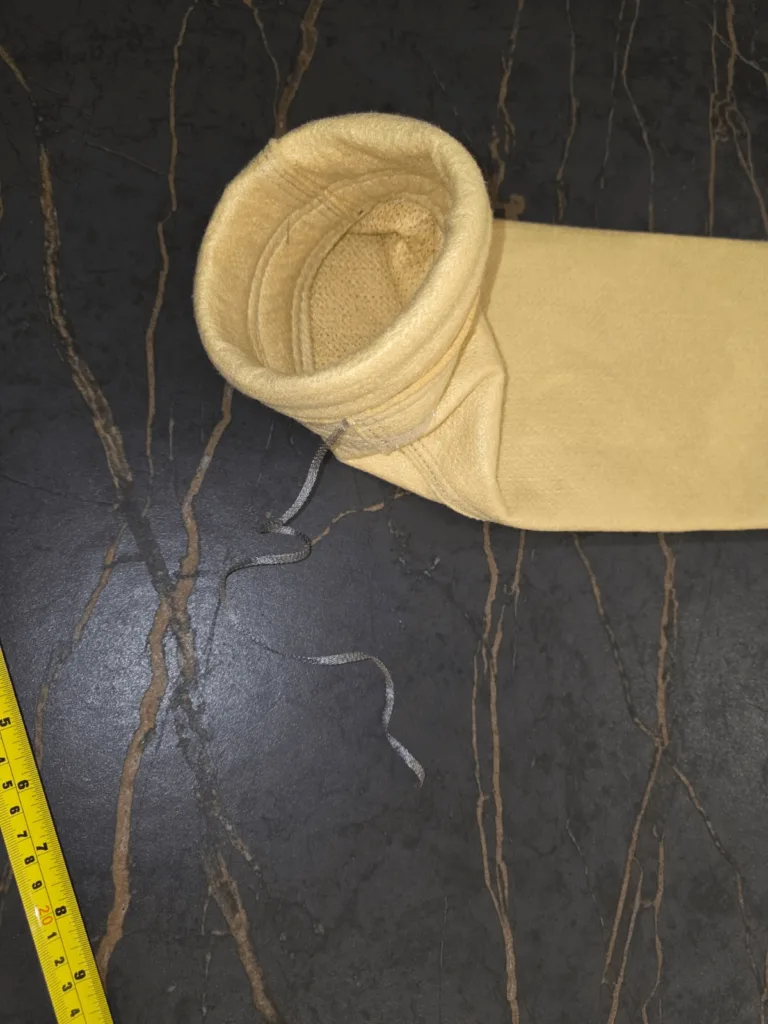
4. Fiberglass for High-Temperature Lead Smelting Gas
Fiberglass filter bags provide high-temperature resistance, dimensional stability, and good chemical resistance. They may be suitable for furnace and smelting applications where gas temperature is too high for polyester, acrylic, or standard PPS.
Depending on the working condition, fiberglass can be treated with PTFE membrane, PTFE dipping, graphite, silicone, or acid-resistant finishes. These treatments can improve dust release, chemical resistance, and filtration efficiency.
The main concern with fiberglass is mechanical flexing. Incorrect cage dimensions, excessive pulse pressure, aggressive cleaning, or rough handling can damage the fibers. Fiberglass performs best when the baghouse uses properly sized cages and carefully controlled cleaning parameters.
5. Aramid for Dry, Medium-High-Temperature Conditions
Aramid is a practical option for dry, elevated-temperature dust collection. It offers good mechanical strength and abrasion resistance, making it useful for certain furnace ventilation and metal-processing applications.
However, aramid is not normally the first choice for wet, strongly acidic, or condensation-prone flue gas. Selecting it only according to temperature can lead to premature chemical or hydrolytic damage.
Aramid with PTFE membrane may be suitable where the gas remains relatively dry but the dust is fine and the emission target is strict. It can also be considered for process areas where abrasion and intermittent temperature peaks are more important than acid resistance.
Why PTFE Membrane Is Valuable for Lead Dust
Lead fumes can contain extremely fine particles. When these particles enter deeply into conventional felt, they can increase residual differential pressure and become difficult to remove through normal pulse cleaning.
A PTFE membrane creates a microporous surface filtration layer. Dust is captured mainly on the surface rather than throughout the depth of the felt. This can improve fine lead particulate capture, reduce dust penetration, support easier cake release, and maintain a more stable pressure drop.
Surface filtration is especially useful in lead oxide production, refining fumes, and strict low-emission systems. It can also reduce the amount of hazardous dust embedded inside used filter bags, although safe replacement and disposal procedures are still required.
PTFE Membrane Is Particularly Useful When:
- The dust contains a high proportion of fine or submicron lead particles.
- Differential pressure rises quickly because dust penetrates into the felt.
- The plant requires lower and more stable particulate emissions.
- The collected lead oxide or dust has recovery value.
- Conventional felt is difficult to clean during pulse operation.
- Moisture or sticky dust increases the risk of bag blinding.
The membrane does not compensate for an unsuitable base fiber. Polyester with PTFE membrane, for example, should not be used in a gas stream that exceeds polyester’s thermal or chemical limits.
Lead Dust Application and Product Recommendation Table
| Process Area | Main Filtration Risk | Recommended Starting Direction |
|---|---|---|
| Battery breaking and material handling | Abrasive dust, acid residue, moderate temperature | Polyester or acrylic for verified mild conditions; antistatic or water/oil treatment if required |
| Furnace charging and smelting | Fine fumes, heat, sparks, and corrosive gas | PPS/PTFE, P84, fiberglass with PTFE membrane, or full PTFE |
| Refining and alloying | Fine oxide fumes and temperature fluctuation | P84, PPS with membrane, aramid with membrane, or PTFE |
| Dross and slag handling | Abrasion, hot particles, and heavy dust load | Stronger felt, wear reinforcement, and suitable inlet protection |
| Lead oxide production | Very fine product dust and recovery requirements | PTFE membrane on a chemically compatible base felt |
| High-corrosion flue gas | Acid gases, moisture, and cage corrosion | Full PTFE or fiberglass/PTFE with corrosion-resistant cages |
| Strict low-emission system | Fine lead penetration and leak sensitivity | PTFE membrane, accurate bag fit, leak detection, and high-quality sealing |
Baghouse Design Factors That Affect Filter Bag Performance
Even the correct filter material may fail if the baghouse is poorly designed or maintained.
An excessive air-to-cloth ratio forces too much gas through the available filtration area. This increases dust penetration, differential pressure, cleaning frequency, and mechanical wear. Fine lead fume applications usually require a more conservative filtration velocity than coarse, easy-to-release dust.
Airflow distribution is equally important. High-velocity particulate should not strike the first rows of filter bags directly. Inlet baffles, dropout sections, and abrasion protection can remove heavier particles and distribute gas more evenly across the baghouse.
The hopper and dust discharge system must also remain sealed. Collected lead dust should not accumulate in the hopper or leak from rotary valves, screw conveyors, flanges, and transfer containers. A baghouse may capture dust successfully while a leaking conveyor releases the same hazardous material back into the workplace.
Cage condition must be checked whenever bags are replaced. Bent, corroded, rough, or incorrectly sized cages can create vertical wear marks and holes. Depending on temperature and chemical exposure, plants may use galvanized, epoxy-coated, silicone-coated, or stainless steel filter bag cages.
Mid-System Inspection Priorities
During routine inspection, maintenance teams should focus on several connected areas rather than checking only the filter bags:
- Differential-pressure trends and abnormal pressure changes
- Inlet baffles and the first rows of bags exposed to dust impact
- Hopper levels, bridging, and discharge equipment
- Rotary valves, screw conveyors, and dust-container seals
- Pulse valves, diaphragms, blow-pipe alignment, and compressed air quality
- Cage corrosion, broken wires, rough welds, and bag-to-cage fit
- Clean-air chamber dust deposits and signs of bag leakage
These inspections help distinguish filter-media problems from airflow, cleaning, sealing, or mechanical problems.
Public Industry Case Lessons
Case 1: Dust Collection Equipment Can Become an Exposure Source
Industry guidance for secondary lead smelters emphasizes that furnaces and ventilation systems commonly direct contaminated gas through cyclones, scrubbers, and baghouses. However, the dust collection system itself can become a significant lead-exposure source when it is not properly operated, cleaned, and maintained.
This means filtration efficiency alone is not enough. Access doors, hopper seals, rotary valves, screw conveyors, clean-air chambers, and maintenance procedures should all be included in the plant’s inspection program.
Case 2: Enclosed Flue-Dust Conveying
Baghouse flue dust is often transferred by screw conveyors to storage or further processing. Worn conveyor seals, open joints, and poorly enclosed discharge points can release collected lead dust.
For this reason, dust discharge equipment should remain enclosed and be inspected regularly for leakage, abnormal dust accumulation, and worn sealing components. Operators should not treat the hopper and conveyor as separate from the emission-control system.
Case 3: Membrane Filtration for Fine Metallurgical Dust
Public metallurgical filtration references show that membrane filter bags can help reduce particulate emissions, stabilize airflow, and extend operating periods in steel, lead, and ferroalloy applications.
For lead processing, this supports using PTFE membrane where fine-particle penetration, rising differential pressure, or strict emissions are the main concerns. The base material must still be selected according to actual temperature, moisture, oxygen, and gas chemistry.
Information Needed Before Selecting Lead Dust Filter Bags
A reliable recommendation requires more than the filter bag dimensions. Before confirming the media, provide information about the process section, baghouse type, cleaning method, continuous and peak temperature, gas moisture, dew point, oxygen level, corrosive components, dust concentration, and emission requirement.
The supplier should also review the current filter bag material, service life, bag and cage dimensions, differential-pressure history, and photographs of the failed bags, dust cake, and cages.
These details help determine the appropriate fiber, membrane, surface treatment, sewing thread, reinforcement design, cage finish, and cleaning parameters.
How to Reduce Lead Dust Emissions and Extend Bag Life
Reliable lead dust control requires disciplined operation in addition to correct filter media selection. Plants should monitor differential pressure and emissions, keep gas temperature above the relevant dew point, use clean and dry compressed air, and prevent sparks or hot particles from reaching the bags.
Hoppers should be emptied continuously, and screw conveyors and dust containers should remain sealed. Cages should be inspected before every bag replacement, while failed bags should be analyzed before the same specification is ordered again.
When damage repeatedly appears in the same row or position, the cause is often related to airflow, cage condition, or baghouse design rather than filter media quality alone.
Final Recommendation
The best lead dust emission filter bag is not automatically the material with the highest temperature rating or highest price.
For cooled and relatively mild material-handling applications, polyester or acrylic may be sufficient. PPS with PTFE membrane is often suitable for humid and acidic gas when oxidation remains controlled. P84 can improve fine-fume capture at elevated temperature. Fiberglass is a strong option for high-temperature smelting gas, while full PTFE is usually the safest direction for highly corrosive, humid, or strict-emission conditions.
Omela Filtration provides polyester, acrylic, aramid, PPS, P84, fiberglass, PTFE, membrane-treated filter bags, and corrosion-resistant cages for lead smelting, battery recycling, lead oxide production, refining, casting, and heavy-metal dust control.
The final recommendation should always be based on actual process data. Correct material selection, reliable sealing, stable airflow, sealed dust discharge, and preventive maintenance must work together to control lead emissions safely and consistently.
FAQ
1. What filter bag material is best for lead smelting?
PTFE, PPS with PTFE membrane, P84, and fiberglass with PTFE treatment are common options. The best material depends on gas temperature, moisture, oxygen, corrosive gases, dust characteristics, and emission requirements.
2. Why is PTFE membrane recommended for lead dust?
PTFE membrane captures fine lead particles mainly on the filter surface. This can reduce depth penetration, improve dust release, stabilize differential pressure, and support lower particulate emissions.
3. Can polyester filter bags be used for lead dust?
Polyester may be used for cooled, dry, moderate-temperature material-handling dust when the gas chemistry is mild. It should not be used in hot, humid, strongly acidic, or hydrolysis-prone conditions.
4. Is PPS suitable for secondary lead smelters?
PPS may be suitable for humid and acidic flue gas at medium-high temperature. However, oxygen concentration and temperature must be reviewed because excessive oxidation can weaken PPS.
5. What causes high differential pressure in lead dust baghouses?
Common causes include fine-particle penetration, moisture, condensation, sticky dust, insufficient cleaning, excessive air-to-cloth ratio, blocked hopper discharge, and unsuitable filter media.
6. Why do lead dust filter bags fail near the cage wires?
Vertical wear marks or holes often indicate bent, corroded, rough, or incorrectly sized cages. The cage should be inspected or replaced before new bags are installed.
7. What information is needed to quote lead dust filter bags?
Provide the process type, temperature, gas chemistry, moisture, dust concentration, emission target, bag dimensions, cage details, current material, service life, and photos of used bags.
Author

Jessica Ma – Senior Filtration Engineer, Omela Filtration
Jessica Ma is a senior filtration engineer at Omela Filtration, specializing in dust and liquid filtration. With over 15 years of experience, she focuses on optimizing baghouse performance, enhancing filtration efficiency, and developing high-performance solutions for industrial dust collectors and precision liquid filtration applications.