
Key Takeaways
High-viscosity liquid filtration requires more than selecting a filter bag with the desired micron number. As viscosity increases, the liquid encounters greater resistance while passing through the media. This can reduce flow, increase initial differential pressure, shorten filter life, and place additional load on the pump and support basket.
The most important selection factors are:
- Viscosity at the actual operating temperature
- Required flow rate and acceptable initial pressure drop
- Particle size, concentration, shape, and compressibility
- Chemical compatibility between the liquid and filter media
- Nominal or absolute filtration requirements
- Filter area, housing size, and number of bags
- Ring, flange, gasket, and construction compatibility
Omela liquid filter bags are available in polypropylene, polyester, nylon mesh, multifilament mesh, high-efficiency multilayer media, and oil-absorbing constructions. Standard and customized sizes can be supplied with sewn or fully welded bodies, steel rings or plastic flanges, and optional handles.
For applications requiring finer polishing after bag filtration, Omela also supplies industrial filter cartridges. Additional information about multilayer polypropylene media is available in our guide to absolute-precision polypropylene filter bags.
Why Viscosity Changes Filter Bag Performance
Viscosity describes a liquid’s resistance to flow. Water moves easily through a filter bag, while resin, adhesive, heavy oil, concentrated syrup, ink, or coating may require substantially more pressure to pass through the same media.
For a given filter bag, clean differential pressure generally increases as either flow rate or viscosity increases. It also rises when a finer or denser filter medium is selected.
This means a filter bag that provides a high flow rate for water may perform very differently when used with a liquid that is hundreds or thousands of centipoise.
Some industrial liquid filter bags are documented for fluids with viscosities of 10,000 cP or higher. However, this figure should not be treated as a universal limit. Actual performance depends on the media, micron rating, filter area, operating temperature, solids loading, pump capacity, housing design, and allowable differential pressure.
Viscosity is also temperature-dependent. Many oils, resins, syrups, and coatings become less viscous when heated. Where the process and product permit it, maintaining a controlled operating temperature can improve flow and reduce pressure drop. The maximum temperature limits of the filter media, seals, housing, and liquid must still be respected.
Typical High-Viscosity Liquid Applications
High-viscosity filter bags are used across chemical processing, coatings, petroleum, food production, automotive manufacturing, and general industrial operations.
Common fluids include:
- Paints, varnishes, coatings, and printing inks
- Adhesives, sealants, and plastisols
- Polymer resins and chemical intermediates
- Hydraulic oils, lubricants, and gear oils
- Edible oils, syrups, concentrates, and liquid sugar
- Cosmetics, gels, detergents, and personal-care products
- Coolants and metalworking fluids
- Crude oil and petroleum process liquids
These liquids do not require the same filter bag simply because they are viscous. A resin containing hard agglomerates may need a mesh or felt bag, while an oil containing fine particles and free oil droplets may require a multilayer or oil-absorbing construction.
How Viscosity Affects the Main Design Decisions
A higher viscosity normally leads to a higher clean pressure drop through the filter media. To compensate, the filtration system may need a coarser rating, more open media, additional filter area, a larger housing, multiple bags, lower flow per bag, or controlled heating.
The correct response is not automatically to select a stronger pump. Excessive pump pressure may deform the bag, force contaminants through nominal media, damage seams, collapse an unsupported bag, or create unsafe pressure inside the housing.
A better system design balances four variables:
- Flow: the volume of liquid that must be processed per unit of time
- Viscosity: measured at the real operating temperature
- Media resistance: influenced by material, construction, and micron rating
- Filter area: determined by bag size and the number of bags in service
When one variable increases, another may need to change. For example, maintaining the same flow after viscosity rises may require more filter area.
Filter Bag Media Selection
| Filter Media | Typical Micron Range | Main Function | Suitable High-Viscosity Applications |
|---|---|---|---|
| Polypropylene Needle Felt | 1–200 μm | Depth filtration with broad chemical compatibility | Acids, alkalis, chemicals, oils, resins, inks, and process liquids |
| Polyester Needle Felt | 1–200 μm | Strong mechanical performance and stable depth filtration | Paints, coatings, coolants, lubricants, and moderately aggressive liquids |
| Nylon Monofilament Mesh | Approximately 5–800 μm or more | Precise surface filtration with reusable mesh | Coarse particles in paints, resins, oils, food liquids, and wash fluids |
| Polypropylene Monofilament Mesh | Approximately 250–800 μm | Coarse surface filtration with chemical resistance | Aggressive chemicals and liquids requiring large-particle removal |
| Polyester Multifilament Mesh | Approximately 75–1500 μm | Economical surface filtration with good strength | Coarse filtration of viscous liquids with high solids loading |
| High-Efficiency Multilayer PP | Approximately 0.5–90 μm | Fine filtration with graded density and higher dirt capacity | Resins, coatings, chemicals, oils, and critical polishing applications |
| Oil-Absorbing Polypropylene | Approximately 1–50 μm | Captures particles while absorbing free or dispersed oil | Wash water, condensate, coolants, and oil-contaminated process liquids |
Available ratings vary by media design and manufacturer. A micron number should therefore be evaluated together with the filter’s stated efficiency.
Polypropylene Felt Filter Bags
Polypropylene is one of the most widely used materials for industrial liquid filtration because it offers broad resistance to acids, alkalis, and many chemical solutions.
Function
Polypropylene needle felt works as a depth filter. Particles are captured not only on the surface but also within the thickness of the fiber structure.
This provides greater dirt-holding capacity than a simple single-layer mesh, especially when the contamination contains particles of different sizes.
Best Uses
Polypropylene felt is commonly considered for chemical products, resins, inks, lubricating oils, electroplating liquids, water treatment, and other applications requiring chemical compatibility.
It is also naturally oleophilic and hydrophobic, making specially designed polypropylene microfiber bags useful for oil-absorbing applications.
Limitations
Polypropylene has a lower temperature capability than polyester or high-temperature fibers. Its compatibility with strong oxidizing chemicals, solvents, and the process temperature must be confirmed before use.
Polyester Felt Filter Bags
Polyester needle felt provides good tensile strength, dimensional stability, and abrasion resistance. It is often selected where mechanical durability is more important than the broader chemical resistance of polypropylene.
Function
The dense three-dimensional fiber structure captures particles throughout the media depth. Singed or glazed surfaces may reduce fiber migration and improve the release of accumulated solids.
Best Uses
Polyester bags are commonly used for paints, coatings, coolants, lubricants, parts-washing fluids, aqueous process liquids, and moderately aggressive chemicals.
For viscous coatings or inks, polyester can offer a useful balance between flow, strength, and contaminant-holding capacity.
Limitations
Polyester is less suitable for strong alkaline solutions and hydrolysis-prone conditions. Chemical compatibility should be checked using the actual fluid composition and operating temperature.
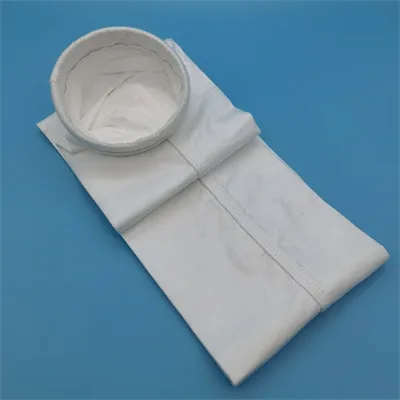
Mesh Filter Bags
Mesh bags operate mainly through surface filtration. Particles larger than the mesh opening are retained on the surface rather than throughout the depth of the media.
Monofilament mesh is woven from individual strands and provides relatively uniform openings. Multifilament mesh uses yarns made from multiple smaller filaments, offering good strength and an economical solution for many coarse-filtration duties.
Function
Mesh media provides an open flow path and generally creates less resistance than fine needle felt. This makes it useful for high-viscosity liquids where only larger particles need to be removed.
Mesh bags may also be cleaned and reused when the process, contamination, and sanitation requirements permit.
Best Uses
Nylon or polyester mesh can be used to remove gels, skins, agglomerates, resin particles, paint lumps, fibers, and other relatively large contaminants.
A mesh prefilter can also protect a finer felt bag or cartridge installed downstream.
Limitations
Mesh does not usually provide the same fine-particle dirt capacity as depth felt. It may blind quickly if the liquid contains a large quantity of particles close to the mesh opening or soft contaminants that deform and block the pores.
High-Efficiency and Multilayer Filter Bags
A standard felt bag may not provide the predictable efficiency required for critical final filtration. High-efficiency filter bags use microfiber layers, graded-density structures, meltblown media, or multiple filtration layers to improve retention.
Function
A coarse inner layer captures larger particles first, while progressively finer layers retain smaller contaminants. This distributes the solids through the media instead of concentrating them on one thin surface.
The result can be:
- Greater dirt-holding capacity
- More predictable particle removal
- Longer service life
- Lower risk of premature surface blockage
- Fewer bag change-outs
High-efficiency bags may be available with defined efficiencies of 90%, 95%, 99%, or other manufacturer-specific ratings.
Best Uses
These bags are suitable for fine chemical filtration, resin polishing, hydraulic and lubricating oils, coatings, activated-carbon removal, pharmaceutical preparation, and other processes where ordinary nominal felt is insufficient.
Because fine multilayer media creates more resistance than coarse mesh, its pressure drop must be calculated using the real liquid viscosity.
Oil-Absorbing Filter Bags
Oil-absorbing bags are normally manufactured from specially structured polypropylene microfibers. They combine particulate filtration with the ability to capture free or dispersed hydrocarbons.
Function
The polypropylene fibers attract and retain oil while allowing water or another continuous phase to pass through. A multilayer design increases the oil-holding capacity and particle-removal efficiency.
Best Uses
Typical applications include oily wash water, boiler condensate, metalworking coolants, degreasing fluids, electrophoretic paint systems, and industrial wastewater.
Important Distinction
Oil-absorbing bags should not automatically be selected for filtering lubricating oil or hydraulic oil.
When the product itself is oil, an oil-absorbing bag may retain valuable process fluid and load prematurely. These bags are intended primarily for removing unwanted oil from another liquid phase.
How to Choose the Correct Micron Rating
The best micron rating is not necessarily the smallest available number.
For high-viscosity liquids, selecting an unnecessarily fine bag can produce excessive clean pressure drop, slow production, increase pump load, and shorten the operating cycle.
The rating should be based on the smallest particle that can damage the product, equipment, nozzle, coating finish, or downstream process.
For example:
- 100–800 μm: removal of coarse debris, gels, skins, fibers, and large agglomerates
- 25–100 μm: general clarification and equipment protection
- 5–25 μm: fine polishing of paints, oils, chemicals, and process fluids
- Below 5 μm: critical filtration requiring high-efficiency or absolute-style media
These ranges are starting points only. Pilot testing or a sample filtration trial is advisable when particle behavior is unknown.
Nominal vs. Absolute Filtration
A nominal filter bag captures a stated percentage of particles at or above its rated size, but it does not necessarily retain every particle of that size.
An absolute or high-efficiency filter is rated according to a defined removal efficiency. The supplier should state the efficiency, test method, and particle size rather than using the term “absolute” without supporting data.
For critical viscous-liquid applications, specifications should include both the micron rating and required efficiency. A “10 μm” nominal bag and a “10 μm at 99% efficiency” bag may produce very different results and pressure drops.
Sewn vs. Fully Welded Construction
Liquid filter bags may be manufactured with sewn seams or thermally welded seams.
Sewn Bags
Sewn construction is economical, flexible, and suitable for many felt and mesh materials. It is commonly used for standard industrial filtration.
Needle holes may create potential bypass paths in critical fine-filtration applications. Proper thread, seam overlap, and protective tape can reduce this risk.
Fully Welded Bags
A welded bag uses thermal or ultrasonic bonding to join compatible media without sewing needle holes.
Its main benefits include:
- Reduced risk of seam bypass
- Cleaner internal construction
- Consistent seam geometry
- Lower risk of thread contamination
- Suitability for high-efficiency applications
Not every material can be welded. The media, ring, flange, and bottom must all be compatible with the welding process.
Steel Ring or Plastic Flange?
The filter bag top must seal correctly against the housing basket and prevent unfiltered liquid from bypassing the media.
Steel Ring
A steel ring is a traditional and widely compatible option. It is commonly used in ring-style housings from multiple manufacturers.
The metal material and any covering should be compatible with the fluid. Stainless steel rings may be preferred for corrosive or sanitary applications.
Plastic Flange
A molded polypropylene or polyester flange can provide a flexible, pressure-activated seal. Plastic flanges are lightweight, corrosion-resistant, and may support easier installation.
The flange shape must match the specific housing. A plastic flange designed for one brand or basket geometry may not seal correctly in another housing.
Handle Option
A handle makes a saturated bag easier and safer to remove. This is particularly useful when filtering viscous products because the used bag may retain significant liquid and become heavy.
The handle should be strong enough for the expected wet weight and compatible with the process fluid.
Standard Liquid Filter Bag Sizes
| Bag Size | Approximate Diameter | Approximate Length | Typical Filter Area |
|---|---|---|---|
| Size #1 | 7 in / 178–179 mm | 16–17 in / 406–419 mm | 0.19 m² |
| Size #2 | 7 in / 178–179 mm | 32 in / 813 mm | 0.41 m² |
| Size #3 | 4 in / 102–105 mm | 8–8.25 in / 203–210 mm | 0.05 m² |
| Size #4 | 4 in / 102–105 mm | 14 in / 355–356 mm | 0.09 m² |
Size #2 provides approximately twice the area of Size #1 and is frequently preferred where higher flow, higher viscosity, or longer service intervals are required.
Dimensions can differ slightly between manufacturers and seal styles. The housing model, basket dimensions, ring or flange, and existing bag sample should be checked before ordering.
Selecting the Right Housing
The housing is as important as the filter bag. A correctly selected bag cannot deliver the required flow if the vessel, basket, piping, or inlet design creates excessive restriction.
Single-Bag Housing
A single-bag housing is suitable for lower flow rates, batch processes, pilot systems, and applications with manageable solids loading.
For viscous fluids, a Size #2 housing normally offers lower velocity and more filter area than a Size #1 housing.
Multi-Bag Housing
A multi-bag housing distributes flow across several bags. This reduces the flow and pressure drop through each individual bag.
It is often the better choice when the process has:
- High viscosity
- High total flow
- Heavy contaminant loading
- Long required operating cycles
- Limited allowable pump pressure
Multi-bag systems also reduce the frequency of shutdowns for filter replacement.
Duplex Housing
A duplex or parallel housing arrangement allows one filter to remain in service while the other is isolated for bag replacement.
This is useful for continuous production lines that cannot be stopped when differential pressure reaches the change-out limit.
Top-Inlet and Side-Inlet Designs
A top-inlet housing can direct the liquid into the open end of the bag, helping seat the seal and reducing the amount of unfiltered product retained above the bag.
Side-inlet housings are common and versatile but should incorporate proper internal flow distribution and bag hold-down components.
For high-value viscous products, minimizing residual volume can reduce product loss during change-outs.
Housing Features for High-Viscosity Liquids
The support basket should have sufficient open area and mechanical strength. It must support the bag under differential pressure without creating unnecessary flow restriction.
The housing should also include suitable pressure gauges or differential-pressure monitoring. A rising pressure drop indicates that the bag is loading with contaminants or that viscosity has changed.
Other important features include:
- Correctly sized inlet and outlet connections
- Chemically compatible housing material
- Compatible O-rings or gaskets
- Bag hold-down or anti-collapse devices
- Safe venting and draining
- Quick-opening mechanisms where frequent changes are expected
- Heating jackets or insulation where controlled warming is required
For products whose viscosity rises rapidly as they cool, a jacketed or heat-traced housing may help maintain flow. Heating must be controlled to avoid product degradation and exceeding the filter bag or seal temperature limits.
Should You Use One Fine Bag or Staged Filtration?
Staged filtration is often more economical for viscous liquids with broad particle distributions or high solids loading.
A coarse mesh bag can remove large agglomerates before the liquid reaches a finer felt or high-efficiency bag. This protects the final media, increases its service life, and reduces sudden pressure increases.
A typical arrangement may use:
- A coarse mesh bag for gels and large debris
- A felt or multilayer bag for general clarification
- A cartridge filter for final polishing where required
The correct stages depend on the target particle size and product quality requirements.
Public Industry Case Lessons
Case 1: Increasing Coating Production Capacity
A U.S. manufacturer of water- and solvent-based wood finishes needed a filtration system capable of supporting a higher automated production rate. Its existing system required frequent maintenance, bag changes, and downtime.
After installing higher-capacity single-bag housings, the reported production flow increased from approximately 4 to 9.5 gallons per minute. Sampling-related downtime also fell from about 30 minutes to five minutes, while total production increased substantially.
The lesson for viscous coatings is that housing capacity, ease of operation, and product hold-up can be just as important as the filter bag micron rating.
Case 2: Filtering Automotive Plastisol
A European supplier of automotive coatings experienced nozzle blockages because its existing filtration system allowed oversized particles to enter the final plastisol product.
The company installed top-inlet bag filter housings with fully welded mesh bags and pressure-responsive seals. Improved particle control reduced nozzle clogging, product waste, and unplanned maintenance.
This case demonstrates why precise surface filtration and bypass-free sealing are particularly important when a viscous liquid is applied through small injection nozzles.
Case 3: Extending the Life of Oily Washing Fluid
A German automotive component manufacturer used a staged process to remove coarse oils, particles, and fine contaminants from part-washing fluids.
High-capacity bag elements combining depth felt and a final mesh layer helped keep the process fluid cleaner for longer. The company could recycle the washing fluid through more operating cycles, reducing purchases and disposal.
The lesson is that multilayer and staged filtration may lower total operating cost even when the filter element itself costs more than a standard single-layer bag.
When a Filter Bag May Not Be the Best Solution
Bag filters are economical and versatile, but they are not ideal for every high-viscosity process.
An automatic self-cleaning filter, scraper filter, backwashing filter, basket strainer, or another technology may be more appropriate when:
- The liquid is extremely viscous and difficult to pass through disposable media
- Solids loading is very high
- Continuous flow is required without bag changes
- The contaminants form a rapidly compressible cake
- Frequent disposal of product-filled bags is too expensive
- The process needs automatic solids discharge
A filter bag may still be useful as a prefilter or final safety filter in a broader filtration system.
Information Needed Before Selecting a Filter Bag
A reliable recommendation requires actual process data rather than only the liquid name.
Provide the following information:
- Liquid name and complete chemical composition
- Viscosity at the operating temperature
- Normal and maximum temperature
- Required flow rate
- Particle size and target removal efficiency
- Solids concentration and contaminant description
- Current filter media and service life
- Initial and final differential pressure
- Housing brand, model, and number of bags
- Bag size, ring, flange, and gasket details
- Batch or continuous operating mode
- Food-contact, pharmaceutical, or silicone-free requirements
A fluid sample, particle analysis, existing bag, or filtration test can help confirm the recommendation.
Final Recommendation
The best high-viscosity liquid filter bag is the one that delivers the required particle retention without creating an unacceptable pressure drop or change-out frequency.
For chemically aggressive liquids, acids, alkalis, resins, and many oils, Omela polypropylene needle-felt filter bags provide broad chemical compatibility and good depth-filtration capacity.
For paints, coatings, coolants, lubricants, and applications requiring greater mechanical strength, Omela polyester felt filter bags can provide a practical balance of durability, flow, and cost.
When only coarse particles, gels, fibers, or agglomerates must be removed, Omela nylon, polypropylene, or polyester mesh bags offer a more open structure and lower pressure resistance. These bags can also be used as prefilters before finer felt or cartridge filtration.
For finer filtration and more predictable efficiency, Omela can supply multilayer, meltblown, graded-density, and absolute-precision polypropylene filter bags. Oil-absorbing polypropylene constructions are also available for applications where unwanted oil must be removed from water, condensate, or another liquid phase.
Filter bags can be manufactured in standard Sizes #1, #2, #3, and #4 or customized dimensions. Available construction options include sewn or fully welded seams, steel rings, plastic flanges, drawstrings, and handles.
Omela can also provide matching single-bag, multi-bag, side-inlet, top-inlet, stainless steel, and plastic filter housings. Housing selection will be based on the required flow, viscosity, solids loading, operating pressure, temperature, chemical compatibility, and preferred change-out interval.
Customers are welcome to contact Omela Filtration with their liquid viscosity, operating temperature, flow rate, micron requirement, chemical composition, housing details, and current filtration problems. Our engineers will evaluate the complete process and recommend a suitable media, micron rating, bag construction, seal, size, and housing configuration.
FAQ
1. What filter bag material is best for high-viscosity liquids?
There is no universal best material. Polypropylene is commonly selected for chemical compatibility, polyester for mechanical strength, mesh for coarse low-resistance filtration, and multilayer polypropylene for higher-efficiency particle removal.
2. How does viscosity affect filter bag pressure drop?
Higher viscosity increases the resistance of liquid flowing through the media. At the same flow rate, a more viscous liquid normally produces a higher clean differential pressure and may require more filtration area.
3. What micron rating should be used for a viscous liquid?
The rating should be based on the smallest harmful particle rather than selecting the finest available bag. Overly fine media can create excessive pressure drop and short filter life.
4. Is felt or mesh better for high-viscosity filtration?
Mesh usually provides lower resistance and is suitable for coarse surface filtration. Felt provides depth filtration and greater dirt-holding capacity for finer or mixed-size particles.
5. Are welded liquid filter bags better than sewn bags?
Fully welded bags reduce the potential for leakage through sewing holes and are useful for fine or high-efficiency filtration. Sewn bags remain suitable and economical for many general industrial applications.
6. Should a high-viscosity process use a single-bag or multi-bag housing?
A single-bag housing may be sufficient for lower-flow batch processing. Multi-bag housings are generally better for high flow, high viscosity, heavy solids loading, or longer required operating cycles.
7. What information is needed to quote high-viscosity liquid filter bags?
Provide the liquid composition, viscosity at operating temperature, flow rate, particle size, solids loading, micron and efficiency target, temperature, pressure, housing model, bag size, seal type, and current service-life data.
Author

Jessica Ma – Senior Filtration Engineer, Omela Filtration
Jessica Ma is a senior filtration engineer at Omela Filtration, specializing in dust and liquid filtration. With over 15 years of experience, she focuses on optimizing baghouse performance, enhancing filtration efficiency, and developing high-performance solutions for industrial dust collectors and precision liquid filtration applications.