
Key Takeaways
A sugar mill does not have only one type of dust. Fine sugar released from screens, elevators, silos, and packaging equipment has very different filtration and safety requirements from the hot, abrasive fly ash generated by a bagasse-fired boiler.
The correct filter bag should be selected according to the actual collection point, operating temperature, moisture, particle size, abrasiveness, gas chemistry, combustible-dust risk, cleaning method, and required emission level.
For dry sugar handling at moderate temperatures, polyester or antistatic polyester may provide an economical solution. Hotter boiler gas may require aramid, PPS, P84, fiberglass, FMS, or PTFE-based media. PTFE membrane can be added to a compatible base felt when fine-particle capture, surface filtration, easier cleaning, or more stable differential pressure is required.
Omela supplies a broad range of industrial dust filter bags for sugar processing and biomass boiler applications. Typical options include polyester filter bags for moderate dry dust, PPS filter bags for humid and chemically demanding flue gas, and PTFE filter bags for severe operating conditions.
Why Sugar Mills Need Different Filter Bags for Different Processes
The phrase “sugar industry dust” can refer to several materials with completely different behavior inside a dust collector.
Granulated or powdered sugar released during drying, screening, conveying, silo filling, and packaging is generally dry and fine. It can enter deeply into conventional felt, raise differential pressure, leak through poorly fitted bags, and form combustible dust clouds if it escapes from process equipment.
Bagasse boiler ash presents another challenge. Bagasse is the fibrous residue left after juice extraction and is commonly burned to generate steam and electricity. Its combustion produces fly ash, unburned carbon, char, and mineral particles. This dust can be hot, abrasive, irregular in size, and occasionally accompanied by sparks or glowing particles.
Other filtration points may include lime handling, carbon preparation, sugar drying and cooling, bagasse transport, boiler ash discharge, storage silos, and general ventilation. Because these processes differ in temperature, humidity, chemistry, and dust characteristics, using one bag material throughout an entire sugar plant may result in premature failure or unnecessary cost.
A better approach is to divide the plant into product dust, material-handling dust, and boiler flue-gas applications, and then select the filter media for each area independently.
Typical Dust Sources in Sugar Processing
Dry sugar dust is commonly generated when crystals move between dryers, coolers, vibrating screens, conveyors, bucket elevators, storage bins, and packaging equipment. Powdered sugar production can create particularly fine dust because grinding and blending increase the proportion of small airborne particles.
Bagasse handling systems generate a mixture of fibrous and mineral dust. The moisture content of the bagasse may vary, so the collected material can range from dry and easily released to damp and cohesive. Lime, activated carbon, and boiler ash may create additional abrasive or chemically different dust streams.
Boiler emissions depend on fuel preparation and combustion quality. Cane that carries excessive soil into the mill can increase the mineral content of bagasse ash. Wet bagasse may burn less consistently and require auxiliary fuel during startup or low-load operation, changing the temperature and chemistry seen by the filter bags.
These variations make actual operating records more valuable than a single design temperature written on a data sheet.
Quick Filter Media Selection Table
| Filter Media | Typical Sugar Industry Application | Main Considerations |
|---|---|---|
| Polyester | Dry sugar handling, packaging, conveying, and moderate-temperature dust | Economical and mechanically strong, but unsuitable for high heat, condensation, or aggressive gas |
| Antistatic Polyester | Powdered sugar, silos, bucket elevators, and packaging lines | Helps dissipate static when properly grounded but does not replace explosion protection |
| Acrylic | Humid material handling or moderate-temperature gas | Better hydrolysis resistance than polyester but has a lower temperature limit than PPS or aramid |
| Aramid | Dry, elevated-temperature bagasse boiler ash | Good thermal and abrasion resistance; condensation and acidic gas must be controlled |
| PPS | Humid or mildly acidic boiler flue gas | Good hydrolysis and acid resistance; oxidation risk must be evaluated |
| P84 | Fine fly ash, high temperature, and strict emission control | Strong fine-particle capture, but moisture and chemical compatibility require confirmation |
| Fiberglass | High-temperature bagasse and biomass boiler flue gas | Excellent dimensional stability; careful cage and pulse-cleaning design is required |
| FMS Composite | High temperature combined with abrasive ash and changing chemistry | Provides a balance of heat, abrasion, and chemical resistance |
| PTFE | Highly corrosive, humid, high-temperature, or low-emission systems | Broad chemical resistance and stable performance with a higher initial investment |
| Base Felt with PTFE Membrane | Fine sugar dust or fly ash requiring surface filtration | Improves dust release and capture, but the base fiber must still match the process |
The table provides initial guidance rather than fixed rules. The final selection should consider continuous and peak temperatures, gas analysis, fuel composition, dust loading, air-to-cloth ratio, and cleaning intensity.
Polyester Filter Bags for Sugar Handling and Packaging
Polyester is commonly selected for dry sugar dust because it offers good mechanical strength and cost efficiency under moderate conditions. It can perform reliably in packaging machines, screens, conveyor transfer points, and silo ventilation systems when the air remains dry and the temperature stays safely within the material’s operating range.
Surface treatment may improve performance. Singeing and calendering create a smoother filtration surface that can help sugar dust release during cleaning. For very fine sugar or lower emission targets, PTFE membrane may be laminated onto the polyester felt.
However, moisture control is essential. Sugar is soluble and can become sticky when exposed to condensation or water. Once a wet sugar cake forms inside the felt, pulse cleaning may no longer remove it effectively. Differential pressure rises, airflow falls, and operators may respond by increasing pulse frequency, which can accelerate mechanical wear without solving the underlying moisture problem.
For systems where collected sugar is returned to production, the filter bag construction should also be reviewed for hygiene, fiber shedding, stitching, cleanability, and any applicable food-processing requirements.
Antistatic Filter Bags for Combustible Sugar Dust
Fine sugar dust can be combustible when dispersed in air. Static electricity is one possible ignition source, particularly in dry conveying, grinding, silo, and packaging applications.
Antistatic polyester bags may contain conductive yarns or fibers arranged in line, grid, or blended constructions. When the bags, cages, tube sheet, and collector housing are correctly connected to ground, the conductive path can help prevent electrostatic charge from accumulating on the filter media.
Antistatic media should be treated as one part of a wider dust-hazard strategy. It does not make a conventional collector inherently safe for combustible dust.
A complete assessment may need to address:
- Dust explosibility and process-specific ignition risks
- Bonding and grounding of conductive components
- Explosion venting, suppression, or containment
- Explosion isolation between connected equipment
- Spark, overheated bearing, and hot-particle detection
- Enclosed conveying and effective source capture
- Safe dust discharge and housekeeping procedures
The collector location, fan arrangement, ductwork, hopper, rotary valve, and downstream equipment should be reviewed as a connected system according to applicable local standards.
Aramid Filter Bags for Dry Bagasse Boiler Ash
Aramid is a practical option when bagasse boiler gas is too hot for polyester but remains relatively dry. It provides good heat resistance, tensile strength, and abrasion resistance, which are valuable when the ash contains coarse or irregular particles.
The condition of the inlet system is particularly important. High-velocity ash striking the first rows of bags can wear even a strong aramid felt. Inlet baffles, dropout chambers, spark arrestors, and appropriate bag spacing may be necessary to protect the media.
Aramid should not be selected only by comparing the normal gas temperature with the fiber’s temperature rating. Frequent condensation, acidic compounds, and unstable startup conditions may weaken the material. The plant should provide the normal temperature, highest recorded peak, moisture level, auxiliary fuel, and startup procedure before a final specification is confirmed.
Aramid with PTFE membrane may be considered where the gas is dry but the fly ash is fine, difficult to clean, or subject to a more demanding stack emission limit.
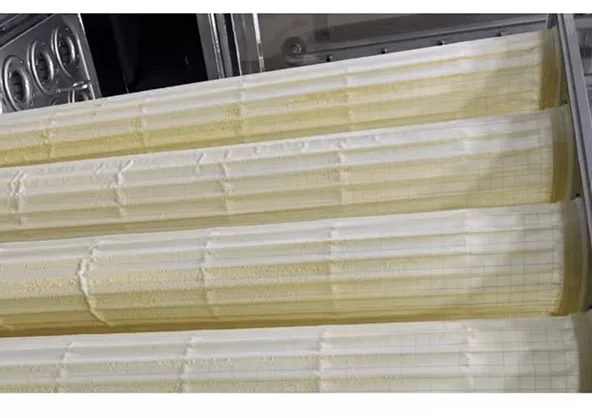
PPS Filter Bags for Humid and Mildly Acidic Flue Gas
PPS combines medium-high temperature capability with strong resistance to hydrolysis and many acidic gas conditions. It can be suitable for bagasse or mixed-biomass boiler systems where moisture and chemical exposure would shorten the service life of aramid or polyester.
PPS with PTFE membrane provides a useful combination of base-fiber resistance and surface filtration. The membrane captures fine ash at the surface, reducing deep penetration and supporting more stable cleaning behavior.
The main limitation of PPS is oxidation. Elevated oxygen content combined with high temperature can gradually reduce fiber strength. This means that oxygen concentration, temperature history, excess-air operation, and process upsets should be evaluated before PPS is recommended.
PPS may be an appropriate choice when the boiler flue gas is humid or mildly acidic, but it is not automatically the best option for every biomass boiler. For severe oxidation, higher temperature, or highly variable chemistry, a different fiber or composite material may be safer.
P84, Fiberglass, FMS, and PTFE for Demanding Boiler Conditions
P84 has a multilobal fiber cross-section that creates a large effective filtration surface. It is useful for fine fly ash and may help reduce particle penetration in systems where conventional felt does not provide sufficient emission performance.
Fiberglass offers high-temperature resistance and excellent dimensional stability. Woven fiberglass or fiberglass needle felt can be treated with PTFE membrane, silicone, graphite, or other finishes depending on the gas chemistry and cleaning method.
The primary weakness of fiberglass is flex fatigue. Incorrectly sized cages, rough welds, excessive pulse pressure, and misaligned blow pipes can damage the fibers. It should therefore be used with carefully matched cages and controlled cleaning settings.
FMS is a composite high-temperature media that combines fiberglass with other performance fibers. It may be selected where the application involves high temperature, abrasive ash, and changing chemical conditions that are difficult for a single fiber to manage.
Full PTFE is normally considered for the most severe sugar and biomass boiler conditions. It provides broad resistance to heat, moisture, acids, alkalis, oxidation, and hydrolysis. Its higher purchase cost may be justified where previous materials experienced rapid chemical degradation or where stable low emissions and longer service intervals are more important than the lowest initial price.
Why PTFE Membrane Can Improve Sugar and Bagasse Dust Filtration
Conventional needle felt provides depth filtration. Fine particles may enter the felt structure before a stable dust cake is established, increasing residual differential pressure and making cleaning more difficult.
PTFE membrane adds a microporous surface layer that captures most particles on the outside of the bag. For powdered sugar and fine bagasse ash, this can support easier dust release, more predictable pressure drop, and lower particle penetration.
Membrane filtration may be especially valuable when:
- The dust contains a high proportion of fine particles
- Product recovery is important
- Conventional felt blinds prematurely
- Differential pressure remains high after cleaning
- Emission requirements are strict
- The plant wants to reduce dependence on a thick initial dust cake
PTFE membrane cannot compensate for an unsuitable base fiber. Polyester with membrane still has the temperature and chemical limitations of polyester, while PPS with membrane remains sensitive to excessive oxidation.
Sugar Mill Process and Filter Bag Recommendation Table
| Process Area | Main Filtration Challenge | Recommended Starting Direction |
|---|---|---|
| Sugar screening and packaging | Fine combustible dust and product recovery | Antistatic polyester with smooth surface treatment; optional PTFE membrane |
| Powdered sugar production | Very fine dust and static accumulation | Antistatic polyester with PTFE membrane and properly grounded construction |
| Silos and bucket elevators | Dust clouds, leakage, and explosion propagation | Antistatic media combined with suitable venting, isolation, and sealed discharge |
| Bagasse conveying | Fibrous dust and changing moisture | Polyester for dry conditions or acrylic where humidity is higher |
| Lime and carbon handling | Fine, abrasive, or cohesive dust | Polyester or membrane media selected according to moisture and chemistry |
| Dry bagasse boiler gas | Hot, abrasive ash and occasional sparks | Aramid with optional membrane and effective inlet protection |
| Humid or mildly acidic boiler gas | Moisture, fine ash, and corrosion | PPS with PTFE membrane after reviewing oxygen and temperature |
| High-temperature boiler gas | Heat, ash abrasion, and thermal cycling | Fiberglass, P84, FMS, or PTFE according to gas chemistry |
| Strict low-emission system | Fine-particle penetration and unstable emissions | PTFE membrane on a compatible base felt or full PTFE |
Bagasse Boiler Variables That Affect Bag Life
Bagasse fly ash can be abrasive, and the amount of ash entering the collector depends partly on fuel quality and combustion performance. Cane carrying more soil and mineral contamination can produce a heavier and more abrasive ash load.
Bagasse moisture also matters. Wet fuel can make combustion unstable and may require fuel oil, gas, or another auxiliary fuel during startup. These fuels can alter flue-gas chemistry and create short operating periods that are more damaging to the bags than normal steady production.
Before selecting filter media, the plant should provide operating data covering:
- Normal, startup, shutdown, and upset temperatures
- Bagasse moisture and ash content
- Auxiliary fuels and their operating periods
- Oxygen, moisture, SOx, and other relevant gas components
- Dust loading, particle size, and unburned carbon
- Required stack emission level
- Existing spark and fire-protection measures
Selecting bags from average temperature alone can hide the short peaks, condensation events, and fuel changes responsible for many premature failures.
Fire and Explosion Protection
Sugar dust and bagasse systems present different but related fire hazards. Fine sugar can form combustible dust clouds, while boiler ash may carry glowing particles or unburned carbon into the collector.
Depending on the process and applicable requirements, a dust-control system may need explosion venting, suppression, isolation, spark detection, temperature monitoring, emergency shutdown logic, or fire-extinguishing equipment.
Hoppers must discharge continuously. Ash or sugar accumulating in the hopper can become re-entrained, block the collector, damage the lower parts of the bags, or contribute to fire and explosion hazards.
Rotary valves, screw conveyors, flexible connections, and dust containers must remain sealed. Capturing dust at the filter and then releasing it from a leaking discharge point does not provide effective plant control.
Baghouse Design and Maintenance Considerations
Correct filter media cannot compensate for an undersized or poorly maintained collector.
An excessive air-to-cloth ratio forces too much gas through the available filtration area. This increases pressure drop, dust penetration, cleaning frequency, and mechanical stress. High interstitial velocity can also keep cleaned dust suspended, causing it to return to the bags instead of settling into the hopper.
Airflow should be distributed evenly. Abrasive bagasse ash should not enter at high velocity and strike the same rows of bags continuously. Inlet baffles and pre-separation devices can reduce localized wear.
Differential pressure should be trended rather than checked only after a problem appears. A gradual increase may indicate blinding, moisture, inadequate cleaning, or blocked hopper discharge. An unusually low reading may indicate broken bags, poor sealing, or incorrectly installed snap bands.
Cages should be inspected during every bag change. Bent wires, corrosion, sharp welds, and incorrect dimensions can create vertical wear lines and early leakage. Installing premium filter bags over damaged cages usually results in the same failure recurring.
Public Industry Lessons
The Imperial Sugar Explosion
The Imperial Sugar disaster demonstrated that combustible sugar dust cannot be controlled through occasional housekeeping alone. The investigation identified dust released from conveying and packaging equipment, inadequate collection and maintenance, extensive dust accumulation, and an ignition event inside an enclosed conveyor.
The initial explosion disturbed additional accumulated dust and triggered destructive secondary explosions. The lesson for modern sugar plants is that source capture, sealed conveying, dust-collector protection, isolation, maintenance, and housekeeping must function together.
Antistatic filter bags can support static control, but they are not a substitute for a complete combustible-dust engineering strategy.
Bagasse Boiler Emission Variability
Public environmental guidance identifies particulate matter as the principal pollutant from bagasse-fired boilers. It also shows that cane washing, soil contamination, fuel moisture, combustion conditions, and auxiliary fuel use can change the quantity and composition of emissions.
This explains why two sugar mills operating similar boilers may not achieve the same bag life with the same filter media. A plant with cleaner bagasse, stable combustion, and well-controlled temperature may use a more economical material than a plant handling abrasive ash, wet fuel, and frequent fuel changes.
Information Needed for an Accurate Recommendation
A filter bag quotation should not be based only on diameter, length, and quantity.
For dry sugar dust, the supplier should understand the product type, particle size, moisture, collection point, recovery requirements, combustible-dust assessment, airflow, and cleaning method.
For bagasse boilers, the most useful information includes continuous and peak temperature, fuel moisture, auxiliary fuel, oxygen level, flue-gas chemistry, dust loading, ash composition, emission target, and differential-pressure history.
Photos of the used bags, dust cake, cages, tube sheet, and damaged areas can reveal abrasion, condensation, chemical attack, installation problems, or pulse-cleaning damage.
With this information, engineers can select the correct fiber, felt weight, scrim, PTFE membrane, antistatic construction, surface treatment, seam thread, reinforcement, top and bottom design, and cage coating.
Final Recommendation
There is no universal filter bag specification for the entire sugar industry. The most reliable solution is to match each product to the actual process section and operating environment.
For dry sugar conveying, screening, silo ventilation, and packaging, Omela polyester filter bags provide an economical starting point. Where fine sugar dust and electrostatic charge are concerns, Omela can manufacture antistatic polyester bags with conductive line, grid, or blended structures. Singed, calendered, water- and oil-repellent, or PTFE membrane finishes can be added according to dust behavior and emission requirements.
For dry bagasse boiler gas at elevated temperatures, Omela aramid filter bags can provide good thermal stability and abrasion resistance. Where moisture and mildly acidic components are present, Omela PPS filter bags with optional PTFE membrane may offer a better balance of hydrolysis resistance, surface filtration, and service life.
For more demanding boiler systems, Omela can supply P84, fiberglass, FMS composite, and full PTFE filter bags. These products cover applications involving fine fly ash, high temperatures, aggressive gas chemistry, thermal cycling, strict particulate limits, and previous premature bag failures.
Omela also supplies matched filter cages in galvanized, silicone-coated, epoxy-coated, and stainless steel constructions. Correct bag-to-cage fit is important for preventing internal abrasion and maintaining reliable pulse-cleaning performance.
Because sugar mills operate different equipment, fuels, temperatures, and emission targets, the product names above should be treated as selection directions rather than automatic specifications. Our engineers can review your operating data and recommend the most suitable media, weight, membrane, surface treatment, bag construction, sewing thread, reinforcement, and cage finish.
Customers are welcome to contact Omela Filtration with the process section, temperature, humidity, gas composition, dust characteristics, bag dimensions, cage details, current service life, and photos of used bags. Based on these details, we will provide a practical recommendation designed to balance filtration efficiency, safety, service life, and total operating cost.
FAQ
1. What filter bag material is best for sugar dust collection?
For dry, moderate-temperature sugar dust, polyester is commonly used. Antistatic polyester should be evaluated where combustible-dust and static risks exist. PTFE membrane may be added for finer dust, easier cleaning, and lower emissions.
2. What filter bags are suitable for bagasse-fired boilers?
Aramid, PPS, P84, fiberglass, FMS, and PTFE may be used depending on temperature, moisture, oxygen, ash abrasiveness, auxiliary fuel, and flue-gas chemistry. The final choice should be based on actual operating data.
3. Are antistatic filter bags required for sugar dust?
Antistatic media may be appropriate for powdered sugar, silos, elevators, and packaging lines. The requirement should be determined through a dust-hazard assessment. Antistatic bags do not replace grounding, explosion protection, isolation, or housekeeping.
4. Why do bagasse boiler filter bags fail prematurely?
Common causes include temperature peaks, hot particles, abrasive ash, condensation, unsuitable media, excessive air-to-cloth ratio, uneven airflow, aggressive pulse cleaning, blocked hoppers, and damaged cages.
5. Is PTFE membrane useful for sugar industry filter bags?
Yes. PTFE membrane can improve fine-particle capture, reduce depth penetration, support easier cleaning, and stabilize differential pressure. The underlying fiber must still match the process temperature and chemistry.
6. Can polyester filter bags be used on a bagasse boiler?
Polyester should only be considered when the gas is reliably cooled, dry, chemically mild, and safely within the material’s temperature range. It is generally unsuitable for hot, condensation-prone, or chemically aggressive boiler gas.
7. What information is needed to quote sugar mill filter bags?
Provide the process section, dust type, operating and peak temperatures, humidity, gas chemistry, airflow, emission target, cleaning method, bag dimensions, cage details, current media, service life, and photos of the used bags.
Author

Jessica Ma – Senior Filtration Engineer, Omela Filtration
Jessica Ma is a senior filtration engineer at Omela Filtration, specializing in dust and liquid filtration. With over 15 years of experience, she focuses on optimizing baghouse performance, enhancing filtration efficiency, and developing high-performance solutions for industrial dust collectors and precision liquid filtration applications.