
Biomass boilers are increasingly common in district heating, industrial process heat, and power generation — driven by carbon reduction targets and renewable fuel mandates. The combustion of wood chips, agricultural residues, straw, rice husks, and other biomass feedstocks produces thermal energy with a significantly lower carbon footprint than fossil fuels. But biomass combustion also generates a flue gas environment that is far more aggressive toward filter bags than most plant operators expect when they commission their dust collection systems.
The industry assumption — “it’s just burning wood, how bad can it be for the bags?” — leads directly to the premature bag failures that characterize biomass boiler baghouses running conventional filter media. Biomass flue gas is not a mild version of coal combustion. In several important respects, it’s worse.
This article covers the three specific mechanisms that destroy filter bags in biomass boiler applications, why fiberglass composite filter bags with PTFE treatment are the correct engineering solution for high-temperature biomass applications, why PPS is the appropriate choice for moderate-temperature biomass installations, and how to select between them based on your specific operating conditions.
The Three Problems That Define Biomass Boiler Dust Collection
1. Moisture and condensation — the paste-blinding mechanism
Biomass fuels contain significantly higher moisture content than coal. Wood chips typically arrive at the boiler at 30–55% moisture content. Agricultural residues vary widely but are often in the 15–40% range. This fuel moisture enters the combustion zone and exits as water vapor in the flue gas, producing gas streams with moisture content of 15–25% or higher — substantially more than coal-fired boiler flue gas at 6–12%.
High moisture content in the flue gas means the acid dewpoint temperature is elevated. When gas temperature at any point in the ductwork or baghouse drops below this dewpoint — during low-load operation, startup, shutdown, or simply from inadequate insulation — water condenses on the filter bag surface. Biomass ash is hygroscopic: it absorbs condensed moisture and forms a paste that blocks the filter pores completely. This paste-blinding is not reversible by pulse-jet cleaning. Once it occurs, the affected bags must be removed, cleaned offline, or replaced.
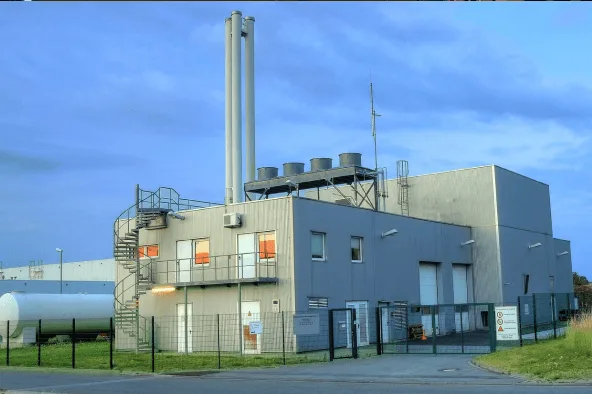
The standard approach to managing condensation risk — operating above the dewpoint temperature — is complicated in biomass applications by the fact that many biomass boilers operate at variable load depending on heat demand. A district heating plant that modulates output with outdoor temperature will spend significant operating time at partial load, where flue gas temperatures are lowest and condensation risk is highest.
The filter media solution for this problem is a hydrophobic surface that prevents moisture absorption and allows condensed water droplets to shed rather than penetrate the media. PTFE-treated fiberglass filter bags achieve this through the inherently low surface energy of PTFE — the same non-stick property that defines the material. Water droplets on a PTFE-treated surface bead up and roll off rather than spreading and being absorbed into the fiber matrix. This doesn’t eliminate the need for proper temperature management, but it provides a meaningful margin of protection during the transient low-temperature events that are unavoidable in real-world biomass boiler operation.
2. Alkali metal corrosion — the chemical mechanism nobody plans for
This is the failure mode that distinguishes biomass from coal. Biomass fuels — particularly agricultural residues, straw, and fast-growing energy crops — contain high concentrations of potassium (K) and sodium (Na) relative to coal. During combustion, these alkali metals volatilize and then condense in the cooler sections of the flue gas path as alkali metal oxides (K₂O, Na₂O), hydroxides (KOH, NaOH), chlorides (KCl, NaCl), and sulfates (K₂SO₄, Na₂SO₄).
These alkali compounds are strongly basic — they create a high-pH chemical environment that attacks filter media from the alkaline side. Conventional filter bags specified for acid gas resistance — a reasonable default for coal-fired applications — often have poor resistance to concentrated alkaline attack. Polyester, for example, is hydrolyzed by both acids and strong alkalis. Aramid has limited resistance to sustained alkali exposure. Even PPS, which handles most acids well, can be affected by concentrated alkali at elevated temperatures.
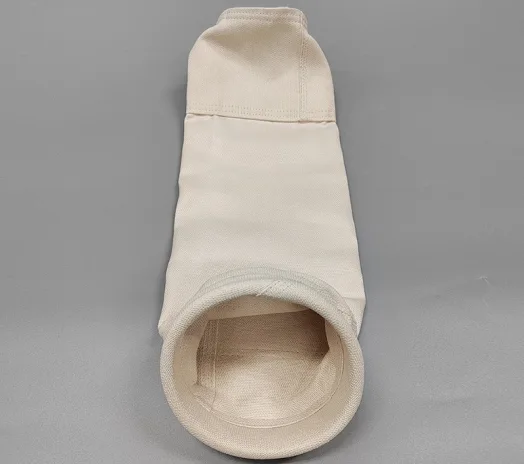
Fiberglass filter bags have inherent resistance to alkaline environments because glass fiber itself is an inorganic material — the silicate glass matrix does not undergo the polymer chain degradation that organic fibers experience under alkaline attack. Combined with PTFE dipping treatment — which provides an additional chemically inert barrier between the alkali compounds and the glass fiber surface — fiberglass composite filter bags deliver the alkali resistance needed for biomass applications where potassium and sodium concentrations are high.
For moderate-temperature biomass boiler applications (continuous operation below 160°C), PPS filter bags provide an alternative with good chemical resistance to both acids and moderate alkali conditions. PPS’s polyphenylene sulfide polymer backbone does not contain hydrolyzable bonds, giving it inherent resistance to the combined acid/alkali environment found in biomass flue gas. For biomass installations where the alkali metal content of the fuel is moderate and operating temperatures are well controlled below 160°C, PPS represents a cost-effective solution with service life of 2–3 years.
3. Fine particle filtration — the compliance mechanism
Biomass combustion produces particulate matter with a bimodal size distribution. The coarse fraction consists of bottom ash and fly ash particles from the mineral content of the fuel — primarily silica, calcium, and aluminum compounds. The fine fraction — which is the regulatory compliance concern — consists of condensed alkali metal salts, heavy metal aerosols, and fine char particles in the 0.1–5 μm range.
These fine particles are the hardest fraction to capture consistently, particularly during the transient periods immediately after cleaning pulses when the protective dust cake has been partially removed. For biomass boiler applications with emission requirements of 10 mg/Nm³ or below — which is increasingly standard as environmental regulations tighten globally — the filtration precision of the filter media during the entire operating cycle, including the post-cleaning transient, determines whether the plant achieves compliance reliably or operates in marginal territory.
PTFE membrane lamination on fiberglass or PPS base media changes the filtration mechanism from depth filtration to surface filtration, capturing fine particles at the membrane surface from the first operating cycle without dependency on dust cake development. This eliminates the post-cleaning emission spike that depth-filtration media produces and provides consistent emission performance across the full range of operating conditions.
For a detailed technical overview of the advantages of surface filtration in demanding applications, see our article on applications of PTFE membrane filter bags.
Fiberglass Composite vs PPS: Choosing the Right Media for Your Biomass Application
Both fiberglass composite and PPS filter bags serve biomass boiler applications successfully, but they serve different segments of the operating envelope. The selection depends on the actual gas temperature, the alkali metal content of the fuel, and the emission requirement.
Fiberglass composite with PTFE treatment — the high-temperature specification
Omela fiberglass composite filter bags are built on a heavy-weight 900 g/m² glass fiber substrate with PTFE dipping treatment. This construction provides continuous operating temperature ratings from 180°C to 240°C depending on the specific grade, with peak tolerance from 220°C to 280°C.
For biomass boiler applications operating above 160°C continuous — which includes many direct-fired biomass boilers without extensive flue gas cooling — fiberglass composite is the only appropriate organic-fiber-free option. The inorganic glass fiber structure provides inherent resistance to the alkali metal compounds that degrade organic fiber media, while the PTFE dipping treatment adds hydrophobic surface properties for condensation resistance and chemical inertness against both the acid and alkaline species present in the flue gas.
The dimensional stability of fiberglass under thermal cycling — with heat shrinkage values of ≤1.5% warp and ≤1.0% weft — ensures the bags maintain their fit in the tube sheet through the repeated temperature swings that biomass boilers experience during load changes, startup, and shutdown.
For the highest-temperature biomass applications, P84 (polyimide) filter bags provide an alternative at 550 g/m² with continuous temperature to 240°C and peaks to 260°C. P84’s trilobal fiber cross-section offers superior fine particle capture compared to round-section fibers, making it suitable for biomass applications where both temperature and emission precision requirements are extreme.
PPS — the moderate-temperature, cost-effective specification
For biomass boiler applications operating at continuous temperatures below 160°C — which includes many stoker-fired, grate-fired, and fluidized bed biomass boilers with adequate flue gas cooling — PPS filter bags provide a cost-effective solution with strong chemical resistance.
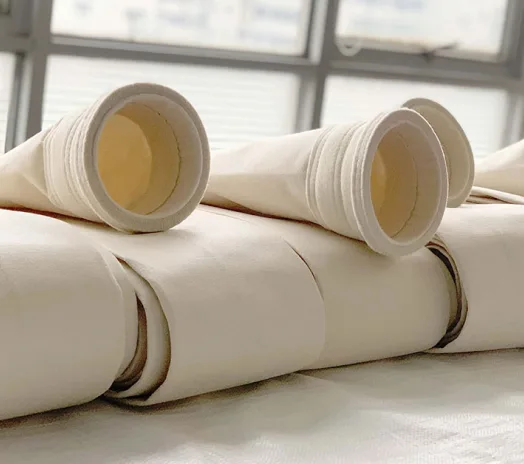
Omela PPS filter bags (OM-PPS160 series) are rated for 160°C continuous with peaks to 190°C, at weights from 530 to 650 g/m². PPS’s key advantage in biomass applications is its combination of hydrolysis resistance — it does not degrade in high-moisture, acid-catalyzed environments — and chemical resistance to both acids and moderate alkali conditions. For biomass fuels with moderate potassium and sodium content (clean wood chips, pellets, and well-characterized agricultural residues), PPS delivers service life of 2–3 years at a lower per-bag cost than fiberglass composite.
The limitation of PPS in biomass applications is its sensitivity to strong oxidizing conditions at temperatures above 140°C. Biomass flue gas can have elevated oxygen content (12–15%) depending on the combustion air management, and in some configurations the combination of high oxygen and operating temperatures near the PPS ceiling can accelerate oxidative degradation. If your biomass boiler operates near 160°C with oxygen content above 14%, fiberglass composite is the safer long-term specification despite the higher cost.
Selection summary
| Condition | Recommended media |
|---|---|
| Continuous temp 160–240°C | Fiberglass composite with PTFE treatment |
| Continuous temp >200°C, extreme precision | P84 (polyimide) or fiberglass composite |
| Continuous temp <160°C, moderate alkali | PPS Needle-Punched Felt |
| Any temp + ultralow emission (<5 mg/Nm³) | Add PTFE membrane lamination |
| High condensation risk | PTFE treatment or PTFE membrane essential |
Product Engineering: Why Construction Quality Determines Real-World Performance
The three product advantages that separate a specification-compliant filter bag from one that actually delivers multi-year service life in biomass applications:
Structural optimization. The heavy-weight fiberglass substrate at 900 g/m² — compared to standard fiberglass at 550–750 g/m² — provides the mechanical backbone needed to resist the combined stress of high-temperature operation, alkaline chemical exposure, and sustained pulse-jet cleaning. The reinforced scrim and PTFE dipping treatment create a composite structure where each layer contributes a specific property: structural strength from the scrim, filtration performance from the needle-felt, and chemical/hydrophobic protection from the PTFE treatment.
High-efficiency, low-resistance filtration. The multi-dimensional membrane structure on PTFE-laminated grades ensures the bag surface remains smooth and releases the sticky, hygroscopic biomass ash cleanly during each cleaning pulse. This maintains stable low differential pressure across the bag service life — preventing the progressive pressure drop buildup that forces premature bag replacement in systems using conventional media. Lower differential pressure directly reduces fan energy consumption, which in a biomass boiler baghouse running continuously represents a material operating cost saving.
Extended service life through process consistency. Stable manufacturing processes and quality control produce bags with consistent fiber distribution, consistent PTFE coating thickness, and consistent mechanical properties from bag to bag across an entire order. In a baghouse with 1,000+ bags, consistency matters — a few bags with substandard coating thickness or fiber distribution will fail early and produce emission problems that appear as random events but are actually manufacturing variability.
Author

Jessica Ma – Senior Filtration Engineer, Omela Filtration
Jessica Ma is a senior filtration engineer at Omela Filtration, specializing in dust and liquid filtration. With over 15 years of experience, she focuses on optimizing baghouse performance, enhancing filtration efficiency, and developing high-performance solutions for industrial dust collectors and precision liquid filtration applications.