
Key Takeaways
Selecting an industrial filter bag involves more than choosing polyester, PPS, aramid, fiberglass, or PTFE. The material establishes the bag’s basic resistance to temperature, moisture, chemicals, and abrasion, while its construction determines how well it seals, cleans, fits the cage, and survives repeated operation.
A typical filter bag for pneumatic conveying may combine several features:
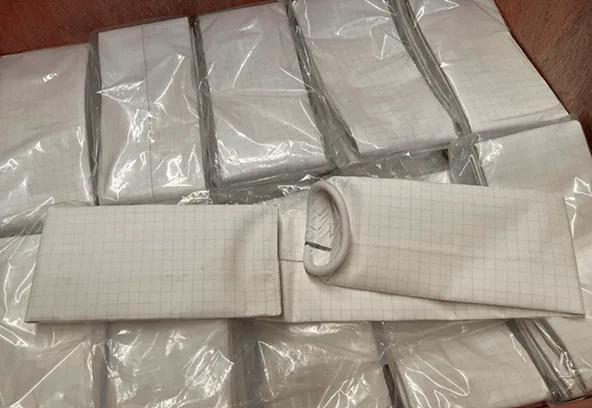
- Anti-static polyester with a conductive grid to dissipate electrostatic charge
- PTFE coating or impregnation to improve dust release and resistance to moisture or oils
- A snap ring top to create a secure seal in the tube-sheet opening
- Reinforced seams and bottoms to resist repeated pulse cleaning and mechanical wear
- A correctly matched cage to support the bag and prevent internal abrasion
Each feature has a separate function. Anti-static fibers control charge accumulation, while PTFE treatments affect the filter surface. A snap ring prevents mechanical bypass, but it does not improve the chemical resistance of the fabric.
Omela supplies customized industrial dust filter bags for pneumatic conveying, bulk material handling, baghouses, bin vents, and process filters. Available options include polyester filter bags, antistatic felt, PTFE-treated media, PTFE membrane, customized snap rings, reinforced bottoms, and matched filter bag cages.
Why Filter Bag Material and Design Must Be Evaluated Together
The base material determines the general operating limits of a filter bag. Polyester, for example, offers good mechanical strength and cost efficiency in dry, moderate-temperature applications. However, polyester alone does not provide reliable static dissipation, surface filtration, or resistance to severe moisture and chemical exposure.
These additional requirements are addressed through fiber modification, surface treatment, and mechanical construction.
Consider two filter bags made from the same polyester needle felt. One is untreated and fitted with a simple sewn cuff. The other contains conductive grid fibers, has a PTFE-treated surface, uses a precisely sized snap ring, and includes a reinforced bottom.
Although both products may be described as “polyester filter bags,” their operating functions are significantly different.
The first may be suitable for ordinary, non-combustible dry dust. The second is better configured for fine powders moving through a pneumatic conveying system, where static electricity, difficult dust release, sealing reliability, and frequent pulse cleaning must all be considered.
A complete filter bag specification should therefore identify:
- Base fiber and supporting scrim
- Felt weight and thickness
- Air permeability
- Antistatic construction
- Surface treatment
- Bag body seam
- Top attachment
- Bottom structure
- Reinforcement areas
- Dimensions and tolerances
- Cleaning-system compatibility
- Cage and tube-sheet dimensions
Core Configuration: Anti-Static Polyester, PTFE Treatment, and Snap Ring Top
The filter bag configuration discussed in this guide combines three important features for powder-handling and pneumatic conveying applications.
| Feature | Construction | Primary Function |
|---|---|---|
| Anti-Static Polyester | Polyester needle felt containing conductive fibers in a visible grid | Dissipates electrostatic charge generated during powder transfer |
| PTFE Treatment | PTFE coating, dipping, impregnation, or membrane applied to the filter media | Improves dust release and adds resistance to moisture, oil, and particle penetration |
| Snap Ring Top | Spring steel ring enclosed in a fabric and gasket cuff | Creates a secure, tool-free seal in the collector tube sheet |
These features work together but should not be confused with one another. The conductive grid manages electrical charge, the PTFE treatment modifies surface behavior, and the snap ring provides mechanical attachment and sealing.
Anti-Static Polyester with a Conductive Grid Pattern
Material
The base media is polyester needle-punched felt. Conductive fibers or yarns are incorporated into the fabric in a visible grid pattern.
The grid may consist of carbon-containing yarns, stainless steel fibers, or another electrically conductive material selected according to the required surface or volume resistance.
Function
The primary function of the conductive grid is to dissipate static electricity produced by friction during pneumatic conveying, mixing, filling, screening, or powder transfer.
When powder particles move through conveying pipes and repeatedly contact the air stream, equipment surfaces, other particles, and filter media, electrostatic charge can develop.
Standard polyester has limited conductivity. Without a controlled discharge path, charge may accumulate on the media or nearby equipment.
Conductive fibers create a lower-resistance path that allows the charge to travel from the filter bag to the metal cage, tube sheet, collector housing, and grounding system.
Why It Matters
Static accumulation can cause several operational problems.
A charged filter surface may attract fine powder more strongly, making the dust cake harder to release during pulse cleaning. This can increase differential pressure and reduce airflow.
More importantly, an electrostatic discharge may become an ignition source if the conveyed powder is combustible and the required dust concentration is present.
The conductive grid helps reduce this risk by preventing charge from building up on the filter media. However, the bag can only dissipate charge if it remains electrically connected to a properly bonded and grounded collector.
Typical Applications
Anti-static polyester filter bags are commonly considered for moderate-temperature systems handling:
- Plastic resins and polymer powders
- Flour, starch, sugar, and other food powders
- Pharmaceutical ingredients
- Powder coatings
- Chemical powders
- Pigments and additives
- Fine mineral powders
- Battery and electronic-material powders
The actual need for antistatic media should be determined through a process and dust-hazard assessment rather than from the powder name alone.
Important Limitation
An anti-static filter bag does not make a dust collector explosion-proof.
The conductive media must work together with suitable grounding, bonding, explosion venting or suppression, isolation devices, safe electrical equipment, spark control, and effective housekeeping.
If a conductive bag is installed on a nonconductive or poorly grounded cage, the intended discharge path may not function correctly.
Common Anti-Static Filter Media Constructions
| Anti-Static Design | Conductive Structure | Function and Best Use |
|---|---|---|
| Line Pattern | Conductive yarns run in one direction | Provides a basic discharge path and is easily identified |
| Grid Pattern | Conductive yarns cross horizontally and vertically | Distributes conductivity across a larger area of the bag |
| Blended Fiber | Conductive fibers are mixed throughout the felt | Provides more uniform conductivity without a visible pattern |
| Conductive Scrim | Conductive support cloth is placed inside the felt | Combines mechanical reinforcement with an internal discharge path |
The grid pattern is visually distinctive, but appearance should not be used as the only quality criterion. Electrical resistance, continuity, fiber distribution, and connection to grounded components should also be verified.
PTFE Coating
Material
PTFE stands for polytetrafluoroethylene, commonly associated with the Teflon family of fluoropolymers.
In filter media, PTFE may be applied as a surface coating, dispersion treatment, impregnation, or laminated membrane. These constructions have different filtration characteristics and should be clearly distinguished in a technical specification.
Function
The main function of a PTFE coating is to create a smoother and less adhesive filter surface.
This improves the release of the accumulated dust cake during pulse-jet cleaning. It can also reduce the affinity of the fabric for moisture, oils, and certain sticky contaminants.
When fine powder is less strongly attached to the fibers, the compressed-air pulse can remove a larger portion of the dust cake. The bag returns closer to its normal operating pressure drop, reducing the need for excessive cleaning.
Why It Matters
Fine powders can penetrate deeply into untreated needle felt. Once embedded between the fibers, they may not be removed effectively during normal pulse cleaning.
Moisture or oil can make this problem worse by causing dust to form a sticky or hardened layer. This condition is commonly known as filter blinding.
A PTFE-treated surface helps reduce direct contact between the particles and the base fibers. This can provide:
- Easier dust-cake release
- More stable differential pressure
- Reduced fine-particle penetration
- Better resistance to moisture
- Better resistance to oily contamination
- Less frequent manual cleaning
- Longer usable filter life
PTFE coating is particularly useful when the powder is fine, slightly cohesive, moisture-sensitive, or difficult to remove from standard polyester felt.
Typical Applications
PTFE-coated polyester may be considered for:
- Plastic resin powders
- Flour and starch
- Chemical additives
- Pigments
- Powder coatings
- Pharmaceutical powders
- Fine minerals
- Carbon powders
- Slightly oily or moisture-sensitive dust
The temperature and chemical environment must still remain within the limits of the polyester base material.
PTFE Coating vs. PTFE Membrane
PTFE coating and PTFE membrane are often described using similar terminology, but they do not provide identical functions.
PTFE Coating or Impregnation
A coating modifies the surface of the fibers. It improves smoothness, moisture resistance, and dust release while the felt continues to operate mainly through depth filtration.
The gas and particles still enter part of the felt structure, although penetration may be reduced.
PTFE Membrane
A PTFE membrane is a thin microporous layer laminated onto the surface of the base felt. Most particles are captured on the membrane before entering the supporting media.
Its main function is surface filtration.
A membrane normally provides:
- Higher fine-particle filtration efficiency
- Lower depth penetration
- Cleaner dust release
- More consistent emissions
- Reduced dependence on an initial dust cake
- Better protection of the base felt
For very fine powders, valuable product recovery, or strict emission targets, a PTFE membrane may offer more reliable performance than a standard coating.
However, membrane media normally has a higher initial cost and must be handled carefully during manufacturing, installation, and cage insertion.
Snap Ring Top
Design
The filter bag top contains a flexible spring steel ring enclosed inside a fabric cuff. A gasket or sealing material is positioned around the ring.
The configuration described by the user uses a 30 mm snap ring gasket.
The bag is installed by compressing the ring, inserting it into the tube-sheet opening, and allowing it to expand into position.
Function
The snap ring performs three essential functions.
First, it supports the filter bag from the collector tube sheet.
Second, it creates an airtight seal between the dirty-air chamber and the clean-air chamber.
Third, it allows the bag to be installed and removed without separate clamps, bolts, or special fastening tools.
Why It Matters
The sealing function is particularly important.
If the snap ring is not fully seated, dust can bypass the filter media and pass directly into the clean-air chamber. This may produce visible emissions even when the filter fabric has no holes.
A poorly fitted snap ring can also loosen during operation, damage the tube-sheet opening, or allow the bag to move excessively during pulse cleaning.
A correctly designed snap ring should match:
- Tube-sheet hole diameter
- Tube-sheet thickness
- Snap band diameter
- Band width
- Groove position
- Gasket thickness
- Bag diameter
- Cage collar or venturi design
A “30 mm snap ring” does not automatically fit every collector. The complete set of dimensions must be confirmed.
Typical Applications
Snap ring tops are widely used in top-loading pulse-jet collectors, bin vents, pneumatic receivers, silo filters, and process dust collectors.
They are useful when plants need fast filter replacement and reliable sealing without additional clamps.
Bag Body Seam
Design
The body seam connects the filter media along the full length of the cylindrical bag.
Common construction methods include:
- Double- or triple-row sewing
- Overlap sewing
- Heat welding
- Glued seams
- Sewn seams covered with PTFE sealing tape
Function
The seam keeps the bag body closed while resisting airflow pressure, repeated pulse expansion, cage contact, and the weight of accumulated dust.
For fine powders, the seam must also minimize particle leakage through the needle holes.
Why It Matters
A weak or poorly aligned seam may split after repeated pulse cycles. An unsuitable sewing thread may also fail before the filter media if it cannot tolerate the operating temperature or chemical environment.
For low-emission applications, PTFE seam tape may be added over the stitched area. Its function is to seal the needle holes, protect the sewing thread, and reduce leakage through the seam.
The thread should be selected according to the base material and working conditions. Polyester thread may be suitable for standard polyester bags, while aramid or PTFE thread may be required for higher-temperature or chemically demanding applications.
Closed and Reinforced Bottom
Design
Pulse-jet filter bags normally have a closed bottom because dusty gas flows from the outside of the bag toward the inside.
The bottom may use a single felt disc, double-layer disc, molded cap, or reinforced wear cuff.
Function
The bottom closes the bag, supports the cage, and withstands mechanical movement during filtration and pulse cleaning.
Additional reinforcement protects the lower section against abrasion caused by cage contact, dust re-entrainment, bag movement, or accumulated material in the hopper.
Why It Matters
The lower section of a filter bag is a common wear area.
If the cage is too short, rough, bent, or incorrectly centered, it may repeatedly strike the bag bottom. High hopper dust levels can also expose the lower section to abrasive particles.
A reinforcement cuff adds material to this high-wear zone and can extend service life. However, it should not make the bag so rigid that it cannot flex correctly during cleaning.
Filter Bag Cage
Design
The cage is a metal support structure installed inside a pulse-jet filter bag. It normally consists of vertical wires connected by horizontal rings.
Common finishes include galvanized steel, epoxy coating, silicone coating, and stainless steel.
Function
The cage prevents the filter bag from collapsing under negative pressure. It also controls bag movement during pulse cleaning and helps maintain a stable cylindrical filtration surface.
Why It Matters
A correctly matched cage protects the filter bag. An unsuitable cage damages it.
A cage that is too large stretches the felt and increases friction. A cage that is too small allows excessive movement and flex fatigue. Bent wires, corrosion, sharp welds, and misaligned joints can cut the bag or create vertical wear lines.
The cage surface should be smooth enough to avoid damaging the conductive grid or PTFE treatment during installation.
For an anti-static bag, the cage may also form part of the electrical discharge path. Electrical continuity between the bag, cage, tube sheet, and grounded collector should therefore be maintained.
Typical Material Selection by Operating Condition
| Operating Condition | Recommended Material or Design | Primary Function |
|---|---|---|
| Dry, non-combustible powder | Standard polyester | Provides economical filtration and mechanical strength |
| Fine combustible powder | Anti-static polyester with conductive grid | Dissipates electrostatic charge |
| Fine powder with strict emissions | Anti-static polyester with PTFE membrane | Combines static control with surface filtration |
| Slightly oily or moisture-sensitive powder | PTFE-coated polyester | Improves dust release and resistance to wetting |
| Abrasive powder | Heavier felt with reinforced bottom | Resists mechanical wear |
| Humid moderate-temperature powder | Acrylic or treated polyester after review | Improves hydrolysis and moisture resistance |
| Higher-temperature dry dust | Aramid | Provides higher thermal stability and abrasion resistance |
| Humid or acidic higher-temperature gas | PPS | Resists hydrolysis and many acidic conditions |
| Fine high-temperature dust | P84 or P84 blend | Improves fine-particle capture |
| Severe temperature or chemical conditions | Fiberglass, FMS, or PTFE | Provides greater heat and chemical resistance |
The application should determine the material. A premium high-temperature fiber is not automatically better for a moderate-temperature pneumatic conveying system.
Applications in Coperion and K-Tron Systems
Coperion and Coperion K-Tron filtration equipment is used to separate conveyed product from transport air, vent displaced air from bins and rotary valves, and collect fine powder from pneumatic conveying systems.
An anti-static polyester filter bag with PTFE treatment and a snap ring top may be suitable for selected pulse-clean receivers, bin vents, airlock vents, or secondary filters handling moderate-temperature powders.
Typical materials may include:
- Plastic pellets, resins, and additives
- Flour, starch, and food ingredients
- Pharmaceutical powders
- Chemicals and pigments
- Powder coatings
- Minerals and fine fillers
The collector brand alone is not enough to confirm compatibility. Different Coperion and K-Tron models use different bag diameters, lengths, top attachments, access arrangements, and cleaning systems.
The equipment model, original part number, tube-sheet opening, cage size, and operating conditions should be verified before replacement bags are manufactured.
Public Industry Lessons
Pneumatic Conveying and Static Electricity
Dry powders can generate electrostatic charge during transfer, mixing, and pneumatic conveying. Industry safety guidance therefore emphasizes electrical continuity, bonding, and grounding where combustible dust is present.
The practical lesson is that a conductive filter bag should not be installed as an isolated component. The complete conveying and collection system must provide a continuous discharge path.
Pulse-Clean Filters for Fine Powders
Pulse-clean filters are used in material-handling systems where collected powder must be removed automatically from the filter surface.
This cleaning method places repeated mechanical stress on the bags. The media, seam, snap ring, bottom, and cage must all withstand the expansion and contraction caused by each compressed-air pulse.
PTFE treatment can improve powder release, but the pulse pressure, duration, blow-pipe alignment, and compressed-air quality must also be correct.
Moisture-Related Filter Blinding
When moisture enters a dust collector, fine powders may stick to the filter media and form a hardened cake. Increasing pulse frequency does not solve the underlying problem and may accelerate bag wear.
PTFE coating or membrane can reduce wetting and improve surface release, but the source of moisture should also be identified. Possible causes include process humidity, condensation, wet compressed air, or air leakage into the collector.
Information Required for Replacement Filter Bags
To manufacture a replacement bag for a pneumatic conveying filter, bin vent, or Coperion/K-Tron collector, the supplier should receive:
- Equipment manufacturer and model
- Original part number or drawing
- Bag diameter and total length
- Snap ring width and diameter
- Tube-sheet hole diameter and thickness
- Cage diameter, length, and wire count
- Top and bottom photographs
- Powder name and particle size
- Operating and peak temperature
- Moisture or oil content
- Combustibility and static-control requirements
- Cleaning pressure and pulse frequency
- Existing service life and failure symptoms
A used filter bag sample is particularly useful when the original drawing is unavailable.
Final Recommendation
For moderate-temperature pneumatic conveying of resins, flour, chemicals, pigments, or other fine powders, an anti-static polyester filter bag with a conductive grid, PTFE surface treatment, and precisely sized snap ring top can provide a balanced filtration solution.
The anti-static polyester material provides mechanical strength while the conductive grid dissipates charge generated during powder transfer.
The PTFE coating improves dust-cake release, reduces the adhesion of moisture or oily particles, and helps prevent premature blinding.
The snap ring top supports the bag and creates an airtight seal between the dirty-air and clean-air chambers.
The reinforced seam and bottom help the bag withstand repeated pulse cleaning and mechanical wear.
The matched cage supports the media, controls movement, prevents abrasion, and may provide part of the electrical path to ground.
These features should always be selected as a complete configuration. Adding an antistatic grid will not correct an incorrectly fitted snap ring, and applying PTFE coating will not solve excessive filtration velocity or wet compressed air.
Omela Filtration manufactures customized polyester, antistatic polyester, polypropylene, acrylic, aramid, PPS, P84, fiberglass, FMS, and PTFE filter bags. Available options include conductive line or grid patterns, blended antistatic fibers, singeing, calendering, PTFE dipping, PTFE coating, PTFE membrane, water- and oil-repellent treatment, sealed seams, reinforced bottoms, customized snap rings, and matched cages.
Customers are welcome to contact Omela Filtration with the collector model, filter bag dimensions, tube-sheet measurements, powder information, operating temperature, static-control requirements, and photos of the existing bags. Our engineers will review the complete operating conditions and recommend a suitable material, treatment, seam, snap ring, reinforcement, and cage configuration.
Consistent Manufacturing Quality
Material selection and design features only deliver their intended performance when manufacturing quality is consistent across every production run. Variations in felt weight, seam strength, or snap-ring sizing — even within the same specification — can produce filter bags that perform differently in the field.
To maintain consistent construction standards and reliable capacity for high-volume orders, Omela works with established manufacturing partners specializing in dust collector filter bags. This collaborative manufacturing model ensures stable supply and uniform quality control for customers worldwide.
FAQ
1. What is the function of the conductive grid in an anti-static filter bag?
The conductive grid creates an electrical path that helps transfer static charge from the filter media to a grounded cage and collector. It reduces charge accumulation but does not replace complete bonding, grounding, and explosion protection.
2. What is the function of PTFE coating on a filter bag?
PTFE coating creates a smoother and less adhesive surface. It improves dust-cake release during pulse cleaning and provides additional resistance to moisture, oils, and premature filter blinding.
3. Is PTFE coating the same as PTFE membrane?
No. PTFE coating modifies the surface of the felt, while a PTFE membrane is a separate microporous layer that captures most particles at the media surface and normally provides higher fine-particle filtration efficiency.
4. What is the function of a snap ring top?
The snap ring supports the filter bag in the tube sheet and creates an airtight seal between the dirty-air and clean-air chambers. It also allows installation without separate clamps or bolts.
5. Can a 30 mm snap ring fit every dust collector?
No. The ring diameter, band width, gasket, groove position, tube-sheet hole, and tube-sheet thickness must match the specific collector.
6. Are anti-static polyester filter bags suitable for flour and resin powders?
They may be suitable when the operating temperature and chemistry are compatible with polyester. The complete system must still be evaluated for combustible-dust hazards, grounding, venting, isolation, and other safety requirements.
7. What information is needed to manufacture a replacement filter bag?
Provide the equipment model, original drawing or part number, bag dimensions, snap ring details, tube-sheet opening, cage dimensions, powder characteristics, temperature, moisture, static requirements, and photos or a used sample.
Author

Jessica Ma – Senior Filtration Engineer, Omela Filtration
Jessica Ma is a senior filtration engineer at Omela Filtration, specializing in dust and liquid filtration. With over 15 years of experience, she focuses on optimizing baghouse performance, enhancing filtration efficiency, and developing high-performance solutions for industrial dust collectors and precision liquid filtration applications.