
Key Takeaways
Dust control in a concrete batching plant is not limited to installing a filter on top of the cement silo. A reliable system must control emissions from pneumatic cement delivery, aggregate handling, weigh hoppers, mixers, truck loading, plant roads, and collected-dust discharge.
The cement side normally creates the most visible and difficult dust because the material is extremely fine and is pneumatically conveyed into storage silos. If displaced air cannot escape through a correctly sized and maintained bin vent filter, silo pressure rises and cement dust may be released from the roof, pressure-relief device, fill pipe, or other weak point.
An effective dust-control strategy should combine:
- Source enclosure and local capture
- Correctly sized silo and central collectors
- Suitable filter media and pulse-cleaning systems
- Differential-pressure and silo-level monitoring
- Anti-overfill protection
- Sealed dust recycling or discharge
- Road and aggregate-dust suppression
- Preventive maintenance and operator training
Omela supplies industrial dust filter bags, filter bag cages, and customized filtration components for cement, concrete, aggregate, and bulk-material handling systems. More detailed media guidance is available in our article on selecting filter bags for cement production, while operators troubleshooting collector performance can review how a Magnahelic gauge measures baghouse differential pressure.
Where Dust Is Generated in a Concrete Plant
A ready-mix or concrete batching plant receives, stores, weighs, transfers, and mixes several dry materials before water is added. Each material-handling step can release particulate matter.
The main emission points include cement and supplementary material unloading, aggregate delivery, conveyor transfer, sand handling, weigh-hopper filling, mixer charging, truck loading, storage piles, paved and unpaved roads, and wind erosion.
Not all of these dust sources should be controlled in the same way.
Cement and fly ash are fine powders that are easily carried by displaced air. They normally require enclosed pneumatic conveying, silo vent filtration, and tightly sealed transfer equipment.
Sand and aggregate dust is generally coarser. It is often better controlled through enclosures, reduced drop heights, water sprays, fogging, wind barriers, paved roads, vehicle-speed control, and housekeeping.
Mixer and truck-loading dust contains both fine cementitious particles and aggregate fines. These points usually require capture hoods, shrouds, flexible enclosures, and either a central collector or a dedicated point-of-use unit.
Concrete Plant Dust Sources and Recommended Controls
| Dust Source | Main Risk | Recommended Control Direction |
|---|---|---|
| Cement tanker unloading | Silo overpressure and visible roof emissions | Properly sized bin vent, level controls, fill-line inspection, pressure-relief protection |
| Cement and fly-ash silos | Fine dust penetration and filter blinding | Pulse-cleaned silo collector with differential-pressure monitoring |
| Aggregate and sand storage | Wind erosion and vehicle-generated dust | Wind barriers, moisture control, covered storage, paved travel routes |
| Conveyor transfer points | Dust from falling and impacting material | Enclosures, skirts, reduced drop height, local extraction or fogging |
| Weigh hopper | Fine dust released during batching | Enclosed hopper with local vent or central collector connection |
| Central mixer loading | Short, high-concentration dust surges | Mixer shroud, correctly sized ducting, pulse-jet collector |
| Transit-mix truck loading | Fugitive dust around the loading zone | Retractable shroud, enclosure, central extraction, material recycling |
| Plant roads | Continuous fugitive dust from vehicles | Paving, sweeping, water application, speed control |
| Collector discharge | Re-release of collected cement dust | Sealed screw conveyor, rotary valve, recycle system, enclosed container |
Cement Silo Bin Vent Filters
The silo bin vent is one of the most important dust-control devices in a concrete plant.
When a tanker pneumatically blows cement into a silo, the incoming powder and conveying air displace an approximately equal volume of air from the silo. That air must pass through the bin vent filter before it can be released.
If the filter area is too small, the elements are blinded, or the pulse-cleaning system is not working, the vent cannot handle the displaced air. Silo pressure then increases.
Visible dust from the top of a silo is therefore not always caused by low-efficiency media. It may indicate:
- A blocked or undersized bin vent
- Failed pulse valves or inadequate compressed air
- Excessive tanker unloading pressure
- A damaged or incorrectly installed filter element
- A full silo or malfunctioning level indicator
- A leaking fill pipe or pressure-relief valve
- Dust accumulating inside the clean-air chamber
The vent filter should be selected according to the maximum tanker unloading rate rather than the plant’s average production capacity. The design must handle short periods of high airflow without excessive differential pressure.
Why Ground-Level Differential-Pressure Monitoring Matters
Many silo collectors are installed high above the plant, where they are difficult to inspect during daily operation. A ground-level differential-pressure display or transmitter allows the operator to see whether the filter is loading normally.
A gradually rising pressure drop may indicate dust buildup, weak pulse cleaning, wet compressed air, or media blinding. A sudden low reading can indicate broken filters, leakage, a disconnected sensing line, or a malfunctioning instrument.
Differential pressure should be trended rather than checked only after visible emissions appear. The trend provides an early warning that maintenance is required before the plant experiences overpressure, dust release, or production interruption.
Central Dust Collection for Mixing and Truck Loading
Silo collectors handle displaced air during pneumatic filling, but they do not control every dust source in the batching process.
Mixer charging and truck loading create short-duration, high-concentration dust clouds. These emissions are often captured through a central dust collector connected to the mixer, weigh hopper, and loading area.
The effectiveness of the system depends heavily on the capture enclosure. Installing a large fan without an effective shroud may pull excessive outdoor air while still allowing dust to escape.
A well-designed loading shroud should surround the dust-generation zone without interfering with truck positioning. Flexible curtains or telescopic sections can help reduce the open area while accommodating different truck heights.
The collected material may be returned to the production process when its composition and quality permit. A sealed recycle system can reduce waste and eliminate dust from manual disposal.
The collector must be sized for simultaneous or overlapping operations. Connecting additional pickup points to an existing system without recalculating airflow can reduce capture velocity at every location.
Point-of-Use Collectors vs. Central Systems
Concrete plants can use either individual collectors at each emission point or one central collector serving multiple locations.
Point-of-Use Collectors
A point-of-use collector is installed directly on a silo, bin, mixer, or transfer point. It returns cleaned material to the same process and may eliminate long duct runs.
Advantages include compact installation, lower duct losses, and easier material recovery. Silo bin vents are the most common example.
However, multiple small collectors create multiple maintenance points. Each unit requires inspection, pulse-air supply, filter replacement, and monitoring.
Central Dust Collectors
A central system connects several sources through ductwork to a larger collector. It can simplify monitoring and provide stronger extraction for mixing and loading areas.
Its performance depends on balanced ducting. Poor layouts, long flexible hoses, sharp elbows, leaking ducts, and unauthorized changes can create high static pressure or material dropout.
Neither approach is automatically better. Many plants use a hybrid arrangement: individual collectors on cement silos and one central system for weigh hoppers, mixers, and truck loading.
Choosing Filter Media for Concrete Plant Dust
Concrete batching usually operates near ambient temperature, so high-temperature fibers are rarely required for standard silo and mixer collection. Filter-media selection should focus on fine-particle capture, dust release, abrasion resistance, moisture exposure, cleaning method, and collector geometry.
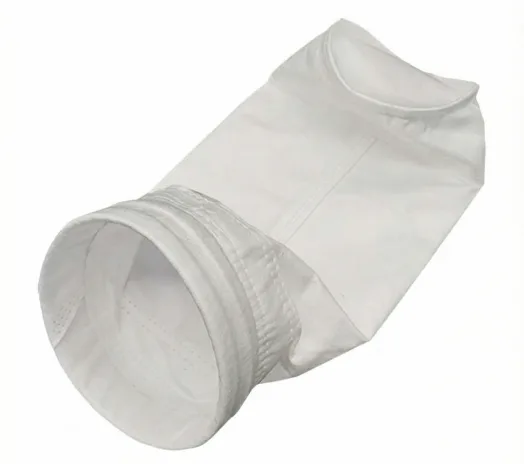
Polyester Needle Felt
Polyester needle felt is a practical and economical option for many dry cement and concrete dust applications.
Its main functions are to provide mechanical strength, stable airflow, and depth filtration under moderate temperatures. Singeing and calendering can create a smoother surface, improving dust release during pulse cleaning.
Polyester should be protected from condensation. Cement dust exposed to moisture can harden on and inside the felt, causing severe blinding.
Polyester with PTFE Membrane
A PTFE membrane adds a microporous surface-filtration layer to the polyester felt.
Its main functions are to capture fine cement particles at the surface, reduce deep dust penetration, improve cake release, and support more stable emissions. It can be valuable where ordinary felt experiences persistent high pressure drop or dust leakage.
The membrane does not make the bag waterproof in the system-design sense. Condensation must still be prevented because wet cement can accumulate on housings, cages, hoppers, and discharge equipment.
Acrylic Media
Acrylic may be considered where humidity and hydrolysis resistance are greater concerns. It can provide more stable performance than standard polyester in damp, moderate-temperature conditions.
The final choice should be based on actual moisture conditions rather than automatically specifying acrylic for every silo.
Pleated Elements
Pleated spunbond-polyester elements provide more media area in a compact collector. They are widely used in silo vents and point-of-use systems where space is limited.
Their benefits can include lower filtration velocity, compact design, and easier replacement. Pleat spacing must remain open enough to release fine cement dust during pulse cleaning.
Filter Media Selection Table
| Operating Condition | Recommended Starting Direction | Main Function |
|---|---|---|
| Dry cement silo | Polyester felt or spunbond-polyester pleated element | Economical fine-dust capture |
| Strict particulate control | Polyester with PTFE membrane | Surface filtration and reduced penetration |
| Condensation-prone collector | Acrylic or suitable moisture-resistant media | Better hydrolysis resistance |
| Abrasive aggregate fines | Heavier polyester with reinforced wear areas | Improved mechanical durability |
| Compact silo vent | Pleated polyester or membrane element | Increased media area in a small housing |
| Frequent pulse cleaning | Dimensionally stable media with matched support cage | Resistance to flex and mechanical wear |
The correct media should be installed with a matching cage or support structure. Bent wires, rough welds, corrosion, and incorrect cage diameter can damage a high-quality filter before the media reaches its expected service life.
Airflow, Filter Area, and Air-to-Cloth Ratio
Dust collectors must provide enough airflow to capture emissions without forcing too much air through the available media.
The air-to-cloth ratio compares airflow with total filter area. If it is too high, fine cement dust may penetrate the media, differential pressure may rise rapidly, and pulse-cleaning frequency may increase.
More frequent cleaning is not always the answer. Aggressive pulsing can shorten filter life while failing to solve an undersized collector.
Sizing should consider:
- Maximum process airflow
- Cement unloading rate
- Dust concentration
- Number of simultaneous pickup points
- Media type and dust-release behavior
- Available compressed-air pressure
- Required emissions performance
- Desired time between maintenance stops
For central systems, duct velocity must remain high enough to transport collected dust without allowing it to settle. At the same time, excessive velocity can increase abrasion and static-pressure losses.
Pulse-Jet Cleaning and Compressed-Air Quality
Pulse-jet collectors clean filter bags or pleated elements using short bursts of compressed air.
For effective cleaning, pulse valves, diaphragms, solenoids, air headers, blow pipes, and controllers must work together. A pulse that sounds normal may still be too weak or poorly aligned to clean the complete filter element.
Compressed air must be clean and dry. Oil or water entering the collector can combine with cement dust and create a hard deposit that ordinary pulsing cannot remove.
Cleaning based on differential pressure is generally more efficient than cleaning continuously on a fixed timer. Demand-based cleaning responds to actual filter loading, reducing compressed-air consumption and unnecessary wear.
Preventing Silo Overfilling and Pressure Events
The bin vent should not be used as the only protection against silo overfilling.
A reliable silo system may include:
- High- and high-high-level indicators
- Tanker fill-line identification
- Automatic fill-line shutoff
- Pressure sensor or switch
- Properly maintained pressure-relief valve
- Differential-pressure monitoring
- Alarm signals visible to the tanker operator
- Written unloading and communication procedures
A collector can filter displaced air, but it cannot safely manage a silo filled beyond capacity or a tanker operating at excessive conveying pressure.
The vent filter, level controls, fill pipe, and pressure-relief system should be inspected as one integrated protection system.
Controlling Aggregate, Road, and Fugitive Dust
Fabric filters are highly effective for enclosed fine-dust sources, but they are not the best solution for every outdoor emission.
Aggregate stockpiles and unpaved roads are generally controlled through moisture, paving, sweeping, wind barriers, reduced vehicle speeds, and good site layout.
Transfer-point dust can be reduced by lowering the material drop height and keeping conveyor skirts in good condition. Fogging may be suitable where added moisture does not affect the concrete mix or create housekeeping problems.
Water should be applied carefully. Excessive water can create mud, contaminate aggregate proportions, block drainage systems, and increase cleanup work.
The most effective plant-wide program combines dry capture for cementitious powders with appropriate suppression and housekeeping for coarse outdoor material.
Maintenance Checklist for Concrete Plant Dust Collectors
Operators should inspect the system before visible emissions become routine.
Key maintenance tasks include:
- Record differential pressure during normal and tanker-filling conditions
- Test pulse valves and inspect compressed-air quality
- Inspect filter elements for tears, hardened dust, and poor sealing
- Verify that the clean-air chamber remains free of cement dust
- Check silo level sensors and pressure-relief valves
- Inspect tanker fill pipes, couplings, and hoses for leakage
- Confirm that hoppers, rotary valves, and recycle systems discharge freely
- Inspect shrouds, curtains, and duct connections around truck loading
- Check cages and support baskets during every filter change
- Investigate any recurring dust plume immediately
Repeatedly replacing filters without determining why they failed usually leads to the same problem returning.
Public Industry Case Lessons
IAC: Silo Venting and Differential Pressure
IAC highlights cement silos as a critical dust-control point in concrete plants. During pneumatic unloading, a blocked or poorly vented silo can become pressurized and release a highly visible dust plume from the roof.
The practical lesson is that bin vent performance should be measured from ground level through differential-pressure monitoring. Maintenance should begin when the pressure trend changes, not after a visible release occurs.
CEMEX Cement Mixing Facility
A CEMEX facility in Sweden handled approximately 80 tonnes of cement through a mixing line each day and processed about 320 tonnes of different mixed products daily.
Dust was generated while conveying cement from the main silo to the mixing line and from product silos to transport trucks. Compact collectors were installed on the silos to manage the sticky cement and lime dust. The reported result was clean operation without the previous dust problems.
The case shows the value of placing filtration directly at the source and selecting elements designed for cohesive cementitious dust.
Complete Ready-Mix System Engineering
Public ready-mix case materials also emphasize that reliable dust control is rarely achieved by the collector alone. Successful projects combine correctly sized collectors with ducting, loading shrouds, recycle systems, silo protection, and safe maintenance access.
This system-level approach is particularly important when a plant expands production. Increasing batch rate or adding new pickup points without reviewing the collector and ductwork can reduce capture performance.
Final Recommendation
Concrete plant dust control should begin with the cement silo but must cover the complete batching process.
Silo bin vent filters should be sized for the maximum pneumatic unloading airflow and equipped with ground-level differential-pressure monitoring. Mixer and truck-loading emissions should be captured through effective enclosures and properly balanced central extraction.
For most dry, moderate-temperature concrete plant applications, polyester filter bags or pleated polyester elements provide a practical starting point. PTFE membrane can improve fine cement-dust capture, dust release, and pressure-drop stability. Acrylic or another moisture-resistant material may be considered where humidity and condensation cannot be fully avoided.
Omela Filtration can supply customized polyester, acrylic, PTFE-membrane, water- and oil-repellent, and wear-resistant filter bags, as well as matched cages and collector components for cement silos, mixers, packing stations, batching systems, and aggregate handling.
Customers are welcome to contact Omela Filtration with the plant layout, dust source, airflow, collector model, filter dimensions, operating pressure, current differential pressure, and photos of the existing elements. Our engineers can review the complete working conditions and recommend suitable media, dimensions, surface treatment, cage construction, and maintenance direction.
FAQ
1. What is the main source of dust at a concrete batching plant?
The cement side is usually the main source of fine and highly visible dust. Important emission points include pneumatic silo filling, weigh-hopper loading, mixer charging, and truck loading. Aggregate transfer, roads, and stockpiles also produce fugitive dust.
2. Why does cement dust come out of the top of a silo?
Common causes include a blinded or undersized bin vent filter, failed pulse cleaning, excessive tanker pressure, silo overfilling, damaged filter elements, or a leaking pressure-relief valve.
3. What filter media is best for a concrete plant?
Dry, moderate-temperature cement dust is commonly filtered with polyester felt or spunbond-polyester pleated elements. PTFE membrane may be added for finer capture and easier dust release. Actual moisture and collector design must also be evaluated.
4. How should a silo dust collector be monitored?
Differential pressure should be displayed or transmitted to ground level and recorded during normal operation and tanker filling. Silo level and pressure-relief systems should also be checked routinely.
5. Can one dust collector control an entire concrete plant?
A central collector can serve weigh hoppers, mixers, and truck loading when correctly sized and balanced. Cement silos normally use separate point-of-use bin vent filters. Many plants therefore use a hybrid system.
6. Why does differential pressure rise quickly in a cement dust collector?
Possible causes include fine dust penetrating the media, moisture or oil in the compressed air, condensation, failed pulse valves, excessive air-to-cloth ratio, overloaded filters, or blocked dust discharge.
7. What information is needed to select concrete plant filter bags?
Provide the dust source, collector type, airflow, bag or cartridge dimensions, temperature, moisture, cleaning method, operating differential pressure, emission requirement, current service life, and photos of used filters and support cages.
Author

Jessica Ma – Senior Filtration Engineer, Omela Filtration
Jessica Ma is a senior filtration engineer at Omela Filtration, specializing in dust and liquid filtration. With over 15 years of experience, she focuses on optimizing baghouse performance, enhancing filtration efficiency, and developing high-performance solutions for industrial dust collectors and precision liquid filtration applications.