
Key Takeaways
- Basalt filter bags are made from basalt fiber, an inorganic mineral fiber produced from natural volcanic basalt rock.
- They are mainly considered for high-temperature, abrasive, acidic, alkaline, oxidizing, or spark-prone dust collection where standard polyester, acrylic, or PPS may not be enough.
- Basalt can be used as needle felt, woven fabric, scrim reinforcement, or composite media depending on the baghouse design and emission target.
- Basalt filter bags should not be selected by temperature rating alone. Gas chemistry, moisture, dust abrasiveness, pulse cleaning intensity, cage condition, and air-to-cloth ratio must all be reviewed.
- In some applications, fiberglass, P84, PTFE membrane, FMS, PPS, or aramid may still be the safer choice.
Industrial plants comparing basalt with other high-temperature media can review Omela’s industrial dust filter bags, needle-punched felt, woven filter fiber cloth, and matched filter bag cages. For special high-temperature or corrosive applications, customers can also contact Omela Filtration with gas temperature, dust type, chemistry, humidity, bag size, and current failure photos.
What Are Basalt Filter Bags?
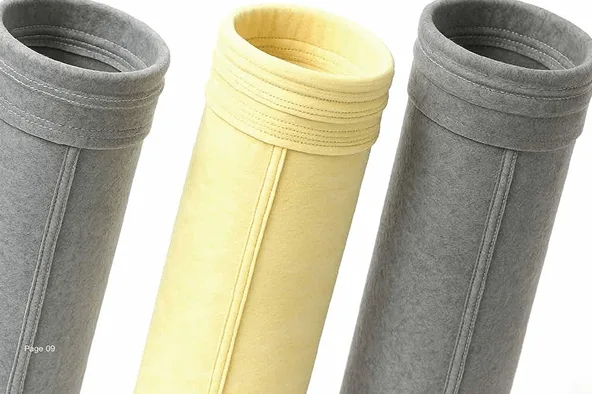
Basalt filter bags are dust collector filter bags made from basalt fiber or basalt-fiber-based filter media. Basalt fiber is produced by melting natural basalt rock and drawing it into continuous fibers. Because it is an inorganic mineral fiber, it behaves differently from organic fibers such as polyester, acrylic, PPS, aramid, or P84.
In baghouse filtration, basalt may appear in several forms:
Basalt Needle Felt Filter Bags
Basalt needle felt is made by mechanically entangling basalt fibers into a felt structure, sometimes with a supporting scrim. It is used where the process requires temperature resistance, mechanical strength, and resistance to chemically demanding dust.
Woven Basalt Filter Bags
Woven basalt cloth is more similar to woven fiberglass fabric. It may be used in reverse-air or shaker collectors, or in applications where woven media and dimensional stability are required.
Basalt Scrim or Basalt-Reinforced Composite Bags
In some filter designs, basalt is not the entire media. Instead, it may be used as a reinforcement layer or scrim to improve spark resistance, strength, or high-temperature stability.
Basalt with Surface Treatments
Depending on the dust and emission requirement, basalt filter bags may be treated with PTFE dipping, PTFE membrane, silicone, graphite, or other finishes to improve dust release, fine-particle capture, or chemical resistance.
The most important point is this: basalt filter bags are not simply a higher-temperature version of polyester. They should be treated as a specialized high-temperature mineral-fiber solution and compared carefully with fiberglass, P84, PTFE, FMS, PPS, and aramid.
Why Plants Consider Basalt Fiber Filter Bags
Many plants start looking for basalt filter bags after experiencing one or more of these problems:
- Standard filter bags shrink, harden, or fail under high temperature.
- Abrasive dust cuts through the bag surface or damages bag bottoms.
- Acidic or alkaline gas causes chemical degradation.
- Sparks or hot particles create pinholes or burning marks.
- Fiberglass works thermally but is too fragile under mechanical stress.
- P84 or PTFE gives good filtration but cost or chemistry becomes a concern.
Basalt fiber can be attractive because it combines several useful properties in one media direction: heat resistance, mineral-fiber stability, chemical resistance, low combustibility, and good mechanical strength. This makes it worth evaluating in cement, lime, steel, non-ferrous smelting, mineral processing, carbon black, foundry, and other harsh dust collection systems.
However, basalt should not be treated as a universal replacement. It has its own limits in flexing behavior, media construction, finishing options, and compatibility with the cleaning method. A successful application depends on the full baghouse system.
Where Basalt Filter Bags Make Sense
High-Temperature Dust Collection
Basalt filter bags are mainly considered when the gas temperature is higher than the safe range for polyester, acrylic, or polypropylene.
Typical target applications may include:
- Cement kiln and lime kiln dust collection
- Steel and metallurgical furnace filtration
- Non-ferrous smelting dust control
- Foundry and metal melting furnace dust collection
- Mineral drying and calcination processes
- High-temperature chemical and ceramic production
The operating temperature must be evaluated carefully. Some basalt filter bag suppliers advertise very high temperature capability, but real baghouse service life depends on the media structure, scrim, finish, sewing thread, cage contact, cleaning pressure, gas chemistry, and peak temperature frequency.
For practical selection, do not ask only, “Can basalt fiber withstand this temperature?” Ask instead:
Can the complete filter bag construction survive this operating temperature, peak temperature, cleaning stress, chemical exposure, and dust load for the required service life?
Abrasive Dust Environments
Basalt may be useful where dust is hard, sharp, or erosive. Abrasive dust can damage bags through direct impingement, bottom wear, cage contact, and high-velocity inlet airflow.
Common abrasive dust sources include:
- Cement and clinker dust
- Lime and mineral powder
- Steel oxide dust
- Foundry dust
- Slag processing dust
- Ceramic and glass raw material dust
- Sand, quartz, and refractory dust
If abrasion is the main failure mode, media selection alone is not enough. The inlet baffle, hopper discharge, can velocity, bag spacing, cage finish, and bottom reinforcement should also be checked.
Basalt can help in abrasive environments, but a poorly designed inlet or damaged cage can still destroy the bag quickly.
Acidic and Alkaline Dust or Gas
Basalt fiber is often promoted for good acid and alkali resistance compared with some organic fibers. This can be useful in flue gas streams containing SOx, NOx, alkali dust, mineral acids, or chemically reactive particles.
Potential applications include:
- Cement kiln tail gas
- Lime kiln exhaust
- Non-ferrous smelting gas
- Steel furnace dust
- Chemical process dust
- Mineral roasting or calcining lines
Still, chemical compatibility must be checked case by case. Gas composition, moisture, acid dew point, alkaline dust, oxygen content, and temperature all affect filter bag life.
If the gas stream contains severe acid condensation, strong corrosive vapor, or high humidity, PTFE membrane, full PTFE, PPS, acrylic, fiberglass with PTFE treatment, or another engineered composite may perform better.
Spark-Prone and Hot Particle Applications
Basalt is an inorganic mineral fiber, so it is sometimes considered for spark-prone or hot-particle dust collection. In metalworking, foundry, steel, and smelting systems, hot particles may reach the filter surface and cause pinholes, burns, or local media damage.
Basalt scrim or basalt-based media can be part of a spark-resistance strategy. But it should not replace proper system protection.
Spark-prone systems may also need:
- Spark arrestors
- Inlet dropout chambers
- Temperature monitoring
- Fire detection
- Correct duct velocity
- Proper hopper discharge
- Anti-static media if combustible dust is present
If hot particles are entering the baghouse frequently, the upstream process and collector design should be corrected first.
Basalt Filter Bags vs. Other High-Temperature Filter Media
Basalt should be compared with other materials based on the actual failure risk, not only on price or maximum temperature.
| Media | Main Strength | Main Limitation | Typical Direction |
|---|---|---|---|
| Polyester | Low cost, strong general media | Low temperature, poor hydrolysis resistance | General dry dust |
| Acrylic | Better moisture and hydrolysis resistance | Medium temperature only | Humid medium-temperature dust |
| PPS | Good acid/alkali and hydrolysis resistance | Oxidation risk at elevated temperature | Boilers, WtE, chemical flue gas |
| Aramid/Nomex | Good heat resistance and strength | Sensitive to acid and moisture | Asphalt, dryers, stable hot gas |
| P84 | Excellent fine dust capture | Cost, hydrolysis/chemistry limits | Cement, incineration, fine dust |
| PTFE | Excellent chemical resistance | Higher cost, lower mechanical strength in some designs | Severe corrosion, high-value processes |
| Fiberglass | High temperature, dimensional stability | Flex and abrasion sensitivity | Cement, steel, boilers, kilns |
| FMS | Composite high-temperature media | Must match gas chemistry and cleaning | Steel, cement, high-temperature dust |
| Basalt | Heat resistance, mineral stability, chemical resistance, abrasion potential | Needs careful design validation and finishing | Hot, abrasive, acidic/alkaline, spark-prone dust |
Basalt is most interesting when the plant needs a balance of heat resistance, chemical resistance, and mechanical robustness. But if the application requires ultra-low emissions, PTFE membrane or P84 may be needed. If chemical corrosion is severe, full PTFE may be safer. If the gas is hot but dry and stable, fiberglass or FMS may still be more established.
Application Guidance by Industry
Cement and Lime Kilns
Cement and lime processes can involve high temperature, alkaline dust, abrasive particles, and fluctuating operating conditions. Basalt filter bags may be considered in kiln tail, clinker cooler, mineral drying, or calcining systems when standard media does not provide enough heat and abrasion resistance.
However, cement applications are not all the same. Raw mill, coal mill, kiln head, kiln tail, cooler, cement mill, silo, and packing station may require different media.
Basalt may be worth evaluating when the process has:
- High temperature beyond polyester or acrylic limits
- Abrasive mineral dust
- Alkali-rich dust
- Frequent temperature fluctuation
- Premature wear of standard bags
For strict emissions or very fine dust capture, basalt may need PTFE membrane or another surface treatment.
Steel and Metallurgical Furnaces
Steel and metallurgical dust collection often involves oxide dust, hot particles, sparks, abrasive particulate, and variable chemistry. Basalt filter bags may be considered for furnace exhaust, metal melting, foundry, ferroalloy, and hot gas filtration where both heat and abrasion matter.
Important checks include:
- Spark and hot particle control
- Inlet baffle condition
- Bag bottom wear
- Cage corrosion and sharp edges
- Acidic or alkaline gas components
- Dust explosibility or toxicity risk
If lead, zinc, cadmium, chromium, or other hazardous metal dust is present, filter integrity, leak detection, safe changeout procedures, and emission monitoring become especially important.
Non-Ferrous Smelting
Copper, lead, zinc, aluminum, and other non-ferrous smelting processes may generate fine metallic fume, oxide dust, corrosive gas, and abrasive particles. Basalt can be considered where high-temperature mineral-fiber stability is needed.
For these processes, the selection should be based on gas analysis and failure mode:
- If bags fail from heat, basalt or fiberglass-based media may be reviewed.
- If bags fail from chemical attack, PTFE, PPS, or treated fiberglass may be better.
- If bags fail from dust penetration or emissions, P84 or PTFE membrane may be needed.
- If bags fail from abrasion, inlet design and cage condition must be reviewed together with media selection.
Foundries and Metal Melting
Foundry dust can be abrasive, fine, and sometimes spark-prone. Basalt may be useful where hot particles and mineral dust damage standard media. But for foundry dust, the collector design is often as important as the fabric.
A basalt bag will not solve:
- Poor hood capture
- Undersized ductwork
- High inlet velocity
- Hopper storage problems
- Damaged cages
- Excessive pulse cleaning
- Hot sparks entering the bag section
Basalt should be evaluated as part of a complete dust collection review.
Mineral Processing, Ceramic, and Glass
Mineral processing, ceramic production, refractory handling, and glass-related processes can generate abrasive dust and high-temperature exhaust. Basalt filter bags may be considered when standard polyester or acrylic fails due to heat or abrasion.
For glass and ceramic processes, compare basalt with fiberglass, FMS, PTFE membrane fiberglass, and P84 depending on temperature, dust size, and emission target.
When Basalt Filter Bags May Not Be the Right Choice
Basalt has useful properties, but it is not the best answer for every difficult baghouse.
Avoid selecting basalt only because the word “high temperature” appears in the specification. In many cases, another media may be better.
If the Main Problem Is Fine Emission
If the plant is failing emission limits because of fine dust penetration, basalt alone may not solve the issue. P84, PTFE membrane, or a membrane-laminated composite may be more effective.
If the Main Problem Is Severe Chemical Corrosion
If the gas contains strong acid condensation, aggressive solvents, high moisture with acid dew point, or severe corrosive vapor, full PTFE or PTFE membrane composites may be safer.
If the Main Problem Is Hydrolysis
Basalt is inorganic, but the complete bag construction, finish, sewing thread, and operating condition still matter. If the system repeatedly crosses the dew point, fix the condensation problem first.
If the Baghouse Has Mechanical Problems
If cages are rusted, bent, or rough, new basalt bags may still fail early. If the inlet baffle is damaged, abrasive dust may strike the bag bottoms. If pulse cleaning is too aggressive, media fatigue can occur.
If the Process Needs a Proven Standard Media
In some cement, asphalt, boiler, and waste incineration systems, fiberglass, P84, PPS, aramid, or PTFE membrane may have more operating history. Basalt should be tested or validated before a full-collector conversion.
Surface Treatments and Construction Options
Basalt filter bag performance depends strongly on media construction and finish.
PTFE Membrane
PTFE membrane can improve surface filtration, reduce dust penetration, improve dust release, and support lower emissions. It is useful when the dust is fine or when emission limits are strict.
PTFE Dipping or Impregnation
PTFE treatment may improve chemical resistance and dust release. It can help reduce dust adhesion and improve cleaning behavior.
Silicone or Graphite Treatment
Some high-temperature mineral-fiber media use silicone or graphite treatments to improve flexibility, handling, and dust release. The right treatment depends on temperature and gas chemistry.
Reinforced Bottoms
For abrasive dust, double bottoms or reinforced wear zones may be needed. This is especially important in pulse-jet baghouses where inlet velocity and dust impingement affect lower bag sections.
Correct Sewing Thread
The sewing thread must match the media temperature and chemistry. A high-temperature fabric with weak stitching can fail at the seam before the media fails.
Practical Selection Checklist
Before selecting basalt filter bags, collect the following information:
- Continuous operating temperature and peak temperature
- Peak temperature duration and frequency
- Gas moisture and dew point risk
- Acid, alkali, SOx, NOx, oxygen, and corrosive gas content
- Dust type, particle size, abrasiveness, stickiness, and concentration
- Current filter bag material and service life
- Current failure mode: shrinkage, burning, abrasion, corrosion, blinding, seam failure, or emissions
- Cleaning method: pulse jet, reverse air, or shaker
- Air-to-cloth ratio and differential pressure trend
- Bag size, top design, bottom design, cage material, and cage condition
- Emission target and whether PTFE membrane is required
If these details are missing, basalt filter bags cannot be recommended confidently.
Common Mistakes to Avoid
Mistake 1: Choosing Basalt Only by Maximum Temperature
Maximum fiber temperature is not the same as real baghouse service temperature. The full bag construction must survive cleaning stress, chemical attack, dust abrasion, and temperature cycling.
Mistake 2: Ignoring Moisture and Dew Point
High-temperature systems can still have condensation during startup, shutdown, or cold-air leakage. Moisture can harden dust cake, increase pressure drop, and accelerate corrosion.
Mistake 3: Forgetting the Cage
A rough, corroded, or bent cage can damage any filter bag. High-temperature bags are often more expensive, so cage inspection is even more important before replacement.
Mistake 4: Treating Basalt as a Direct Fiberglass Replacement
Basalt and fiberglass are both mineral fibers, but their media structure, flexibility, finishing behavior, and application history may differ. A trial installation is often safer before full conversion.
Mistake 5: Ignoring Emission Requirements
If low emissions are the main objective, basalt may need PTFE membrane or a different media may be required. Material strength alone does not guarantee low outlet dust concentration.
Public Industry Lessons
Metallurgical Dust Collection
Ferrous and non-ferrous plants often deal with high temperature, fine metal fume, abrasive dust, and hazardous emissions. The lesson for basalt selection is clear: material choice must be tied to the exact process, such as steel, zinc, aluminum, lead, copper, or ferroalloy production. One high-temperature filter bag specification rarely covers the entire plant.
Cement and Lime Kiln Filtration
Cement and lime systems may combine heat, alkali dust, abrasion, moisture, and temperature fluctuation. The lesson is that basalt may be considered when heat and abrasion are the main problems, but P84, fiberglass with PTFE membrane, FMS, or other media may be better when fine emissions or established operating history are more important.
Foundry and Metal Melting Applications
In foundries and metal melting systems, filter bag failure is often caused by sparks, hot particles, poor inlet design, or abrasive dust impact. The lesson is that basalt fiber may improve resistance, but it should be combined with good spark control, inlet protection, cage maintenance, and differential pressure monitoring.
High-Temperature Chemical Dust
Chemical and mineral processes can expose filter bags to acid gas, alkaline dust, oxidizing environments, and high temperature. The lesson is that basalt may be useful in some inorganic hot-gas applications, but chemical compatibility and dew point control must be verified before selection.
Final Recommendation
Basalt filter bags are worth considering when a baghouse operates under high temperature, abrasive dust, acidic or alkaline gas, oxidizing conditions, or spark-prone metallurgical dust. They are most useful when standard organic fibers are limited by heat and when fiberglass, P84, PTFE, PPS, or aramid must be compared against a more mineral-fiber-based option.
However, basalt should not be selected as a universal high-temperature solution. The final decision should be based on the real failure mode: heat, abrasion, corrosion, moisture, blinding, emissions, or mechanical damage.
For plants in cement, lime, steel, non-ferrous smelting, foundry, mineral processing, ceramic, glass, and chemical production, the best approach is to review the full system before changing media. Gas temperature, dust chemistry, moisture, air-to-cloth ratio, cleaning method, cage condition, bag construction, and emission target all affect the result.
Omela Filtration can help compare basalt filter bags with fiberglass, P84, PTFE, PPS, aramid, FMS, and membrane-laminated options based on your operating data. With the right material, surface treatment, cage condition, and baghouse settings, high-temperature dust collection systems can achieve longer filter life, lower failure risk, and more stable emissions.
FAQ
1. What are basalt filter bags?
Basalt filter bags are dust collector filter bags made from basalt fiber, an inorganic mineral fiber produced from melted natural basalt rock. They are used for high-temperature and harsh industrial dust collection.
2. What are basalt filter bags used for?
Basalt filter bags are mainly used in high-temperature, abrasive, acidic, alkaline, oxidizing, or spark-prone dust collection applications such as cement kilns, steel furnaces, smelting, foundries, mineral processing, and chemical dust collection.
3. Are basalt filter bags better than fiberglass filter bags?
Not always. Basalt may offer good heat resistance, chemical resistance, and mechanical stability, but fiberglass has a long operating history in many high-temperature baghouses. The better choice depends on temperature, chemistry, abrasion, cleaning method, and emission target.
4. Can basalt filter bags handle acidic or alkaline gas?
Basalt fiber is often considered for chemically demanding environments, including acidic or alkaline dust and gas. However, actual performance depends on gas composition, moisture, dew point, temperature, surface treatment, and complete bag construction.
5. Are basalt filter bags suitable for low-emission applications?
Basalt filter bags can be used in dust collection, but low-emission applications may require PTFE membrane or another surface filtration treatment. If the main issue is fine dust penetration, P84 or PTFE membrane media may also be reviewed.
6. What temperature can basalt filter bags withstand?
The usable temperature depends on fiber quality, media construction, scrim, finish, sewing thread, and cleaning method. Some suppliers position basalt filter bags for high-temperature service, but the complete bag design should always be matched to continuous and peak operating temperatures.
7. What information is needed to quote basalt filter bags?
Provide continuous temperature, peak temperature, gas chemistry, moisture, dust type, abrasiveness, emission target, bag size, top and bottom design, cleaning method, cage condition, current bag material, service life, and failure photos if available.
Author

Jessica Ma – Senior Filtration Engineer, Omela Filtration
Jessica Ma is a senior filtration engineer at Omela Filtration, specializing in dust and liquid filtration. With over 15 years of experience, she focuses on optimizing baghouse performance, enhancing filtration efficiency, and developing high-performance solutions for industrial dust collectors and precision liquid filtration applications.