
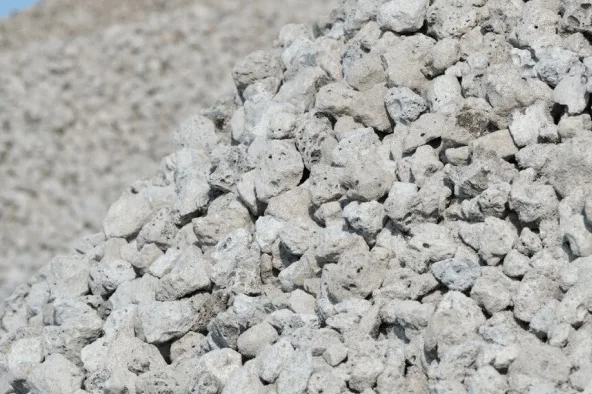
Ground granulated blast-furnace slag — GGBS — has become one of the most important supplementary cementitious materials in modern concrete construction. As infrastructure projects demand stronger, more durable concrete mixes, high-quality GGBS acts as a key performance additive, improving workability, long-term strength, and resistance to chemical attack. The production volumes needed to supply this demand are significant, and so are the dust collection challenges that come with them.
This case study documents a filter bag replacement project at a GGBS production facility in El Paso, TX — a plant running two vertical mill production lines that had been experiencing repeated filter bag failures and emission exceedances within months of each bag change.
The Process and the Problem
The process flow at this facility follows a straightforward sequence: blast-furnace slag → vertical roller mill → baghouse dust collector → stack. The baghouse is a compartmentalized pulse-jet type, cleaned by pressurized air compartment flushing. Maximum flue gas volume runs to 300,000 m³/h, with long-term operating temperature in the 80–100°C range and peak temperatures reaching 120°C. The required particulate emission limit is less than 5 mg/Nm³ — a standard that the existing system was consistently failing to meet.
The plant had replaced a full set of filter bags approximately eight months prior to our site visit. Within weeks of startup, bags began failing. Differential pressure climbed. Stack emissions drifted above the limit. The production team was facing a familiar and costly situation: new bags, same problems.
What the Site Inspection Found
Our engineering team conducted a full on-site inspection of both production lines. The findings explained everything.
Wrong filter media for the actual flue gas conditions. The bags that had been installed were standard polyester needle-felt — a reasonable default choice for many dust collection applications, but not this one. GGBS production flue gas from coal gas and pulverized coal combustion carries sulfur oxides, nitrogen oxides, and significant moisture. Polyester fiber hydrolyzes in these conditions. The bags weren’t failing because of poor quality — they were failing because polyester fundamentally cannot maintain its structural integrity in a humid, acid gas environment over time. Eight months was actually longer than might be expected.
Severely corroded and deformed filter cages. Multiple cages showed heavy rust, bent support rings, and structural collapse. A filter bag installed over a deformed cage cannot maintain its cylindrical operating geometry. The cleaning pulses that are supposed to dislodge the dust cake instead cause the bag to flex unevenly against the collapsed cage structure, creating abrasion wear and stress concentration at contact points. Bags in this condition typically fail within weeks.
Tube sheet damage. Inspection of both compartment tube sheets revealed significant corrosion pitting, uneven surfaces, and local deformation. A compromised tube sheet means the bag collar seal is incomplete — contaminated flue gas bypasses the filter media and goes directly into the clean-air plenum. No filter bag, however well specified, can fix bypass leakage caused by a damaged tube sheet.
Pulse valve leakage. Several pulse valves were found to be leaking continuously — a condition that bleeds compressed air pressure from the cleaning manifold, reduces cleaning pulse energy, and allows uncleaned bags to progressively blind over time.
The combination of these four problems meant the system had been performing far below its design capability regardless of what filter bags were installed.
The Solution: Structural Repairs First, Then the Right Filter Media
Our recommendation to the plant covered both dimensions of the problem.
On the structural side: anti-corrosion treatment and surface restoration of both compartment tube sheets; replacement of all deformed and corroded filter cages with new correctly dimensioned galvanized steel cages; inspection and replacement of leaking pulse valves; and operational guidance on condensation management during startup and low-load periods to prevent future tube sheet deterioration.
On the filter media side: replacement of the polyester bags with acrylic filter bags.
The choice of acrylic for this application comes down to a specific combination of properties that polyester lacks. Acrylic fiber has inherently strong resistance to hydrolysis — it does not degrade in high-humidity flue gas the way polyester does, even when acid gases are present. The continuous operating temperature rating of 125°C, with peaks to 150°C, comfortably covers the thermal profile of this process. Acrylic also provides good resistance to the sulfur and nitrogen oxide species present in the flue gas from coal combustion, and its fine fiber structure gives it the filtration efficiency needed to achieve the sub-5 mg/Nm³ emission target consistently.
For more context on why filter media selection matters this much, the article on top 5 factors influencing the service life of dust filter bags covers the variables that determine whether a bag change succeeds or fails.
Installation and Commissioning
With the structural repairs completed, the new acrylic filter bags were installed across both production lines. The installation scope included full bag removal and replacement, pre-coat application before startup, and fluorescent tracer powder leak detection on completion.
Pre-coating is a step that gets skipped more often than it should. Before the first startup after a bag change, a fine layer of lime powder is dispersed into the clean compartments and drawn onto the new bag surfaces. This protective layer shields the fresh media from the initial surge of fine, sticky GGBS particles that would otherwise penetrate and partially blind the filter media before a stable dust cake has had time to form naturally. In a process producing very fine mineral powder, pre-coating makes a measurable difference to how quickly the system stabilizes after commissioning.
Fluorescent tracer powder leak detection was conducted on both lines after bag installation. Tracer powder is introduced into the baghouse and any leakage — around bag collars, through tube sheet bypass, or through failed bags — shows up as fluorescent traces under UV light in the clean-air plenum. This step confirmed that the tube sheet repairs and new bag installations were providing complete sealing before the system was returned to service.
Verified Results
Two months after commissioning, the online continuous emission monitoring system at Line 1 South outlet recorded particulate concentrations consistently in the range of 1.2 mg/Nm³ — against a compliance limit of 5 mg/Nm³. The full operating parameters at the time of the verified reading:
| Parameter | Value |
|---|---|
| Flue gas temperature | 101.0°C |
| Flue gas moisture | 22.25% |
| Standard volumetric flow | 92,749 m³/h |
| SO₂ | 0.8 mg/m³ |
| NOₓ | 1.5 mg/m³ |
| Particulate matter (outlet) | 1.2 mg/Nm³ |
The system has continued running normally since commissioning. Both production lines are operating at stable differential pressure, and the plant has not experienced a bag failure event since the new installation.
Why the Previous Change Failed and This One Succeeded
The difference between the two outcomes wasn’t the quality of the filter bags. It was the approach.
The first change treated it as a consumables swap — old bags out, new bags in, same structural conditions. Eight months later, same result.
The second change started with a diagnostic assessment of the whole system: what are the actual flue gas conditions, is the media specification correct for those conditions, and is the collector structure capable of supporting the bags properly? The answers to all three questions drove the scope of work.
Polyester in a high-moisture acid gas environment will always hydrolyze. Bags on deformed cages will always fail mechanically. Bags installed into a system with tube sheet bypass will never achieve the emission performance the media is capable of. Fixing one of these without addressing the others produces partial improvement at best.
For GGBS and similar mineral grinding applications, acrylic filter bags are the appropriate specification when the flue gas contains moisture and mild acid gas species at operating temperatures below 130°C. They cost more than polyester upfront and significantly less over a two or three-year operating horizon when the replacement frequency difference is factored in.
About Omela Filtration
Omela Filtration supplies dust collector filter bags for mineral processing, building materials, power generation, and heavy industrial applications. Our services include on-site condition assessment, filter media selection, bag installation, pre-coat application, and fluorescent powder leak detection.
Author

Jessica Ma – Senior Filtration Engineer, Omela Filtration
Jessica Ma is a senior filtration engineer at Omela Filtration, specializing in dust and liquid filtration. With over 15 years of experience, she focuses on optimizing baghouse performance, enhancing filtration efficiency, and developing high-performance solutions for industrial dust collectors and precision liquid filtration applications.