
Dust collector replacement parts are critical components that keep baghouse filtration systems running with stable pressure drop, reliable pulse cleaning, and minimal downtime.
Key Specs Engineers Must Verify:
- Pulse Valve Response Time: <50 ms for consistent cleaning cycles
- Compressed Air Supply Pressure: typically 5–7 bar for diaphragm performance
- Filtration Efficiency Target: ≥99.9% (often <10 mg/Nm³ emissions)
Omela Filtrations Value: Omela Filtrations supplies engineered filter bags and compatible pulse-cleaning spare parts that reduce unplanned shutdowns and extend total collector service life.
When Industrial dust collector fails
Industrial dust collectors do not fail all at once.
They fail gradually—through worn pulse valves, leaking diaphragms, unstable control boards, and overloaded filters.
In cement kilns, steel furnaces, asphalt plants, biomass power stations, and chemical reactors, dust collectors operate under:
- High dust loading
- Abrasive particulate wear
- Temperature swings
- Tight emission limits
- Continuous production schedules
When one small replacement part fails, the result is often immediate:
- Rising differential pressure (ΔP)
- Poor cleaning performance
- Bag blinding or rupture
- Emergency shutdown
Omela Filtrations supports industrial plants with engineered filter bags and the essential replacement parts that keep pulse-jet dust collectors running reliably.
Technical Core & Omela Insights
Challenges & Macro Trends
Modern dust collection systems face increasing operational stress:
- Higher air-to-cloth ratios due to compact collector designs
- Stricter particulate regulations (<10 mg/Nm³, often <5 mg/Nm³)
- More abrasive dust from high-output grinding and clinker handling
- Chemical attack from SOx, NOx, acid dew point condensation
The weakest points are often not the steel housing—it is the maintenance-critical components:
- Timer boards controlling pulse sequencing
- Solenoids triggering compressed air release
- Diaphragms sealing pulse valves
- Valve bodies exposed to fatigue and contamination
- Filter media carrying the full dust load
Preventive replacement of these parts is one of the fastest ways to reduce downtime.
Material Selection / Product Deep Dive
Filter performance is ultimately limited by filter media selection. Omela Filtrations engineers match dust conditions with the correct needle felt.
| Omela Filtrations Filter Media | Max Temp (°C) | Chemical Resistance | Relative Cost | Typical Service Life |
|---|---|---|---|---|
| Polyester (PE) | 130–150 | Low (acid sensitive) | Low | 8–18 months |
| PPS Needle Felt | 190 | Excellent in acid gas | Medium-High | 18–30 months |
| Nomex (Aramid) | 200–220 | Moderate (hydrolysis risk) | Medium | 16–28 months |
| Fiberglass + PTFE Membrane | 260 | Very high, inert surface | High | 24–40 months |
Engineering rule: Even the best solenoid valve cannot compensate for the wrong filter media in abrasive or acidic dust environments.
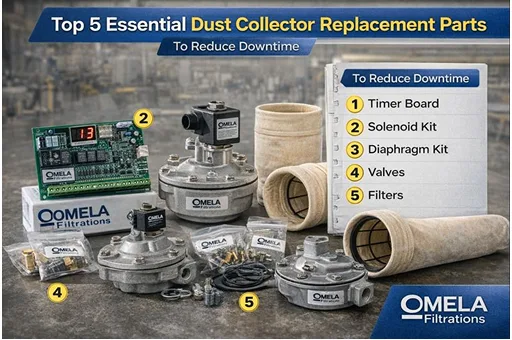
Top 5 Essential Dust Collector Replacement Parts to Reduce Downtime
1. Timer Board (Pulse Control Board)
The timer board is the brain of a pulse-jet dust collector.
It controls:
- Pulse interval timing
- Sequence order
- Cleaning frequency
Failure symptoms include:
- Irregular pulsing
- Continuous pulsing (air waste)
- Dead rows of filter bags
A poorly calibrated timer board increases ΔP and shortens bag life.
Omela Filtrations recommends verifying pulse cycle stability whenever filter replacement is scheduled.
2. Solenoid Kit
Solenoid valves convert electrical signals into pneumatic action.
They trigger the diaphragm valve to release compressed air.
Common failure causes:
- Coil burnout from heat
- Dust ingress into pilot ports
- Voltage instability
Signs of solenoid failure:
- Weak cleaning pulses
- Rapid ΔP rise
- Dust cake buildup on bags
Replacing solenoids proactively avoids full-row bag blinding.
3. Diaphragm Kit
The diaphragm is the sealing element inside pulse valves.
It handles thousands of cycles per day.
Diaphragm wear leads to:
- Air leakage
- Reduced pulse energy
- Unstable cleaning efficiency
Typical replacement interval: 12–24 months, depending on pulse frequency and air quality.
Omela Filtrations emphasizes dry, oil-free compressed air to maximize diaphragm life.
4. Valves (Pulse Jet Valves & Manifold Valves)
Valve bodies experience mechanical fatigue and contamination over time.
Critical valve performance requirements:
- Fast opening response
- Full pulse air volume delivery
- Leak-free sealing
Valve issues often appear as:
- Uneven cleaning across compartments
- Increased compressor load
- Higher operating cost
A worn valve increases total cost of ownership more than most plants realize.
5. Filters (Filter Bags and Cartridges)
Filters carry the full dust burden.
They determine emissions compliance and collector stability.
Filter failure modes include:
- Abrasion holes from silica dust
- Chemical degradation from acid gases
- Blinding from moisture and sticky dust
- Seam damage from poor cage alignment
Omela Filtrations filter bags are engineered for:
- High tensile retention
- Stable permeability
- Reinforced cuffs and seams
- PTFE membrane options for fine dust control
Correct filter selection is the single most important downtime prevention strategy.
Engineering Q&A
How often should dust collector pulse valves and diaphragms be replaced?
Most industrial plants replace diaphragms every 1–2 years depending on:
- Pulse frequency
- Air quality
- Temperature exposure
Valves should be inspected annually for leakage and response speed.
What causes sudden pressure drop increases in a baghouse?
Rapid ΔP rise usually indicates:
- Solenoid or diaphragm failure (weak pulsing)
- Sticky dust blinding filters
- Undersized collector operating at high A/C ratio
Omela Filtrations recommends checking pulse system components before replacing all bags.
When should I replace filter bags instead of just spare parts?
Replace filter bags when:
- Emissions increase
- ΔP remains high after cleaning
- Visible abrasion holes appear
- Bags lose structural strength
Spare parts restore cleaning, but filters remain the primary barrier.
Omela Filtrations Authority & Performance Data
“Downtime prevention starts with understanding pulse-cleaning reliability. At Omela Filtrations, we treat valves, diaphragms, and filter media as one integrated system. A single weak component will shorten the life of the entire baghouse.”
— Dr. Li, Chief Material Engineer at Omela Filtrations
In a recent 5000 t/d cement kiln baghouse retrofit, Omela Filtrations supplied PPS + PTFE membrane filter bags with upgraded pulse valve components:
- Emissions maintained at <5 mg/Nm³
- Stable ΔP operation for 24 months
- Unplanned shutdown events reduced by >40%
This is the measurable impact of engineered spare part + filter integration.
Conclusion & CTA
Dust collector downtime is rarely caused by one catastrophic event.
It is usually caused by small component failures:
- Timer boards
- Solenoid kits
- Diaphragm kits
- Valves
- Filters
Replacing these essential parts proactively reduces:
- Shutdown risk
- Maintenance cost
- Bag failure rates
- Compressed air waste
The long-term ROI comes from stable operation and predictable service life.
Contact Omela Filtrations technical team today for a customized filtration audit and quote.
Author

Jessica Ma – Senior Filtration Engineer, Omela Filtration
Jessica Ma is a senior filtration engineer at Omela Filtration, specializing in dust and liquid filtration. With over 15 years of experience, she focuses on optimizing baghouse performance, enhancing filtration efficiency, and developing high-performance solutions for industrial dust collectors and precision liquid filtration applications.